
MEMBER INTELLIGENCE WORKSHOP
Know the People Behind Your Membership.
Your records can tell you who joined without revealing what members need, what they know, or what they could contribute.
Connect member goals, experience, relationships, participation, and feedback into a clearer foundation for decisions—with members participating in how their information is understood and shared.

Your organization holds pieces of the member picture. Important connections are still missing.
Profiles stop at contact details
Names, employers, titles, and membership status reveal little about a person’s experience, current goals, or capacity to contribute.
Member needs change between surveys
Career moves, business challenges, new responsibilities, and changing work alter what members need before the organization’s records catch up.
Expertise stays hidden
Potential mentors, speakers, collaborators, volunteers, and subject experts remain difficult to find because their relevant experience is not visible.
The most visible members shape the picture
Frequent participants and established leaders provide valuable input, but their perspectives may not represent the wider membership.
Activity records lack context
Attendance, purchases, and logins show that something happened without explaining the member’s purpose, contribution, or experience.
Relationships are difficult to follow
Individual members, member companies, employers, chapters, committees, and partners appear in separate records with unclear connections.
Information is scattered across systems and people
Membership platforms, event tools, learning systems, surveys, spreadsheets, and staff conversations each hold a different part of the story.
Members are unsure how their information will be used
Unclear sharing expectations can limit participation and make it harder to build information members trust and want to keep current.
Better membership decisions need a fuller understanding of the people they affect.
Membership organizations make decisions about programs, communications, relationships, representation, learning, and support using the information available to them.
That information often describes transactions more clearly than people.
A job title may not reveal what someone has done. An event registration may not explain what they hoped to gain. A quiet activity record may coexist with strong appreciation for the organization’s advocacy, resources, or professional community.
Member Intelligence connects those records with relevant human context so teams can examine a particular question more responsibly.
Before deciding what to offer, whom to involve, or where to invest attention, leaders may need to understand:
- Who belongs to the membership and how affiliations work
- What different members are trying to accomplish
- Which challenges and transitions affect their needs
- What experience, knowledge, and capabilities members bring
- How members participate and contribute
- Which relationships already exist
- Whose perspectives are missing
- What feedback and observations actually support
- Where information comes from and how current it is
- What members choose to share for the purpose
- Which gaps matter to the decision
- Who maintains the information and follows up
Member intelligence is the ability to connect relevant information about members, their goals, experiences, capabilities, relationships, and contributions well enough to support a defined decision—with clear context, appropriate sharing, and room for correction.
Start with the member question your organization needs to answer.
The Member Intelligence Workshop is configured around a bounded organizational question.
Every engagement begins with the required Member Intelligence Direction foundation. Your organization then selects the modules that address the information gaps most relevant to that question.
Each selected module combines a short practical lesson with an applied exercise using your organization’s examples. Together, the findings establish what you know, what still needs to be understood, and how that understanding could be maintained.
Required
1. Establish the Member Intelligence Direction
Define the decision, member population, purpose, available information, participating roles, sharing expectations, and boundaries of the engagement.
Choose 2–3
2. Select the Problem Modules
Examine the identity, goals, expertise, representation, feedback, activity, relationship, changing-needs, system, sharing, or governance questions that matter most.
Outcome
3. Build a 30–90 Day Member Intelligence Path
Leave with priorities, responsible owners, information needs, practical next steps, and a starting configuration brief for the relationships worth maintaining.
A typical engagement combines the required foundation with two or three problem modules. Your organization does not need to complete all 12.
Additional member conversations, information review, system analysis, or specialist participation can be scoped where the selected question requires them. The consultation establishes the appropriate format, preparation, participants, and fee.
A clearer member picture should help the community as well as the organization.
For members
Help the organization understand your goals, experience, and interests while giving you a clearer role in how that information is represented and shared.
For membership and program teams
Work from connected context when examining member needs, identifying relevant expertise, and deciding which questions require further listening.
For chapters, committees, and partners
Understand relevant affiliations, contributions, and knowledge across organizational boundaries while clarifying information responsibilities.
For leadership and boards
Examine priorities using a more representative and explainable view of the membership, including uncertainty and missing perspectives.
Explore the 12 Member Intelligence Workshop Modules
The modules connect member identity, goals, experience, participation, relationships, information sources, and responsible use.
Choose the modules that help answer your particular question. Each produces a practical working brief and identifies the profiles, relationships, information, and responsibilities a future Gobekli configuration would need.
ESTABLISH THE MEMBER PICTURE
Member Intelligence Direction
Define the organizational decision, member population, information gaps, available sources, responsibilities, and boundaries the workshop should address. (Required foundation)
Member Identity & Affiliation Clarity
Clarify relationships among individuals, member companies, employers, chapters, roles, and membership arrangements so the organization knows whom its records describe.
Member Goals, Needs & Career Transitions
Understand what members are trying to accomplish and how career, business, and life transitions change the support or opportunities they need.
Member Expertise & Hidden Capability
Make relevant experience, knowledge, and capabilities easier to understand so potential contributors are not limited to the people already known to staff.
UNDERSTAND THE WIDER COMMUNITY
Member Segmentation & Representation Gaps
Examine whether current member categories support the decision at hand and reveal whose experiences, needs, or perspectives are missing.
Member Listening & Feedback Intelligence
Connect surveys, conversations, requests, and other feedback to defined questions, source context, interpretation, and follow-up.
Participation & Contribution Visibility
Understand what members do across activities and programs, distinguishing attendance, responsibility, contribution, and the context needed to interpret each.
Member Relationships & Network Visibility
Examine existing connections among members, groups, and organizations to reveal useful relationships, isolated communities, and gaps in what is known.
KEEP THE PICTURE RELEVANT & TRUSTWORTHY
Changing Work & Emerging Member Needs
Examine how changes in a profession, industry, or community may affect members, then identify the questions that need validation with them.
Fragmented Member Data & System Connections
Trace information across membership, events, learning, community, and other sources to clarify identity, source responsibilities, and useful connections.
Member Consent, Sharing & Trust
Clarify what members choose to share, for which purposes, with whom, and how the arrangement can remain understandable and trustworthy.
Member Intelligence Governance & Currency
Establish ownership, source context, correction routes, update responsibilities, review triggers, and appropriate boundaries for using member information.
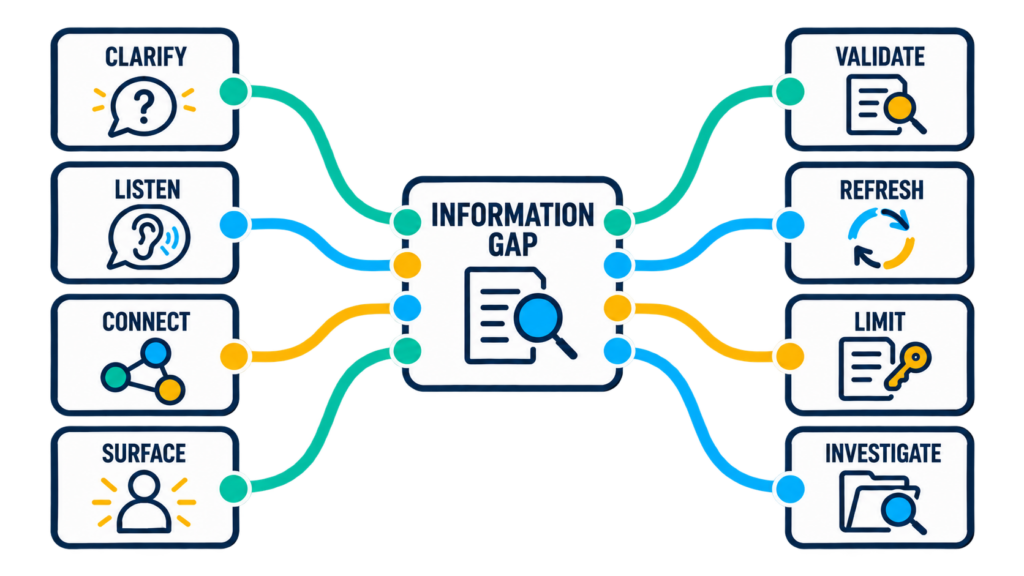
The right response depends on what the information gap reveals.
Clarify
Resolve ambiguity about the member population, question, record, affiliation, or meaning of an existing information field.
Listen
Seek relevant member perspectives where current information does not explain goals, experiences, needs, or changing circumstances.
Connect
Relate existing records and context that become more useful when their connections are understood.
Surface
Make relevant expertise, contributions, or relationships visible for a defined purpose with appropriate member participation.
Validate
Check an interpretation, apparent pattern, or assumption against suitable evidence and member input.
Refresh
Update information whose age or changed circumstances limit its usefulness.
Limit
Narrow collection, access, or use when information is unnecessary for the purpose or cannot be interpreted appropriately.
Investigate
Gather additional information or specialist input before using the available picture to make a consequential decision.
These responses organize practical action. A member’s activity, profile completeness, job title, or visibility should not be treated as a complete measure of their contribution, potential, or relationship with the organization.
How Your Workshop Is Configured:
-
1
Free Discovery Call Identify the member question creating concern and determine whether this workshop is an appropriate starting point. -
2
Focused Intake & Direction Review the membership structure, available information, relevant systems, participants, and sharing considerations. Establish the required Member Intelligence Direction and select the problem modules. -
3
Collaborative Workshop Work through the selected minicourses with the people who understand the membership, information sources, community context, and decision. Apply each method to a bounded organizational example. -
4
Member Intelligence Path Integrate the findings into a 30–90 day plan with priorities, owners, information needs, dependencies, review points, and a starting configuration brief.

Leave with more than a conversation.
Member Intelligence Decision Foundation
A shared definition of the question, purpose, member population, available information, boundaries, and criteria for a useful result.
Member & Affiliation Map
A structured view of the relevant people, organizations, roles, chapters, and relationships within the selected scope.
Goals, Needs & Expertise Picture
A working account of the member context relevant to the decision, with clear distinctions between member statements, recorded experience, and interpretations.
Evidence & Assumption Register
A distinction among known information, member feedback, staff observations, interpretations, conflicts, missing perspectives, and unanswered questions.
Source & Relationship Map
A view of where relevant information lives, how it connects, and which source or person maintains it.
Ownership, Sharing & Review Plan
Responsibilities for gathering, interpreting, updating, correcting, and appropriately using the selected information.
Starting Gobekli Configuration Brief
An outline of the profiles, activities, relationships, source connections, member workflows, and access arrangements worth maintaining.
30–90 Day Member Intelligence Path
Sequenced actions, responsible owners, information needs, dependencies, decision points, and review conditions.
Final outputs depend on the selected modules, available information, participants, and decision established through Member Intelligence Direction.
The workshop creates a useful starting point within that scope. It does not assume that one session can produce a complete understanding of every member.

Understand the membership through the people who make it.
We help membership organizations connect what they know about members to the goals, experiences, relationships, and contributions that give those records meaning.
The work should improve organizational understanding while making participation worthwhile and understandable for members themselves.
Purpose-connected
Begin with a defined question and gather the information needed to answer it. Keep the intended use clear as the work develops.
Member-centered
Give members an appropriate role in describing their goals, explaining their experience, correcting information, and choosing what they share.
Evidence-aware
Preserve source context and distinguish records, observations, member statements, and interpretations. Make gaps and uncertainty visible.
Current & accountable
Identify who maintains important information, what changes should prompt review, and how corrections reach the people using it.
When the workshop reveals something worth maintaining
Turn scattered member information into an ongoing, connected understanding.
A workshop may reveal valuable relationships that are difficult to maintain through separate spreadsheets, staff memory, and disconnected member records.
A potential Gobekli configuration could help connect organizational context in TalentSync with appropriate member-controlled information through TalentPass.
The starting point is the question examined during the workshop: which profiles and relationships matter, how people would use them, what information supports them, and who keeps them current.
Workshop Findings
Identify the member goals, expertise, affiliations, activities, feedback, source relationships, and information gaps that should remain visible after the engagement.
Gobekli Setup
Scope appropriate profiles, activity records, organizational relationships, source connections, review responsibilities, and purpose-specific member sharing.
Ongoing Visibility
Maintain and refine the organization’s Human Intelligence Layer as members gain experience, change roles, contribute, form relationships, and update what they want to share.
For example, an association may discover that it cannot identify suitable mentors beyond the people already known to staff.
The workshop could clarify the experience members need help with, the evidence useful for understanding potential mentors, the affiliations involved, and the sharing choices members should have.
A configuration brief could then define mentor and participant profiles, relevant experience relationships, member invitations to contribute information, and responsibilities for keeping the picture current. Designing and operating the mentoring journey could follow through the Member Engagement Workshop.
A Gobekli setup is an optional continuation. The workshop outputs remain useful independently of product adoption.
The configuration described here includes potential TalentSync and TalentPass capabilities. Current availability, configuration needs, system integrations, and any required development would be confirmed during scoping.
Existing membership and other systems may continue to maintain their respective records. The workshop helps identify which connections would add practical value.
Frequently asked questions
Questions membership leaders ask before booking.
It is a configurable, facilitated workshop that helps an organization understand its members well enough to address a defined question.
The workshop connects relevant goals, experience, capabilities, affiliations, participation, feedback, and information sources. Every engagement begins with Member Intelligence Direction and then applies selected problem modules to the organization’s examples.
It is designed for professional associations, trade associations, chambers, unions, alumni networks, federated organizations, and other member communities.
Participants may include membership leaders, program teams, chapter colleagues, research or data staff, technology teams, organizational leaders, and relevant member representatives.
No. Every engagement begins with the required Member Intelligence Direction foundation.
A typical workshop then includes two or three modules selected around the question your organization needs to answer.
A survey is one way to gather information. This workshop examines the decision, what needs to be understood, what existing sources contribute, whose perspectives are missing, and how findings should be interpreted and maintained.
The resulting plan may include a survey, member conversations, record clarification, or another focused action.
Data cleanup addresses record problems such as duplication, inconsistency, and missing fields.
Member Intelligence also examines what the information means, how it relates to member goals and experience, whether it supports the intended decision, and what members should contribute or control.
Yes. The work can distinguish the member organization, its participating employees or representatives, relevant affiliations, and the purposes each relationship serves.
The scope should make clear whose needs and experiences are being examined.
Yes. It can help identify what is known, what activity records leave unexplained, and how to seek relevant perspectives.
Limited recorded participation does not establish that a member is dissatisfied or receiving little value.
Yes. The expertise and relationship modules can clarify what experience is relevant, where that knowledge may exist, and how members can appropriately make it visible.
The workshop does not assume that having expertise means someone wants to volunteer. Interest, availability, and the specific opportunity also need consideration.
Members may contribute through direct participation, interviews, feedback, profile development, or review of how their experience is interpreted.
The appropriate approach depends on the question and should make the purpose, requested contribution, and sharing expectations understandable.
No. Begin with the question, a description of the membership, available sources, and suitable examples.
The intake determines what information is useful for the selected exercise. The workshop can identify gaps without requiring an unrestricted export of the entire membership database.
The workshop uses information to support a defined organizational question, with human interpretation and member context.
Any proposed AI assistance would need to be scoped around that purpose, available capabilities, and appropriate review. A generated interpretation should not be treated as a complete judgment of a person’s value, potential, or contribution.
No. The workshop is designed to produce a practical Member Intelligence Path whether or not your organization adopts Gobekli software.
If the findings reveal relationships worth maintaining, an appropriate configuration can be explored afterward.
Member Intelligence examines what the organization understands about members, their needs, capabilities, relationships, and contributions.
Member Engagement examines how members discover opportunities, enter useful experiences, participate successfully, and stay connected.
Member Intelligence establishes a clearer understanding of the people and organizations the membership serves.
Membership Value examines what the membership helps them achieve, how benefits should be designed, and what supports the case for joining or renewing.
Your organization leaves with a scoped response and a 30–90 day path.
Next steps may include listening to an underrepresented group, clarifying affiliations, gathering member expertise, connecting selected information sources, improving sharing arrangements, or establishing ownership and review practices.
Where useful, the configuration brief becomes the starting point for a Gobekli implementation conversation.
KNOW THE PEOPLE BEHIND YOUR MEMBERSHIP
Turn scattered member information into a clearer next decision.
Understand what members need, what they bring, and which connections your organization is missing. Build a focused path toward information that is useful, current, and trusted.
Begin with Member Intelligence Direction, then select the modules that address your organization’s particular challenges.
