
AN ORGANIZATIONAL GROWTH & EXPANSION WORKSHOP MODULE
Expansion Planning:
Enter New Markets Without Breaking the Operating Model
A new market, location, customer segment, product, or business line can create significant growth.
It can also expose every weakness in the organization supporting it.
Leaders may approve the opportunity based on demand, revenue potential, strategic importance, or competitive pressure. But the expansion must still be sold, delivered, staffed, supported, governed, measured, and connected to the existing organization.
A credible expansion plan connects the opportunity to the operating capacity required to make it real.
Does this sound familiar?
The revenue case is clearer than the operating plan
Leadership can explain the market opportunity but not how the organization will consistently sell, deliver, support, and manage it.
Existing teams are expected to absorb the expansion
The plan assumes current employees can carry additional customers, locations, products, or services without examining workload and capability.
The expansion depends on a few key people
Founders, executives, specialists, or experienced employees become the bridge between the existing organization and every new requirement.
Local differences appear late
Customer expectations, talent availability, regulation, language, infrastructure, time zones, and partner conditions emerge after commitments.
Systems do not extend cleanly
Technology, data, processes, permissions, reporting, and support models that work today do not automatically fit the new environment.
Success is measured only through revenue
Leaders track sales or launch milestones without seeing service quality, capacity strain, capability gaps, or organizational disruption.
What is organizational expansion planning?
Organizational expansion planning is the process of translating a growth opportunity into the work, capability, capacity, structure, systems, relationships, and evidence required to pursue it responsibly.
Expansion may involve:
- Entering a new geographic market
- Opening a new office, facility, or service location
- Serving a new customer segment
- Launching a new product or service
- Establishing a new business line
- Expanding through a distributor, franchise, or partner
- Entering a regulated or specialized market
- Extending operations across time zones
- Building a new delivery channel
- Moving from a regional to a national or international model
The commercial opportunity is only one part of the decision. Leaders must also understand how expansion changes the work, which current assumptions still apply, and whether the organization can support both the new operation and the existing business.
The problem is not whether the opportunity looks attractive. It is whether the organization can carry it.
Market demand, revenue forecasts, competition, partnerships, and contract potential matter. They do not establish whether the organization can operate successfully in the new environment.
Leaders must connect the opportunity to:
- The customer or stakeholder outcome
- The work required to produce it
- Differences from the current environment
- Required capabilities and available capacity
- Leadership and local ownership
- Systems, data, facilities, and infrastructure
- Central, local, and shared responsibilities
- The effect on current operations
- Evidence guiding continued investment
Expansion is not simply entering a market. It is building or adapting the operating system necessary to serve it.
See the complete expansion
not just the market opportunity.
Opportunity and Demand
- Customer need
- Market conditions
- Revenue potential
- Strategic importance
- Timing and competition
Work and Delivery
- Customer acquisition
- Product or service delivery
- Operations and support
- Quality and experience
- Recurring local activities
People and Capability
- Leadership
- Critical capabilities
- Workforce capacity
- Local knowledge
- Hiring and development needs
Systems and Infrastructure
- Technology
- Data and reporting
- Facilities and equipment
- Supply and logistics
- Policies and controls
Ownership and Evidence
- Central and local authority
- Cross-functional responsibility
- Investment stages
- Operating measures
- Review and exit conditions
Expansion becomes decision-useful when the opportunity, operating work, people, systems, ownership, and evidence can be evaluated together.
How expansion outruns organizational capacity
STAGE 1
An attractive opportunity appears
A customer, investor, partner, executive, or market signal creates pressure to enter a new location, segment, channel, or business line.
STAGE 2
Commercial commitments move first
The organization announces the expansion, signs agreements, establishes targets, or begins selling before operating requirements are understood.
STAGE 3
Existing teams bridge the gaps
Current employees create workarounds, add responsibilities, transfer knowledge informally, and solve local problems as they emerge.
STAGE 4
Complexity compounds across the organization
Service inconsistency, role conflict, delayed decisions, duplicated systems, quality problems, and employee strain affect both the expansion and core business.
Market readiness and organizational readiness are different questions.
Market research can help determine whether an opportunity exists. It cannot determine whether the organization is prepared to pursue it.
A useful expansion review must ask:
Which customer expectations, workflows, regulations, hours, languages, logistics, pricing models, service requirements, or local conditions differ?
What must happen before, during, and after a sale? Which activities are new, and which will increase in volume or complexity?
Which capabilities, processes, systems, policies, relationships, and practices can support the expansion without significant change?
What requires new expertise, local knowledge, leadership, infrastructure, technology, partnerships, policies, or authority?
Which employees, leaders, systems, budgets, and resources will be divided between current responsibilities and the expansion?
Which market, customer, financial, workforce, quality, and operating signals should determine whether the organization proceeds, adapts, pauses, or exits?
What leaders need to see before committing to expansion
The real operating difference
Identify what changes between the current business and the proposed market, location, segment, product, or business line.
The work behind the opportunity
Map what must be sold, delivered, supported, governed, coordinated, and measured.
The capacity being assumed
Determine which people, teams, systems, facilities, partners, and budgets are expected to absorb demand.
The capability that must be added
Clarify which expertise, relationships, leadership, credentials, local knowledge, and capabilities do not exist.
The effect on existing operations
Reveal where expansion may draw attention, talent, working capital, service capacity, or leadership from the core business.
Conditions for continued investment
Establish evidence, thresholds, review points, and decision rights controlling the pace and scale of expansion.
Copy the current model
A replication-centered approach may assume the same customer needs, sales process, service model, roles, technology, policies, pricing, leadership, talent sources, and success measures.
Replication can preserve consistency and reduce reinvention. Untested assumptions can also create poor fit, resistance, service gaps, or operational failure.
Build everything locally
A localization-centered approach may create separate workflows, tools, roles, policies, reporting structures, vendors, expertise, information, and operating practices.
Adaptation can respond to local needs. Unnecessary variation increases cost, fragmentation, risk, and difficulty scaling what the organization learns.
Decide what remains central
Strategy, brand, core product direction, financial controls, enterprise technology, data standards, oversight, procurement, policies, and common talent infrastructure may benefit from consistency and shared ownership.
Decide what must move closer to the market
Customer relationships, local delivery, staffing, sales activity, partnerships, facilities, language, logistics, and exception handling may require local information and authority.
The goal is to distinguish what should remain consistent from what the new environment requires the organization to adapt.
Expand the operating model
not just the sales target.
Connect opportunity to capacity before commitments outrun the organization.
WORKSHOP MODULE DETAILS
Module 4: New Market, Location & Business-Line Expansion
This module helps participants connect a growth opportunity to the organizational capacity required to pursue it.
The workshop examines what will be different, what work the expansion creates, which capabilities and systems can be extended, what must be adapted, and how central and local ownership should operate.
The purpose is not to produce a complete market-entry, legal, financial, or regulatory assessment. It is to make the organizational implications visible enough to support a bounded leadership decision.
This module helps your team:
- Define the expansion opportunity and intended outcome
- Identify differences from the current environment
- Map the work required to sell, deliver, and support
- Assess current capacity and capability
- Identify leadership, workforce, and expertise requirements
- Distinguish core standards from local adaptations
- Clarify central, local, and shared responsibilities
- Trace systems, data, facility, supply, and partner dependencies
- Examine the effect on existing operations
- Identify questions requiring specialist review
- Establish staged investment and review conditions
- Develop an evidence-backed expansion response
How should the organization respond to the expansion opportunity?
An attractive opportunity does not require an immediate full-scale launch. The response should reflect demand, strategic importance, operating readiness, capability, investment exposure, and the consequences of being wrong.
Explore
Develop stronger evidence about demand, customers, operating conditions, capability, cost, regulation, or delivery requirements.
Pilot
Test the model through a bounded location, customer group, product, service, channel, partnership, or operating period.
Partner
Use a distributor, institution, local operator, specialist, joint venture, contractor, or other partner for capability and access.
Build
Create the internal leadership, roles, capabilities, systems, facilities, processes, and ownership the opportunity requires.
Scale
Extend a model supported by market and operating evidence while maintaining quality, capacity, coordination, and visibility.
Pause or Exit
Limit exposure when evidence does not support continued investment or conditions require redesign, delay, or withdrawal.
These categories structure an organizational expansion decision. They do not replace financial, legal, regulatory, tax, market, real-estate, cybersecurity, employment, or other specialist assessments.
What should an organizational expansion review examine?
The opportunity
What customer, market, mission, competitive, contractual, or strategic condition makes the expansion worth considering?
The difference
What changes between the current operation and the proposed market, location, segment, channel, product, or business line?
The work
What activities, workflows, decisions, services, support, and coordination must happen?
The capability and capacity
Which leadership, expertise, relationships, systems, facilities, partners, and workforce capacity are available or missing?
The organizational effect
How will expansion affect current customers, employees, leaders, budgets, priorities, systems, and commitments?
The evidence and thresholds
What would demonstrate demand, readiness, quality, capacity, viability, or the need to change direction?
Build the operating model around the expansion—not after it.
A staged expansion plan allows the organization to learn without treating every early assumption as a permanent operating commitment.
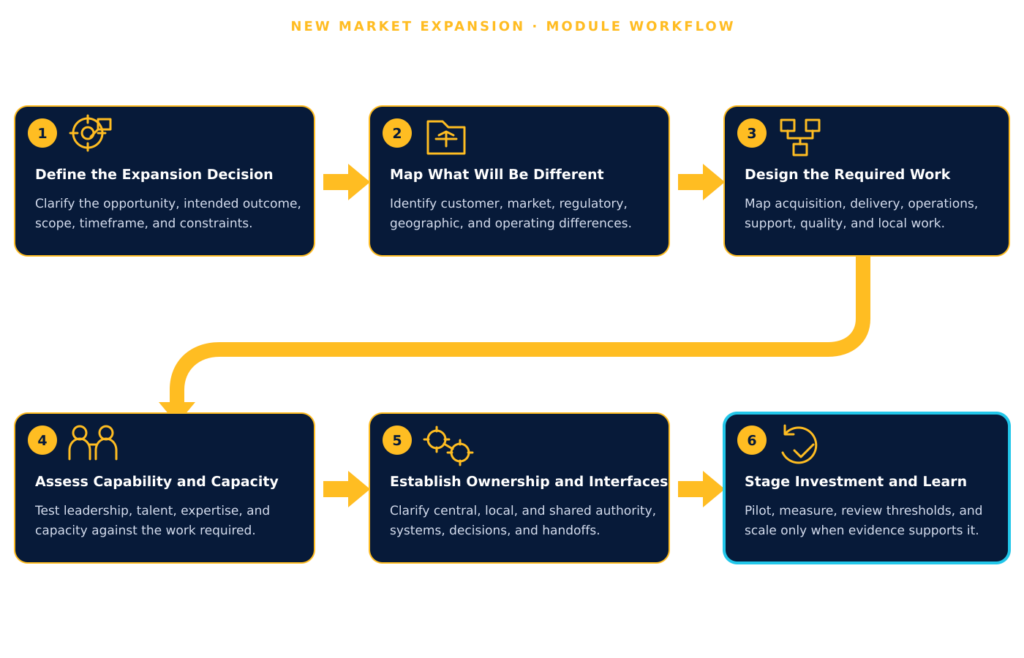
STEP 1
Define the expansion decision
Clarify the opportunity, intended outcome, scope, timeframe, constraints, and bounded decision leadership must make.
STEP 2
Map what will be different
Compare customers, work, regulation, logistics, talent, technology, infrastructure, partners, and local conditions.
STEP 3
Design the required work
Identify what must happen to acquire customers, deliver value, provide support, maintain quality, govern operations, and learn.
STEP 4
Assess capability and capacity
Determine what can be extended, what teams can absorb, and what must be built, hired, developed, partnered, or redesigned.
STEP 5
Establish ownership and interfaces
Define central, local, and shared responsibilities, decision rights, handoffs, information flows, escalation paths, and review authority.
STEP 6
Stage the investment and learn
Sequence commitments, establish measures and thresholds, test critical assumptions, and adapt according to evidence.
A staged expansion plan allows the organization to learn without treating every early assumption as a permanent operating commitment.
- Compare the new environment with current operations
- Make capacity assumptions visible
- Protect service to the core business
- Clarify central and local authority
- Use evidence to control investment
- Keep pause and exit conditions available
SEE THE PEOPLE AND CAPABILITIES BEHIND THE EXPANSION
Connect expansion requirements to the talent the organization can actually access.
TalentSync can help leaders structure information about the organizations, roles, activities, capabilities, relationships, and gaps involved in an expansion.
This visibility can help leaders understand whether the organization has the people and capability required to support the proposed expansion.
Depending on the available implementation and context, that view may include:
- Existing organizational and department profiles
- Proposed locations or operating units
- Roles supporting current and future operations
- Activities associated with critical workflows
- Active and latent capabilities
- Capability and capacity gaps
- Leadership and management responsibilities
- Cross-functional relationships
- Local and central ownership
- Credentials requiring confirmation
- Internal mobility possibilities
- External hiring or partnership needs
It may reveal where the same key employees are assumed across several initiatives or where expansion depends on capability that is not yet available.
PRODUCT AND DECISION BOUNDARIES
Organizational visibility supports the expansion decision. It does not make it.
TalentSync and the workshop should not be presented as:
- Determining which market to enter
- Producing a complete market forecast
- Guaranteeing customer demand or financial performance
- Making legal, tax, regulatory, or compliance determinations
- Selecting the correct facility or location
- Automatically determining the workforce plan
- Recommending individuals for relocation or employment decisions
- Predicting employee or leader success
- Replacing local expertise
- Eliminating expansion risk
The process helps leaders structure the work, capabilities, dependencies, evidence, ownership, and organizational tradeoffs surrounding the opportunity.
Market research, financial modeling, law, tax, employment, labor, immigration, real estate, insurance, licensing, privacy, cybersecurity, accessibility, environmental review, and other questions may require qualified specialists.
What to bring into the conversation
You do not need a completed market-entry plan, finalized location, or approved expansion budget.
We begin with the opportunity, assumptions, operating evidence, and organizational information already available.
Useful inputs may include:
- Market or customer research
- Revenue forecasts and financial assumptions
- Customer requests or commitments
- Strategic plans
- Product or service descriptions
- Proposed locations or regions
- Current operating models
- Process and workflow documentation
- Organizational charts
- Current workforce and capacity information
- Role and capability information
- Leadership and succession considerations
- Technology and data architecture
- Facility and infrastructure requirements
- Supply, logistics, and vendor information
- Potential partners
- Known regulatory or licensing questions
- Quality and customer-service measures
The required Growth Direction module establishes the outcome, scope, timeframe, evidence, constraints, and organizational decision this module should support.
What this module can help clarify
What the expansion requires
Translate the opportunity into specific organizational work and operating conditions.
What can be extended or adapted
Distinguish reusable capabilities, systems, processes, and standards from elements requiring change.
Where capability and capacity are missing
Identify leadership, workforce, expertise, infrastructure, technology, relationship, and partner requirements.
How central and local ownership should work
Clarify responsibilities, decision rights, interfaces, handoffs, information flows, and escalation conditions.
Final outputs depend on the modules selected and the organizational decision established through the workshop’s required Growth Direction module.
Where might the work lead next?
Questions leaders ask before booking.
A market expansion strategy explains how an organization intends to reach and serve new customers, geographies, segments, channels, products, or business lines. A complete strategy also addresses the operating capacity required.
Market-entry planning often focuses on commercial viability. Organizational expansion planning focuses on whether the organization can build or adapt the capacity required to pursue it.
Readiness depends on the defined opportunity, work required, available capacity, missing capability, leadership model, system requirements, local conditions, core-business effect, and evidence controlling investment.
A bounded pilot can test important assumptions about demand, delivery, customer behavior, capability, partnerships, systems, and local conditions before a larger commitment.
Responsibilities may remain centralized when they benefit from consistency, shared infrastructure, specialist expertise, enterprise visibility, or organizational accountability.
Identify the employees, leaders, systems, budgets, and resources the expansion will use, then determine what current work will be transferred, delayed, redesigned, reduced, or stopped.
The answer depends on the work, duration, local knowledge, capability availability, employee interest, continuity, legal conditions, cost, and operating model.
A partner may be useful when the organization needs local relationships, infrastructure, distribution, licensing, expertise, credibility, capacity, or a lower-exposure way to learn.
Measures may include revenue, quality, service, retention, workforce capacity, employee strain, delivery reliability, cost, local capability, partner performance, risk signals, and effects on the core business.
The same organizational questions apply. The differences may concern customer type, delivery, pricing, technology, expertise, support, sales process, or regulation rather than geography.
No. TalentSync can structure relevant information about roles, activities, experience, capabilities, credentials, relationships, and gaps. Leaders remain responsible for workforce decisions.
No. The module examines organizational operating requirements and may identify questions requiring qualified market, legal, tax, financial, employment, regulatory, or other specialist review.
Every engagement begins with Growth Direction. This module is selected when the organization needs to connect a growth opportunity to the operating capacity required to pursue it.
EXPAND THE OPERATING MODEL—NOT JUST THE SALES TARGET
Turn an attractive opportunity into an expansion the organization can actually carry.
Connect market demand to work, capability, capacity, systems, ownership, local conditions, and evidence—then determine how the organization should proceed.
This module is part of Gobekli’s configurable Organizational Growth & Expansion Workshop.
