
ORGANIZATIONAL GROWTH & EXPANSION PROBLEM
Organizational Launch, Integration & Mobilization:
Turn the Growth Plan Into a Working Organization
A new team, department, location, business line, operating model, or acquired organization does not become functional simply because the launch date arrives.
People must understand the work, responsibilities, decision rights, systems, relationships, priorities, and conditions required to contribute together.
Organizational launch, integration, and mobilization help leaders turn a growth decision into a coordinated operating reality—without leaving employees to assemble the organization around them.
Does this sound familiar?
The launch date is clearer than the operating model
Leaders know when the new operation should begin but not exactly how the work will function.
Plans are divided across separate workstreams
People, process, technology, facilities, vendors, communications, and customer commitments are planned independently.
Employees receive tasks without enough context
People know what they were assigned but not how their work connects to the complete launch.
Dependencies surface during execution
Missing access, information, approvals, capabilities, equipment, relationships, and connections appear after work begins.
Temporary launch work becomes permanent
Manual coordination, duplicate systems, emergency meetings, and informal workarounds continue after launch.
Leaders cannot confirm mobilization
Activity is underway, but no shared evidence shows whether the operation can perform without constant intervention.
What is organizational launch, integration, and mobilization?
Organizational launch, integration, and mobilization is the coordinated process of turning a growth decision, organizational design, or transition plan into a functioning operation.
It may support a new function, team, location, business line, contract, operating model, organizational integration, partnership, workforce transition, or system-enabled workflow.
Launch establishes the new operation. Integration connects it to the people, systems, information, processes, relationships, and decisions surrounding it. Mobilization ensures that people have the direction, capability, access, resources, and support required to work together.
The objective is not simply to reach a date. It is to create the conditions through which the new organization can perform.
The problem is not the launch plan. It is the gap between planned activity and operational readiness.
Completing a task does not necessarily mean the organization is ready to operate. A system may be configured without working access. Roles may be filled without clear authority. Training may be delivered before the workflow is stable.
Without a connected view, the organization may complete the project plan while remaining operationally unprepared. The launch date is an event. Mobilization is a condition.
See the complete mobilization
not just the launch checklist.
Direction and Outcomes
- Growth decision
- Launch objectives
- Customer commitments
- Success conditions
- Scope and boundaries
Work and People
- Critical activities
- Roles and responsibilities
- Required capabilities
- Leadership and management
- Workforce availability
Process and Decisions
- End-to-end workflows
- Cross-functional handoffs
- Decision authority
- Review and escalation
- Exceptions and contingencies
Systems and Resources
- Platforms and access
- Data and information
- Facilities and equipment
- Vendors and services
- Documentation and support
Readiness and Transition
- Dependencies
- Readiness evidence
- Launch sequence
- Transition support
- Steady-state ownership
Mobilization becomes decision-useful when leaders can see how direction, work, people, processes, decisions, systems, resources, dependencies, and readiness evidence fit together.
How launches become prolonged periods of improvisation
STAGE 1
The organization commits to a launch
A new market, team, location, function, contract, integration, or operating model receives leadership approval.
STAGE 2
Workstreams begin planning separately
Functions develop individual plans for hiring, technology, process, facilities, vendors, communications, training, and delivery.
STAGE 3
Cross-functional dependencies remain hidden
Each workstream may appear on schedule while the connections between them remain incomplete, unclear, or unowned.
STAGE 4
Employees assemble the operation after launch
People create workarounds, seek missing context, reconcile plans, escalate routine questions, and perform hidden integration work.
A completed checklist is not the same as a mobilized organization.
A readiness review should examine whether the connected operation can perform—not simply whether individual tasks have been marked complete.
The purpose is not to eliminate uncertainty. It is to make the remaining uncertainty visible enough to support a responsible decision.
Do employees understand what the launch must accomplish, for whom, within what boundaries, and how success will be recognized?
Are critical activities, outputs, handoffs, decisions, quality expectations, and foreseeable exceptions sufficiently understood?
Are roles filled or covered, with the capability, context, relationships, time, and management support required?
Do employees have working access to the platforms, information, equipment, facilities, services, and documentation they need?
Have relationships between workstreams, teams, systems, vendors, decisions, and external conditions been identified and tested?
Is responsibility clear for the operation, workforce, systems, information, quality, performance, and unresolved risks?
Every workstream can appear ready while the organization remains unready
Outcome-ready
The launch objective, scope, affected stakeholders, success conditions, and activation boundaries are understood.
Work-ready
Critical activities, outputs, workflows, handoffs, decisions, quality expectations, and exceptions are defined.
People-ready
Roles, capabilities, staffing, leadership, relationships, management support, and workforce availability are sufficient.
System-ready
Platforms, information, access, integrations, equipment, facilities, vendors, and support function in practice.
Dependency-ready
Cross-functional prerequisites, assumptions, approvals, relationships, and external conditions have owners.
Transition-ready
Early issues, questions, defects, workload spikes, escalation, stabilization, and ownership transfer can be handled.
Workstream completion
Functions may report that hiring, systems, training, facilities, vendors, policies, communications, and milestones are complete.
Operational readiness
The connected organization demonstrates functioning handoffs, information, access, capability, support, and ownership.
Temporary launch work
Interim staffing, parallel operations, manual transfers, heightened oversight, and emergency coordination are explicit and bounded.
Steady-state ownership
Stabilization evidence, residual issues, exit conditions, permanent support, and responsibility transfer are defined.
Launch the organization
not just the project plan.
Connect people, work, systems, dependencies, and evidence.
WORKSHOP MODULE DETAILS
Module 12: Organizational Launch, Integration & Mobilization
This module helps participants turn an approved growth decision or organizational design into a coordinated operating launch.
The workshop connects the launch outcome to work, roles, capabilities, decisions, processes, systems, information, resources, relationships, dependencies, transition support, and evidence.
Participants identify what must be ready, which dependencies could prevent execution, how mobilization should be sequenced, what temporary support is required, and how ownership will move into steady-state operations.
This module helps your team:
- Translate the growth decision into launch conditions
- Define the work that must begin or change
- Clarify launch and steady-state ownership
- Align roles, capabilities, systems, and resources
- Reveal dependencies across workstreams
- Distinguish planned activity from verified readiness
- Identify temporary work and interim infrastructure
- Establish escalation and exception paths
- Sequence activities around dependencies
- Define stabilization and transfer conditions
- Identify questions requiring specialist review
- Develop an evidence-backed mobilization decision
What should happen next for each part of the launch?
Not every component will be equally ready at the same time. The response should reflect the importance of the work, available evidence, unresolved dependencies, consequences of delay, and consequences of launching before readiness is established.
Confirm
Readiness is supported by evidence across the people, work, systems, resources, relationships, and ownership required.
Connect
Resolve an incomplete handoff, information flow, relationship, integration, decision, or shared condition.
Strengthen
Improve capability, staffing, access, documentation, testing, support, ownership, or operational preparation.
Sequence
Change activation order or scope through staging, piloting, parallel operation, delay, or reduced initial scope.
Support
Add bounded coordination, specialist help, interim infrastructure, management attention, or mobilization capacity.
Hold
Do not activate a component while a consequential gap, failure, exposure, or ownership problem remains.
Transition
Move from launch governance into steady-state ownership after stabilization conditions have been met.
Investigate
Resolve uncertainty about readiness, dependencies, consequences, or the appropriate response.
These categories organize readiness evidence and leadership judgment. They do not automatically authorize a launch, delay, workforce action, system change, vendor decision, safety determination, or professional conclusion.
What should an organizational readiness review examine?
The outcome and scope
What must the launch accomplish, for whom, within which boundaries, and what has intentionally been excluded or deferred?
The work and people
Which activities, roles, capabilities, leadership, staffing, relationships, and management support are required?
The process and decisions
How will work move across teams? Who owns decisions, reviews, approvals, exceptions, quality, and escalation?
The systems and resources
Which platforms, information, access, integrations, facilities, equipment, vendors, services, and documentation must function?
The dependencies and risks
What must happen before something else can begin? Which assumptions, bottlenecks, constraints, and failure conditions remain?
The transition and evidence
What demonstrates readiness, how will early operation be supported, and what permits responsibility to move into steady state?
Use TalentSync to connect the organization before launch.
TalentSync can help make the work, people, roles, capabilities, systems, services, relationships, and evidence surrounding a launch easier to understand.
The process begins with the organizational outcome—not with a generic checklist or automated readiness score.
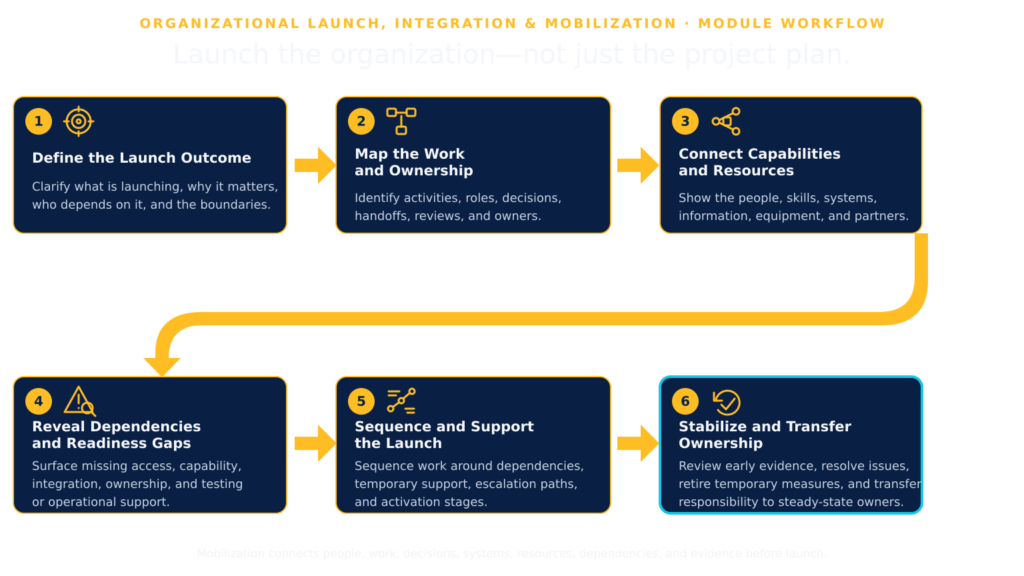
STEP 1
Define the launch outcome
Clarify what is launching, why it matters, who depends on it, what must change, and which boundaries define the mobilization.
STEP 2
Map the work and ownership
Identify critical activities, outputs, roles, contributors, decisions, handoffs, reviews, and steady-state owners.
STEP 3
Connect capabilities and resources
Show which skills, knowledge, staffing, leadership, systems, information, equipment, vendors, and services are required.
STEP 4
Reveal dependencies and readiness gaps
Identify missing access, relationships, capability, integration, information, ownership, testing, and support.
STEP 5
Sequence and support the launch
Organize activities around dependencies, define temporary support, assign escalation paths, and establish activation stages.
STEP 6
Stabilize and transfer ownership
Review early evidence, resolve critical issues, retire temporary measures, and transfer responsibility to steady-state owners.
TalentSync can help make relationships between work, people, capabilities, systems, services, dependencies, and evidence more visible. Leaders, employees, launch owners, operational owners, customers, partners, vendors, and qualified specialists remain responsible for interpretation, implementation, and decisions.
- Connect launch outcomes to work
- Map people, roles, and capabilities
- Reveal dependencies and readiness gaps
- Sequence activation and support
- Track stabilization evidence
- Transfer steady-state ownership
PASSPORT PAGES AND MOBILIZATION CONTEXT
Give every critical system and service a place in the launch.
A conventional launch inventory may identify a system or service by name, vendor, contract owner, implementation date, cost, technical owner, or status.
That information matters, but it may not explain how the system or service contributes to the connected operation.
A TalentSync Passport Page can connect a system or service to the launch outcome, work, employees, capabilities, information, integrations, decisions, ownership, documentation, constraints, unresolved issues, and readiness evidence surrounding it.
The system or service becomes visible as one component within the complete mobilization.
PRODUCT AND DECISION BOUNDARIES
Structured readiness evidence supports launch decisions. It does not make them.
TalentSync, TalentPass, Passport Pages, Pythia, and workshop outputs should not be presented as:
- Automatically declaring an organization ready
- Producing a definitive readiness score
- Authorizing a launch or delay
- Automatically assigning employees to launch work
- Predicting individual, team, or launch success
- Performing technical integration testing
- Certifying systems, processes, facilities, or operations
- Making legal, regulatory, safety, accessibility, labor, or compliance determinations
- Replacing project, change, or operational leadership
- Guaranteeing launch performance, integration, or mobilization
The workflow helps make work, ownership, capability, dependencies, evidence, assumptions, and unresolved questions visible.
Technology, cybersecurity, privacy, accessibility, procurement, finance, safety, regulatory, labor, facilities, quality, customer, and other questions may require qualified specialist review. TalentPass is not designed for use by minors.
What to bring into the conversation
You do not need a complete launch program, perfect project plan, or finished operating model.
We begin with the consequential growth decision and the work that must become operational.
Useful inputs may include:
- Growth strategy and leadership decisions
- Launch charter or business case
- Target launch date or activation window
- Scope and success criteria
- Customer or service commitments
- Operating-model documentation
- Organization and team designs
- Role and responsibility information
- Workforce plans and hiring status
- Project and workstream plans
- Dependency logs
- Risk and issue registers
- Decision and approval records
- Process or workflow maps
- System and application inventories
- Data and integration diagrams
- Access and permission plans
- Facilities and equipment plans
- Vendor and partner agreements
- Training and onboarding plans
- Internal and external communications
- Testing or readiness evidence
- Employee and manager observations
- Customer or stakeholder feedback
- Transition and stabilization plans
- Continuity or contingency plans
- Known interim processes
- Unresolved specialist concerns
The Growth Direction module establishes the consequential outcome, affected work, growth conditions, evidence, and bounded launch decision this module should support.
What this module can help clarify
What must be ready for launch
Identify the people, work, decisions, systems, information, resources, relationships, and support required for activation.
Which dependencies could prevent execution
Reveal cross-functional connections, prerequisites, assumptions, constraints, and unresolved conditions.
How launch should be sequenced and supported
Determine where to confirm, connect, strengthen, sequence, support, hold, transition, or investigate.
When the operation can move into steady state
Define stabilization evidence, residual issues, temporary measures, and the transfer of responsibility.
Final outputs depend on the modules selected and the growth decision established through the workshop’s required Growth Direction module.
Where might the work lead next?
Questions leaders ask before booking.
It is the process of preparing and connecting the people, work, decisions, systems, information, resources, relationships, and support required to begin operating around a defined outcome.
Implementation puts a plan or solution into effect. Mobilization prepares the organization around it so employees can use, connect, and sustain it.
Project completion tracks planned deliverables. Readiness asks whether the connected operation can perform under expected conditions.
New teams, functions, departments, locations, markets, business lines, contracts, operating models, integrations, partnerships, and significant transitions.
No. Governance should reflect complexity, dependency, uncertainty, risk, and consequence, with a defined purpose and exit condition.
Examine unresolved conditions, available evidence, consequences of launching, consequences of delay, contingencies, and sequencing options.
No. A staged launch, pilot, limited scope, parallel operation, or sequenced transition may provide a more responsible path.
Make it explicit, assign ownership, define duration and workload, identify what replaces it, and establish evidence permitting it to end.
When defined stabilization conditions are met, critical issues are controlled, handoffs function, ownership is accepted, and temporary measures can end.
No definitive score is implied. TalentSync can organize work, people, capabilities, systems, services, dependencies, and evidence for human review.
No. Project tools manage tasks and milestones. TalentSync provides organizational context around people, work, capability, relationships, systems, and evidence.
It can help individuals develop a person-controlled view of relevant experience, activities, skills, credentials, accomplishments, and project evidence.
Not exclusively. It can support integration, but it is designed for a broader range of organizational launches and transitions.
Every engagement begins with Growth Direction. This module is selected when an approved growth decision must become operational readiness and coordinated execution.
MOVE FROM PLAN TO OPERATION
Launch the organization—not just the project plan.
Connect people, work, decisions, systems, resources, dependencies, and evidence—then mobilize the organization around a launch it can sustain.
This module completes Gobekli’s configurable Organizational Growth & Expansion Workshop. Explore the full 12-module structure and identify the right starting point for your organization.
