
A LEARNING VISIBILITY & CREDENTIALING WORKSHOP MODULE
Prior Learning Assessment Readiness:
Turn Experience Into Evidence
Learners often possess relevant knowledge developed outside the institution—but recognizing that learning requires more than identifying an experience or submitting a résumé.
The learner needs help translating experience into evidence. Reviewers need clear criteria, sufficient context, and a responsible process for determining whether that evidence demonstrates relevant learning.
PLA Evidence & Recognition Readiness helps institutions prepare both sides of that decision.
Does this sound familiar?
Learners do not know what counts as evidence
People can describe where they worked or what they experienced but struggle to show what they learned, performed, produced, or understood.
Experience is mistaken for demonstrated learning
Time in a role or participation in an activity is treated as proof without examining the learning that resulted.
Evidence requirements are difficult to understand
Learners encounter unfamiliar terminology, inconsistent instructions, and unclear expectations about what they should submit.
Review quality depends on who receives the request
Different departments, faculty members, advisors, or evaluators may interpret similar evidence differently.
Recognition pathways are disconnected
Portfolio assessment, examinations, transfer review, military credit, challenge assessments, and other options operate through separate processes.
Learners invest effort without knowing what is possible
People may gather extensive evidence before learning whether the experience is relevant, the pathway is available, or recognition can advance their goal.
What is PLA evidence and recognition readiness?
PLA evidence and recognition readiness is the condition in which a learner’s potentially relevant prior learning can enter an understandable, evidence-based, and appropriately governed recognition process.
Readiness requires alignment among the learner’s goal, the learning being claimed, the evidence available, the institutional standard, the recognition pathway, the qualified reviewer, the decision process, and the resulting credit, placement, waiver, credential, or other outcome.
Experience itself is not automatically equivalent to academic credit or another form of recognition. The institution must determine whether the evidence demonstrates learning that is relevant, sufficiently aligned, appropriately assessed, and eligible for the recognition being considered.
The challenge is not merely collecting evidence. It is preparing evidence for a real decision.
A portfolio of certificates, work samples, job descriptions, evaluations, and personal statements may contain useful information. But a collection of artifacts does not automatically show what a learner knows or whether that learning meets an institutional standard.
Institutions need to connect the learner’s objective, the source and context of learning, activities performed, responsibility held, outcomes produced, evidence available, standard under review, authorized reviewer, possible recognition, and unanswered questions.
These relationships help reviewers distinguish participation from learning, familiarity from capability, and an interesting experience from evidence relevant to a specific standard.
See the complete recognition pathway—not just the submitted documents.
Learner Goal
- Complete a credential
- Avoid repeating known material
- Meet a prerequisite
- Receive placement
- Advance toward employment
Prior Learning
- Employment and projects
- Military education and service
- Community or volunteer work
- Independent study
- Previous education and training
Learning Evidence
- Work products
- Demonstrations
- Assessments
- Verified records
- Reflective explanations
Standards & Review
- Course outcomes
- Competencies
- Program requirements
- Faculty or evaluator criteria
- Evidence-quality expectations
Recognition Decision
- Credit
- Placement
- Waiver
- Advanced standing
- Additional review required
A recognition process becomes decision-useful when the learner’s goal, claimed learning, available evidence, applicable standard, reviewer authority, and possible outcome can be understood together.
How potentially valuable learning becomes difficult to recognize
STAGE 1
Relevant experience remains unexamined
Learners may know that an experience was important without recognizing the knowledge and capabilities developed through it.
STAGE 2
Evidence is gathered without a target
Documents and stories are collected before the learner understands which course, competency, requirement, or recognition pathway may apply.
STAGE 3
Reviewers receive incomplete context
Evidence arrives without a clear claim, explanation of the learner’s role, connection to a standard, or indication of what decision is being requested.
STAGE 4
Recognition becomes slow or inconsistent
Learners face repeated requests, reviewers reconstruct missing information, and outcomes depend too heavily on local knowledge or individual interpretation.
Experience matters—but recognition depends on the learning it can demonstrate.
Two people may participate in similar environments and develop very different levels of knowledge, responsibility, judgment, or capability.
A job title does not explain what someone actually did. Time served does not establish mastery. A certificate of attendance may confirm participation without demonstrating learning. A strong personal story may provide context without supplying enough evidence for a formal decision.
A useful PLA process examines six connected questions:
Where, when, and under what conditions did the learning develop?
What did the learner actually perform, create, analyze, decide, supervise, troubleshoot, or improve?
What decisions did the learner own, and what independence, complexity, or accountability was involved?
What knowledge, concepts, methods, capabilities, or judgment did the learner develop and use?
What artifacts, demonstrations, assessments, records, or corroborating sources support the claim?
What course outcome, competency, prerequisite, program requirement, or expectation must the learning satisfy?
Different learning claims require different forms of evidence.
Direct evidence
Work products, performances, demonstrations, simulations, examinations, projects, or presentations that let a reviewer examine the learning itself.
Verified records
Transcripts, military records, licenses, certifications, training records, employer documentation, or other records confirming participation or achievement.
Corroborating evidence
Supervisor statements, client feedback, performance reviews, awards, recommendations, or other sources providing external context.
Reflective explanation
A structured account connecting the experience to activities, decisions, learning, evidence, and the standard being considered.
Supplemental assessment
An examination, interview, demonstration, challenge activity, or follow-up request used when existing evidence is incomplete.
Contextual evidence
Information about tools, constraints, teams, responsibility, and consequences that helps a reviewer interpret the evidence accurately.
Evidence volume
A volume-centered approach may emphasize:
- Number of documents submitted
- Length of the portfolio
- Years spent in a role
- Broad lists of skills
- Every available work sample
- Credentials with unclear relevance
- Testimonials without sufficient context
These materials may describe a learner’s history without showing whether specific learning meets the applicable standard.
Evidence value
A value-centered approach examines:
- Relevance to the learner’s goal
- Connection to a specific standard
- Actual activities and responsibility
- Demonstrated knowledge or capability
- Authenticity and verification
- Quality, currency, and context
- Missing information
- Reviewer accessibility
The goal is enough relevant evidence for the decision in front of the learner.
Not every learner—or every learning claim—should follow the same pathway.
Once potentially relevant learning has been identified, the institution must determine which recognition route is appropriate and whether the learner has enough information to proceed.
Possible recognition pathways
- Transfer or transcript review: Apply recognized records and established equivalencies.
- Standardized or challenge assessment: Demonstrate knowledge through an approved examination or performance.
- Portfolio assessment: Evaluate a structured claim supported by artifacts and explanation.
- Military or industry recognition: Apply approved recommendations, mappings, or policies.
- Substitution, waiver, or placement: Change the pathway without necessarily awarding credit.
- Further learning or evidence development: Address partial alignment or missing evidence.
A readiness process should help the learner reach the right pathway earlier—not promise that every experience will produce recognition.
Learners cannot be recognition-ready when the institution is not.
A learner needs to understand the decision being requested, how it supports their goal, which experience may be relevant, what learning they claim, which standard applies, what evidence is appropriate, who will review it, and what outcomes, costs, timelines, or limitations apply.
The institution needs published pathways, clear eligibility, accessible instructions, appropriate advising, qualified reviewers, shared criteria, reasonable timelines, consistent records, transparent costs, reconsideration procedures, system connections, and appropriate privacy and accessibility practices.
Recognition readiness is a system property. It cannot be created by asking the learner to assemble a portfolio while the institutional pathway remains ambiguous.
Prepare learners, evidence, reviewers, and pathways
for a responsible recognition decision.
Turn experience into evidence without promising an outcome.
THE MATCHING WORKSHOP MODULE
Module 3: PLA Evidence & Recognition Readiness
This module helps institutions examine whether potentially relevant prior learning can move from discovery into an understandable and responsible recognition process.
Participants connect learner goals, experiential learning, evidence types, institutional standards, review responsibilities, recognition pathways, and operating conditions.
The purpose is not to make recognition decisions during the workshop. It is to clarify what must be true for learners and qualified reviewers to make those decisions effectively.
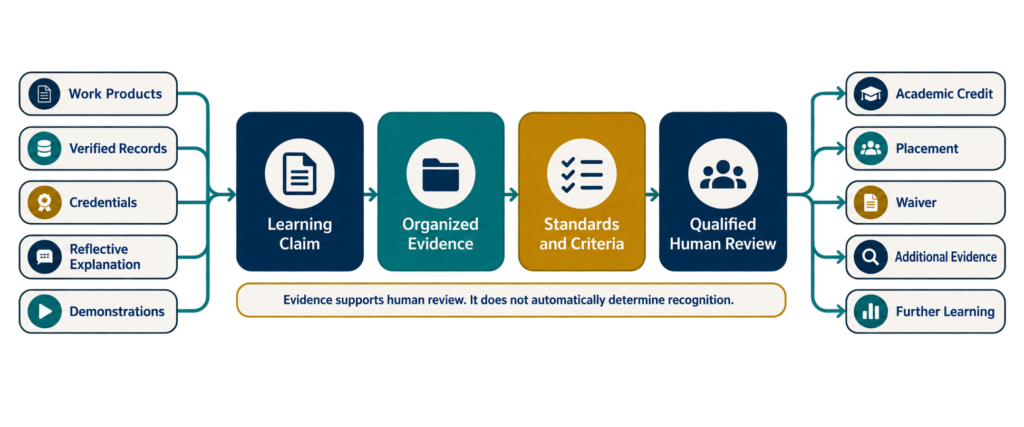
This module helps your team:
- Connect prior learning to specific learner goals
- Distinguish experience from demonstrated learning
- Define decision-useful evidence
- Identify appropriate recognition pathways
- Clarify learner instructions and expectations
- Examine reviewer roles, criteria, and authority
- Reveal workflow and information gaps
- Identify where evidence requires verification
- Reduce unnecessary learner and reviewer effort
- Establish readiness conditions for recognition
- Route unresolved questions to qualified specialists
- Develop an evidence-backed readiness response
What should happen next for each potential recognition claim?
Not every prior-learning discovery should proceed immediately to formal assessment. The next step should reflect the learner’s goal, the relevance of the learning, the available evidence, institutional policy, and the recognition pathway involved.
Prepare
Organize the claim and available evidence. Connect the experience, activities, learning, evidence, and applicable standard.
Develop
Strengthen the evidence with additional artifacts, explanation, verification, demonstration, or assessment.
Route
Move the claim to transfer review, portfolio assessment, testing, credential review, placement, waiver, or another approved process.
Review
Engage a qualified and authorized evaluator to interpret the evidence against the applicable standard.
Redirect
Pursue a better-fitting course, program, assessment, credential, support service, or developmental opportunity.
Investigate
Resolve uncertainty about eligibility, evidence, policy, verification, reviewer authority, or consequences.
These categories organize readiness and routing. They do not award credit, establish equivalency, determine competency, or replace an institution’s authorized assessment and recognition process.
What should a PLA readiness review examine?
The learner’s goal
What is the learner trying to accomplish, and would recognition meaningfully advance that objective?
The learning claim
What knowledge, capability, or outcome does the learner believe they can demonstrate?
The evidence
What supports the claim, and what remains self-reported, outdated, inaccessible, or missing?
The standard
Which course outcome, competency, prerequisite, requirement, policy, or approved equivalency applies?
The review process
Who is authorized and qualified to evaluate the evidence, and what procedure and record are required?
The potential outcome
What recognition is possible, how would it affect the learner’s pathway, and what limitations remain?
From talent evidence to institutional review
TalentPass can help an individual organize experience, activities, skills, credentials, accomplishments, and supporting evidence. A recognition review should then examine only the information needed for the specific institutional decision.
STEP 1
Clarify the learner’s goal
Identify the credential, requirement, course, placement decision, or outcome the learner is trying to reach.
STEP 2
Identify potentially relevant learning
Connect experience to activities, knowledge, capabilities, and possible institutional standards.
STEP 3
Select the appropriate pathway
Determine whether the claim belongs in transfer review, portfolio assessment, testing, credential review, placement, or waiver.
STEP 4
Develop the evidence request
Explain what evidence is relevant, what criteria will be applied, and what the learner should not need to provide.
STEP 5
Support qualified review
Provide the authorized evaluator with the claim, evidence, context, standard, and unresolved questions.
STEP 6
Record and explain the outcome
Communicate the decision, rationale, limitations, next steps, and effect on the learner’s pathway.
Structured evidence can make review more understandable and efficient, but the institution remains responsible for its standards, policies, evaluators, records, and recognition decisions.
- Organize learner-controlled experience and evidence
- Keep each review bounded to a specific decision
- Preserve context behind summaries
- Identify missing or uncertain evidence
- Support qualified human interpretation
- Explain and record the institutional outcome
FROM EXPERIENCE TO STRUCTURED EVIDENCE
Help learners develop a reusable account of what they have done and learned.
With the learner’s participation, TalentPass may help structure employment and role history, activities performed, responsibility and decision context, skills and how they developed, licenses and credentials, accomplishment stories, and supporting evidence references.
The individual controls their TalentPass information and chooses when it is shared.
TalentPass can support evidence organization and learner agency. It does not determine course equivalency, competency, eligibility, credit, placement, or recognition.
PRODUCT AND DECISION BOUNDARIES
Evidence infrastructure supports recognition decisions. It does not make them.
TalentPass, TalentSync, Pythia, or another technology used in this process should not be presented as automatically awarding credit, determining equivalency, certifying mastery, authenticating every artifact, replacing faculty or evaluator judgment, making accreditation or legal determinations, or guaranteeing recognition.
Technology may help learners describe experience, organize evidence, identify missing information, and prepare for human review. Academic policy, accreditation, transfer, privacy, accessibility, records, financial aid, veterans’ benefits, intellectual property, and other questions may require review by appropriately qualified specialists.
What to bring into the conversation
You do not need a perfect PLA system, a universal rubric, or a complete inventory of every possible evidence type.
We begin with the recognition pathways, learner experiences, policies, artifacts, and operational knowledge the institution already has.
Useful inputs may include:
- Current PLA policies and eligibility requirements
- Portfolio instructions and templates
- Transfer-credit procedures
- Challenge examination options
- Military and industry credential policies
- Course outcomes and competency statements
- Existing evaluation rubrics
- Samples of de-identified evidence
- Common learner questions
- Advisor, faculty, evaluator, and registrar observations
- Review timelines and handoff procedures
- Available participation and outcome data
- Fees, limits, residency requirements, or constraints
- Appeal or reconsideration procedures
- Degree-audit and learner-record workflows
- Accessibility, privacy, verification, and retention practices
- Known inconsistencies or bottlenecks
The Learning Visibility Direction module establishes the learner outcome and institutional boundary this module should examine.
What this module can help clarify
What evidence learners need
Define the artifacts, explanations, demonstrations, and verification appropriate to a bounded recognition decision.
Which pathway should receive the claim
Distinguish among transfer, portfolio assessment, testing, credential review, placement, waiver, and further learning.
Where the institution is not ready
Reveal unclear policies, inaccessible instructions, missing criteria, ownership gaps, disconnected systems, and inconsistent review.
What should happen next
Organize claims into preparation, evidence development, routing, authorized review, redirection, or investigation.
Final outputs depend on the modules selected and the learner-centered decision established through the workshop’s required Learning Visibility Direction module.
Where might the work lead next?
PLA readiness frequently reveals connected problems in prior-learning discovery, evidence development, credential transparency, and learner navigation.
Prior Learning Discovery
Help learners identify knowledge and capabilities developed through work, service, caregiving, community participation, independent study, and education.
Learning Evidence & Portfolio Development
Help learners organize experiences, artifacts, reflections, demonstrations, and verified records into clearer evidence of learning.
Credential Transparency & Portability
Make recognized learning easier to understand, verify, share, and use across education and employment contexts.
Learner Advising & Opportunity Navigation
Connect visible learning and recognition outcomes to the learner’s next educational, career, or developmental opportunity.
Questions institutions ask about PLA evidence and recognition readiness.
Prior learning assessment, or PLA, refers to institutionally approved processes for evaluating relevant learning developed outside a conventional course. The experience itself does not receive credit; authorized reviewers evaluate whether demonstrated learning satisfies an applicable standard.
Discovery identifies potentially relevant learning. Assessment formally evaluates whether demonstrated learning meets a standard. Readiness helps determine whether the learner, evidence, pathway, and review process are prepared.
PLA describes evaluation; credit is one possible outcome. Other outcomes may include placement, waiver, advanced standing, fulfillment of a requirement, a request for more evidence, or no recognition.
No. The institution must examine what the learner did, what learning developed, what evidence supports the claim, and how that learning aligns with the applicable standard.
Evidence may include work products, demonstrations, examinations, credentials, training or military records, employer documentation, evaluations, reflective explanations, and corroborating statements.
Usually not by itself. A résumé can identify possible areas of learning but rarely establishes what the learner knows or how it aligns with a specific standard.
A certificate may represent attendance, completion, achievement, assessment, or licensure. Reviewers must understand what it represents and whether it is relevant and eligible under institutional policy.
Authenticity concerns whether evidence can reasonably be connected to the learner and their contribution. Appropriate support may include verified records, issuer confirmation, metadata, demonstrations, interviews, or corroboration.
Learners should not disclose protected material. An institution may allow a redacted or recreated artifact, demonstration, supervisor confirmation, structured interview, or another approved alternative.
Enough relevant evidence to support the bounded claim and let a qualified reviewer decide or identify what remains missing. Portfolio length is not the same as evidence quality.
A reviewer should have the subject knowledge, institutional authority, and procedural support required for the decision. The appropriate role varies by pathway and policy.
Clarify decision boundaries, shared outcomes, evidence expectations, reviewer guidance, documented rationales, and periodic calibration while preserving appropriate professional judgment.
AI may organize or summarize information and flag missing context. It should not independently award credit, determine equivalency, certify mastery, or replace an authorized human reviewer.
TalentPass can organize experience and evidence. Whether it satisfies a PLA requirement depends on the institution’s policies, required format, standard, and authorized process.
TalentPass is designed around individual participation and control. The learner chooses when information is shared; institutions remain responsible for information they receive and retain.
Institutions should use the systems and formats required by their academic, registrar, accreditation, reporting, and learner-record practices.
Evidence may include awareness, advising access, participation, processing time, reviewer effort, recognition outcomes, credit application, persistence, time or cost saved, demographic patterns, appeals, and learner feedback.
Learning Visibility Direction establishes the decision foundation. Prior Learning Discovery identifies potentially relevant learning. This module determines whether the learner, evidence, standard, reviewer, and recognition process are ready for an appropriate decision.
MAKE PRIOR LEARNING READY FOR A REAL DECISION
Turn valuable experience into evidence that qualified reviewers can use.
Connect learner goals, prior learning, evidence, standards, reviewers, and recognition pathways—then create a clearer route toward credit, placement, waivers, advanced standing, or the next appropriate step.
This module is part of Gobekli’s configurable Learning Visibility & Credentialing Workshop.
TalentPass
TalentPass is a Universal Talent Passport app that makes it easy for you to claim, collect, filter and share your all of your work and education history, evidence and data in a quantifiable and verifiable way.
By doing so, it becomes easy for you to generate profiles of your relevant and aligned talent for any opportunity in compelling presentations for individual, organizational and machine review.
TalentPass is an extendable app with a private AI companion, central talent tree and pages for exchanging filtered sets of your talent data with your organizations and other apps in exchange for enhanced and integrated services, in work, education and beyond.
- Claim, collect, mange, filter and share all of your work and education data in one place
- Generate profiles that showcase your talent in different ways
- Leverage your own data to grow yourself and to create and seizing opportunities
TalentPass is a Universal Talent Passport that helps individuals represent and manage their own professional growth and personal development seamlessly. It empowers you to organize, showcase, and share your skills, experiences, and achievements in a dynamic and verifiable format.
By allowing you to create data-rich, verifiable profiles called ViiSAs, TalentPass enables you to present a compelling narrative of your skills and experiences tailored to specific opportunities. This makes your applications stand out to employers, increasing your chances of landing desired roles.
Absolutely! TalentPass integrates verifiable learning credentials and comprehensive learner records, making it easier to track and present your academic achievements alongside professional experiences.
TalentPass includes Pythia, a private AI assistant that helps you draft, manage, and refine your profiles. It provides personalized guidance and insights, helping you identify and articulate your skills and experiences effectively.
Yes, TalentPass is designed to support diverse professional paths, including freelancing and entrepreneurship. Its flexible platform lets you craft multiple profiles (ViiSAs) to suit different roles and projects, showcasing your versatility and breadth of skills.
TalentPass prioritizes your privacy with robust security measures, ensuring that your data is protected and shared only with your consent. You have complete control over what information you share and with whom.
Unlike static resumes or profiles, TalentPass provides a dynamic and interactive representation of your skills and experiences. It allows for real-time updates and generates ViiSAs that are tailored for specific opportunities or platforms, providing a more precise and impactful presentation of your professional narrative.
TalentPass ensures secure and controlled data sharing through its platform by leveraging encrypted data transfer and strict access controls. When you choose to share your ViiSAs with organizations, you can specify exactly which data elements are shared, ensuring that only relevant information is accessible. This method supports compliance with privacy standards and fosters trust, enabling you to engage confidently with potential employers, educational institutions, and other organizations while maintaining full control over your personal information.
