
A LEARNING VISIBILITY & CREDENTIALING WORKSHOP MODULE
Prior Learning Discovery:
Help Learners See What They Already Know
Learners arrive with knowledge developed through work, military service, caregiving, community participation, independent study, previous education, and life experience.
Much of that learning remains invisible because people do not know what may be relevant, how to describe it, or where to take it.
This module helps institutions create a clearer path from lived experience to appropriate learning, advising, and recognition opportunities.
Does this sound familiar?
Learners do not recognize their experience as learning
People may describe where they worked or what responsibilities they held without recognizing the knowledge and capabilities those experiences developed.
Discovery begins with institutional terminology
Learners are asked to interpret course descriptions, learning outcomes, competency frameworks, or academic policies before they understand how their experience may connect.
Prior learning is reduced to a résumé
Job titles and brief summaries hide the activities, decisions, challenges, accomplishments, and evidence that could make previous learning understandable.
Learners find the process too late
Recognition opportunities may appear only after a learner has enrolled, repeated material, chosen a program, or paid for unnecessary coursework.
Different offices provide different answers
Admissions, advising, faculty, registrars, career services, veterans’ services, and program teams may explain prior-learning pathways differently.
Promising experience has nowhere to go
The institution may discover relevant learning but lack a clear route into advising, evaluation, portfolio development, transfer review, or another next step.
What is prior learning discovery?
Prior learning discovery is the process of helping a person identify, describe, and organize potentially relevant learning developed outside the immediate course or program.
That learning may come from employment, military service, previous education, industry training, licenses, community participation, caregiving, entrepreneurship, projects, independent study, or other lived experience.
Discovery does not determine that experience is equivalent to a course, satisfies a competency, or deserves academic credit.
It helps the learner and institution understand what may be present, what evidence may exist, and which opportunities or review processes could be relevant.
The problem is not that learners have no prior learning. It is that experience is difficult to translate.
People rarely organize their lives according to course outcomes, competencies, credit hours, occupational frameworks, or institutional departments.
They remember what they were responsible for, what they accomplished, which problems they encountered, what decisions they made, which tools they used, who relied on their work, and what changed because of their contribution.
An institution may need to understand concepts, methods, competencies, performance standards, assessments, documentation, recency, level, or equivalency.
Prior Learning Discovery creates a bridge between those perspectives. It begins with the person’s experience and makes the activities, learning, capabilities, and possible evidence visible enough to support an appropriate next conversation.
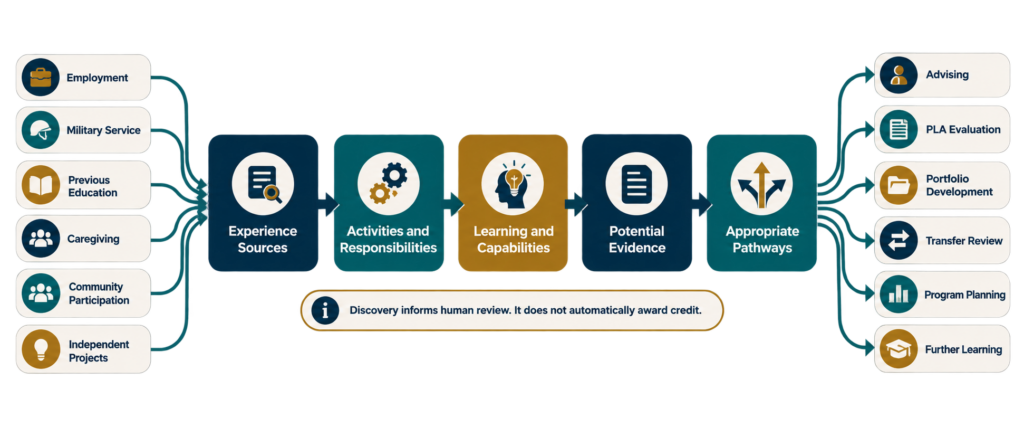
See the complete discovery pathway—not just the final application.
Experience Sources
- Employment
- Military service
- Education and training
- Community participation
- Caregiving
- Independent projects
Activities & Responsibilities
- Work performed
- Problems addressed
- Decisions made
- People supported
- Tools used
- Outcomes produced
Learning & Capabilities
- Knowledge developed
- Technical capabilities
- Human capabilities
- Methods and practices
- Judgment and responsibility
- Context of application
Potential Evidence
- Work products
- Credentials and licenses
- Evaluations and assessments
- Records and documentation
- Accomplishment stories
- Qualified verification
Appropriate Pathways
- Advising
- Formal PLA evaluation
- Portfolio development
- Transfer review
- Program planning
- Further learning
Prior learning becomes discoverable when experience, activity, learning, evidence, and an appropriate institutional pathway can be understood together.
How prior learning remains hidden
STAGE 1
The learner enters with experience
The person brings years of work, education, service, responsibility, problem-solving, and informal learning into the institution.
STAGE 2
The institution asks for familiar records
The process focuses on transcripts, course histories, credentials, résumés, and forms the institution already knows how to receive.
STAGE 3
Unstructured learning is compressed or omitted
Important activities, accomplishments, capabilities, and evidence disappear behind titles, dates, incomplete documents, or uncertainty about what matters.
STAGE 4
Potential pathways are missed
The learner may repeat learning, overlook an evaluation opportunity, choose an inefficient program path, or never receive guidance about what could be explored.
Discovery and evaluation are different responsibilities.
A learner must often recognize and describe prior learning before an authorized evaluator can determine whether it satisfies a particular requirement.
Combining these stages too early can discourage discovery. A learner may omit valuable experience because they cannot immediately prove equivalency or predict what an evaluator will accept.
A better process allows the learning to become visible before making a formal judgment about it.
Discovery and evaluation ask different questions:
Begin with the settings, responsibilities, projects, and transitions in which meaningful learning may have developed.
Move beyond titles to activities, decisions, challenges, contributions, tools, and operating context.
Identify possible knowledge, methods, judgment, technical capability, and human capability without making a premature equivalency claim.
Locate records, work products, credentials, assessments, references, demonstrations, or qualified verification.
Consider advising, portfolio development, formal PLA evaluation, transfer review, career support, or further learning.
Keep discovery separate from the faculty, evaluator, registrar, or other authorized process responsible for recognition.
A résumé shows where someone has been. Discovery must uncover what happened there.
Activities
What did the person regularly do, create, operate, analyze, coordinate, repair, explain, manage, or improve?
Responsibility
What outcomes, people, resources, processes, risks, or decisions were entrusted to them?
Challenges
What difficult situations did they encounter, and how did they respond?
Accomplishments
What changed, improved, succeeded, or became possible through their contribution?
Knowledge
What concepts, practices, methods, regulations, tools, or contexts did they need to understand?
Evidence
What records, work products, credentials, assessments, references, or observations may support the account?
The learner’s language
A learner may say: “I trained new employees and handled difficult customer situations.”
Discovery begins with that authentic account, asks for specific examples, and preserves the context in which the learning developed.
- Begin with open descriptions
- Ask about specific activities and situations
- Preserve the original experience
- Let the learner correct interpretations
The institution’s language
The institution may eventually examine instruction, coaching, communication, conflict resolution, policy interpretation, process documentation, feedback, leadership, or responsibility.
Institutional language should clarify a possible connection without rewriting the learner’s story to force a match.
- Introduce frameworks when useful
- Show how interpretations were formed
- Separate relevance from determination
- Retain the evidence behind summaries
Not every experience requires the same level of exploration.
Initial discovery
An accessible first conversation may identify important experience areas, surface possible learning, recognize credentials or records worth locating, prepare for advising, and determine whether deeper exploration is worthwhile.
Deeper evidence development
More detailed work may be appropriate when a formal PLA pathway has been identified, defined outcomes must be demonstrated, important evidence must be organized, or an evaluator needs additional context.
Discovery should reduce uncertainty about the next step—not create an unlimited demand for personal information.
Opportunity should not depend on knowing the right institutional language.
Prior-learning processes can unintentionally favor people who already understand higher education, professional terminology, portfolio development, or internal pathways.
Other learners may have equally relevant experience but struggle to recognize the opportunity, describe experience academically, locate records, document informal learning, understand evidence, find the right office, or invest in an uncertain process.
A stronger discovery process makes the entry point understandable, explains what happens next, and provides multiple ways to describe what a learner knows and has done.
Equitable discovery does not lower evaluation standards. It gives more learners a fair opportunity to determine whether their experience may be relevant to those standards.
Help learners begin with what they already know
and find the pathway that fits.
Make experience visible before asking for proof.
THE MATCHING WORKSHOP MODULE
Module 2: Prior Learning Discovery
This module helps institutions understand how learners identify, describe, and organize learning developed through previous education, employment, military service, community participation, caregiving, independent study, and other experiences.
Participants examine the pathway from the learner’s first awareness through the point at which potentially relevant learning reaches an appropriate institutional process.
The purpose is not to award credit during the workshop. It is to make prior learning and its possible evidence visible enough to support better guidance and responsible next steps.
This module helps your team:
- Identify where potentially relevant prior learning may originate
- Understand how learners currently discover recognition opportunities
- Reveal where experience is lost behind titles, records, or institutional language
- Clarify the activities and context needed to understand experience
- Identify potential sources of evidence
- Distinguish discovery from formal evaluation
- Examine barriers affecting access and participation
- Clarify advising, routing, ownership, and handoffs
- Define when deeper evidence development is appropriate
- Create a more understandable learner discovery pathway
What should happen next when prior learning is discovered?
Discovery does not always lead to the same destination. The appropriate response depends on the learner’s goal, the experience identified, available evidence, institutional policy, and the decisions authorized participants must make.
Explore
Develop the learner’s account. Clarify activities, responsibilities, context, and possible capabilities.
Document
Locate or develop useful records, work products, credentials, references, or other evidence.
Advise
Connect the discovery to program planning, transfer, placement, career development, or another learner decision.
Evaluate
Move potentially relevant learning into an authorized formal review process.
Develop
Identify additional instruction, practice, assessment, or evidence that may be needed.
Refer
Route the learner to transfer review, licensure, verification, support, another institution, or a specialist.
These categories organize possible next steps. They do not determine equivalency, award credit, verify every learner claim, or replace authorized academic judgment.
What should the module examine?
Learner awareness
How and when do learners discover that prior experience may be relevant?
Experience discovery
How are learners invited to describe employment, service, education, caregiving, projects, and other experience?
Learning interpretation
How are activities connected to possible knowledge and capabilities without premature equivalency claims?
Potential evidence
What records, credentials, work products, assessments, references, or demonstrations may help?
Institutional routing
Who receives the discovery, what happens next, and how does the learner reach the right pathway?
Learner participation
Can the learner understand, review, correct, control, and appropriately share the information?
From lived experience to an appropriate learning path
A useful discovery process has a visible destination. Learners should understand what may happen after they describe their experience.
STEP 1
Identify experience sources
Invite the learner to consider work, service, education, caregiving, community participation, projects, and other relevant settings.
STEP 2
Unpack activities and responsibilities
Clarify what the learner did, decided, created, supported, improved, or was accountable for.
STEP 3
Interpret possible learning
Identify knowledge and capabilities that may have developed while preserving context and uncertainty.
STEP 4
Locate potential evidence
Find records, credentials, work products, assessments, references, demonstrations, or other support.
STEP 5
Choose an appropriate pathway
Connect the learner to advising, evaluation, portfolio development, transfer, planning, or further learning.
STEP 6
Clarify ownership and expectations
Explain responsibilities, requirements, costs, timelines, limitations, and the next decision.
Discovery becomes valuable when it helps the learner move forward with greater clarity—even when the appropriate result is not academic credit.
- Summarize what has been identified
- State what remains uncertain
- Explain which pathway may be relevant
- Identify who owns the next step
- Set learner expectations before deeper work
- Preserve discovery separately from formal judgment
FROM DISCOVERY TO A RESPONSIBLE NEXT STEP
Discovery supports recognition opportunities. It does not make recognition decisions.
The module improves discovery, description, evidence awareness, communication, and routing. Academic credit, competency, equivalency, transfer, licensure, and credential decisions remain with the authorized people and processes responsible for making them.
Prior Learning Discovery should not be presented as:
- Automatically translating experience into academic credit
- Determining course equivalency
- Confirming competency or mastery
- Guaranteeing recognition, transfer, placement, or completion
- Treating every experience as educationally relevant
- Verifying every learner statement
- Replacing faculty or authorized evaluator judgment
- Lowering academic or professional standards
- Requiring unrestricted access to personal information
- Making accreditation, licensure, legal, or compliance determinations
PROCESS AND DECISION BOUNDARIES
Keep discovery open enough to find learning—and bounded enough to protect the learner.
The learner should understand why information is being requested, how it may be interpreted, who may receive it, and what decisions it can and cannot support.
Potential relevance should remain distinct from confirmed equivalency, competency, verification, or credit.
Questions involving privacy, accessibility, records retention, identity, verification, financial aid, veterans’ benefits, accreditation, licensure, employment, or legal obligations may require review by qualified specialists.
What to bring into the conversation
You do not need a complete inventory of every form of prior learning or a finished PLA process.
We begin with the learners, pathways, policies, and observations the institution already has.
Useful inputs may include:
- The Learning Visibility Decision Foundation
- Current PLA, CPL, RPL, or transfer policies
- Learner-facing descriptions of prior-learning opportunities
- Admissions and advising materials
- Intake forms and portfolio instructions
- Course, program, and competency outcomes
- Assessment and evaluation criteria
- Military, industry, and training crosswalks
- Credential and license information
- Common learner questions
- Successful and unsuccessful case examples
- Participation and credit-award data
- Fees and timelines
- Learner, advisor, faculty, and evaluator observations
- Current referral and handoff processes
- Technology and accessibility constraints
- Known equity or access concerns
Incomplete or inconsistent information is useful. It can reveal where learners and institutional participants currently encounter uncertainty.
What this module can help clarify
Where prior learning remains hidden
Identify the sources, populations, process stages, and assumptions that prevent learning from becoming visible.
How learners can describe experience
Move from roles and records to activities, responsibilities, learning, capabilities, and potential evidence.
Which discovery pathways are appropriate
Clarify when to explore, document, advise, evaluate, develop, or refer.
What the institution must improve
Identify changes to communication, participation, evidence guidance, routing, ownership, accessibility, and learner support.
Final outputs depend on the Learning Visibility Decision Foundation, available evidence, participant perspectives, institutional policy, and the modules selected for deeper work.
Where might the work lead next?
Prior Learning Discovery often reveals that the institution needs to strengthen evaluation readiness, learner Profiles, advising visibility, or the systems and governance supporting recognition.
PLA Evidence & Recognition Readiness
Clarify what evidence authorized evaluators need, how learners can prepare it, and whether the institution is ready to support consistent recognition decisions.
Purpose-Built Learner Profiles
Create a focused view of the experiences, activities, learning, capabilities, and evidence relevant to a defined purpose.
Student Learning Visibility
Connect prior learning with courses, projects, assessments, credentials, and development across the learner journey.
Systems, Standards & Visibility Governance
Determine how prior-learning information moves across people, systems, permissions, standards, and decision points.
Questions institutions ask about prior learning discovery.
Prior learning is knowledge, capability, or understanding developed before or outside a learner’s current course or program through education, employment, service, training, community participation, caregiving, projects, or other experience.
It helps a learner identify, describe, and organize experiences that may contain relevant learning and connect that discovery to an appropriate next pathway.
No. Discovery identifies what learning may exist. Assessment is a formal process in which authorized evaluators determine whether demonstrated learning satisfies defined criteria.
No. An experience may be meaningful without satisfying the outcomes, level, evidence requirements, or policies associated with academic credit.
A résumé summarizes employment and qualifications. It often hides the activities, decisions, challenges, knowledge, and evidence needed to understand learning.
Relevant sources may include employment, military service, education, training, apprenticeships, credentials, caregiving, volunteering, community leadership, independent study, entrepreneurship, creative work, and technical projects.
Potential evidence may include transcripts, credentials, licenses, work products, assessments, reviews, training records, project documentation, portfolios, demonstrations, and qualified verification.
The experience may still be worth discussing. Discovery can identify what is known, what remains self-reported, alternative evidence, and whether an assessment or demonstration pathway exists.
AI may help structure conversations, identify activities, suggest questions, or organize information. It should not independently determine equivalency, award credit, verify an account, or make a consequential academic decision.
Separate exploration from determination. Invite specific descriptions, present possible learning as something to investigate, and let the learner review and correct interpretations.
Usually not. The Decision Foundation should define the population, purpose, evidence boundary, and decision so discovery focuses on experiences likely to matter.
It may be useful before enrollment, during admissions or advising, when selecting a program, during transfer, at the beginning of study, or when a learner’s goals change.
Ownership varies, but institutions should clearly identify who introduces the opportunity, supports the learner, receives the discovery, evaluates evidence, and communicates decisions.
It can create accessible entry points for people with relevant learning who do not know institutional terminology, recognition processes, or conventional documentation practices.
No. It examines how prior learning is discovered, described, supported, and routed. Authorized evaluators retain responsibility for formal decisions.
No. Any later technology or product configuration should follow the approved use case and be evaluated separately.
It can produce a mapped discovery pathway, learner entry points, experience and evidence prompts, routing categories, ownership assignments, identified barriers, and recommendations for deeper work.
Learning Visibility Direction establishes the decision foundation. Prior Learning Discovery is selected when relevant learning remains hidden, difficult to describe, or disconnected from appropriate institutional pathways.
HELP LEARNERS BEGIN WITH WHAT THEY ALREADY KNOW
Turn lived experience into a clearer path forward.
Help learners discover the activities, learning, capabilities, and evidence within their experience—then connect them to the institutional pathway that fits.
Prior Learning Discovery is part of Gobekli’s configurable Learning Visibility & Credentialing Workshop.
