
REGIONAL WORKFORCE & INDUSTRY ALIGNMENT WORKSHOP MODULE
Regional Talent Supply & Hidden Capability
Examine the experience and capabilities your region may already hold, then clarify what is known about interest, availability, and access—so potential talent sources can be investigated with a clearer understanding of the gaps.
Does this sound familiar?
Population totals become assumptions about available workers.
A regional count is used to describe a talent pool without establishing whether people are interested, available, or able to access the proposed opportunity.
Job titles hide relevant experience.
People may have performed useful activities in other industries or settings, but their current titles do not make that experience visible.
The picture includes only people already in familiar systems.
Partner records describe existing participants, students, or applicants while leaving other potential talent sources largely unexplored.
Credentials are easier to see than the capabilities behind them.
Records show qualifications and completion without enough context to understand what people have done or could demonstrate.
Different sources describe the same people differently.
Counts, categories, dates, and coverage vary across providers and partners, making regional summaries difficult to interpret.
Interest and availability are assumed to remain current.
An old registration or expression of interest continues to inform plans after someone’s goals, employment, location, or circumstances may have changed.
What are regional talent supply and hidden capability?
Regional talent supply concerns the people whose experience, capabilities, interests, and circumstances may be relevant to a selected workforce initiative.
Understanding that supply requires more than counting residents, graduates, jobseekers, or people employed in a related occupation.
Hidden capability is relevant experience or ability that available records do not make sufficiently visible or understandable. It may be absent, described too broadly, or disconnected from the work the initiative needs.
Potential sources may include people working in adjacent industries, returning to employment, completing education, leaving military service, or bringing experience from caregiving, independent work, and community activity.
This module helps partners examine the information they have, identify potential sources worth investigating, and define what needs validation before making claims about readiness or availability.
Relevant experience is a starting point for a conversation.
A person’s current job title may explain little about the activities they have performed.
Someone working in a different industry may have experience with equipment inspection, scheduling, documentation, troubleshooting, or coordinating others.
Those activities may be relevant to a priority role, but the relationship needs examination.
The person may need additional preparation. They may have no interest in changing work. The proposed opportunity may not fit their location, schedule, or goals.
The workshop keeps these questions separate so that possible relevance does not become an assumed match.
A useful regional picture shows where further investigation could reveal opportunity and where the evidence remains incomplete.
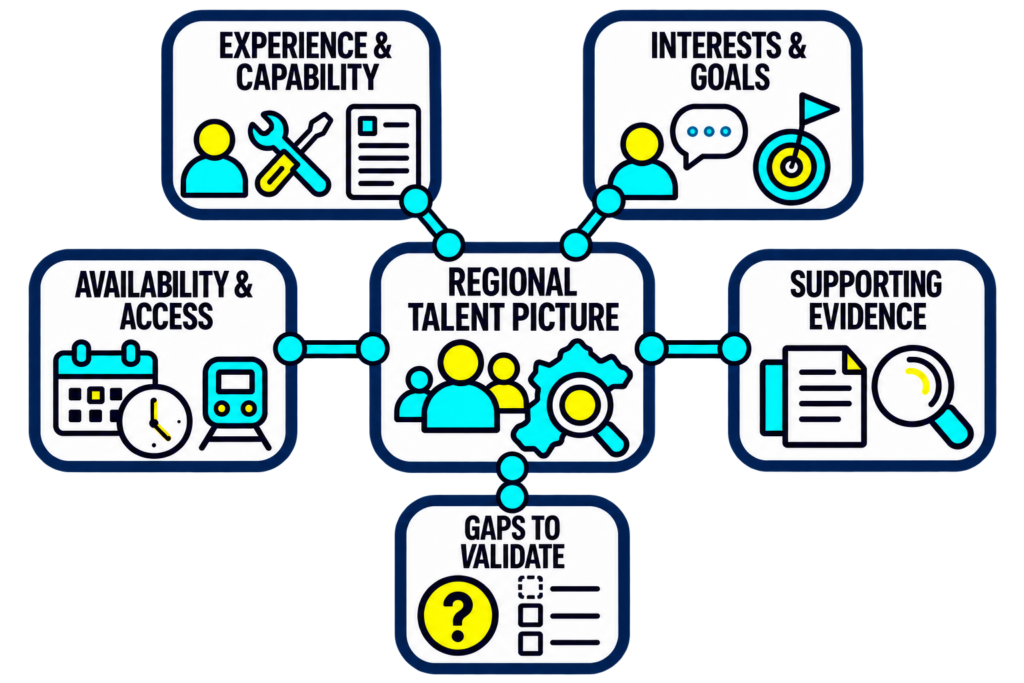
What needs to connect?
Population and coverage
Selected geography
Potential source groups
People represented
People missing
Limits of coverage
Experience and capability
Work activities
Learning and qualifications
Other relevant experience
Available supporting evidence
Questions about relevance
Interest and goals
Expressed interests
Desired opportunities
Career intentions
Date and context
Questions for people
Availability and access
Timing
Location and travel
Schedule conditions
Participation constraints
Changes needing confirmation
Sources and validation
Source owners
Definitions and dates
Possible overlap
Appropriate use boundaries
Follow-up responsibilities
These elements support different conclusions. Information about experience, interest, availability, and readiness should remain distinguishable throughout the review.
How this module helps
1. Understand the talent-supply question
Learn why regional counts and familiar classifications can leave important experience and participation questions unresolved.
2. Examine available information
Review selected sources for coverage, context, currency, and what they reveal about potentially relevant capability.
3. Identify validation priorities
Determine which questions require better source information, partner input, or direct confirmation from people.
4. Prepare a responsible next step
Develop a talent-source brief and validation plan that can guide further investigation and a possible Gobekli configuration.
Begin with one assumption about the available talent.
Choose a claim influencing the initiative, such as “people in these occupations could fill the new roles” or “local program completers provide enough potential participants.”
Identify the information supporting that claim and what it does not establish.
The exercise examines whether the partnership needs a clearer account of experience, broader coverage, current interest, participation conditions, or several of these together.
Questions to review together
Identify the geography, source populations, and inclusion criteria. Clarify whether records concern residents, workers, students, applicants, program participants, or another group.
Examine whether sources describe meaningful activities and evidence or provide only titles, qualifications, and broad categories.
Identify groups or settings that may hold relevant experience but are not represented in the available information. Record the basis for investigating them.
Distinguish people’s expressed preferences from assumptions based on their occupation, enrollment, location, or past participation.
Review the timing and conditions attached to available information. Identify what would need confirmation before someone could participate.
State what the evidence supports, which possibilities deserve investigation, and what remains unknown about readiness or participation.
Six dimensions of a useful talent-supply picture
Coverage
An understandable account of who is represented and which potential sources remain outside the available information.
Experience detail
Enough context about activities and responsibilities to investigate relevance beyond a job title or credential.
Evidence context
Clarity about where capability information came from and what it can reasonably support.
Expressed interest
A distinction between opportunities people have chosen to explore and possibilities identified by the partnership.
Availability and conditions
Current information about timing and participation conditions where it has been appropriately confirmed.
Validation ownership
Named responsibilities for resolving uncertainty, inviting input, and keeping the picture current.
When talent supply is treated as a headcount
Partners may overlook:
- Differences among the populations being counted.
- Overlap across records or programs.
- Relevant activities hidden behind broad titles.
- People outside established recruitment sources.
- Unconfirmed interest and participation conditions.
- Changes since the information was collected.
The resulting estimate can overstate immediate availability while overlooking experience worth investigating.
When talent supply becomes more understandable
Partners can establish:
- Clear descriptions of source populations.
- Visible coverage limits and overlap questions.
- Examples of potentially relevant experience.
- Separate accounts of interest and availability.
- Questions requiring direct confirmation.
- A focused plan for investigating potential sources.
This gives the partnership a stronger basis for deciding where to learn more and how to involve people appropriately.
What this can look like in practice
A regional partnership is considering a preparation route for industrial maintenance work.
Its initial talent estimate combines graduates from related programs with counts of workers in selected occupations.
The estimate is being used to suggest that enough people are available for an initial cohort.
During the module, participants clarify that the sources describe different populations and time periods.
Some graduates may already be working, some records may overlap, and the occupational counts do not indicate interest in the proposed opportunity.
Employer and provider representatives identify activities in adjacent settings that may be relevant, including inspection, routine servicing, documentation, and escalation.
The partnership records these as reasons to investigate particular talent sources, with readiness still unconfirmed.
It also identifies gaps in information about people outside the partner programs represented in the initial estimate.
Partners define a voluntary way to invite interested people to describe relevant experience and indicate the conditions that would affect participation.
The resulting brief replaces the assumed cohort supply with a clearer set of potential sources, evidence limitations, and assigned validation questions.
Missing information does not mean missing capability.
A record may contain little detail because it was created for a different purpose.
An enrollment record may establish participation in a program. A résumé may summarize selected employment. An occupational category may support regional analysis.
None of these necessarily provides a complete account of what someone has done.
The workshop examines where missing context limits interpretation and whether additional information would help the selected decision.
It also avoids assuming that every gap should be filled with more personal data.
The next step may be a better question, an improved description of experience, or a voluntary invitation to contribute relevant context.
Potential relevance does not establish willingness to participate.
A person may have relevant experience and still prefer their current work.
They may be interested in a new opportunity at another time, under different conditions, or after learning more about it.
Location, compensation, schedule, support, and preparation demands may affect that choice.
The partnership should distinguish what people have expressed from what others believe might suit them.
Interest and availability should be confirmed for the intended purpose and revisited when circumstances change.
This helps regional planning respect people’s choices while producing a more credible account of potential participation.
WORKSHOP MODULE 4
Find a clearer starting point for understanding regional talent.
Regional Talent Supply & Hidden Capability is a focused minicourse in interpreting the experience and participation information behind a regional talent estimate. Participants examine selected sources, identify potentially overlooked capability, and define the validation needed using the foundation established in Regional Workforce Direction.
What can this module address?
The module examines potential talent sources relevant to one selected initiative. Topics may include:
- The populations represented in current estimates.
- Geographic and source-coverage boundaries.
- Definitions, dates, and possible record overlap.
- Experience hidden behind job titles or categories.
- Learning, credentials, and their supporting context.
- Relevant experience from other work and life settings.
- Potential sources outside familiar partner systems.
- Expressed interests and career goals.
- Known availability and participation conditions.
- Information gaps requiring direct confirmation.
- Appropriate source use and invitation routes.
- Validation owners and review responsibilities.
What responses might emerge?
The appropriate response depends on what the current picture reveals and what the initiative needs to decide.
Clarify
Describe the populations, measures, and source limitations behind a regional talent estimate.
Broaden
Identify additional potential talent sources with a clear reason for investigating their relevance.
Surface
Invite more meaningful descriptions of activities and experience that existing records do not explain.
Separate
Distinguish capability information from interest, availability, access, and readiness.
Validate
Confirm relevant questions with source owners, knowledgeable partners, and people who choose to participate.
Refresh
Review information whose age or changed context limits its usefulness for current planning.
These responses identify where further investigation may help. They do not automatically establish a pool of ready or available candidates.
What will we review?
The talent-supply claim
The statement or estimate currently influencing the initiative and the decision it is expected to support.
The source populations
Who appears in each source, how they were included, and which groups or settings are missing.
The experience information
Activities, roles, learning, qualifications, and evidence that may indicate relevant capability.
The interest and availability information
What people have expressed, when they expressed it, and which conditions remain unknown.
The interpretation limits
Gaps, overlap, outdated information, and assumptions that could affect the proposed conclusion.
The validation route
Who can clarify the sources, how people may be invited to contribute, and who will maintain the resulting picture.
A practical exercise: create a Regional Talent Source & Validation Brief.
Participants review one talent-supply claim and develop a practical plan for investigating it.
STEP 1
State the question
Identify the priority opportunity and the decision the talent-supply review should support.
STEP 2
Map the available sources
Describe their populations, geography, dates, definitions, owners, and known coverage limits.
STEP 3
Examine visible experience
Identify activities and evidence that may be relevant, along with the limits of what can be inferred.
STEP 4
Separate participation questions
Record what is known and unknown about interest, goals, availability, and access.
STEP 5
Identify overlooked sources and validation needs
Choose the most relevant gaps to investigate and define appropriate partner or individual input.
STEP 6
Assign the next review
Name owners, invitation routes, update responsibilities, and the conditions for revising the planning claim.
A draft Regional Talent Source & Validation Brief connecting potential talent sources to their evidence, coverage limits, participation questions, and follow-up responsibilities.
CONNECT THE WORKSHOP TO A PRACTICAL NEXT STEP
Define how relevant experience could become more visible and usable.
A useful regional talent configuration needs to preserve the difference between what a source suggests and what a person has confirmed. This module identifies the context and participation choices that a subsequent Gobekli implementation would need to support.
- The selected initiative and relevant role context.
- Potential talent sources and responsible organizations.
- Population definitions and coverage boundaries.
- Experience described through activities and responsibilities.
- Supporting evidence and its source context.
- Person-expressed interests and goals.
- Availability and participation conditions when provided.
- Information-use purposes and access boundaries.
- Validation questions and responsible reviewers.
- Update responsibilities and changes requiring review.
Where appropriate, these requirements can inform a TalentSync configuration for organizational understanding of potential talent sources. TalentPass may support people who choose to describe and share relevant experience, interests, and progress.
The workshop does not assume a shared regional database of identifiable people. Product scope, participation arrangements, source access, integrations, and permissions are established separately.
SCOPE AND BOUNDARIES
What this module does—and what requires further work
This module examines the information behind a selected regional talent-supply question.
It helps partners identify potentially relevant sources, understand limitations, and define proportionate validation.
It does not certify capability, determine an individual’s suitability, or establish that someone is interested in or available for a particular opportunity.
Further work may be needed to:
- Gather additional regional or partner information.
- Invite voluntary descriptions of relevant experience.
- Compare source and destination occupations in detail.
- Review individual evidence or demonstrations.
- Confirm current interest and participation conditions.
- Develop recruitment or support arrangements.
- Establish information-sharing and access processes.
- Implement and maintain the supporting configuration.
Information collected for one purpose may not answer another question or be appropriate for a new use. The review should identify the purpose, responsible source, and limits of the proposed interpretation.
Missing records should remain visible as uncertainty. They should not be treated as proof that people lack capability, interest, or potential.
What should participants bring?
Bring the information currently used to describe potential talent for the selected initiative.
Aggregated summaries and de-identified examples can usually support the initial review without requiring individual records.
Useful inputs
- The Regional Workforce Direction Brief.
- Reviewed priority-role descriptions.
- Current regional talent or workforce estimates.
- Source definitions and collection dates.
- Relevant occupational or population summaries.
- Program participation or completion summaries.
- Examples of how experience is currently recorded.
- Available information about expressed interests.
- Available summaries of participation conditions.
- Partner observations about overlooked experience.
- Known coverage gaps or possible duplication.
- Source-owner and follow-up responsibilities.
Bring material participants are authorized to use. The workshop can record a need for further information without assuming immediate access to it.
What can you leave with?
Regional Talent Source Brief
A clearer description of potential sources, represented populations, available experience information, and relevance to the selected initiative.
Coverage & Interpretation Map
Visible gaps, overlap questions, source limitations, and distinctions among capability, interest, availability, and readiness.
Validation & Participation Plan
Assigned questions, appropriate invitation routes, responsible partners, and review points for confirming what remains unknown.
Investigation & Configuration Priorities
Recommended next areas of work and starting requirements for a possible Gobekli configuration connecting experience with relevant context.
These outputs begin with the sources examined during the module. They provide a basis for further investigation, rather than a verified regional candidate inventory.
Where might the work lead next?
Career Transitions & Transferable Experience
Compare selected source and destination occupations to examine relevant activities and additional preparation.
Regional Access & Workforce Participation Constraints
Examine the conditions that may affect whether interested people can participate in the selected opportunity.
Regional Workforce Results & Demand Change
Define how changes in demand, participation, and available information should inform the partnership’s next decisions.
Regional Workforce Direction provides the required foundation. Critical Roles & Capability Requirements can help establish the work against which potential experience is being considered.
Frequently asked questions
Questions regional partners ask before beginning.
Relevant experience or ability that available information does not make sufficiently visible. It may be missing, described too broadly, or disconnected from the work the initiative needs.
The module examines what a talent estimate can support. It distinguishes population counts from information about relevant experience, expressed interest, availability, and readiness.
Usually not. Aggregated summaries, source definitions, and de-identified examples can establish the initial coverage and interpretation questions.
Sources may include related occupations, adjacent industries, education and training programs, returning workers, military experience, independent work, caregiving, and community activity. Their relevance depends on the selected role and evidence.
No. It can provide a reason to investigate. Activities, conditions, evidence, and additional preparation need to be reviewed before drawing a readiness conclusion.
This module identifies potential sources and examines the information available about them. The transition module compares selected source and destination work in greater detail.
Review source definitions and possible overlap before combining figures. Where overlap cannot be resolved appropriately, keep the uncertainty visible instead of presenting an unsupported unique-person total.
Yes. It can guide investigation, but occupational categories do not establish the activities, interests, or availability of every person included.
The module identifies which additional context would help the decision and how it might be obtained appropriately. It does not assume every record needs a complete personal history.
Use an appropriate voluntary route to ask about the specific opportunity or type of opportunity. Distinguish current responses from assumptions or older expressions of interest.
Their experience may be relevant, but employment status alone does not establish interest in changing roles or availability to participate. Those are separate questions for individuals to consider.
Yes. The review can identify missing potential sources and appropriate ways to invite input. The partnership should explain why it believes further investigation is relevant.
No. It reviews potential sources and information needs. Individual evidence review, selection, and readiness decisions require further work and appropriate responsibility.
The brief identifies the intended purpose, source responsibilities, and access questions. Any collection or sharing of identifiable information requires an appropriate arrangement established separately.
Assign review owners and identify changes that matter, such as new role requirements, changed interests, revised availability, or outdated source coverage.
It can identify starting requirements for one. Implementation scope, product fit, participation arrangements, integrations, and operating responsibilities are agreed separately.
Confirm priority source questions, invite appropriate input, review the implications for the initiative, and continue with the transition or participation modules that address the remaining uncertainty.
LOOK BEYOND THE FAMILIAR TALENT PICTURE
Find potential worth investigating—and the questions that matter next.
Connect regional experience to meaningful work while keeping interest, availability, and evidence in context.
Use that clearer picture to guide partner inquiry, voluntary participation, and the next workforce planning decision.