
ORGANIZATIONAL GROWTH & EXPANSION PROBLEM
Role Clarity & Accountability:
Stop Letting Growth Blur Who Owns What
As organizations grow, responsibilities accumulate faster than roles are redesigned.
Founders continue doing work that should have moved elsewhere. Managers inherit accountability without authority. New employees receive job titles but not clear decision boundaries. Important work sits between teams because everyone contributes but no one owns the complete outcome.
Role clarity is not merely a matter of improving job descriptions. It requires connecting real work to outcomes, responsibilities, decisions, capabilities, dependencies, and evidence.
Does this sound familiar?
Several people think they own the same work
Responsibilities overlap because roles evolved informally and ownership was never explicitly resolved.
Important work belongs to no one
Activities that fall between departments, projects, or leadership layers remain unassigned or are handled only when someone notices them.
Accountability exists without authority
People are expected to deliver outcomes but cannot make the decisions, access the information, or direct the resources required.
Job descriptions no longer reflect reality
Formal role documents describe how work was originally designed—not what employees, managers, and teams actually do now.
Every exception moves upward
Routine questions and unusual situations escalate to founders or senior leaders because decision boundaries remain unclear.
Performance problems are really role problems
Employees are held responsible for outcomes shaped by conflicting expectations, unavailable support, unclear handoffs, or decisions they do not control.
What is role clarity?
Role clarity is the shared understanding of what a person or group is responsible for, which outcomes they influence, what decisions they can make, how their work connects with others, and how successful contribution will be recognized.
A clear role connects organizational outcomes, work activities, responsibilities, decision authority, required capabilities, information and system access, cross-functional dependencies, escalation conditions, evidence of contribution, and working relationships.
Role clarity does not mean eliminating flexibility or specifying every action in advance. Growing organizations need people who can adapt, collaborate, and respond to changing conditions. Flexibility works when people understand the outcome, their responsibilities, the boundaries of their authority, and how to coordinate with others.
Accountability becomes meaningful when someone has enough clarity, authority, capability, support, and evidence to take responsibility for an outcome.
The problem is not that people need more detailed job descriptions.
A job description usually provides a general summary of a position. It may identify duties, qualifications, reporting relationships, and employment conditions. That information is useful, but it does not necessarily explain how work actually operates.
Leaders need to connect the role to the outcome it supports, the activities required, the decisions it makes, consultation and approval boundaries, information and systems, capabilities, dependencies, escalation conditions, and evidence of contribution.
Without those connections, the organization may add more detail to a role document while leaving the operating problem unresolved. Role clarity must be designed around the work—not around the title alone.
See the complete role
not just the position description.
Outcomes
- Organizational priorities
- Customer or stakeholder results
- Team commitments
- Required outputs
- Measures of completion
Activities and Responsibilities
- Recurring work
- Project contributions
- Coordination responsibilities
- Review and approval work
- Exception handling
Decisions and Authority
- Independent decisions
- Consultation requirements
- Approval boundaries
- Escalation conditions
- Decision consequences
Capabilities and Resources
- Technical capabilities
- Human capabilities
- Domain knowledge
- Systems and information
- Time and support
Relationships and Evidence
- Managers and direct reports
- Cross-functional partners
- Internal and external customers
- Handoffs and dependencies
- Evidence of contribution
A role becomes decision-useful when leaders and employees can see how outcomes, work, authority, capability, relationships, and evidence fit together.
How role ambiguity takes hold
STAGE 1
Work accumulates informally
Founders, managers, and reliable employees take on whatever must be done to keep the organization moving.
STAGE 2
People and teams are added
New roles are created around immediate needs, familiar titles, available candidates, or urgent capacity gaps.
STAGE 3
Responsibilities begin to overlap
Old work remains with existing employees while new people assume they are responsible for similar activities or outcomes.
STAGE 4
Accountability becomes difficult to locate
Decisions slow down, work falls between roles, conflicts escalate, and leaders cannot tell whether a problem comes from performance or design.
Why a conventional job description is not enough
A job description is an important employment artifact. It can communicate the general purpose, duties, requirements, and conditions of a position.
But a growing organization must answer several additional questions.
A useful role model makes these relationships visible and revisable as the organization changes.
What organizational, customer, team, project, or operational result should become easier to achieve because the role exists?
What recurring work, decisions, coordination, review, problem-solving, and exception handling does the role perform?
Which outputs or responsibilities have one clearly accountable owner, even when several people contribute?
Which decisions can be made independently? When is consultation, approval, notification, or escalation required?
Which people, teams, systems, information, resources, and prior activities must be available?
Which customers, colleagues, workflows, decisions, or downstream activities are affected by its performance?
What outputs, observations, decisions, accomplishments, feedback, or operating measures help people understand how the role is functioning?
Ownership and contribution are not the same thing
Accountable owner
The person or group responsible for ensuring that the defined outcome or output is completed appropriately.
Contributors
People who perform activities, provide expertise, create components, or otherwise help produce the result.
Decision authority
The person or group authorized to make a defined choice within an established boundary.
Consulted participants
People whose knowledge, perspective, experience, or responsibility should inform a decision before it is made.
Informed participants
People who need timely visibility because the decision or outcome affects their work.
Escalation owner
The person responsible when a situation exceeds normal authority, creates material risk, or cannot be resolved within the workflow.
Accountability without authority
A person may be expected to deliver an outcome while lacking decision rights, budget authority, information, resources, support, permission to change the process, authority to resolve conflicts, or a workable escalation path.
Authority without accountability
A person may make consequential decisions without a defined outcome, clear boundaries, required consultation, downstream visibility, evidence, implementation responsibility, feedback, or a mechanism for correction.
Shared work still needs visible boundaries
Some outcomes legitimately require coordinated contributions across roles, teams, partners, systems, and leadership layers. The goal is to clarify how responsibility moves across the work.
Clear accountability gives collaboration a structure
Healthy role design aligns the outcome, responsibility, authority, capability, support, and evidence as closely as the work allows.
Make ownership visible
without eliminating collaboration.
Connect every role to the work and decisions around it.
WORKSHOP MODULE DETAILS
Module 7: Role Clarity & Accountability
This module helps participants untangle responsibilities that accumulated informally as the organization grew.
Participants connect roles to outcomes, activities, decisions, capabilities, dependencies, evidence, and working relationships. They examine where responsibilities overlap, where ownership is missing, and where accountability is not supported by sufficient authority or resources.
The purpose is not simply to rewrite job descriptions or produce a static organizational chart. It is to clarify how people contribute to the operating system the organization is building.
This module helps your team:
- Connect roles to organizational outcomes
- Map the work people actually perform
- Distinguish ownership from contribution
- Clarify decision authority and approval boundaries
- Identify overlapping or unowned responsibilities
- Reveal accountability without sufficient authority
- Trace important role and team dependencies
- Define escalation and exception responsibilities
- Connect roles to required capabilities and support
- Establish evidence for ongoing role review
What should happen next for each responsibility?
Not every role problem requires a new position or a rewritten job description. The response should follow the outcome, work, decision authority, capabilities, dependencies, evidence, and consequences involved.
Clarify
Make an existing outcome, activity, boundary, decision, dependency, or expectation explicit.
Assign
Give necessary but inconsistently handled work a clearly accountable owner.
Separate
Resolve unnecessary overlap while preserving the collaboration the work requires.
Share
Design explicit joint responsibility, including contributions, decisions, handoffs, and complete-outcome accountability.
Delegate
Move responsibility and authority together to another appropriately supported role.
Redesign
Change the role or surrounding system when the current combination cannot support the expected outcome.
Investigate
Resolve uncertainty about the work, authority, dependencies, performance, or consequences before changing the role.
These categories structure organizational planning and human judgment. They do not automatically determine an employee’s performance, status, compensation, promotion, transfer, or continued employment.
What should a role clarity review examine?
The outcome
What result should the role help produce, and how does that result connect to the organization’s growth direction?
The work
Which activities, responsibilities, decisions, coordination tasks, and exceptions does the role actually handle?
The authority
What can the role decide independently, and where are consultation, approval, notification, or escalation required?
The dependencies
Which people, teams, systems, information, resources, and prior activities does the role rely on?
The capability and support
What knowledge, skills, experience, tools, access, time, management, and operating conditions does the role require?
The evidence
What demonstrates contribution, completion, decision quality, collaboration, or the need to reconsider the role design?
Use TalentSync to connect roles with the work around them.
TalentSync can help organizations build structured role and organizational profiles that connect responsibilities to outcomes, activities, capabilities, relationships, and evidence.
The process begins with the work—not with an automated judgment about the person performing it.
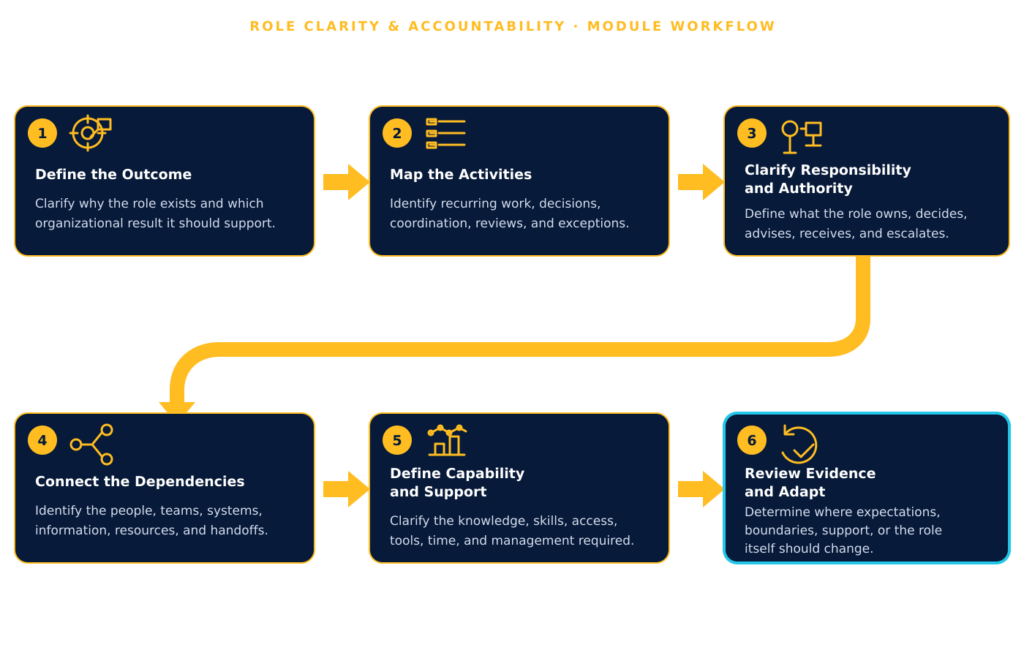
STEP 1
Define the outcome
Clarify why the role exists and what organizational, customer, team, or operational result it should support.
STEP 2
Map the activities
Identify recurring work, project contributions, decisions, coordination, reviews, and exceptions.
STEP 3
Clarify responsibility and authority
Distinguish what the role owns, contributes to, approves, advises, receives, communicates, and escalates.
STEP 4
Connect dependencies
Identify the people, teams, systems, information, resources, and handoffs required for the role to function.
STEP 5
Define capability and support
Clarify the technical, human, domain, managerial, system, access, and operating requirements surrounding the work.
STEP 6
Review evidence and adapt
Use available evidence and employee participation to determine where expectations, boundaries, support, or the role itself should change.
TalentSync can make the relationship between roles, work, people, teams, and organizational outcomes more visible. Employees, managers, HR, organizational leaders, and appropriate specialists remain responsible for interpretation, communication, participation, and decisions.
- Connect roles to outcomes
- Map activities and decisions
- Make ownership boundaries visible
- Trace dependencies and support
- Organize evidence of contribution
- Review and adapt as work changes
FROM POSITION DESCRIPTION TO OPERATING ROLE
Let role understanding evolve with the work.
Static job descriptions often fall out of date because the work changes faster than the document-review process.
A structured role profile can help the organization maintain a more current view of outcomes, activities, responsibilities, decisions, required capabilities, systems and tools, dependencies, working relationships, evidence needs, and unresolved questions.
Employees and managers can contribute practical information about how work is actually performed, where expectations conflict, which dependencies matter, and what support is missing.
This does not eliminate the need for formal job descriptions, employment documentation, compensation review, classification decisions, or qualified professional judgment. It provides better organizational context for those processes.
PRODUCT AND DECISION BOUNDARIES
Structured role information supports organizational judgment. It does not replace it.
TalentSync, TalentPass, Pythia, and workshop outputs should not be presented as:
- Automatically assigning work or responsibilities
- Determining whether someone is performing adequately
- Selecting the correct organizational structure
- Making promotion or compensation decisions
- Determining employee classification
- Resolving legal or labor obligations
- Predicting who will succeed in a role
- Providing the sole basis for an employment decision
- Guaranteeing organizational performance
The workflow helps people define work, organize relevant evidence, identify ambiguity, and support more transparent human review.
Employment, labor, compensation, classification, accessibility, privacy, collective-bargaining, cybersecurity, and other questions may require review by qualified specialists.
What to bring into the conversation
You do not need perfect job descriptions or a complete organizational architecture.
We begin with the role documents, operating information, and employee observations the organization already has.
Useful inputs may include:
- Current organizational charts
- Job descriptions
- Role or position profiles
- Team charters
- Workflow and process documentation
- Decision-rights or approval matrices
- Standard operating procedures
- Performance expectations
- Project plans and responsibility assignments
- Meeting and communication structures
- Escalation procedures
- System permissions and approval workflows
- Known ownership gaps
- Examples of duplicated work
- Employee and manager observations
- Recent reorganizations or hiring plans
- Customer or stakeholder complaints
- Evidence of recurring delays, conflicts, or rework
The Growth Direction module establishes the consequential outcome and organizational boundary this module should examine.
What this module can help clarify
Who owns which outcomes
Connect important organizational results to roles with explicit responsibility.
Where responsibilities overlap or disappear
Identify duplicated activities, competing ownership, unassigned work, and ambiguous boundaries.
Whether authority supports accountability
Reveal where people lack the decisions, access, resources, information, or support required to deliver.
How roles should respond
Determine where to clarify, assign, separate, share, delegate, redesign, or investigate.
Final outputs depend on the modules selected and the organizational decision established through the workshop’s required Growth Direction foundation.
Where might the work lead next?
Questions leaders ask before booking.
Role clarity is the shared understanding of what a person or group is responsible for, which outcomes they influence, what decisions they can make, how their work connects with others, and how contribution will be understood.
Role ambiguity often develops when work accumulates informally, new employees are added quickly, founders retain responsibilities, teams evolve independently, and job descriptions no longer reflect actual operations.
No. Role clarity also addresses outcomes, decision rights, dependencies, handoffs, escalation, required support, and evidence.
Many complex outcomes require several contributors, and some responsibilities are legitimately shared. The organization should still clarify contributions, decisions, handoffs, and complete-outcome accountability.
Responsibility describes work or an obligation assigned to a person or group. Accountability identifies who must answer for whether a defined outcome, output, decision, or obligation is appropriately completed.
Role design should distinguish decisions the person can make independently from those requiring consultation, approval, notification, or escalation.
Map the outcomes, activities, decisions, approvals, relationships, and dependencies associated with each role, then determine whether overlap supports collaboration or creates duplicated effort and conflicting ownership.
Yes. A flexible role can still have a clear purpose, expected outcomes, decision boundaries, relationships, and escalation path.
Roles should be revisited when work, strategy, leadership, systems, organizational structure, customer needs, regulation, or operating conditions change materially.
No. TalentSync can structure outcomes, activities, capabilities, relationships, dependencies, and available evidence. People remain responsible for deciding how work and authority should be assigned.
The module examines roles as part of the organization’s operating system and may reveal questions requiring organizational development, HR, employment, labor, compensation, classification, accessibility, legal, or other specialist review.
Every engagement begins with Growth Direction. Role Clarity & Accountability can then be selected when growth has created overlapping responsibilities, unclear ownership, unsupported accountability, or ambiguous decision authority.
MAKE OWNERSHIP VISIBLE
Turn informal responsibilities into clear organizational accountability.
Connect roles to outcomes, activities, decisions, capabilities, dependencies, support, and evidence—then clarify who owns what as the organization grows.
This module is part of Gobekli’s configurable Organizational Growth & Expansion Workshop. Explore the complete 12-module structure and identify the right starting point for your organization.
