
AN AI TRANSFORMATION WORKSHOP MODULE
Set the AI Direction:
Start With the Outcome That Matters
Organizations often begin AI transformation with a growing list of technologies, opportunities, projects, and concerns. The conversation expands before anyone has clearly connected AI to the organizational outcome and work that matter most.
Set the AI Direction creates the minimum shared foundation required for focused work: the outcome, workflow, AI-enabled change, available evidence, and question the workshop must help answer.
Does this sound familiar?
The AI conversation is too broad
Leaders want an AI strategy, but the discussion spans every department, technology, opportunity, risk, and possible future at once.
Different teams define success differently
Technology, operations, finance, risk, and functional leaders enter the conversation with different expectations about what AI should accomplish.
The technology appears before the work is understood
A tool, model, agent, or vendor becomes the focus before the organization has defined the workflow or outcome it should improve.
Evidence is scattered across the organization
Useful information exists in project updates, employee observations, system data, financial records, and customer feedback, but it has not been connected.
The scope keeps expanding
Every discussion reveals another stakeholder, workflow, risk, dependency, or use case until the original purpose becomes difficult to recognize.
Workshops produce ideas without direction
Participants leave with observations, opportunities, and action items but no shared focus for what the organization should examine next.
What does it mean to set the AI direction?
Setting the AI direction means connecting an important organizational outcome to the work that produces it and defining what the AI transformation effort needs to examine.
It begins with the outcome. Participants then identify the relevant workflow, people, systems, information, and operating conditions. They clarify the role AI currently plays—or is expected to play—and organize the evidence already available.
From that foundation, the organization can state the question the workshop must help answer and select the modules needed to investigate it.
The result is an AI Direction Foundation.
It does not attempt to create the organization’s complete AI strategy or determine every future action. It establishes enough shared direction for the deeper work to remain focused, connected, and useful.
Every Gobekli AI Transformation Workshop begins here.
The starting point is not the technology.
It is the organizational outcome.
Organizations often begin by asking:
- Where could we use AI?
- Which tools should we purchase?
- What are our competitors doing?
- How should we govern AI?
- Which projects should receive funding?
- How do we prove ROI?
- How do we move pilots into production?
These may all be legitimate questions. But without an outcome and workflow boundary, each can expand into an enterprise-wide assessment that cannot be completed responsibly in one workshop.
A useful starting point connects:
- The organizational outcome that matters
- The workflow where that outcome is produced
- The people who perform or experience the work
- The role AI currently plays or is expected to play
- The evidence currently available
- The assumptions that remain untested
- The constraints and dependencies shaping the work
- The question the workshop must help answer
- The modules required to investigate that question
- The issues that remain outside the engagement
The AI Direction Foundation turns a broad transformation concern into a focused area of organizational work.
How AI transformation loses direction
A broad ambition starts the conversation
The organization wants to use AI, improve productivity, accelerate transformation, or respond to competitive pressure.
Technologies and use cases multiply
Participants introduce tools, pilots, models, vendors, opportunities, risks, and examples from across the organization.
Scope and evidence fragment
The discussion expands across workflows, stakeholders, data, systems, assumptions, and organizational priorities.
No shared direction emerges
The organization generates ideas and concerns but cannot determine which outcome, workflow, evidence, or question should guide the work.
Why a list of AI opportunities is not enough
A use-case list can help an organization recognize where AI might be relevant. It may surface valuable opportunities that formal planning would otherwise miss.
But an opportunity is not yet a direction.
A useful AI Direction Foundation must answer several more questions.
What consequential organizational result is the transformation intended to influence, and why does that result deserve attention now?
Which workflow, activities, roles, systems, information, decisions, handoffs, and operating conditions contribute to the result?
What activity, capability, experience, or operating condition would become different if the AI-enabled approach worked?
Which employees, leaders, customers, partners, specialists, or other stakeholders perform the work, experience the outcome, or bear the consequences?
What does the organization currently know about performance, cost, effort, quality, adoption, risk, and experience?
What question connects the concern to a practical organizational response, and which modules are required to investigate it?
Without these connections, a use-case list may create more possibilities without helping the organization determine where to focus.
What leaders need to see clearly
The outcome that matters
Define the consequential organizational result that should guide the transformation work.
The work connected to it
Identify the workflow, people, information, systems, decisions, and operating conditions that produce the outcome.
What is known and assumed
Separate available evidence from expectations, inherited beliefs, vendor claims, and unanswered questions.
What the workshop must answer
Establish the focused question and select the modules needed to investigate it.
Setting direction does not require pretending the organization already knows the answer.
Early AI conversations often contain significant uncertainty. The organization may lack complete evidence, reliable measures, technical details, stakeholder input, or specialist determinations.
The purpose of the foundation is not to eliminate uncertainty before the workshop begins. It is to make that uncertainty visible and establish where the deeper work should focus.
A useful AI Direction Foundation
The foundation should:
- Establish a meaningful outcome
- Define a workable scope
- Connect AI to an actual workflow
- Identify affected people and stakeholders
- Separate evidence from assumptions
- Surface important unknowns
- Establish the question to investigate
- Select the relevant workshop modules
- Define what remains outside scope
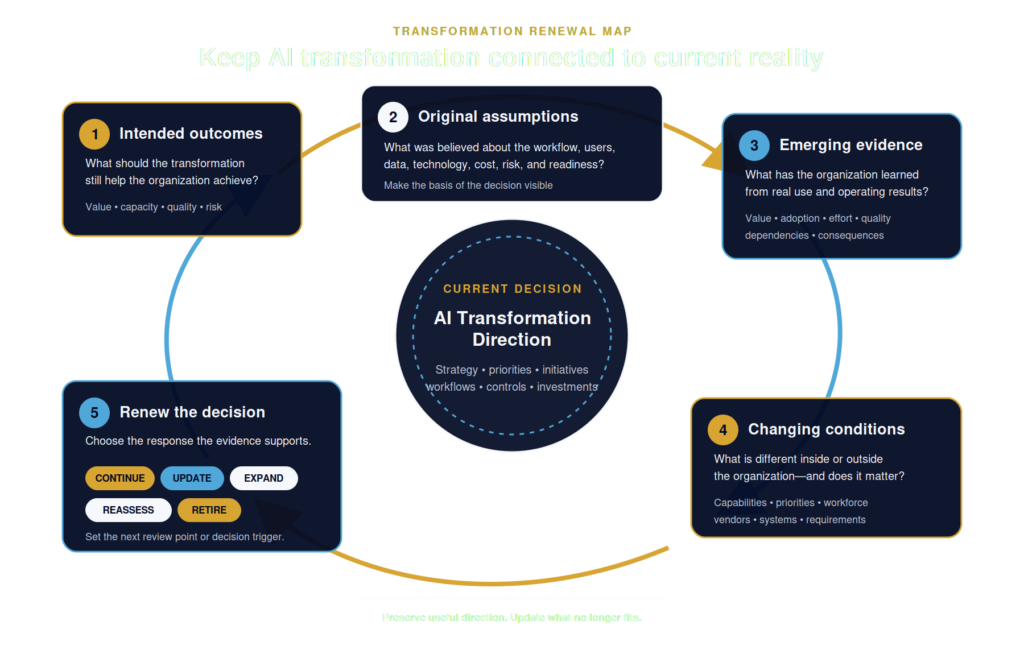
The organization preserves strategic direction while updating the parts of the transformation that evidence shows should change.
False precision
The organization should avoid:
- Inventing measures that do not exist
- Treating assumptions as established facts
- Selecting a tool before understanding the work
- Ranking opportunities without comparable evidence
- Claiming agreement where important differences remain
- Expanding the workshop to cover the entire enterprise
- Making specialist determinations without qualified review
- Promising a solution before diagnosing the problem
Premature certainty can produce a clear-looking plan built on an unstable foundation.
The goal is not to know the answer at the beginning.
It is to know what the organization needs to understand.
WORKSHOP MODULE DETAILS
How to Keep Set the AI Direction
Every AI Transformation Workshop begins with this required foundation.
Participants identify the consequential outcome, affected workflow, AI-enabled change, available evidence, important assumptions, and question the engagement must explore. Those choices determine which additional workshop modules are appropriate.
This prevents the engagement from becoming an unfocused review of every AI initiative, tool, risk, or opportunity across the organization.
- Define the outcome the work should influence
- Establish the relevant workflow boundary
- Identify affected people and stakeholders
- Clarify the AI-enabled change under consideration
- Gather and organize available evidence
- Separate facts, assumptions, and missing information
- State the question the workshop must help answer
- Select the modules needed to investigate that question
- Define what remains outside the engagement
What must be established before the deeper work begins?
The AI Direction Foundation gives every selected module a common organizational context.
It ensures that governance, value, workflow, technology, adoption, and other questions are examined in relation to the same outcome and area of work.
Outcome
What consequential organizational result should guide the work? The outcome establishes why the engagement matters and prevents the conversation from being organized around AI activity alone.
Workflow
Where is the outcome produced? The workflow identifies the activities, people, handoffs, systems, information, decisions, and operating conditions that should be examined.
AI-Enabled Change
What is expected to become different? The organization clarifies what AI currently does or is expected to do—and how that changes the work.
Evidence
What is known, assumed, and missing? Available records, measures, observations, and stakeholder experiences are organized without presenting incomplete information as certainty.
Direction Question
What must the workshop help the organization understand? The question establishes the focus of the deeper work, the modules required, the evidence needed, and the boundaries of the engagement.
The AI Direction Foundation does not determine the final organizational response or replace technical, legal, financial, cybersecurity, privacy, compliance, or other professional review. It establishes the organizational context and question those activities may need to support.
What should the AI Direction Foundation examine?
The intended outcome
What improvement, consequence, or organizational result makes this work important?
The current workflow
How does the work function today, and where do people, information, systems, decisions, exceptions, and handoffs contribute to the result?
The AI-enabled change
What role is AI playing or expected to play, what would become different, and who would be affected?
The available evidence
What is known about outcomes, performance, effort, quality, adoption, experience, dependencies, and risk—and what remains assumed or missing?
What to bring into the conversation
You do not need a complete AI strategy, perfect workflow documentation, or definitive evidence before beginning.
The workshop starts with the artifacts and observations your organization already has. The AI Direction Foundation helps distinguish what is known from what is assumed, missing, disputed, or outside the engagement.
Useful inputs may include:
- Current organizational priorities
- The AI opportunity, concern, or problem that prompted the workshop
- Available strategy documents or roadmaps
- Relevant workflow or process information
- Known AI tools, pilots, models, agents, or embedded features
- Available measures of outcomes, cost, quality, effort, or adoption
- Employee, manager, customer, or stakeholder observations
- Known data, technology, vendor, or integration dependencies
- Existing ownership, governance, or approval information
- Known risks, constraints, and unresolved questions
- Relevant specialist guidance already obtained
- Important timing, budget, or capacity considerations
Incomplete evidence is expected. Identifying what remains unknown is part of establishing the direction.
What this module can help clarify
What outcome should guide the work
Establish the consequential organizational result that gives the engagement its purpose.
Where the work begins and ends
Define the workflow, stakeholders, AI-enabled change, and boundaries the selected modules should examine.
What evidence is available or missing
Separate established information from assumptions, uncertainty, and questions requiring further investigation.
What the workshop should explore
State the direction question and select the modules needed to investigate it.
The AI Direction Foundation is required for every engagement. Final outputs depend on the direction established, available evidence, modules selected, and questions requiring qualified specialist review.
Where might the work lead next?
The AI Direction Foundation does not assume which transformation problem the organization has. It identifies the modules most relevant to the outcome, workflow, and question.
AI Boomerang Recovery
Select when AI was expected to remove work but review, correction, coordination, exceptions, or recovery effort returned elsewhere in the workflow.
AI Initiative Overload
Select when competing projects depend on the same people, systems, data, funding, or organizational capacity and require a credible sequence.
AI Governance & Accountability
Select when ownership, decision rights, boundaries, controls, documentation, escalation, or specialist review are unclear.
Questions leaders ask before booking.
No. Set the AI Direction is the required foundation for every AI Transformation Workshop engagement.
The remaining modules are selected according to the outcome, workflow, AI-enabled change, evidence, and direction question established through this foundation.
No. The AI Direction Foundation does not attempt to create a complete enterprise AI strategy in one session.
It establishes a focused area of organizational work and the question the selected modules must investigate. The result may inform a broader strategy, but it does not replace comprehensive strategic, technical, financial, governance, or specialist work.
The same apparent problem can involve very different outcomes, workflows, stakeholders, evidence, and consequences.
For example, an organization concerned about AI governance may need to examine an employee-facing drafting workflow, an automated customer decision, an internal analytics model, or an enterprise portfolio. Each situation requires a different boundary and different evidence.
The AI Direction Foundation ensures that the selected module examines the right area of work.
A direction question states what the workshop must help the organization understand about a defined outcome, workflow, and AI-enabled change.
Examples include:
- Why is AI-assisted work creating more effort downstream?
- What must change before this pilot can enter operations?
- Which competing initiatives should receive capacity first?
- Where should people retain judgment or control?
- Does the available evidence support continued investment?
- Which tools should be kept, integrated, consolidated, retired, or investigated?
The selected modules help participants examine the evidence and tradeoffs needed to develop a responsible response.
No. Organizations rarely begin with complete evidence.
The foundation identifies what information is available, what remains assumed, what is missing, and what may require additional investigation. Missing evidence may influence which questions the workshop can answer and what should happen next.
Yes. New evidence may reveal that the original outcome, workflow boundary, stakeholder group, AI-enabled change, or question needs refinement.
Changes should be made explicitly so participants remain aligned around the same focus. If the scope expands materially, the organization may need another module, additional evidence, or a separate engagement.
No. The workshop structures evidence, assumptions, relationships, tradeoffs, and response options to support organizational decision-making.
Authority remains with the organization. Questions requiring legal, financial, cybersecurity, privacy, compliance, labor, accessibility, procurement, technical, or other professional judgment should be referred to qualified specialists.
Depending on the engagement, the foundation may document:
- The intended outcome
- The affected workflow
- The AI-enabled change
- The people and stakeholders involved
- Known evidence and important assumptions
- Constraints and dependencies
- Missing information
- Specialist questions
- The direction question
- Selected workshop modules
- The engagement boundary
- The next evidence or action step
Set the AI Direction opens the engagement.
The organization then uses the selected problem modules to examine the workflow, evidence, dependencies, people, risks, value, and response options connected to the direction question.
Keeping AI Transformation Current can later help revisit the organization’s direction as evidence and operating conditions change.
Give your AI transformation a clear organizational focus.
Define the outcome, understand the work, organize the evidence, and establish what the workshop needs to explore before choosing what to change.
Set the AI Direction is the required foundation for Gobekli’s configurable AI Transformation Workshop. Explore the complete workshop and its 12 problem-based modules.
