
AN AI TRANSFORMATION WORKSHOP MODULE
How to Find Shadow AI and Invisible Work
Employees are already using AI to solve real problems—often beyond approved tools, documented workflows, and leadership visibility.
The risk is not simply that unofficial AI use exists. It is that the organization cannot see how the work, information, and decisions surrounding it are changing.
Does this sound familiar?
Employees use unapproved AI tools
People rely on personal accounts, public applications, or unsanctioned AI features to complete work.
Work happens outside official systems
Prompts, outputs, and new processes live outside the tools and workflows leadership can see.
Policies do not match actual practice
The organization’s rules describe how AI should be used, but not how employees are already using it.
Managers cannot see where AI is used
Leaders know AI adoption is happening but cannot identify which workflows, decisions, or teams it affects.
Sensitive context moves into new tools
Organizational, customer, employee, or proprietary information may enter systems that have not been evaluated.
Useful employee innovations stay hidden
Promising practices remain isolated because employees have no safe way to share or formalize them.
What is Shadow AI?
Shadow AI is the use of artificial-intelligence tools, assistants, models, or AI-enabled features outside an organization’s approved systems or established oversight.
It can include entering work into a public generative AI tool, using an unapproved application to analyze information, creating a personal library of prompts, connecting an AI assistant to organizational data, or relying on AI features embedded inside everyday software.
Not every instance begins with reckless behavior. Employees often adopt these tools because they are trying to solve real work problems, overcome limitations in official systems, meet rising expectations, or complete tasks more efficiently.
That makes Shadow AI both a potential source of risk and a valuable signal about unmet organizational needs.
Shadow AI is not only a compliance problem.
Shadow AI is also a visibility problem.
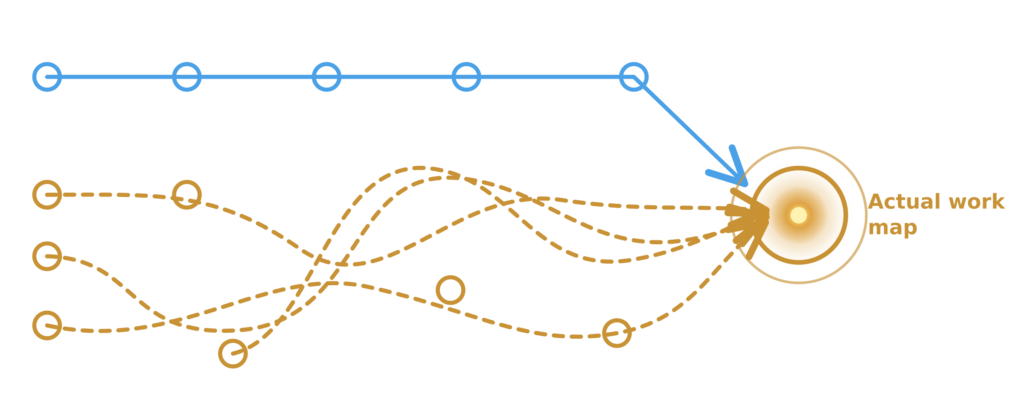
Organizations often approach unofficial AI use primarily through security policies, approved-tool lists, and restrictions. Those controls may be necessary, but they do not explain why the practice emerged or what work it is helping employees accomplish.
When official systems do not meet the realities of the job, people create their own tools, prompts, shortcuts, and informal handoffs. Simply blocking those practices can drive them further from view while leaving the underlying work need unresolved.
Leaders need to understand both sides of the problem: where unofficial AI use creates unacceptable exposure and where employees have discovered a better way of performing work that the organization has not yet recognized.
How invisible AI takes hold
Optional path for organizations that want ongoing visibility and alignment
A real work need appears
A team encounters a challenge, constraint, or opportunity that requires a faster or different way of working.
Official tools fall short
Existing systems do not fully support the task, take too long to change, or make the desired approach difficult.
People create workarounds
Employees adopt their own tools, prompts, shortcuts, and handoffs to get the work done.
AI-enabled work becomes invisible
The new practice continues outside official systems, spreading quietly without shared visibility, evidence, or governance.
Why employees turn to unapproved AI tools
Employees are often responding resourcefully to the conditions surrounding their work. Shadow AI may emerge when the organization encourages AI adoption or increased productivity without giving teams tools that fit their actual needs.
- Approved AI tools do not support the specific task.
- Procurement and implementation cannot keep pace with changing work.
- Policies are unclear, inconsistent, or difficult to apply.
- Teams face pressure to increase output without additional capacity.
- AI features are already embedded in everyday software.
- Employees lack a safe way to test or propose new approaches.
These conditions matter because a software inventory can only show which systems the organization has purchased or approved. It cannot fully reveal how people combine tools, information, prompts, judgment, and informal processes to accomplish the work.
Understanding why Shadow AI exists is essential to choosing an effective response.
What leaders need to see clearly
Actual work
How work really happens from beginning to end—not only how the official process says it should happen.(Required foundation)
AI tools in use
The applications, embedded features, personal accounts, prompts, and platforms people rely on.
Why people bypass systems
The needs, constraints, friction, and gaps that make unofficial approaches useful or necessary.
Where risk and value concentrate
The workflows and decisions where Shadow AI creates the most consequential opportunities or exposure.
Shadow AI creates both risk and information
Unmanaged exposure
Shadow AI may involve:
- Confidential or proprietary information
- Customer, learner, patient, or employee data
- Inaccurate or insufficiently reviewed outputs
- Unclear intellectual-property ownership
- Records retention and discoverability concerns
- Bias, inconsistent decisions, or inappropriate automation
- Undocumented dependencies on personal tools or accounts
The presence of an unapproved tool does not reveal the seriousness of the exposure by itself. Leaders must also understand the information involved, the output being produced, the decision it influences, the human review applied, and the consequences of error.
Hidden organizational value
Unofficial AI practices may reveal:
- Faster methods for completing repetitive work
- Better ways to retrieve or apply organizational knowledge
- Unmet needs for summarization, translation, drafting, or analysis
- Workflows that should be redesigned
- Employee-created practices that could benefit other teams
- Promising use cases that formal planning failed to identify
Shadow AI can therefore function as an early signal of emerging capability. The organization needs a way to distinguish useful innovation from unmanaged risk without treating every employee-created practice as equally dangerous.
The goal is to determine what should be supported,
integrated, governed, redesigned, stopped, or investigated further.
WORKSHOP MODULE DETAILS
How To Map Actual Work, & Invisible AI.
This module helps participants move beyond the organization’s official process maps and approved technology inventory.
Together, we examine how work is actually completed, where AI has entered the workflow, what needs employees are trying to meet, and which practices remain invisible to leadership.
The goal is not to expose or punish individual employees. It is to build a sufficiently accurate organizational view to distinguish useful innovation from unmanaged risk and choose an appropriate response.
- Map the actual workflow alongside the official process
- Surface known and suspected unofficial AI use
- Identify the needs and constraints producing workarounds
- Examine the information, outputs, and decisions involved
- Determine where additional evidence or specialist review is required
- Distinguish practices to support, integrate, govern, redesign, or stop
Shadow AI Response Map
Support
Useful, comparatively low-risk employee innovation that can continue with appropriate visibility.
Integrate
Valuable practices that should be brought into official tools, workflows, training, or organizational support.
Govern
Practices that may continue but require clearer ownership, boundaries, review, controls, or documentation.
Stop or investigate
Practices presenting unacceptable exposure, unresolved concerns, or consequences that require specialist review.
What should a Shadow AI Review Examine?
The work need
What problem is the employee trying to solve? What makes the existing process, system, or approved tool insufficient?
The information involved
What organizational, customer, employee, or proprietary context enters the tool? Where is that information stored or transferred?
The resulting output
What does the AI produce? How is that output checked, modified, shared, stored, or used in a decision?
The operating response
Should the practice be supported, integrated, governed, redesigned, stopped, or referred for additional review?
What to bring into the conversation
You do not need a complete inventory of every AI tool or perfect documentation of every workflow.
We begin with what leaders and employees can already observe. The workshop then helps distinguish what is known, what is reported, what is assumed, and what still needs to be investigated.
Useful inputs may include:
- Current AI policies and approved-tool lists
- Examples of known AI-assisted work
- Existing workflow or process documentation
- Known workarounds or recurring operational friction
- Questions raised by legal, security, privacy, HR, or technology teams
- Workflows where unofficial AI use is known or suspected
- Employee or manager observations about how the work is changing
The pre-work is designed to create a useful starting point—not to conduct a forensic audit or produce a complete surveillance inventory.
Where Shadow AI is occurring
Identify the teams, workflows, activities, or decisions where unofficial AI use is known or reasonably suspected.
Why people are using it
Understand the needs, goals, limitations, and workplace conditions producing unofficial approaches.
What creates value or risk
Separate promising employee innovation from practices that create exposure, uncertainty, or weak accountability.
What requires a governed response
Clarify which practices may need support, integration, redesigned workflows, organizational controls, or specialist review.
Where might the work lead next?
Hidden Human–AI Handoffs
Find where AI has moved checking, correction, coordination, and exception handling to people.
AI Tool & System Sprawl
Map the growing mix of tools, platforms, data, integrations, duplication, and dependencies.
AI Governance & Accountability
Clarify ownership, decision rights, controls, escalation paths, and boundaries requiring specialist review.
Questions leaders ask before booking.
Shadow AI generally refers to AI tools, models, assistants, agents, or AI-enabled features used outside an organization’s approved systems or established oversight.
It may involve a clearly unapproved public tool, but it can also appear inside software the organization already uses. For example, an employee may activate an embedded AI feature, connect an assistant to organizational information, or develop an unofficial AI-enabled workflow without leadership realizing how the work has changed.
The important question is not only whether a tool has been approved. Leaders also need to understand what information enters it, what it produces, which decisions it affects, and how the resulting work is reviewed.
Employees often use unofficial AI tools because they are trying to solve a legitimate work problem. Approved tools may not support the task, implementation may move too slowly, policies may be difficult to apply, or teams may be expected to increase productivity without additional capacity.
This does not eliminate the potential risk. It does mean that a response focused only on employee compliance may fail to address the organizational condition that caused the practice to emerge.
No—but unofficial use should not automatically be assumed safe either.
The level and type of concern depend on factors such as the information involved, the tool’s terms and data practices, the output being produced, the consequences of error, the human review applied, and the decision being influenced.
Some practices may represent useful, comparatively low-risk innovation. Others may create serious security, privacy, legal, quality, or operational exposure. The organization needs sufficient evidence to distinguish between them.
Begin with the work rather than an accusation.
Ask employees and managers where existing tools fall short, which tasks consume unnecessary time, how people are adapting, and what would make it safer to share new approaches. Make it clear that the purpose is to understand changing work and establish appropriate support—not to rank individual performance or punish people for identifying operational gaps.
Trust matters because employees are less likely to disclose unofficial practices if they believe the discovery process is primarily disciplinary or surveillant.
No. Technical discovery tools may reveal applications, network activity, browser use, or other system signals, but they cannot fully explain the work need, the employee’s process, the information involved, or how an AI-generated output influences a decision.
A meaningful Shadow AI review combines appropriate technical evidence with workflow mapping, employee and manager observations, organizational policies, and an understanding of how the work is actually performed.
No. The module examines actual work, organizational conditions, available evidence, responsibilities, and decision boundaries.
It can help identify issues that should be referred to cybersecurity, privacy, legal, compliance, labor, or other qualified specialists. It does not replace those specialists or provide their professional determinations.
No. The workshop examines workflows, tools, operating conditions, evidence, and organizational dependencies—not individual employee performance.
Its purpose is to help the organization understand where AI-enabled work is occurring, why it emerged, and what response the organization should consider.
Every engagement begins with the required Decision Foundation, which establishes the consequential outcome, affected workflow, available evidence, and bounded decision the workshop must support.
Actual Work & Invisible AI can then be selected when the organization needs to understand how AI is already entering work outside its official view. Depending on what the module reveals, it may be combined with modules addressing human–AI handoffs, tool sprawl, adoption, governance, value, or another connected problem.