
LER & TRUSTED WORKFORCE INFRASTRUCTURE WORKSHOP MODULE
Shared Definitions & Semantic Interoperability
Clarify what exchanged information means—so partners can interpret terms, fields, relationships, and status values without losing context or assuming more than the source establishes.
Does this sound familiar?
The same word means different things
Partners use terms such as “completed,” “qualified,” or “active” while referring to different conditions, evidence, or points in a process.
Different labels hide related information
Organizations describe similar information using different names, making useful connections difficult to recognize or review.
A field arrives without its context
A date, score, level, or duration reaches the receiving system without the definition, unit, reference, or conditions needed to interpret it.
The relationship changes during exchange
A record showing that someone attended a course is represented as though it establishes a capability, qualification, or authorization.
Missing information becomes a negative answer
An empty field, unknown status, or unavailable result is treated as “no,” “not completed,” or another conclusion the source did not make.
Mappings lose their basis over time
A field or definition changes, but partners continue using an earlier mapping without knowing which interpretation it reflects.
What are shared definitions and semantic interoperability?
Shared definitions establish what selected terms, fields, relationships, and values mean within an exchange.
Semantic interoperability concerns whether receiving organizations can interpret that information appropriately when it moves between systems or contexts.
Matching field names is only part of the work. Partners also need to understand the underlying concept, the conditions it describes, and any limits on its interpretation.
Different organizations can retain their own terminology while documenting how selected meanings relate. Some relationships may be equivalent for a defined purpose; others may be partial, conditional, or unsuitable for mapping.
This module examines those distinctions around the information needed for a selected exchange and receiving decision.
A successful transfer does not settle what the information means.
A record can arrive in the expected field and format.
The receiving organization may still interpret it differently from the organization that supplied it.
“Completed” might describe finishing an activity, satisfying a program requirement, or reaching a particular administrative stage.
A date might refer to attendance, assessment, issuance, or the last update.
The workshop makes those distinctions visible before partners rely on the exchanged information.
That gives the group a clearer basis for deciding what can be mapped, what context must accompany it, and what requires further explanation.
Where meaning can become unclear
Terms and concepts
The concept being described
Local labels
Working definitions
Examples and exclusions
Intended use
Fields and values
Field purpose
Permitted values
Units or scales
Missing or unknown information
Source-specific conditions
Relationships
Person and activity
Activity and outcome
Evidence and claim
Organization and role
Limits on inference
Statuses and timing
Status definition
Conditions for entry
Effective date
Transition or expiry
Historical meaning
Mappings and maintenance
Source definition
Receiving interpretation
Equivalence or difference
Mapping limitations
Version and review responsibility
The review focuses on the meanings that affect the selected exchange. It does not require every participating organization to adopt one vocabulary.
How this module helps
Make definitions explicit
Identify what selected terms and values establish, with examples that reveal differences between partners.
Review proposed mappings
Examine whether source and receiving concepts are equivalent, partially related, or unsuitable for direct translation.
Preserve necessary context
Identify the units, dates, relationships, references, and limitations recipients need to interpret the information.
Assign meaning and mapping responsibilities
Clarify who confirms definitions, approves proposed mappings, and reviews them when a source or receiving requirement changes.
The field can look right while the interpretation is wrong.
A provider may send a record labeled “completed.”
A receiving organization may place it in a field intended to indicate readiness for a particular role.
The workshop examines whether the source information supports that receiving interpretation.
Example: “Both systems say ‘complete,’ but they are describing different things.”
A training provider uses “complete” when a participant has finished the required learning activities.
An employer’s preparation checklist uses “complete” when all entry requirements for a role have been reviewed.
Mapping one status directly to the other would conceal the additional requirements in the employer’s process.
Partners distinguish the two meanings, identify the relevant relationship, and define how the provider’s record can inform the checklist without determining its final status.
Questions to review together
What concept does the source term or field describe, and what does the receiving organization need to understand?
How does each partner define the concept, and which examples reveal an important difference?
What do permitted values, units, dates, empty fields, and status conditions establish?
What relationship does the record express, and which conclusions would go beyond it?
Where is a direct mapping appropriate, where is it conditional, and where should the distinction remain visible?
Who confirms the interpretation, which version applies, and what changes should trigger another review?
What needs to connect?
The source concept
The fact, condition, relationship, or account the originating field is intended to describe.
The local definition
The source organization’s explanation, examples, exclusions, and relevant conditions.
The receiving question
What the recipient needs to understand within its own workflow.
The mapping relationship
How the source concept relates to the receiving concept, including partial or conditional relationships.
The necessary context
The units, dates, status conditions, references, and limitations required for interpretation.
The review responsibility
Who confirms the meaning, maintains the mapping, and responds when definitions change.
When labels substitute for meaning
Partners may rely on familiar words without examining what they establish.
- Matching names are treated as matching concepts.
- Different terms are assumed to be unrelated.
- Attendance is represented as demonstrated capability.
- Units, scales, or reference points disappear.
- Unknown information becomes a negative result.
- Old mappings remain in use after definitions change.
The exchange can produce a confident interpretation that the originating record does not support.
When meanings and mappings are explicit
Partners can understand the relationship between the information supplied and the question being asked.
- Definitions include examples and exclusions.
- Similarities and differences remain visible.
- Relationships preserve the source’s actual claim.
- Relevant units and reference points accompany values.
- Missing and unknown information retain their meaning.
- Mappings have owners, versions, and review triggers.
Recipients have a clearer basis for using the information and recognizing when further interpretation is required.
A practical example
A workforce partnership wants providers to supply preparation records to a shared portal.
The portal includes a field labeled “program status.”
One provider uses “completed” when all required activities have been finished.
Another uses “completed” only after a final review has confirmed that all award requirements are satisfied.
The workshop selects the receiving question: what has the participant finished, and what remains to be reviewed?
Partners examine each definition using examples of records that would and would not receive that status.
They identify the differences between activity completion, reviewed requirements, and the separate act of issuing a credential.
The proposed mapping retains those distinctions instead of combining them into one unexplained value.
Partners assign responsibility for confirming the definitions and reviewing the mapping when a provider changes its process.
The resulting brief specifies the meanings, contextual fields, unresolved questions, and test examples a subsequent exchange needs to preserve.
Shared understanding does not require identical local terminology.
Organizations may have legitimate reasons for using different terms.
Their programs, responsibilities, and decision processes may also differ.
The workshop examines whether those differences matter to the selected receiving use.
Where meanings align, partners can document that relationship.
Where they differ, the exchange may need a qualified mapping, additional context, or separate concepts.
The purpose is to make the relationship understandable without erasing distinctions that recipients need.
A mapping should not create a stronger claim.
A source may establish that someone participated in an activity.
That does not automatically establish completion, demonstrated capability, or authorization to perform particular work.
A receiving system may need those other concepts, but its requirements do not change what the source record supports.
The workshop identifies where a proposed mapping would introduce an unsupported conclusion.
Partners can then preserve the original relationship and identify any additional evidence or review needed.
Questions about the quality of that evidence or the meaning of a credential can receive deeper attention through the related modules.
WORKSHOP MODULE 4
Shared Definitions & Semantic Interoperability
This module is a focused minicourse and working session within the LER & Trusted Workforce Infrastructure Workshop.
Your team learns how to examine definitions, relationships, and proposed mappings, then applies that method to selected information moving between organizations.
The work produces a reviewed starting point for preserving meaning in the exchange and defining a supporting product configuration.
What this module can address
The selected scope may include:
The workshop selects the meanings that materially affect the defined exchange.
- Terms and concepts used by participating organizations.
- Definitions, examples, and important exclusions.
- Source and receiving field meanings.
- Permitted values and classification choices.
- Units, scales, levels, and reference points.
- Missing, unknown, unavailable, or inapplicable information.
- Relationships among people, activities, claims, and evidence.
- Status definitions and the conditions they represent.
- Dates, effective periods, and historical context.
- Equivalent, partial, conditional, or unmapped concepts.
- Mapping ownership, approval, and documentation.
- Definition changes, versions, and review triggers.
What kinds of responses might emerge?
The response depends on the differences uncovered in the selected example.
A shared definition note
Document the meaning of a selected concept, including examples, exclusions, and the conditions that matter.
A qualified mapping
Specify how a source concept relates to a receiving concept and where the relationship has limits.
Additional interpretation context
Identify the units, dates, reference points, or status conditions that need to accompany a value.
Preserved distinctions
Keep separate concepts or values where combining them would hide a meaningful difference.
A mapping review process
Assign responsibility for confirming, maintaining, and revisiting the interpretation when something changes.
A focused configuration brief
Describe the definitions, relationships, value handling, and review requirements a subsequent implementation would need.
Some responses may involve clearer documentation. Others may require changes to forms, source fields, transformations, or receiving workflows.
What we review together
The selected information
The terms, fields, relationships, and status values needed for the receiving use.
The source definitions
What originating organizations mean, including examples, exclusions, and relevant conditions.
The receiving interpretation
What recipients expect the information to establish and how it enters their workflow.
The proposed mappings
Equivalence, partial relationships, conditions, unsupported inferences, and concepts that should remain separate.
The contextual requirements
Units, scales, dates, references, missing-value meanings, and other information needed for interpretation.
The maintenance arrangements
Who confirms definitions, approves changes, and reviews mappings as the exchange evolves.
The working exercise
Trace one meaning from source to receiving use.
Choose a term, field, relationship, or status that matters to the selected exchange and could be interpreted differently across partners.
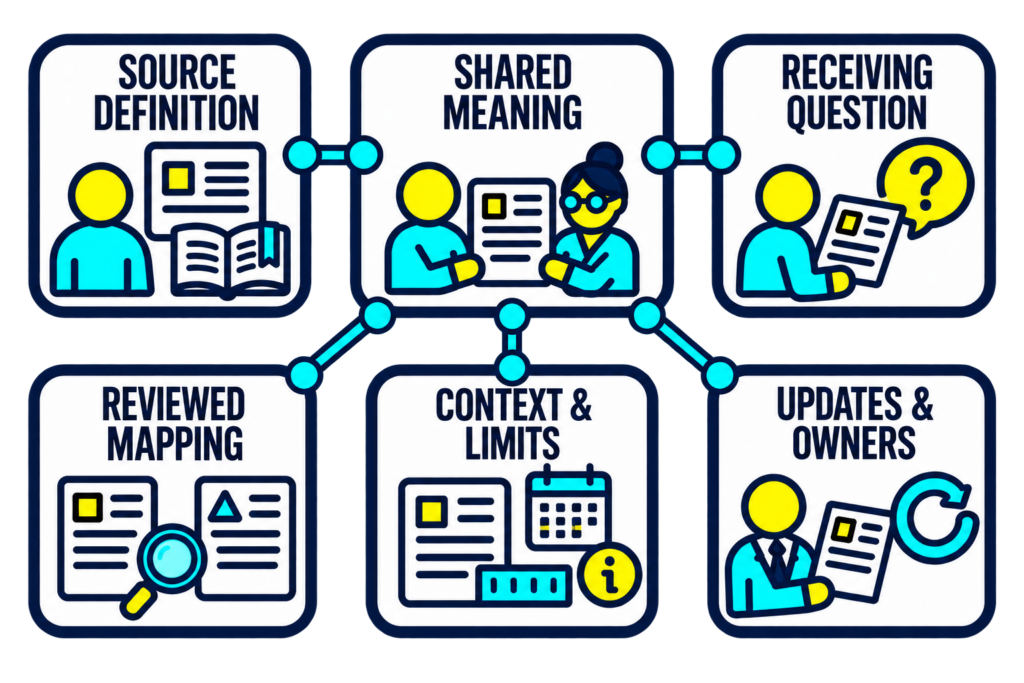
STEP 1
Define the receiving question
State what the recipient needs to understand and how the information would be used.
STEP 2
Gather the local meanings
Record each partner’s definition, examples, exclusions, and relevant conditions.
STEP 3
Compare the concepts
Identify what aligns, what differs, and which differences affect the receiving interpretation.
STEP 4
Test difficult cases
Consider an empty value, an earlier definition, a partial result, a different scale, or an example that fits one partner’s definition but not another’s.
STEP 5
Define the mapping and context
Specify the relationship, its limits, and the additional information or review required.
STEP 6
Assign maintenance and validation
Identify who confirms the interpretation, which examples will test it, and what should trigger another review.
The exercise produces a reviewed definitions and mapping brief for the selected example.
CONNECTING THE WORKSHOP TO A POSSIBLE GOBEKLI SETUP
Keep understandable meaning attached to exchanged information.
The workshop can help define how a subsequent Gobekli implementation would represent selected concepts and preserve interpretation context across TalentPass, TalentSync, Passport Pages, and participating systems.
Depending on confirmed scope and product availability, the configuration brief may describe:
- Selected source and receiving concepts.
- Local labels and working definitions.
- References to relevant vocabularies or frameworks.
- Relationships among records, activities, claims, and evidence.
- Permitted values and their conditions.
- Units, scales, dates, and interpretation context.
- Equivalent, partial, conditional, or unmapped relationships.
- Handling of missing and unknown information.
- Mapping owners, versions, and review requirements.
- Test examples and unresolved interpretation questions.
The workshop clarifies the meanings and behavior required before implementation is proposed.
Specific mapping functions, supported vocabularies, data representations, transformations, integrations, and review features must be confirmed separately against current product availability and partner requirements.
SCOPE AND BOUNDARIES
A focused review of meaning within the selected exchange.
The module begins with the use case defined through Workforce Infrastructure Direction.
It examines how selected information should be interpreted as it moves between participating organizations.
It does not automatically establish or deliver:
- A universal vocabulary for every partner.
- Equivalence between all similarly named fields.
- A complete ontology or enterprise data model.
- Verification of the truth of underlying claims.
- Recognition of one qualification as equivalent to another.
- Permission to access or exchange information.
- A complete standards-conformance assessment.
- Production mappings or live integrations.
Source and receiving representatives may need to confirm the proposed interpretations before implementation.
Questions about record quality, credential claims, identity, permissions, and technical integration connect to their respective modules when they affect the selected use case.
What should you bring?
A small set of fields and realistic examples is more useful than an entire data dictionary without context.
Use fictionalized or appropriately redacted records where practical.
Helpful starting materials
- A description of the selected exchange.
- The receiving question or workflow.
- Examples of the relevant records.
- Source field names and descriptions.
- Receiving field names and expectations.
- Existing glossaries or data dictionaries.
- Permitted values and status definitions.
- Units, scales, levels, or reference points.
- Existing mappings or transformation notes.
- Examples of ambiguous or conflicting interpretations.
- Relevant vocabulary or framework references.
- Definition owners and known change processes.
An incomplete definition is a useful starting point. Unclear meanings can become assigned confirmation tasks.
What can you leave with?
A selected definitions register
Working meanings, examples, exclusions, and responsible sources for the concepts within scope.
A reviewed mapping brief
The relationships between source and receiving concepts, including conditions, limitations, and distinctions to preserve.
An interpretation test set
Representative examples and difficult cases that help partners check whether the proposed mapping preserves meaning.
A configuration and maintenance outline
The context, value handling, responsibilities, versions, and review triggers a subsequent implementation would need.
These outputs begin with the example reviewed during the module. Final scope depends on the modules selected, available inputs, and the exchange established through Workforce Infrastructure Direction.
Where might the work lead next?
Record Quality, Evidence & Provenance
Examine whether the underlying records are complete, accurate, supported, and traceable once their intended meanings are clear.
Credential Issuance, Verification & Status
Examine the specific meanings and responsibilities associated with issuing, checking, updating, expiring, or revoking credentials.
Employer & Institutional Acceptance
Validate whether receiving organizations can interpret and use the selected information within real workflows.
These modules extend different parts of the work. Selection depends on the problem and decision established through Workforce Infrastructure Direction.
Frequently asked questions
Questions organizations ask before beginning.
It addresses differences in meaning that can remain hidden when information moves between organizations. The review focuses on selected terms, fields, relationships, values, and mappings that affect the receiving use.
The foundation establishes the exchange and receiving decision. Those choices determine which meanings need review and keep the exercise focused on information that matters to the use case.
It means that partners can interpret exchanged information appropriately, with the definitions and context needed to understand what it establishes. The workshop examines a selected example rather than attempting to resolve every semantic difference.
A technical connection moves information. This module examines whether recipients understand that information as intended. Both questions matter, but a working connection does not settle a difference in meaning.
No. Partners can retain local terminology while documenting how selected concepts relate. Important differences may need to remain visible rather than being collapsed into one label.
Yes. Forms, example records, instructions, and conversations with responsible staff can reveal working definitions. The module can identify where those definitions need confirmation or documentation.
Compare definitions and examples, then identify whether the difference affects the receiving use. The response may involve separate values, added context, a conditional mapping, or further review.
The workshop can examine whether the concepts are equivalent for the selected purpose. That relationship should be supported by definitions and examples, not assumed from a similar label.
Yes, where they affect interpretation. A value may need a unit, reference scale, effective date, or explanation of what the date represents before a recipient can use it appropriately.
Clarify what each condition means in the source and receiving context. The workshop examines where an empty value could otherwise become an unsupported negative answer or other unintended conclusion.
The workshop examines what relationship the source actually supports. Participation may be relevant context, but representing it as demonstrated capability may require additional evidence and review.
No. It can clarify terminology and proposed relationships, but a decision about qualification equivalence requires the appropriate substantive review and authority.
They can provide useful reference points. The workshop examines whether their concepts and definitions fit the selected information and receiving purpose rather than assuming that adopting a label resolves local differences.
The relevant source and receiving representatives should confirm the interpretation within their responsibilities. Technical staff can help implement it, while substantive questions may need program, credential, or other domain expertise.
The brief can identify the affected mapping, responsible owner, applicable version, and review trigger. Partners should also examine how records created under an earlier definition will remain understandable.
The outputs can inform requirements for definitions, relationships, source context, value handling, and review in a subsequent Gobekli configuration. Specific capabilities and integrations must be confirmed separately.
Partners can confirm definitions, test proposed mappings against examples, resolve priority ambiguities, and scope implementation. Related modules can address record quality, credential meaning, receiving acceptance, or technical readiness.
BUILD A MORE UNDERSTANDABLE WORKFORCE EXCHANGE
Help information arrive with its meaning intact.
Shared Definitions & Semantic Interoperability helps your team clarify the concepts, relationships, and context that make exchanged information understandable.
Begin with Workforce Infrastructure Direction, then combine the modules that address the questions your participating organizations need to resolve.