
LER & TRUSTED WORKFORCE INFRASTRUCTURE WORKSHOP MODULE
Employer & Institutional Acceptance
Clarify what receiving organizations need to request, interpret, and use selected records—so the exchange supports a real decision and a workable next step.
Does this sound familiar?
Records are issued without a receiving use
The initiative measures credentials delivered, but partners have not identified where an employer or institution would use them in an existing process.
Interest is mistaken for adoption
An organization supports the initiative in principle, but no operational owner has agreed to change a request, review step, or decision process.
Recipients cannot tell what the record answers
The information is available, but its relationship to a job requirement, admission question, program condition, or other receiving need remains unclear.
Review creates another layer of work
Staff must open unfamiliar tools, re-enter details, contact issuers, or interpret unexplained claims before they can continue their normal workflow.
Acceptance depends on the individual reviewer
One person recognizes the record while another requests different documentation, leaving participants unsure what will be considered.
People present records and hear nothing back
A record reaches the organization, but there is no clear acknowledgment, explanation of missing information, or route to the next step.
What is employer and institutional acceptance?
Employer and institutional acceptance concerns how a receiving organization determines whether and how to use a record for a defined purpose.
That purpose might involve reviewing preparation for a role, considering entry to a program, or examining evidence within another established process.
Acceptance requires clarity about the information requested, the claims it supports, and the judgments the recipient must make.
It also requires a workable route through the organization’s people, systems, and responsibilities.
This module examines one receiving use so partners can move from general support for record exchange to an explicit, testable adoption arrangement.
A record becomes useful when someone knows how to use it.
A person may hold a record that describes relevant preparation or experience.
The receiving organization still needs to connect that information to a question it is responsible for answering.
Staff need to know where the record arrives, what to examine, and what action follows.
They also need a response when information is incomplete or outside the agreed scope.
The workshop makes those requirements visible.
That gives partners a practical basis for testing whether the exchange helps both the person presenting information and the organization receiving it.
Where acceptance can break down
The receiving purpose
The process being supported
The question to be answered
The intended benefit
Relevant requirements
The decision owner
The information request
Records requested
Acceptable supporting context
Instructions to the individual
Timing of presentation
Alternative routes
Interpretation and review
Meaning of the claim
Issuer considerations
Evidence needed
Remaining uncertainty
Reviewer responsibility
Workflow and action
Entry into the receiving process
Staff access
Review steps
Missing-information handling
The next action
Adoption and feedback
Operational commitment
Staff preparation
Trial arrangements
Participant feedback
Review and adjustment
The review focuses on a selected receiving use. It does not assume that every employer or institution should accept the same records for the same purposes.
How this module helps
Define the receiving question
Identify the process, requirement, or decision that the selected record is intended to support.
Clarify acceptable information
Specify which claims, sources, and supporting context recipients need to consider the record appropriately.
Make review workable
Trace the responsibilities, tools, instructions, and exceptions involved in using the information.
Test practical adoption
Define a bounded trial, responsible receiving partners, and evidence of whether the arrangement is useful enough to continue.
Support for the initiative is a starting point.
An employer or institution may welcome the idea of people carrying useful records between organizations.
That interest does not establish how the records will enter its workflow or affect a decision.
The workshop connects the proposed benefit to a specific receiving process and an accountable operational owner.
Example: “We support digital credentials, but our reviewers still ask for the old paperwork.”
A training partner begins issuing completion records that participants can present to employers.
An employer endorses the initiative, but its application instructions and reviewer guidance remain unchanged.
Applicants submit the new record and are asked to provide the same information again through another route.
Partners examine the employer’s actual requirement, identify where the record could support it, and define what must change before a trial begins.
Questions to review together
Which question or decision should the record help the organization address?
What does the recipient need to see, and how should the individual understand the request?
What does the record establish, what remains uncertain, and what additional information may be needed?
Where does the record enter the process, who reviews it, and what action follows?
What happens when the record is unavailable, unfamiliar, incomplete, or unsuitable for the selected use?
Who will test the arrangement, what support is needed, and how will partners assess the result?
What needs to connect?
The receiving question
The requirement, process, or decision the organization intends to support.
The record’s claim
The achievement, experience, qualification, or other information presented for consideration.
The interpretation criteria
The context and expectations reviewers use to determine relevance and sufficiency.
The operational workflow
The people, systems, and steps through which the record is received and used.
The participant’s next step
The acknowledgment, explanation, request, or action that follows review.
The adoption commitment
The responsible owner, trial scope, staff preparation, and review needed to make the arrangement work.
When acceptance remains a general aspiration
Partners may agree that records should be useful without defining a receiving arrangement.
- The intended decision is unspecified.
- Issuance counts stand in for evidence of use.
- Reviewers receive unfamiliar claims without guidance.
- Staff repeat work in disconnected tools.
- Exceptions depend on informal judgment.
- Participants receive unclear or inconsistent responses.
The exchange can appear successful while the receiving process remains unchanged.
When acceptance has an operational definition
Partners can describe what happens when a record arrives.
- The receiving question is explicit.
- Requested information relates to that question.
- Reviewers understand the record’s meaning and limits.
- Responsibilities and workflow steps are assigned.
- Missing information has a response route.
- A trial examines actual use and participant experience.
The organization has a clearer basis for deciding whether to adopt, adjust, or stop the proposed arrangement.
A practical example
A regional initiative wants employers to use training records when reviewing applicants for a selected role.
The workshop begins with one employer’s existing application and screening process.
The employer identifies the preparation question the record could help answer.
Partners examine the claim, issuer context, and supporting information needed for that question.
They distinguish reviewing documented preparation from the employer’s broader hiring decision.
The group identifies where the record should be requested and which staff role would review it.
Next, they consider an applicant whose record is relevant but does not address every requirement.
They define how the reviewer identifies the remaining information and explains the next step to the applicant.
A bounded trial assigns staff preparation, support, and a review of usefulness, additional work, and participant experience.
The resulting brief describes a receiving arrangement that can be tested without promising that presenting the record guarantees an interview, admission, or other favorable outcome.
Acceptance needs a defined purpose.
An organization may find a record useful for one question and insufficient for another.
A completion record might help establish that someone participated in specified preparation.
It may leave other requirements unresolved.
The workshop asks partners to define the use for which the record will be considered.
It also identifies what additional judgments remain with the recipient.
That prevents a broad acceptance statement from implying more than the receiving organization has agreed to do.
Adoption needs the people who operate the process.
An executive sponsor may support an exchange while front-line staff lack the instructions or capacity to use it.
A reviewer may recognize the benefit but be unable to change an application form or system step.
The workshop identifies those dependencies.
Partners clarify who can approve the proposed workflow and who will carry it out.
They also define what preparation and assistance those people need.
That connects organizational commitment to the work required for a practical trial.
WORKSHOP MODULE 9
Employer & Institutional Acceptance
This module is a focused minicourse and working session within the LER & Trusted Workforce Infrastructure Workshop.
Your team learns to distinguish record availability, interpretation, acceptance, and operational adoption, then applies those distinctions to a selected receiving use.
The work produces a reviewed starting point for recipient requirements, workflow changes, a bounded trial, and a supporting product configuration.
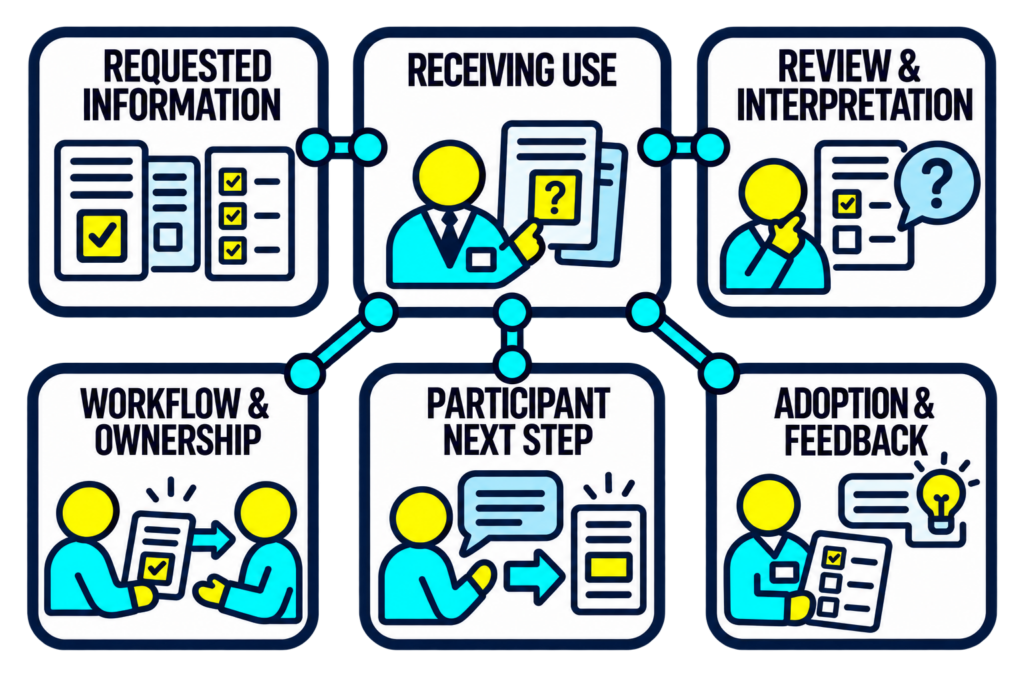
What this module can address
The selected scope may include:
The workshop selects the receiving questions that materially affect the defined exchange.
- The receiving process and intended benefit.
- The question or requirement a record should support.
- Records and contextual information requested.
- Instructions and timing for presentation.
- Issuer and claim considerations.
- Criteria for relevance and sufficiency.
- Reviewer roles and decision responsibilities.
- Entry into existing tools and workflows.
- Missing information and unresolved interpretation.
- Alternative presentation or review routes.
- Operational commitments and staff preparation.
- Trial feedback and adoption decisions.
What kinds of responses might emerge?
The response depends on the gaps uncovered in the selected example.
A clearer receiving use
Identify the specific process and question for which the organization will consider the selected record.
A more useful information request
Clarify what people should present, why it is needed, and which supporting context matters.
Reviewer guidance
Describe the claim, relevant criteria, remaining judgments, and conditions requiring further review.
A workable receiving route
Define where information arrives, who handles it, and how the participant receives a next step.
A bounded adoption trial
Assign a receiving owner, staff preparation, trial conditions, and a review of actual usefulness.
A focused configuration brief
Specify the requests, presentation context, review steps, responsibilities, and feedback a subsequent implementation would need.
Some responses may involve clearer instructions or assigned ownership. Others may require process changes, technical work, or further agreement among receiving partners.
What we review together
The receiving process
The decision, requirement, or workflow the exchange is intended to support.
The proposed record
Its claim, source, context, and relationship to the receiving question.
Interpretation expectations
What reviewers need to understand and which judgments remain unresolved.
Operational responsibilities
Who requests, receives, reviews, responds, and approves changes to the process.
Exceptions and participant experience
Missing information, unfamiliar records, alternative routes, and understandable next steps.
Adoption conditions
The commitment, support, trial scope, and feedback needed to assess practical use.
The working exercise
Follow one record into a real receiving workflow.
Choose a representative record and a receiving organization willing to examine how it would be used.
STEP 1
Define the receiving question
Identify the process, intended benefit, and requirement the record could help address.
STEP 2
Examine the requested information
Specify the record and supporting context needed, then identify what can be excluded.
STEP 3
Clarify interpretation
Describe what the record establishes, what it leaves open, and who makes the remaining judgments.
STEP 4
Trace the receiving steps
Identify how the record arrives, who reviews it, which tools are involved, and what happens next.
STEP 5
Test an exception
Consider missing information, an unfamiliar issuer, or a person without the expected record and define an appropriate response.
STEP 6
Define the adoption trial
Assign the receiving owner, staff preparation, support, feedback, and decision about continuing or adjusting the arrangement.
The exercise produces a reviewed receiving-use and adoption brief for the selected example.
CONNECTING THE WORKSHOP TO A POSSIBLE GOBEKLI SETUP
Connect presented records to an accountable receiving process.
The workshop can help define how a subsequent Gobekli implementation would support the selected receiving use across TalentPass, TalentSync, Passport Pages, and participating systems.
Depending on confirmed scope and product availability, the configuration brief may describe:
- The receiving use and responsible organization.
- Requested records and supporting context.
- Participant-facing presentation instructions.
- Relevant requirements and interpretation guidance.
- Receiving staff roles and access needs.
- Review steps and remaining judgments.
- Missing-information and exception routes.
- Acknowledgment and participant next steps.
- Connections to existing receiving tools.
- Trial feedback and adoption review.
The workshop clarifies the required experience and responsibilities before implementation is proposed.
Specific request functions, presentation methods, review workflows, communications, reporting, and integrations must be confirmed separately against current product availability and partner requirements.
SCOPE AND BOUNDARIES
A focused review of one receiving use.
The module begins with the exchange defined through Workforce Infrastructure Direction.
It examines what a receiving organization needs to request, interpret, and use selected records within a real process.
It does not automatically establish or deliver:
- Acceptance by every employer or institution.
- A guarantee of employment, admission, eligibility, or credit.
- Equivalence between qualifications or credentials.
- Verification of every underlying claim.
- Replacement of the recipient’s decision authority.
- A complete redesign of hiring or institutional policy.
- A legal or compliance determination.
- Production integration with every receiving system.
Appropriate operational, policy, and technical representatives may need to confirm the proposed arrangement.
Questions about verification, shared definitions, permissions, accessibility, and continuing governance connect to their respective modules when they affect the selected use case.
What should you bring?
One representative record and a description of the receiving process are enough to establish a practical starting point.
Include someone who understands how the receiving work is actually performed. Use fictionalized or appropriately redacted examples where practical.
Helpful starting materials
- A description of the selected exchange.
- The receiving process or decision.
- Current requirements or review criteria.
- A representative record.
- Relevant issuer or program context.
- Existing instructions to applicants or participants.
- Current forms or workflow descriptions.
- Reviewer roles and responsibilities.
- Examples of missing or confusing information.
- Current alternative documentation routes.
- A potential receiving owner for a trial.
- Available feedback from staff or participants.
An absent receiving partner can be identified as a dependency, but its acceptance or participation should remain unconfirmed until an authorized representative reviews the proposal.
What can you leave with?
A receiving-use definition
The selected process, intended benefit, question, and responsible decision owner.
An information and interpretation brief
The records requested, relevant context, review criteria, and judgments that remain with recipients.
A workflow and exception outline
Receiving steps, staff responsibilities, participant responses, and routes for unresolved information.
An adoption and configuration brief
Trial commitments, support needs, feedback questions, and requirements for a subsequent implementation.
These outputs begin with the example reviewed during the module. Final scope depends on the modules selected, available inputs, and the exchange established through Workforce Infrastructure Direction.
Where might the work lead next?
Credential Issuance, Verification & Status
Clarify the checks, lifecycle conditions, and explanations recipients need while preserving their responsibility for the receiving decision.
Shared Definitions & Semantic Interoperability
Resolve differences in the meaning of selected claims, fields, relationships, and status values that affect receiving interpretation.
Security, Procurement & Integration Readiness
Translate the proposed receiving workflow into implementation dependencies, review questions, testing, and responsible technical work.
These modules extend different parts of the work. Selection depends on the problem and decision established through Workforce Infrastructure Direction.
Frequently asked questions
Questions organizations ask before beginning.
It addresses the gap between making records available and using them within a receiving organization’s process. The focus is one selected use, with explicit interpretation and operational responsibilities.
The foundation identifies the exchange, intended benefit, participating organizations, and receiving decision. Those choices establish which acceptance and adoption questions matter.
It means the receiving organization has defined whether and how it will consider the selected record for a particular purpose. It does not imply automatic approval of the person’s application or request.
No. Verification concerns specified checks. Acceptance concerns how the recipient uses the record in relation to its requirements, including judgments those checks do not resolve.
No. A record may address one requirement while other requirements remain. The workshop clarifies that distinction in reviewer guidance and participant explanations.
Yes. The receiving organization may be an educational institution, workforce program, public agency, or another organization with a defined use for the selected record.
A receiving representative is important for confirming requirements and practical commitments. Without one, the workshop can identify assumptions and prepare a proposal, but acceptance remains unconfirmed.
Include someone who understands the operational process and someone able to confirm the proposed use or route it for approval. Depending on scope, that may involve several roles.
Identify the specific dependency and responsible owner. A useful output may be a smaller trial or a clear statement of what must happen before adoption can begin.
Yes. It connects the request to the receiving question, identifies necessary context, and makes unnecessary information requests visible.
The workshop can identify the disagreement, clarify relevant criteria, and assign unresolved interpretation questions. It should not conceal those differences behind a general acceptance statement.
The exercise can examine alternative documentation, assistance, or review routes appropriate to the receiving process. The responsible organization confirms which alternatives it can support.
No. It examines how the selected exchange fits those processes and identifies changes or approvals that may be needed. It does not independently establish new policy.
Not necessarily. The workshop can examine a bounded receiving arrangement using existing tools, while identifying where manual work limits usefulness. Technical implementation is scoped separately.
Define the review questions before the trial. These may address whether reviewers can use the record, whether it answers the intended question, what additional work occurs, and whether participants understand the next step.
The outputs can inform information requests, presentation context, reviewer responsibilities, receiving workflows, and adoption feedback in a subsequent Gobekli configuration. Specific capabilities and integrations must be confirmed separately.
Partners can confirm the receiving arrangement, prepare staff, test representative scenarios, and run a bounded trial. The results can inform whether to continue, adjust, or stop the proposed use.
TURN RECORD EXCHANGE INTO PRACTICAL USE
Give receiving organizations a clear way to act on the information.
Employer & Institutional Acceptance helps your team connect useful records to defined questions, prepared reviewers, workable processes, and accountable next steps.
Begin with Workforce Infrastructure Direction, then combine the modules that address the questions your participating organizations need to resolve.