
WORKFORCE SCALABILITY PROBLEM
Contingent Workforce Strategy: Build Flexible Capacity
Organizations need flexible capacity when demand changes, specialized expertise is required, or permanent hiring is not the right response.
But contingent work can create blind spots when leaders cannot see the work, capabilities, dependencies, ownership, or conditions behind each arrangement.
Workshop Module 10 — Flexible & Contingent Workforce Strategy
Does this sound familiar?
Contractors fill urgent gaps
External workers are engaged before the work, outcomes, ownership, and dependencies are fully defined.
Teams use different models
Departments independently rely on freelancers, staffing firms, consultants, vendors, or statement-of-work arrangements.
Critical knowledge sits outside
Important workflows depend on external expertise, relationships, or organizational context.
Classification questions emerge late
The practical reality of the work may not align neatly with the label placed on an agreement.
Access and offboarding vary
Systems, data, permissions, equipment, and organizational knowledge are handled inconsistently.
Leaders cannot see total capacity
Headcount reports omit external people and partners performing consequential work.
What is a contingent workforce strategy?
A contingent workforce strategy is a deliberate approach to deciding when and how an organization uses external, temporary, project-based, partner, or otherwise flexible talent to meet changing work needs.
It connects the workforce need to the work itself, the capabilities required, the appropriate relationship model, ownership of outcomes, operating dependencies, available evidence, and questions requiring specialist review.
The problem is not flexibility. It is flexibility without visibility.
Flexible talent can help organizations respond to variable demand, access specialized capabilities, test emerging work, and avoid premature permanent hiring.
The problem begins when flexibility is treated as a purchasing decision rather than a workforce and operating-system decision.
- What work must be performed and what outcome matters
- How predictable, recurring, integrated, and consequential the work is
- Which capabilities and organizational context are required
- Who directs, reviews, and owns the work
- What systems, data, facilities, and relationships are involved
- Where knowledge and key-person dependencies will accumulate
- Which questions require specialist review
See the complete flexible-capacity decision
not just the contract.
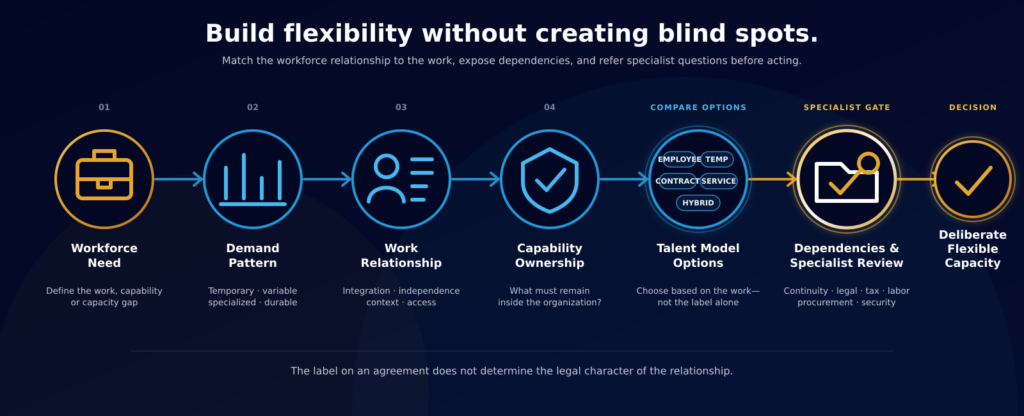
Workforce Need
- Capacity gaps
- Specialized expertise
- Seasonal demand
- Projects and transitions
- Uncertain growth
Demand Pattern
- Duration and urgency
- Variability and recurrence
- Location and timing
- Consequences of delay
- Expected continuity
Work Relationship
- Direction and autonomy
- Integration with teams
- Review and supervision
- Operating context
- Actual working conditions
Capability Ownership
- Knowledge and relationships
- Systems and data access
- Quality and decisions
- Continuity and transfer
- Accountability
Talent Model Options
- Build or hire
- Borrow or contract
- Partner
- Redesign or automate
- Investigate
A useful strategy makes the complete relationship visible: why capacity is needed, how the work will operate, where dependencies may form, and what must be resolved before action.
How contingent workforce fragmentation takes hold
STAGE 1
Demand changes
A deadline, capacity shortfall, project, or specialized need appears.
STAGE 2
A local solution is purchased
The fastest available person, firm, platform, or contract model is selected.
STAGE 3
External work becomes embedded
Access, relationships, knowledge, and critical activities accumulate around the arrangement.
STAGE 4
Dependencies become visible late
Cost, continuity, ownership, quality, security, or offboarding concerns emerge after the work is difficult to change.
Choose a talent model from the work—not from habit.
The same capacity need can lead to very different workforce responses. The appropriate choice depends on the work, demand pattern, capabilities, operating relationship, dependencies, and available evidence.
A responsible review helps the organization understand:
Define the activities, capability, timeframe, quality expectations, and consequences of delay.
Examine urgency, variability, recurrence, duration, location, and the likelihood that the need will continue.
Clarify direction, autonomy, integration, review, supervision, and ownership in practice.
Identify expertise, relationships, systems access, decision authority, and knowledge-transfer requirements.
Compare building, hiring, borrowing, contracting, partnering, redesigning, automating, or investigating.
Refer classification, employment, tax, procurement, privacy, cybersecurity, licensing, or other professional questions to qualified specialists.
Flexible capacity can solve one problem while creating another.
Unclear ownership
No one is clearly accountable for outcomes, quality, coordination, or escalation.
Knowledge dependency
Critical context or relationships become concentrated in an external person or provider.
Access exposure
Data, systems, facilities, credentials, or permissions exceed what the work requires.
Weak continuity
The organization cannot sustain the work or transfer knowledge when the engagement changes.
Fragmented spend
Teams purchase overlapping capacity without a shared view of cost, value, or capability.
Specialist questions
The working relationship raises classification, employment, tax, procurement, privacy, security, or licensing questions.
Contract-first response
A contract-first approach begins with the preferred supplier or familiar agreement rather than the work and operating reality.
Work-first examination
A work-first examination clarifies the outcome, demand, capabilities, relationship, ownership, and dependencies before choosing a model.
The label is not the relationship
The label placed on an agreement does not determine the legal character of the relationship.
Flexibility should be deliberate
The goal is not to eliminate contingent work. It is to create flexible capacity without losing visibility, ownership, continuity, or control.
Build flexible capacity without creating blind spots.
Connect workforce demand, work relationships, capability ownership, dependencies, and specialist review before acting.
THE MATCHING WORKSHOP MODULE
Module 10: Flexible & Contingent Workforce Strategy
This module helps participants connect changing workforce demand to deliberate decisions about external, temporary, project-based, partner, or other flexible capacity.
Participants examine the work, demand pattern, operating relationship, capabilities, ownership, dependencies, evidence, and unresolved questions before choosing a response.
This module helps your team:
- Define the work and capacity need before selecting a talent model
- Compare build, hire, borrow, contract, partner, redesign, automate, and investigate options
- Map external contributors to workflows, capabilities, systems, data, and outcomes
- Reveal knowledge, vendor, access, and key-person dependencies
- Clarify ownership, onboarding, review, handoffs, and offboarding
- Separate known facts from assumptions and specialist questions
- Develop an evidence-backed flexible-capacity response
What should happen next for each flexible-capacity need?
Not every need should lead to a contractor, employee, vendor, or technology purchase. The response should follow the work, evidence, tradeoffs, and unresolved specialist questions.
Build
Develop the capability internally when it should become durable organizational capacity.
Hire
Create or fill an employee role when the work is sustained and appropriately owned inside the organization.
Engage
Use an appropriate flexible arrangement for a bounded, variable, or specialized need.
Partner
Develop a durable relationship with an organization providing complementary capability or shared delivery.
Redesign
Change the work, workflow, role, system, or automation before adding capacity.
Investigate
Resolve insufficient evidence, dependencies, or specialist questions before acting.
These categories structure workforce planning. They do not determine legal worker classification or replace qualified professional review.
What should a contingent workforce review examine?
The need
What work must be supported, when is capacity needed, and what happens if it is unavailable?
The demand pattern
How urgent, variable, recurring, predictable, and long-lasting is the need?
The relationship
How will the work actually be directed, integrated, reviewed, and performed?
The capability
What expertise, context, credentials, judgment, or relationships are required?
The dependencies
What data, systems, vendors, permissions, people, and handoffs must remain available?
The evidence
What supports the selected model, and what remains uncertain or requires specialist review?
Use TalentSync to see the whole workforce—not only employees.
TalentSync can help organizations connect a defined workforce need to capabilities, contributors, teams, systems, and evidence across the operating environment.
The process begins with the work—not an automated recommendation about a person or legal relationship.
STEP 1
Define the work
Clarify outcomes, activities, capabilities, timeframe, and operating conditions.
STEP 2
Map current capacity
Identify employees, external contributors, partners, systems, and existing dependencies.
STEP 3
Examine demand
Understand urgency, duration, variability, recurrence, and consequences of delay.
STEP 4
Compare talent models
Consider build, hire, borrow, contract, partner, redesign, automate, or investigate.
STEP 5
Reveal dependencies
Surface access, knowledge, ownership, vendor, continuity, and handoff conditions.
STEP 6
Support human review
Organize evidence and unresolved questions for authorized leaders and qualified specialists.
TalentSync supports workforce visibility and structured decision-making. Organizational leaders and qualified specialists remain responsible for interpretation, classification, compliance, and final decisions.
- See active capabilities demonstrated in current work
- Reveal latent capabilities from previous experience
- Recognize emerging capabilities being learned or practiced
- Connect talent gaps to a defined organizational need
- Identify missing or incomplete evidence
- Surface dependencies that may affect movement
VISIBLE CAPACITY, CAPABILITY AND DEPENDENCIES
Flexible capacity begins by seeing who and what already supports the work.
Organizational capacity may include employees, contractors, consultants, temporary workers, vendors, partners, technology, and informal support. Each contributes differently and carries different conditions.
A shared view helps leaders understand where capability sits, what the work depends on, and which capacity decision is actually required.
PRODUCT AND DECISION BOUNDARIES
Workforce intelligence supports decisions. It does not make legal determinations.
TalentSync, TalentPass, Pythia, and workshop outputs should not be presented as determining worker classification, employment status, tax treatment, legal compliance, or the universally correct talent model.
- Making legal, tax, employment, procurement, privacy, cybersecurity, licensing, or regulatory determinations
- Replacing HR, legal, tax, finance, procurement, compliance, or other qualified specialists
- Automatically deciding whether a person should be hired, contracted, retained, or released
- Providing the sole basis for a consequential workforce decision
The workflow helps clarify work, relationships, capabilities, evidence, dependencies, and questions requiring specialist review.
What to bring into the conversation
You do not need a perfect enterprise workforce inventory or a legal conclusion about every existing arrangement.
We begin with the workforce signals, agreements, operating knowledge, and observations the organization already has.
Useful inputs may include:
- Workforce demand and capacity projections
- Known contractors, consultants, temporary workers, vendors, and partners
- Statements of work, procurement records, and engagement summaries
- Workflows relying on external contributors
- Role, capability, and project definitions
- Cost, utilization, quality, and outcome information
- Systems, data, access, and offboarding practices
- Known knowledge-transfer or continuity concerns
- Ownership and approval information
- Questions identified for qualified specialists
The Workforce Direction module establishes the consequential outcome and bounded workforce decision this module should support.
What this module can help clarify
Where flexible capacity is needed
Identify work, capabilities, timeframes, and demand patterns that justify a flexible response.
Which talent models fit the work
Compare practical options without defaulting to one relationship type.
Where dependencies concentrate
Reveal critical knowledge, systems, access, vendors, handoffs, and ownership gaps.
What requires specialist review
Separate workforce strategy questions from determinations reserved for qualified professionals.
Final outputs depend on the modules selected and the workforce decision established through the workshop’s required Workforce Direction foundation.
Where might the work lead next?
Contingent workforce strategy frequently reveals connected problems in demand planning, role design, talent pipelines, mobilization, and sustainable workload.
Workforce Demand & Capacity Planning
Clarify when, where, and why workforce capacity is likely to change.
Skills-Based Role Design
Define the work, outcomes, capabilities, responsibilities, and operating context.
External Talent Pipeline Development
Prepare relationships and talent sources before demand becomes urgent.
Hiring Readiness & Candidate Evidence
Turn an authorized hiring need into a structured and evidence-based process.
Team Formation, Onboarding & Mobilization
Bring employees and external contributors into coordinated work with clear handoffs.
Workload, Retention & Sustainable Scale
Ensure flexible capacity supports rather than conceals unsustainable operating conditions.
Frequently asked questions
Questions leaders ask before booking.
A contingent workforce includes people who contribute through temporary, project-based, outsourced, independent, vendor, staffing, consulting, or other nontraditional arrangements. The categories vary, and actual working conditions matter more than a label.
It is a deliberate approach to connecting changing workforce demand with appropriate external, temporary, project-based, partner, or flexible capacity while making work, ownership, evidence, and dependencies visible.
Flexible capacity may be useful for bounded projects, variable or seasonal demand, specialized expertise, transitional needs, or uncertain future demand. The response should follow the work and appropriate specialist review.
No. The workshop supports workforce and operating-model decisions. It does not determine legal worker classification, tax status, employment obligations, procurement compliance, or other professional conclusions.
Not automatically. Some work should remain durable internal capacity; other needs may be better met through partners or flexible talent. The purpose is to evaluate the work and consequences.
Make the work, relationship, ownership, access, data, knowledge, cost, quality, onboarding, review, and offboarding visible, and refer specialist questions appropriately.
No. TalentSync can organize work, capability, contributor, and dependency information. Authorized leaders and qualified specialists remain responsible for interpretation and decisions.
Identify critical context, relationships, procedures, artifacts, and system knowledge early; assign ownership; and establish practical transfer and continuity conditions before an engagement changes.
Every engagement begins with Workforce Direction. Flexible & Contingent Workforce Strategy can then be selected when the organization must decide how external or variable capacity should support the bounded workforce outcome.
No. The practical facts and applicable requirements must be evaluated. Questions about classification or legal character should be referred to qualified specialists.
BUILD FLEXIBILITY DELIBERATELY
Create flexible capacity without losing visibility, ownership, or control.
Connect changing work to the right workforce response, expose the dependencies behind it, and identify the decisions and specialist questions that must be resolved.
This module is part of Gobekli’s configurable Workforce Scalability Workshop.
