
A PROGRAM RELEVANCE WORKSHOP MODULE
Community & Regional Need:
Understand the Place Your Program Must Serve
Education and training programs do not operate in isolation. They exist within communities shaped by changing populations, industries, public institutions, infrastructure, economic conditions, civic priorities, and unequal access to opportunity.
Yet program decisions are often based on a narrow set of signals.
Community & Regional Need helps institutions understand the conditions a program may need to address—and whose experience must become visible before program decisions are made.
Does this sound familiar?
Labor-market data becomes the entire needs assessment
Occupational projections are treated as a complete explanation even when they do not show who has access to opportunities or what the community requires.
The loudest stakeholder defines the problem
One employer, funder, public official, advisory member, or internal advocate receives more influence than the broader evidence supports.
Regional boundaries are assumed
The institution refers to “the community” without defining the neighborhood, service area, labor shed, jurisdiction, tribal community, or online population.
Population change is noticed too late
Migration, aging, displacement, language, family structure, transportation, and participation patterns affect demand before assumptions change.
Public-service needs remain invisible
Education, healthcare, government, infrastructure, nonprofit, care, emergency-response, and community-serving roles receive less attention.
Community input is gathered after the direction is chosen
Residents, learners, service organizations, small employers, and local partners are asked to validate an idea rather than help define the need.
What is a community and regional needs assessment?
A community and regional needs assessment is a structured examination of the people, conditions, institutions, industries, assets, challenges, and opportunities that may create a legitimate need for an education or training program.
It may examine population and demographic change, regional economic conditions, industry transition, civic and public-service priorities, community health and wellbeing, infrastructure, occupational conditions, educational access, existing providers, geographic conditions, technology, policy, and community perspectives.
The goal is not to prove that a proposed program should exist. It is to understand what need may exist, who experiences it, how consequential it is, what assets already address it, and what role the institution could responsibly play.
Community need is a relationship between a place, its people, changing conditions, existing capacity, and the outcomes a program may support.
The problem is not a shortage of regional data. It is the missing connection between conditions and program purpose.
Institutions can often access population estimates, economic-development reports, occupational projections, public budgets, community health assessments, workforce plans, housing and transportation data, educational attainment, broadband availability, and regional strategies.
These sources can describe important conditions. They do not automatically explain what an education provider should do.
To inform a program decision, the institution must connect regional evidence to the people affected, the outcome that needs to improve, the geographic and time boundaries, existing programs and assets, the institution’s ability to contribute, and evidence that confirms or challenges the initial signal.
A useful assessment moves from regional conditions to a bounded program question.
See the whole regional context—not just one demand signal.
People and Population
- Population growth or decline
- Age and family structure
- Migration and displacement
- Language and culture
- Educational attainment
- Unequal access to opportunity
Economy and Industry
- Major industries
- Small-business activity
- Industry transitions
- New investment
- Economic concentration
- Regional resilience
Civic and Public Service
- Healthcare and care
- Education
- Government and administration
- Infrastructure and utilities
- Emergency and community services
- Nonprofit capacity
Place and Access
- Transportation
- Housing
- Broadband and technology
- Rural or urban conditions
- Program proximity
- Geographic service boundaries
Assets and Decisions
- Existing education providers
- Community organizations
- Employer and industry partners
- Public institutions
- Funding and policy initiatives
- Gaps requiring investigation
A program becomes regionally relevant when the institution can connect a real condition to the people experiencing it, the assets already available, the outcomes that matter, and the contribution the program may be positioned to make.
How community need gets oversimplified
STAGE 1
A visible signal creates urgency
An employer announcement, population change, public shortage, funding opportunity, economic disruption, or political priority raises a program question.
STAGE 2
The signal becomes a conclusion
The institution assumes that the visible event represents a durable regional need before examining its scale, distribution, causes, or duration.
STAGE 3
The program response forms around limited evidence
A credential, curriculum change, partnership, recruitment plan, or funding request begins to take shape around the initial interpretation.
STAGE 4
Important conditions appear during implementation
Learner access, community trust, transportation, employer practices, competing providers, public policy, or changing demand complicates the original plan.
A regional needs assessment must answer more than “Which occupations are growing?”
Occupational data can help identify the direction, scale, concentration, and timing of employment change. But community and regional need is broader than projected job openings.
A useful assessment must also ask:
Which residents, learners, workers, families, employers, public institutions, neighborhoods, or communities are affected—and are some groups affected differently?
Is the region trying to improve access, mobility, public-service capacity, business development, resilience, educational attainment, or another consequential outcome?
Does the need reflect population change, technology, regulation, investment, employer practices, compensation, infrastructure, retirements, migration, or disruption?
Which education providers, workforce organizations, employers, unions, nonprofits, agencies, community groups, and informal networks already contribute?
Are the barriers awareness, transportation, affordability, scheduling, trust, language, technology, eligibility, staffing, capacity, or coordination?
Should it create or strengthen a program, coordinate partners, share resources, support a pathway, contribute evidence, or refer the need elsewhere?
A visible signal is a starting point—not proof of program demand.
Scale
How many people, organizations, communities, or outcomes are affected, and how is the need distributed?
Persistence
Is the condition temporary, cyclical, emerging, structural, or likely to change before a program can be delivered?
Specificity
Does the signal identify a clear capability, service, population, or outcome—or only a broad concern?
Accessibility
Could the people who experience the need realistically enter, complete, and benefit from the program?
Additionality
Would a new or changed program add useful capacity, or duplicate services that already exist?
Actionability
Can the institution and its partners contribute within their mission, authority, resources, and timeframe?
A narrow economic-development view
A narrow assessment may emphasize:
- Announced investment
- Projected job creation
- Industry growth rates
- Major employers
- Average wages
- Tax-base expansion
- Commercial development
- Regional competitiveness
These signals can describe economic activity without showing who can access its benefits or which needs remain unmet.
A community-relevance view
A broader assessment examines:
- Who gains access to opportunity
- Who may be displaced or excluded
- Existing community capabilities
- Small and local employers
- Public and civic capacity
- Pathways for current residents
- Quality and stability of opportunity
- Community-defined priorities
- Long-term regional resilience
The goal is to understand whether the proposed program can connect economic development and community value.
Not every consequential need appears in commercial demand data.
Communities depend on people who educate, care, respond, maintain, coordinate, protect, build, and provide essential services.
Vacancies can reflect compensation, funding, working conditions, licensing, geography, or retention—not simply a shortage of trained people. Some essential roles may have limited growth but high replacement demand or severe consequences when capacity is unavailable.
The module identifies these conditions without assuming that education alone can resolve them.
Community engagement should shape the question—not merely endorse the answer.
Quantitative data can reveal patterns. It cannot fully explain how people experience a condition, why existing options are not working, or what a responsible response would look like.
Participation should be purposeful and transparent. People should understand what decision is being considered, how input may influence it, what constraints exist, and where formal authority remains.
A limited consultation should never be presented as speaking for an entire community.
Understand the place
behind the program.
Connect regional conditions to people, assets, barriers, and outcomes.
THE MATCHING WORKSHOP MODULE
Module 2: Community & Regional Need
This module examines the economic, demographic, civic, public-service, industry, geographic, and community conditions a program may need to address.
Participants connect external signals to the people affected, the outcomes at stake, the assets already available, the barriers shaping access, and the institution’s potential role.
The module begins with the outcome, program boundary, and decision established through Program Relevance Direction.
This module helps your team:
- Define the community and regional boundary
- Identify the condition creating the program question
- Examine demographic, economic, civic, public-service, and industry signals
- Understand who experiences the need
- Distinguish durable conditions from short-term events
- Map existing programs, providers, institutions, and community assets
- Identify barriers preventing the current system from responding
- Include perspectives missing from conventional datasets
- Examine whether the institution can make a distinctive contribution
- Identify questions requiring deeper or specialist review
- Develop an evidence-backed statement of need
- Connect findings to the bounded program decision
What should happen next with the regional need?
Identifying a real need does not automatically determine that the institution should launch or expand a program. The next step depends on the evidence, the existing regional response, the institution’s role, and the barriers affecting the people it intends to serve.
Confirm
Multiple credible sources and perspectives indicate a consequential condition within the defined population, geography, and decision horizon.
Focus
The issue may be legitimate, but the affected population, outcome, location, capability, or program question needs a clearer boundary.
Broaden
The assessment relies too heavily on one industry, employer, dataset, institution, population, or definition of value.
Connect
Relevant programs, providers, public institutions, employers, or community organizations exist but remain poorly coordinated.
Partner
The need crosses institutional boundaries and may require shared infrastructure, pathways, funding, referrals, or applied learning.
Investigate
The evidence is incomplete, contradictory, outdated, geographically mismatched, or insufficient for a responsible decision.
These categories organize the next inquiry. They do not determine whether a program should be launched, expanded, redesigned, combined, paused, or retired.
What should a community and regional needs assessment examine?
The condition
What economic, demographic, civic, public-service, industry, environmental, technological, or social change is creating the question?
The people
Who experiences the condition, who may benefit from a response, and whose experience is missing?
The place
Which geography, service area, labor shed, jurisdiction, cultural community, or delivery environment is relevant?
The assets
Which programs, institutions, organizations, services, partnerships, facilities, networks, and capabilities already exist?
The barriers
What prevents people or organizations from using existing opportunities, services, programs, or pathways?
The evidence
Which findings are current, credible, decision-relevant, geographically appropriate, and supported across sources?
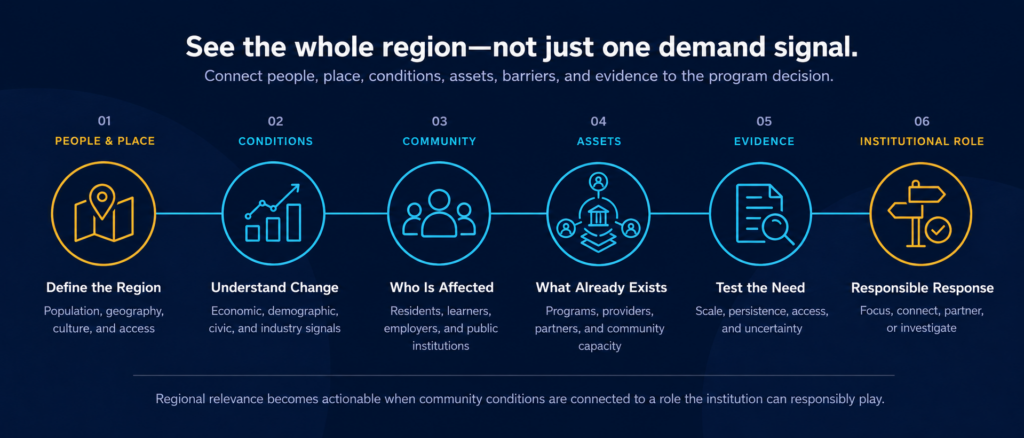
From regional signal to program question
A regional needs assessment becomes useful when it creates a clear line between an external condition and the bounded program decision.
STEP 1
Define the place
Identify the geographic, institutional, civic, cultural, industry, or learner boundary relevant to the decision.
STEP 2
Describe the condition
State what appears to be changing, who raised the concern, and why the condition may matter.
STEP 3
Identify people and outcomes
Determine who experiences the need and which learner, community, workforce, public-service, or institutional outcome is at stake.
STEP 4
Map assets and barriers
Understand what already exists, who contributes, what is working, and what prevents the current system from responding.
STEP 5
Test the evidence
Compare indicators with stakeholder perspectives, local knowledge, time horizons, boundaries, and contradictory findings.
STEP 6
Define the institution’s role
Clarify whether the evidence supports deeper program investigation, partnership, coordination, adaptation, or research.
The result is not a predetermined program proposal. It is an evidence-backed account of the regional need and the questions the institution should examine next.
- Define the geography explicitly
- Connect the condition to affected people
- Map existing regional assets
- Test the durability of the signal
- Record barriers and contradictions
- Identify the institution’s responsible role
DATA AND COMMUNITY KNOWLEDGE
Use regional data and lived experience together.
Neither quantitative data nor stakeholder testimony is sufficient in isolation.
Regional indicators can reveal scale, distribution, change over time, and comparisons across places. Community knowledge can reveal causes, barriers, trust, informal systems, experiences, and consequences that may not be represented in available datasets.
A strong assessment asks:
- What does the data show?
- What can the data not show?
- What do people experience?
- Where do independent sources agree?
- Where do the sources conflict?
- What additional evidence could change the decision?
Community knowledge should not be decoration around a statistical analysis. Data should not erase experiences that are inconvenient or difficult to measure.
EVIDENCE LIMITS AND PROFESSIONAL BOUNDARIES
Regional evidence supports program judgment. It does not eliminate uncertainty.
The module should not be presented as:
- Producing a definitive measure of community need
- Speaking for an entire community through limited participation
- Forecasting economic conditions with certainty
- Guaranteeing future enrollment or employment
- Treating announced jobs as confirmed opportunities
- Assuming every workforce shortage is a training shortage
- Replacing employer-demand or hiring-practices analysis
- Conducting a complete economic-impact study
- Making public-policy or funding determinations
- Determining that the institution should solve every identified need
The workshop structures evidence, reveals assumptions, and identifies what requires deeper investigation.
Economic forecasting, demographic analysis, public policy, civil rights, tribal consultation, accessibility, environmental review, public finance, healthcare planning, accreditation, licensure, and other questions may require qualified specialists and formal processes.
What to bring into the conversation
You do not need a complete regional dataset or a finished community needs assessment.
We begin with the external signals, institutional information, stakeholder knowledge, and questions already available.
Useful inputs may include:
- The Program Relevance Decision Foundation
- Institutional mission and service-area information
- Regional strategic plans
- Community needs assessments
- Economic-development and workforce plans
- Community health assessments
- Population and demographic information
- Migration and commuting information
- Educational attainment data
- Industry and occupational information
- Public-service workforce concerns
- Major investment or infrastructure announcements
- Employer, learner, alumni, and community feedback
- Advisory-board notes
- Existing education and training providers
- Community and public-sector partnerships
- Transportation, housing, broadband, or childcare information
- Known barriers to participation
- Questions raised by residents or community organizations
- Evidence that challenges the initial assumption
The Decision Foundation establishes the outcome, program boundary, geography, population, and question this module should examine.
What this module can help clarify
Which regional condition matters
Define the condition connected to the program decision.
Who experiences the need
Identify the people, populations, organizations, and communities affected.
What already exists
Map the providers, services, institutions, partnerships, networks, and community capabilities contributing.
Where barriers and gaps remain
Reveal conditions limiting the current response and determine the institution’s potential role.
The module also identifies what must be examined next. Final outputs depend on the Decision Foundation, geographic and population boundaries, evidence available, stakeholder participation, and any additional modules required.
Where might the work lead next?
Questions institutions ask about regional need.
It examines the people, conditions, institutions, assets, challenges, and opportunities that may create a legitimate need for an education or training program. The purpose is to determine what need may exist, who experiences it, what already addresses it, and what role the institution could responsibly play.
Employer demand focuses on organizations seeking people to perform work and their actual hiring practices. Community and regional need is broader and may include population change, civic capacity, public services, resilience, infrastructure, educational attainment, and needs not visible in commercial hiring data.
No. It may not show who can access opportunities, whether employers are actually hiring, why vacancies exist, what community needs are unmet, what providers already offer, or whether the institution can contribute usefully.
Use the boundary relevant to the decision. It may be a service area, learner catchment, labor shed, municipality, county, tribal community, rural area, metropolitan area, industry cluster, state, or shared public-service system.
Not necessarily. The relevant population may include current residents, prospective learners, commuters, remote learners, seasonal populations, displaced workers, new arrivals, tribal communities, or military-connected populations.
It can help explain population change, participation, access, educational attainment, geography, and differences in experience. It should not support assumptions about an individual’s interests, abilities, behavior, or likely success.
Treat its request as an important signal rather than a complete conclusion. Examine durability, hiring practices, opportunity quality, supply chains, smaller employers, communities, learner access, existing providers, and what happens if plans change.
Yes, when relevant to the decision. But a vacancy does not automatically indicate a training shortage; compensation, funding, working conditions, licensing, geography, retention, and organizational capacity may contribute.
They may identify needs, explain barriers, interpret evidence, reveal assets, challenge assumptions, define outcomes, or evaluate responses. The institution should explain how input will be used and where decision authority remains.
Surveys can contribute useful evidence but may miss people with limited connectivity, language barriers, accessibility needs, low institutional trust, time constraints, or no existing institutional relationship.
Examine the condition’s history, causes, scale, duration, policy environment, investment commitments, population patterns, employer behavior, and the time required to develop and deliver a program.
No. The need may already have an effective provider or require a policy, employer-practice, transportation, housing, childcare, healthcare, or coordination response rather than a new program.
Map their programs, services, capacity, populations, outcomes, and geographic reach. Existing providers may be partners, pathway contributors, referral sources, or evidence that the need is already being addressed.
It can organize the need, affected population, evidence, assets, partners, barriers, and institutional role. It does not guarantee eligibility or success, and grant-specific requirements require separate review.
Program Relevance Direction first establishes the outcome, program boundary, population, geography, evidence foundation, and decision. Community & Regional Need is then selected when place-based conditions materially affect that decision.
UNDERSTAND THE PLACE BEHIND THE PROGRAM
Turn regional signals into a clearer understanding of who and what the program should serve.
Connect economic, demographic, civic, public-service, industry, geographic, and community evidence to the people affected, the assets available, and the outcomes that matter.
Community & Regional Need is part of Gobekli’s configurable Program Relevance Workshop.
