
PROGRAM RELEVANCE WORKSHOP
Keep Learning Relevant as Work, Learners, and Communities Change.
Programs cannot remain relevant through occasional curriculum review alone.
Institutions need a shared way to connect mission, learner goals, community needs, changing work, employer evidence, curriculum, delivery conditions, and program outcomes—then decide what each program needs next.
This configurable workshop helps colleges, universities, workforce education providers, and other learning organizations develop a focused, evidence-backed path forward.
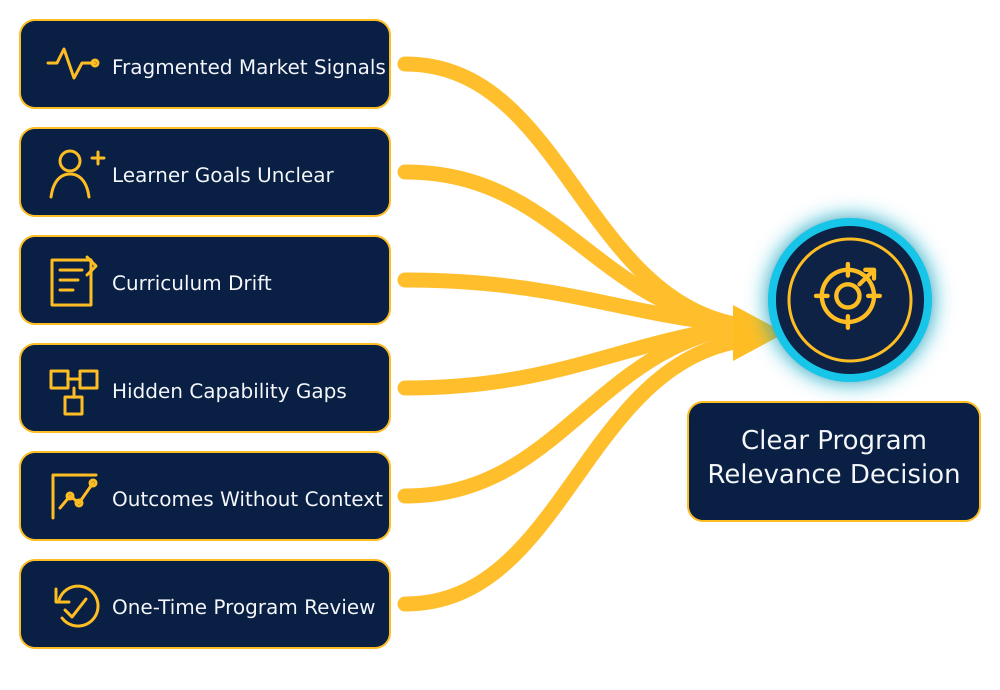
Programs are being asked to keep pace with several kinds of change at once.
Work changes faster than curriculum
Technology, AI, regulation, operating models, and changing customer needs alter roles and activities between formal program-review cycles.
Employer signals are incomplete or contradictory
Job postings, advisory boards, regional data, and employer conversations may point in different directions.
Learner goals are missing from the decision
A program may address an apparent market need without reflecting what learners want, value, understand, or can realistically access.
Capabilities are difficult to trace through the curriculum
Leaders may know which courses are required but not where important capabilities are introduced, practiced, reinforced, and demonstrated.
Outcomes do not explain what should change
Enrollment, completion, transfer, employment, licensure, earnings, and learner feedback may exist without forming a coherent view of program value.
Delivery realities appear too late
Faculty capacity, equipment, schedules, technology, partnerships, learner support, and cost may be examined only after a program direction is chosen.
Evidence remains fragmented across the institution
Faculty, career services, advisors, institutional research, enrollment teams, and leaders each hold a different part of the relevance picture.
Program decisions happen in isolation
New programs are launched, existing programs are revised, and underperforming programs are continued or closed without a shared portfolio view.
The challenge is deciding what remains relevant—not simply updating curriculum.
Institutions face pressure to respond quickly to employer demand, new technologies, demographic change, enrollment conditions, public priorities, and learner expectations.
But relevance should not mean chasing every job-posting trend or redesigning education around the immediate preferences of a small number of employers.
A program may remain highly relevant even when its value cannot be reduced to one occupation or short-term earnings measure. Another may appear aligned to a growing field while failing to provide the capabilities, experience, access, or opportunity that field actually requires.
Before choosing what should change, institutional leaders need to understand:
- The program’s educational purpose and connection to institutional mission
- The learners, communities, and future possibilities it is intended to serve
- Current and emerging work connected to the program
- What employer evidence demonstrates—and what remains uncertain
- The technical, human, and domain capabilities the work requires
- Where those capabilities appear across curriculum and applied learning
- Whether learners can understand, access, complete, and use the program
- What educational, employment, transfer, licensure, and community outcomes show
- Whether the institution can deliver the intended experience responsibly
- What should happen next and what evidence should trigger future review
Program relevance is the ability to connect purpose, people, work, capabilities, learning, delivery, and evidence well enough to make a responsible program decision.
Start with the program decision—not a predetermined curriculum change.
The Program Relevance Workshop is configured around a bounded institutional question. Every engagement begins with the required Program Relevance Direction foundation. Your institution then selects the problem modules most relevant to the program, portfolio, learner population, or decision being examined.
Required
1. Establish the Program Relevance Direction
Define the program or portfolio boundary, intended value, affected learners, institutional context, evidence, timeframe, constraints, and consequential decision.
Choose 2–3
2. Select the Problem Modules
Examine the community, learner, employer, work, capability, curriculum, delivery, applied-learning, outcome, portfolio, or governance problems surrounding the decision.
Outcome
3. Build a 30–90 Day Program Relevance Path
Leave with an evidence-backed response, clear priorities, responsible owners, unresolved questions, and sequenced next steps.
A typical engagement combines the required foundation with two or three problem modules. Additional evidence review, learner or employer conversations, faculty participation, data analysis, or specialist involvement can be added when the decision requires it.
Program relevance creates enduring learning value—not simply alignment to current demand.
Explore the 12 Program Relevance Workshop Modules
The modules connect institutional purpose to learner need, changing work, program design, curriculum, delivery, outcomes, and portfolio decisions. Institutions do not need to complete all 12. The workshop is configured around the program decision that matters now.
DEFINE THE RELEVANCE QUESTION
Program Relevance Direction
Establish the program, learner population, institutional purpose, evidence boundary, timeframe, constraints, and decision the engagement must support. (Required foundation)
Community & Regional Need
Examine the economic, demographic, civic, public-service, industry, and community conditions the program may need to address.
Employer Demand & Hiring Reality
Connect labor-market signals to actual work, hiring practices, advancement opportunities, prerequisites, and operating conditions.
Learner Demand, Goals & Access
Examine what learners want the program to make possible and the conditions affecting whether they can understand, access, complete, and use it.
CONNECT CHANGING WORK TO LEARNING
Program Outcomes & Value
Bring educational, employment, transfer, licensure, advancement, learner-defined, community, and institutional outcomes into a shared value view.
Changing Work & Occupational Futures
Examine how technology, AI, regulation, industry practices, and changing expectations may alter the work connected to a program.
Work-to-Capability Translation
Translate roles and occupational needs into outcomes, activities, responsibilities, knowledge, tools, technical capabilities, and human capabilities.
Curriculum Currency & Coverage
Map where important capabilities are introduced, developed, practiced, integrated, and demonstrated across the curriculum.
STRENGTHEN, DECIDE & SUSTAIN
Program Delivery & Resource Feasibility
Examine whether faculty capacity, expertise, equipment, technology, scheduling, learner support, partnerships, and funding can sustain the intended experience.
Applied & Work-Based Learning Relevance
Connect internships, clinical experiences, projects, simulations, apprenticeships, and community work to the capabilities the program intends to develop.
Program Portfolio Decisions
Organize evidence and tradeoffs around whether to launch, grow, redesign, differentiate, combine, pause, retire, or investigate an offering.
Continuous Relevance Governance
Establish who watches important signals, what triggers action, who participates, and how program decisions are documented and revisited.

A relevant program does more than follow current hiring demand.
Launch
Create a new offering when credible evidence supports an unmet learner, community, educational, or workforce need the institution is positioned to address.
Grow
Expand a valuable program that requires additional capacity, delivery options, partnerships, resources, or learner access.
Redesign
Change curriculum, sequencing, delivery, applied experience, or capability coverage when the need remains relevant but the learning experience no longer fits it.
Differentiate
Clarify a program’s distinctive learner population, purpose, educational outcome, market, or progression opportunity.
Combine
Coordinate overlapping programs, courses, concentrations, credentials, partnerships, or resources to create greater value.
Pause
Delay expansion or major investment while demand, capacity, approval, resource, or delivery conditions remain unresolved.
Retire
End an offering responsibly when it no longer supports a defensible need or cannot be sustained without burdens that outweigh its value.
Investigate
Gather additional learner, employer, outcome, curriculum, financial, technical, or specialist evidence before deciding.
These categories structure evidence and institutional judgment. They do not automatically determine whether a program should be approved, funded, changed, closed, accredited, or marketed.
How Your Workshop Is Configured:
-
1
Free Discovery Call Identify the program or portfolio decision creating the concern and determine whether the workshop is an appropriate starting point. -
2
Focused Intake & Direction Gather available evidence and establish the required Program Relevance Direction, participants, boundaries, and decision criteria. -
3
Collaborative Workshop Complete the selected modules with the people who hold the relevant academic, learner, employer, community, operational, and decision knowledge. -
4
Program Relevance Path Integrate findings into a 30–90 day response with priorities, owners, evidence needs, dependencies, and questions requiring further review.

Leave with more than a conversation.
Program Relevance Decision Foundation
A shared definition of the decision, purpose, program boundary, affected learners, evidence, constraints, and decision criteria.
Program Relevance Landscape
A connected view of mission, learners, communities, changing work, capabilities, curriculum, delivery, outcomes, and stakeholders.
Evidence & Assumption Register
A distinction among known facts, stakeholder observations, interpretations, assumptions, conflicts, and unanswered questions.
Work & Capability Map
A structured view of relevant work outcomes, activities, responsibilities, knowledge, tools, technical capabilities, and human capabilities.
Curriculum Coverage Map
A view of where important capabilities are introduced, practiced, reinforced, integrated, and demonstrated.
Program Response Portfolio
Evidence-backed options to launch, grow, redesign, differentiate, combine, pause, retire, or investigate.
Ownership & Review Map
Clear responsibility for evidence, stakeholder relationships, decisions, implementation, escalation, and future review.
30–90 Day Program Relevance Path
Sequenced next steps, responsible owners, evidence needs, dependencies, decision points, and specialist questions.
Final outputs depend on the selected modules, available evidence, participants, and program decision established through the required Program Relevance Direction foundation.
The workshop supports institutional judgment. It does not guarantee enrollment, employment, earnings, program approval, accreditation, funding, employer participation, or learner outcomes.

Keep learning connected to what comes next—without reducing education to the latest market signal.
We help institutions understand the learning they offer, the people and purposes it serves, the work and capabilities surrounding it, and the evidence required to make a responsible program decision.
Purpose-connected
Connect program decisions to institutional mission, educational purpose, learner goals, community needs, and meaningful future possibilities.
Human-centered
Treat learners as people developing agency, judgment, capability, and future options—not simply as inputs to a workforce pipeline.
Evidence-based
Separate known facts from assumptions and examine learner, employer, community, curriculum, outcome, operational, and financial evidence together.
Future-aware & bounded
Consider changing work and multiple plausible futures while keeping the workshop focused on one consequential program decision.
When the workshop reveals something worth maintaining
Turn a one-time program review into ongoing institutional visibility.
Optional support for institutions that want to maintain the relationships among programs, work, capabilities, curriculum, people, partners, and evidence revealed through the workshop.
Workshop Findings
Identify program relationships, capability maps, curriculum connections, partner knowledge, decisions, or evidence that should remain visible after the engagement.
Gobekli Setup
Configure appropriate Gobekli tools around programs, capabilities, learning activities, partners, organizational profiles, and permission-based learner evidence.
Ongoing Visibility
Continue developing the institution’s Human Intelligence Layer as programs change, learning accumulates, partnerships evolve, and new evidence emerges.
A Gobekli setup is an optional continuation—not a required workshop outcome. The appropriate configuration depends on the institutional decision, participating population, product availability, implementation scope, privacy requirements, and specialist review.
TalentPass is not designed for use by minors.
Questions institutional leaders ask before booking.
The Program Relevance Workshop is a configurable facilitated process that connects program purpose, learner goals, community needs, changing work, employer evidence, capabilities, curriculum, delivery conditions, outcomes, and portfolio decisions.
Every engagement begins with a required Program Relevance Direction foundation. The institution then selects the problem modules most relevant to the decision it needs to make.
The workshop is designed primarily for colleges, universities, community colleges, adult learning providers, workforce education organizations, continuing education divisions, and other institutions responsible for postsecondary or workforce-connected learning.
Participants may include academic leaders, faculty, institutional research, workforce education, career services, learner-support teams, finance, employers, learners, alumni, community partners, or qualified specialists.
No. Every engagement begins with Program Relevance Direction. Most institutions then select two or three additional modules connected to the decision established through that foundation.
The module structure focuses the conversation rather than expanding every engagement into a complete institutional review.
A traditional program review may examine curriculum, enrollment, outcomes, resources, faculty, finances, and academic quality according to an established institutional or accreditation process. This workshop does not replace that process.
It connects evidence that may otherwise remain separated across curriculum, learner experience, labor-market information, employer relationships, community need, outcomes, and portfolio decisions.
No. Labor-market information is one important source of evidence. Program relevance also includes institutional mission, learner goals, community needs, educational value, changing work, transferable capabilities, curriculum, delivery conditions, access, outcomes, and sustainability.
A program should not be redesigned automatically because one dataset or employer indicates demand.
No. The workshop organizes evidence and tradeoffs around whether a program should be launched, grown, redesigned, differentiated, combined, paused, retired, or investigated further.
Institutional leaders, faculty governance, boards, regulators, accreditors, and other authorized parties remain responsible for the decision.
Yes, when the institution has a sufficiently bounded opportunity to examine. The workshop can clarify the need, intended learners, relevant work, capabilities, program proposition, delivery requirements, evidence, risks, partners, and unanswered questions.
It does not replace academic approval, curriculum development, financial analysis, accreditation, regulatory, or governance processes.
Yes. The same relevance questions can apply to degrees, certificates, noncredit programs, continuing education, workforce training, apprenticeships, and other structured learning opportunities.
The evidence and decision criteria should follow the program’s purpose, learners, duration, funding, credential, regulatory environment, and expected outcomes.
Employers may help describe changing work, activities, capabilities, tools, hiring practices, prerequisites, advancement conditions, or applied-learning opportunities.
Their input should be substantive and appropriately broad. It is evidence—not an automatic curriculum decision.
Learners and alumni can provide essential evidence about their goals, choices, experiences, constraints, transitions, outcomes, and the value they believe the program created.
Participation should be appropriate, informed, accessible, and respectful of privacy and power differences.
No. Pythia and other Gobekli capabilities may help people structure information, explore relationships, identify missing context, and prepare for human conversation.
They do not independently determine program quality, curriculum, learner potential, labor-market demand, accreditation compliance, or the correct institutional decision.
No. The workshop is designed to produce a useful program relevance path whether or not the institution adopts Gobekli software.
If the workshop reveals relationships and evidence the institution wants to maintain, an appropriate Gobekli configuration may be explored as an optional continuation.
Program Relevance examines what the institution should offer and teach. Learning Visibility examines how each person’s learning, capabilities, experiences, credentials, and evidence become visible and usable.
Program Relevance examines whether the program itself remains valuable and current. Learning Alignment examines how learning connects across courses, programs, credentials, institutions, advising systems, partners, and external opportunities.
The institution leaves with a bounded program response and a 30–90 day path. The next step may involve gathering evidence, engaging learners or employers, mapping curriculum, developing a proposal, testing a delivery model, conducting specialist review, redesigning applied learning, or establishing a continuing relevance cycle.
KEEP LEARNING CONNECTED TO WHAT COMES NEXT
Turn scattered program signals into a clear relevance decision.
Connect institutional mission, learner goals, community needs, changing work, capabilities, curriculum, delivery, and outcomes—then determine what each program needs next.
In a free exploratory conversation, we will help identify the program decision that needs to be made and determine whether this workshop is the right starting point.
