
MEMBER ENGAGEMENT WORKSHOP MODULE
Benefit & Opportunity Discovery
Your organization may offer exactly what a member needs—yet leave them unsure where to find it or how to begin. Connect member purpose to relevant benefits, understandable options, and a clear next step.
Does this sound familiar?
Benefits go unnoticed
Members ask for help the organization already provides because the relevant benefit is difficult to find.
Program names obscure purpose
Internal names and categories give members few clues about which option addresses their question.
Options are scattered
Programs, resources, services, and contribution opportunities appear across disconnected pages, platforms, and teams.
Requirements appear too late
Members discover costs, eligibility rules, preparation, or time commitments only after trying to participate.
Entry routes are unclear
An appealing opportunity leads to an unfamiliar form, an unexplained handoff, or no obvious next action.
Discovery depends on staff
Members who know whom to ask receive useful guidance. Others never learn what is available.
What is benefit and opportunity discovery?
Benefit and opportunity discovery describes how members find available offerings, understand whether they fit, and determine how to begin.
Benefits may include services, resources, learning, advice, professional connections, or other forms of support.
Opportunities also include ways to contribute: volunteering, mentoring, joining a committee, sharing expertise, supporting research, or helping shape professional practice.
A useful discovery experience connects those offerings to the questions, goals, and circumstances members bring.
It makes the purpose, participation requirements, availability, and next step understandable.
A benefits list leaves an important question unanswered: “Where should I begin?”
Organizations often organize offerings around departments, program names, delivery platforms, or membership categories.
Members may begin with something more immediate:
“I need help with a workplace problem.”
“I want to learn from someone with relevant experience.”
“I have expertise I would like to contribute.”
“I need a resource I can use today.”
The discovery challenge is connecting those starting points to appropriate options without requiring members to understand the organization’s internal structure first.
See the complete discovery route.
Member Purpose
Questions and goals
Immediate circumstances
Interests and experience
Participation preferences
Member-selected priorities
Available Offerings
Benefits and services
Programs and events
Resources and guidance
Peer and mentoring support
Contribution opportunities
Fit and Requirements
Intended audience
Purpose and format
Eligibility and preparation
Time and cost
Expected participation
Discovery and Entry
Search and navigation
Directories and referrals
Opportunity descriptions
Registration or application
Questions and introductions
Ownership and Currency
Source information
Program responsibility
Current availability
Update responsibilities
Entry and support contacts
Discovery becomes useful when member purpose, opportunity information, participation conditions, and a workable next action can be understood together.
How opportunity discovery becomes fragmented
STAGE 1 — Offerings develop separately
Teams create useful programs, resources, benefits, and roles around particular member needs and organizational responsibilities.
STAGE 2 — Each offering gets its own route
Names, descriptions, pages, platforms, and entry processes reflect how the offering is managed.
STAGE 3 — The portfolio changes
New opportunities appear while eligibility, schedules, contacts, and availability change across existing offerings.
STAGE 4 — Members must assemble the picture
Members search across those arrangements, interpret incomplete information, and work out which option fits and how to enter it.
Publishing an opportunity does not establish that members can use it.
A directory can answer an important question:
What does the organization offer?
A discovery review follows the member further: can they locate an appropriate option, understand what it involves, and take the next step?
The review should clarify:
Identify the question, goal, or contribution interest that starts the search. Separate member input from organizational assumptions.
Follow likely starting points, including search, benefits pages, member areas, chapter channels, and staff or peer referrals.
Examine whether descriptions explain purpose, audience, format, and the situations in which the offering may help.
Check whether eligibility, cost, timing, preparation, availability, and commitments are visible before entry.
Trace the actual registration, request, application, or introduction through to the receiving person or system.
Look for an appropriate alternative, a help route, or a clear explanation that a suitable offering is currently unavailable.
A useful description helps members make six judgments.
Purpose
What question, goal, or situation does this opportunity address?
Fit
Whom is it intended to serve, and what makes it relevant to this member?
Experience
What will the member actually do, receive, or contribute?
Commitment
What time, cost, preparation, or ongoing responsibility is involved?
Availability
Can the member enter now, and what conditions or limits apply?
Next Step
What should the member do, and who can help if they have questions?
Useful choice
Several options can help members find a suitable route when they offer:
- Different levels of time commitment.
- Immediate resources or ongoing support.
- Individual or group participation.
- Different formats and schedules.
- Clear differences in purpose.
- Appropriate routes for different experience levels.
Members can compare these options and choose what fits their circumstances.
Unnecessary complexity
Choice becomes difficult when members encounter:
- Different names for similar offerings.
- Descriptions that omit practical differences.
- Duplicate or outdated listings.
- Requirements revealed after registration begins.
- Links that lead to unexplained systems.
- No guidance when the first option is unsuitable.
The review identifies which distinctions help members and which create avoidable work.
One member question can lead to several useful options.
A member wants help introducing a new process at work.
The association offers a practical guide, a facilitated peer discussion, and a working group that exchanges implementation experience.
Each may be useful, but they serve different purposes.
The guide provides something the member can use independently. The discussion offers a chance to ask questions. The working group involves an ongoing contribution.
A discovery review examines whether the member can find these options, understand their differences, and enter the one that fits.
The response may be a clearer description and a connected starting page using language the member recognizes.
Contribution opportunities need a visible route too.
Members may want to share expertise, support peers, contribute to research, or help lead a professional community.
Those opportunities can remain limited to familiar participants when discovery depends on personal invitations or knowledge of existing leaders.
A useful description explains the purpose, responsibilities, expected commitment, relevant experience, selection process, and way to express interest.
This module examines how a potential contributor finds and understands the opportunity. Detailed role design, selection, preparation, and ongoing support can follow through Volunteer & Leadership Participation.
Finding the right opportunity is only useful if the next step works.
A member may recognize a suitable option and still encounter unclear eligibility, an unavailable session, another login, or a handoff that nobody owns.
The review follows the entry route far enough to identify those breaks.
It distinguishes information that needs clarification from practical participation barriers that need deeper attention.
When access, scheduling, technology, cost, or other conditions prevent willing members from participating, Participation Barriers & Inclusive Access can extend the work.
THE MATCHING WORKSHOP MODULE
Module 3: Benefit & Opportunity Discovery
This practical minicourse helps membership organizations connect member questions, goals, and contribution interests to opportunities they can find, understand, and enter.
Participants learn a repeatable review method, apply it to one selected discovery route, and identify whether the priority response concerns descriptions, navigation, requirements, entry, or support.
The exercise also defines the opportunity information, source relationships, responsible contacts, and member choices that a subsequent Gobekli configuration would need to support.
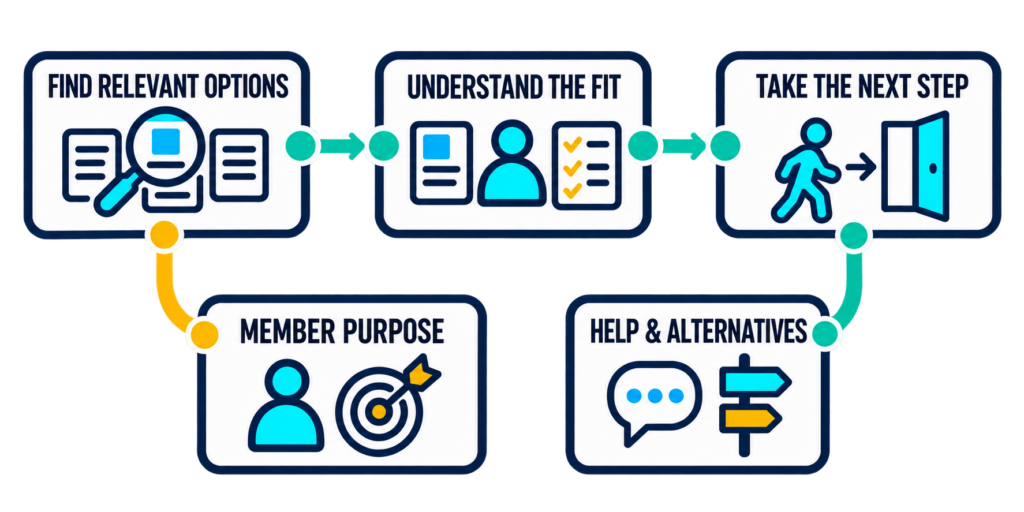
This module helps your team:
- Define a member question or discovery goal.
- Identify relevant existing offerings.
- Examine member language and starting points.
- Review how opportunities are named and grouped.
- Clarify purpose, audience, and participation.
- Distinguish useful options from confusing duplication.
- Make requirements and availability understandable.
- Trace registration, requests, and introductions.
- Identify missing help and alternative routes.
- Assign information and entry responsibilities.
- Develop a focused discovery improvement brief.
- Outline a connected opportunity configuration.
What should happen to each part of the discovery route?
The review leads to a deliberate response based on the member’s purpose, the available offerings, and the difficulty encountered.
Confirm
Retain a route that members can find, understand, and use.
Clarify
Explain purpose, fit, requirements, availability, or the next step.
Connect
Link relevant offerings, starting points, sources, and responsible people.
Simplify
Reduce confusing duplication, unnecessary steps, or competing routes.
Support
Provide help, an introduction, or an appropriate alternative.
Investigate
Resolve uncertainty about relevance, availability, member understanding, or entry.
These responses organize the improvement work. When the review reveals a missing or unsuitable benefit, that finding may require a separate portfolio decision.
What should an opportunity discovery review examine?
The member purpose
What is the member trying to accomplish, and how do they describe the question or situation?
The available offering
Which existing benefit, program, resource, service, or contribution opportunity could reasonably help?
The explanation
Can the member understand the purpose, audience, experience, and differences among relevant options?
The conditions
What eligibility, cost, timing, preparation, availability, or commitment affects participation?
The entry route
What must happen after selection, and where do forms, systems, introductions, or support become involved?
The ownership
Who maintains the information, receives the next action, and can resolve a problem in the route?
Trace one member question to a workable next step.
Your team applies the method to one member purpose and a manageable set of existing offerings established through Member Engagement Direction.
STEP 1
Define the purpose
Identify the member population, question, goal, or contribution interest. Record assumptions that need member validation.
STEP 2
Identify the options
Select existing offerings that could reasonably help. Note when a suitable option is missing.
STEP 3
Follow the discovery route
Begin where the member would look. Trace search, navigation, descriptions, referrals, and links.
STEP 4
Examine fit and entry
Review the information needed to compare options, understand conditions, and take the next action.
STEP 5
Choose a response
Confirm, clarify, connect, simplify, support, or investigate the parts of the route that need attention.
STEP 6
Assign and test the change
Identify the owner, proposed improvement, member feedback needed, and configuration requirements for a practical next step.
The result is a draft Member Opportunity Discovery Map connecting member purpose to clear options, participation conditions, entry, and responsibility.
FUTURE PRODUCT CONNECTION
Keep opportunities connected to the members they can help.
A subsequent Gobekli configuration could help the organization maintain structured information about benefits, programs, resources, and contribution opportunities.
TalentSync could connect those opportunity profiles to their purposes, participation conditions, source information, and responsible people.
TalentPass could help members express relevant goals, interests, experience, and sharing choices. Pythia could help clarify what a member is looking for and explain available options using the information and permissions in scope. Passport Pages could support agreed source and sharing connections.
A connected discovery view could potentially show:
- Which member purposes an opportunity addresses.
- Whom it is intended to serve.
- What members would do, receive, or contribute.
- What eligibility and preparation apply.
- What time, cost, or commitment is involved.
- Whether the opportunity is currently available.
- Which source and owner maintain its information.
- How the member enters or asks a question.
- Which alternatives may be appropriate.
- Where feedback identifies a confusing or broken route.
The workshop produces a starting configuration brief: the selected member purpose, opportunity fields, source connections, entry responsibilities, and member choices needed to support the route.
PRODUCT AND DECISION BOUNDARIES
Connected discovery supports member choice.
An opportunity’s presence in a directory does not establish that it is suitable, available, or useful for every member.
A later configuration should preserve the distinctions among a suggested option, confirmed eligibility, accepted participation, and a useful experience.
The workshop and product connection do not establish:
- Guaranteed fit based on a member profile.
- Eligibility without the relevant source or review.
- Acceptance into a selective or limited-capacity program.
- Permission to use information a member has not agreed to share.
- Useful outcomes based only on clicks or registration.
- A resolution to missing or unsuitable benefits through better presentation alone.
Specific search, filtering, recommendations, integrations, access behavior, and workflows would be confirmed during solution planning.
The workshop can clarify the discovery route and its responsibilities independently of future product adoption.
What to bring into the conversation
You do not need a complete benefit inventory or a redesigned member portal.
Begin with one member question and a small set of offerings connected to the participation challenge established through Member Engagement Direction.
Useful inputs may include:
- A representative member question or goal.
- Current benefit and opportunity descriptions.
- Relevant website or member-area pages.
- Search terms, navigation, or referral examples.
- Member questions about finding help.
- Known points of confusion or abandonment.
- Eligibility and participation requirements.
- Current timing, costs, and availability.
- Registration, application, or request steps.
- Source owners and responsible contacts.
- A membership or member-experience perspective.
- The owner of a proposed improvement.
The aim is to examine one useful route in sufficient detail to make a practical change. The foundation module establishes the population, purpose, evidence, and boundaries for that work.
What this module can help clarify
Where discovery breaks down
Identify where members struggle to find an option, recognize its relevance, or understand what it involves.
What each opportunity needs to explain
Clarify purpose, audience, participation, conditions, availability, and the next action.
How members can enter
Connect the selected offering to a workable registration, request, introduction, or support route.
What should change next
Develop an assigned improvement and test plan, supported by a starting configuration brief.
Final outputs depend on the modules selected and the participation challenge established through the workshop’s required Member Engagement Direction module.
Where might the work lead next?
Relevant Communication & Outreach
Bring appropriate opportunities to members through invitations with useful context, timing, and a clear next action.
New Member Onboarding & First Value
Connect opportunity discovery to the initial welcome and a useful first experience.
Participation Barriers & Inclusive Access
Address obstacles that prevent willing members from entering an opportunity they have found.
Explore the full Member Engagement Workshop to combine this module with the other parts of the participation experience that need attention.
Frequently asked questions
Questions organizations ask before beginning.
It is how members find available offerings, understand whether they fit, and determine how to begin. The review connects member purpose to opportunity information, participation conditions, and a workable next action.
Benefits, services, resources, learning, events, mentoring, committees, volunteer roles, and other ways members receive help or contribute. The exercise focuses on a manageable selection connected to one purpose.
The website may be part of the route, but discovery also happens through staff, peers, chapters, directories, and other systems. The module examines the member experience and identifies a focused improvement.
No. Begin with one member question and a small set of relevant offerings. Missing information and unclear ownership can become findings from the review.
Examine how members describe their needs and whether each program’s explanation makes its purpose recognizable. A program can retain its name while providing a clearer route into it.
The route should help members reach relevant options while allowing broader exploration and different choices. The exercise examines which distinctions and groupings are useful for the selected purpose.
Yes. Begin with the information needed to support an understandable choice and what the member chooses to provide. Specific personalization or recommendation capabilities would be confirmed during solution planning.
Relevant conditions should be understandable before entry, with an identified source and a contact for uncertainty. The review distinguishes explaining a requirement from confirming that a member meets it.
Make its status clear and provide an appropriate next action. That may be a future date, an inquiry route, an alternative, or an explanation that entry is closed.
Yes. Members need to find and understand ways to contribute. Detailed role design, selection, preparation, and ongoing support can follow through Volunteer & Leadership Participation.
Use that experience as an input. Identify what staff clarify, which knowledge is undocumented, and where members need a route that does not depend on knowing a particular person.
Ask members to work through a realistic discovery task. Examine whether they can find a relevant option, explain its requirements, and identify the next step. Record confusion and unresolved questions.
Discovery examines how members locate, interpret, and enter options. Communication and outreach examines how the organization brings an invitation or message to an appropriate member.
Onboarding focuses on the transition from joining to a useful beginning. Discovery applies throughout membership, including when an established member develops a new need or contribution interest.
Record that finding. Clearer presentation cannot resolve a missing or unsuitable offering. Benefit relevance and portfolio decisions belong in the Membership Value Workshop.
The outputs can inform a configuration connecting member-selected context, opportunity profiles, source information, participation conditions, entry routes, and responsible people. Specific capabilities and implementation requirements would be confirmed during scoping.
Your team will review one bounded route and develop a draft opportunity discovery map, assigned improvement and test plan, and starting configuration brief. Wider rollout and ongoing operation are subsequent steps.
MAKE OPPORTUNITIES EASIER TO REACH
Help members find what matters and take the next step.
Connect member purpose to understandable options, clear requirements, and a workable route into participation.
This module is part of Gobekli’s configurable Member Engagement Workshop.