
MEMBER ENGAGEMENT WORKSHOP
Help Members Find Their Place—and Their Next Step.
Your organization creates opportunities to learn, connect, contribute, and lead. Members may still struggle to see where they fit or how to begin.
Connect discovery, invitations, first experiences, support, and follow-through into clearer routes to meaningful participation.
The opportunities are there. The route into them is harder to see.
New members do not know where to begin
Welcome messages introduce the organization without helping someone choose a relevant first experience.
Useful opportunities remain undiscovered
Benefits, programs, resources, and ways to contribute are scattered across pages, platforms, calendars, and conversations.
More communication creates little movement
Members receive announcements without enough context to understand why an opportunity matters to them or what to do next.
The same people carry the community
Familiar volunteers, speakers, committee members, and leaders repeatedly step forward while others lack a clear invitation or entry point.
First experiences do not lead anywhere
An event, introduction, or program creates initial interest, but the next step and responsibility for follow-up remain unclear.
Participation depends on finding the right person
Members who know a staff contact or established leader receive guidance that others struggle to access.
Willing members encounter avoidable barriers
Timing, cost, accessibility, eligibility, technology, unclear expectations, or demanding commitments prevent people from taking part.
Quiet members receive generic reminders
The organization tries to restart participation without knowing whether the member needs a different opportunity, practical support, more time, or fewer messages.
Members need a meaningful reason to participate and a workable way to do it.
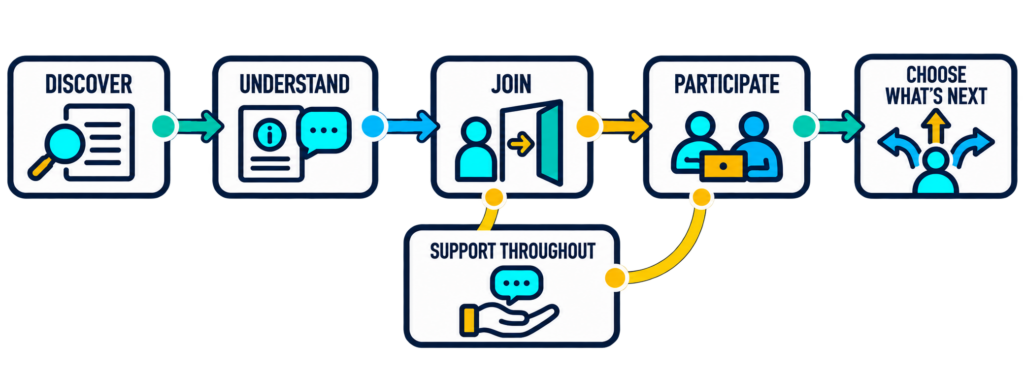
Participation begins before registration and continues beyond attendance.
A member needs to recognize an opportunity, understand its relevance, decide whether it fits, and know what taking part involves. Once they begin, the experience needs to support the purpose that brought them there.
An invitation to mentor may attract interest while leaving the expected commitment unclear. A new member may want professional connections but feel uncomfortable entering an established group. An event participant may leave motivated without knowing how to continue.
These are points where the participation experience needs attention.
To improve that experience, your organization may need to examine:
- What members are trying to accomplish.
- Which opportunities could help.
- How members discover those opportunities.
- What an invitation explains.
- Whether eligibility and commitment are clear.
- How someone takes the first step.
- What happens when they arrive.
- Who provides support.
- Which barriers interrupt participation.
- What happens after an activity.
- How members can continue, change direction, pause, or return.
- Who maintains the experience across teams and programs.
Member engagement is the ongoing relationship through which members find relevant ways to participate, connect, contribute, and receive support. Improving it means making those experiences meaningful, accessible, and practical to sustain.
Start with the participation experience your organization needs to improve.
The Member Engagement Workshop is configured around a defined participation challenge.
Every engagement begins with the required Member Engagement Direction foundation. Your organization then selects the modules that address the most important points of friction in the experience.
Each selected module combines a short practical lesson with an applied exercise using your organization’s examples. Participants examine what members encounter, identify where the experience breaks down, and define a response the organization can carry forward.
Required
1. Establish the Member Engagement Direction
Define the member population, participation challenge, member purpose, desired experience, available evidence, responsible roles, and boundaries of the engagement.
Choose 2–3
2. Select the Problem Modules
Examine the onboarding, discovery, communication, connection, program participation, contribution, access, or return-to-participation challenges that matter most.
Outcome
3. Build a 30–90 Day Member Engagement Path
Leave with priorities, responsible owners, practical changes, member feedback needs, review points, and a starting configuration brief for the experience worth maintaining.
A typical engagement combines the required foundation with two or three problem modules. Your organization does not need to complete all 12.
Member conversations, experience walkthroughs, program review, or specialist participation can be scoped where needed. The consultation establishes the appropriate format, preparation, participants, and fee.
Make participation easier for members and more manageable for the people supporting them.
For members
Find relevant opportunities, understand what participation involves, and receive clearer guidance before, during, and after an experience.
For membership and program teams
Identify where members encounter friction and coordinate invitations, entry processes, support, and follow-up around a shared purpose.
For chapters, committees, and partners
Create clearer participation routes across groups, with defined responsibilities for introductions, handoffs, and member support.
For leadership and boards
Prioritize improvements based on the member experience, organizational capacity, and evidence of meaningful participation.
Explore the 12 Member Engagement Workshop Modules
The modules address how members discover opportunities, begin participating, build relationships, contribute, and stay connected.
Choose the modules that help improve your particular experience. Each produces a practical working brief and identifies the opportunities, profiles, relationships, support processes, and responsibilities a future Gobekli configuration would need.
FIND A RELEVANT WAY IN
Member Engagement Direction
Define the participation challenge, member population, member purpose, desired experience, available evidence, responsibilities, and boundaries the workshop should address. (Required foundation)
New Member Onboarding & First Value
Connect joining, welcome, orientation, and a relevant first experience so new members know where to begin and receive useful support.
Benefit & Opportunity Discovery
Make relevant benefits, programs, resources, and contribution opportunities easier to find, understand, and enter.
Relevant Communication & Outreach
Connect invitations, messages, timing, channels, and follow-up to the member’s circumstances and a clear next step.
BUILD CONNECTION AND CONTINUITY
Peer Connections & Community Belonging
Create clearer routes into introductions, peer interaction, and community participation so members can build useful relationships and find a place to contribute.
Mentoring & Peer Support Participation
Clarify how members enter mentoring or peer-support arrangements, establish expectations, receive support, and continue or conclude the relationship.
Events & Year-Round Participation
Connect event discovery, preparation, participation, and follow-up to useful opportunities before, between, and after individual events.
Learning Program Participation & Follow-Through
Examine the route from discovering a learning opportunity to enrollment, participation, completion, and an appropriate next step.
ENABLE CONTRIBUTION, ACCESS, AND RETURN
Volunteer & Leadership Participation
Make contribution opportunities, expectations, entry routes, support, and progression clearer so participation can extend beyond familiar volunteers and leaders.
Chapter, Committee & Partner Participation
Clarify how members enter and move among groups, local activities, committees, and partner programs, with accountable handoffs and support.
Participation Barriers & Inclusive Access
Identify practical, informational, social, and accessibility barriers, then define changes that make relevant participation more workable.
Lapsed Participation & Re-Engagement
Examine interrupted participation and define respectful routes back that account for changing interests, circumstances, preferences, and availability.
The right response depends on where participation becomes difficult.
Clarify
Explain the opportunity, intended benefit, eligibility, commitment, and next step in terms members can understand.
Invite
Create a relevant invitation that connects an opportunity to an expressed interest or appropriate context.
Simplify
Reduce unnecessary steps, repeated requests, confusing choices, or administrative work involved in taking part.
Introduce
Help members enter a relationship or group with enough shared context to begin a useful interaction.
Support
Provide the orientation, guidance, accommodation, or human assistance needed to participate successfully.
Connect
Link an experience to a relevant next opportunity, conversation, contribution, or source of support.
Adapt
Adjust timing, format, commitment, or delivery when the existing arrangement excludes otherwise willing participants.
Reconnect
Offer an appropriate route back while respecting a member’s choice to pause, decline, or participate differently.
These responses organize practical action. Attendance, message opens, logins, and frequency of participation each describe part of the experience. Their meaning depends on what members were trying to accomplish and what happened when they took part.
How Your Workshop Is Configured:
-
1
Free Discovery Call Identify the participation challenge creating concern and determine whether this workshop is an appropriate starting point. -
2
Focused Intake & Direction Review the member population, relevant opportunities, current experience, available feedback, participating teams, and practical constraints. Establish Member Engagement Direction and select the problem modules. -
3
Collaborative Workshop Work through the selected minicourses with the people who understand the member experience and operate the activities involved. Apply each method to a bounded organizational example. -
4
Member Engagement Path Integrate the findings into a 30–90 day plan with priorities, owners, practical changes, dependencies, member feedback, review points, and a starting configuration brief.
Leave with more than a conversation.
Member Engagement Decision Foundation
A shared definition of the challenge, member population, intended experience, member purpose, boundaries, and criteria for a useful result.
Member Participation Journey Map
A view of how members discover, consider, enter, experience, and continue with the opportunity in scope.
Opportunity & Entry Requirements Brief
A clear account of the opportunity, intended benefit, eligibility, commitment, expectations, and steps involved in taking part.
Friction & Assumption Register
A distinction among observed difficulties, member feedback, staff interpretations, missing perspectives, and questions requiring validation.
Invitation, Support & Follow-Through Plan
Practical changes to communications, entry guidance, assistance, handoffs, and next steps.
Ownership & Review Plan
Assigned responsibilities for the experience, including who handles questions, maintains opportunity information, and reviews whether changes help.
Starting Gobekli Configuration Brief
An outline of the profiles, opportunities, relationships, source connections, member choices, and coordination processes worth maintaining.
30–90 Day Member Engagement Path
Sequenced actions, responsible owners, dependencies, feedback needs, decision points, and review conditions.
Final outputs depend on the selected modules, available information, participants, and challenge established through Member Engagement Direction.
The workshop creates a practical starting point within that scope. Testing changes with members and operating the revised experience continue afterward.
Design participation around the people taking part.
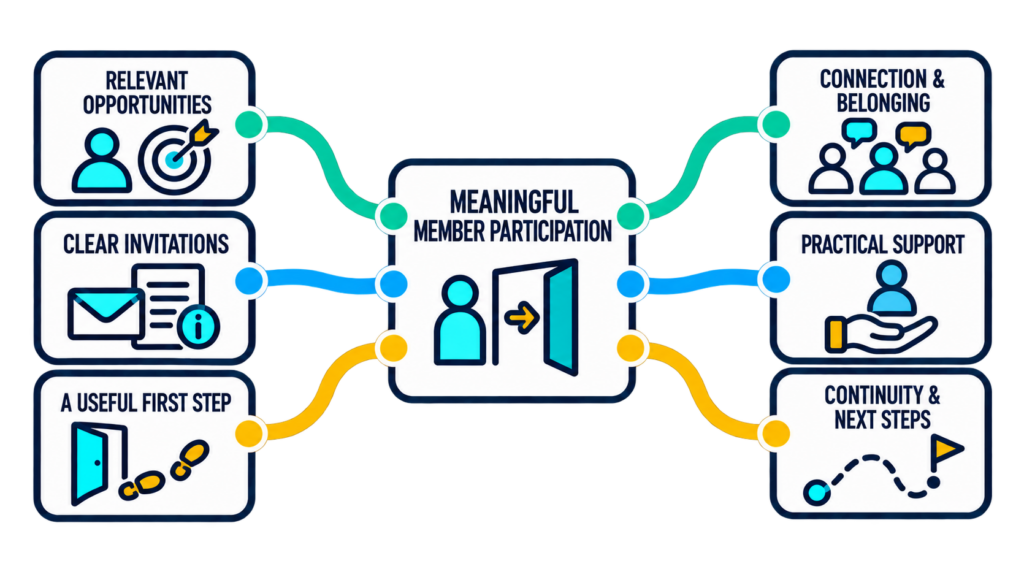
We help membership organizations connect their opportunities to the goals, circumstances, relationships, and practical realities that shape participation.
The work should make it easier for members to take a useful next step and for organizational teams to support that step consistently.
Purpose-connected
Begin with what the member and organization want the experience to accomplish. Use that purpose to guide invitations, support, and review.
Member-centered
Include relevant member perspectives and respect different interests, availability, preferred ways of participating, and decisions to pause.
Experience-aware
Examine what happens across the whole journey, including the points between messages, platforms, teams, and activities.
Practical & accountable
Choose improvements the organization can operate. Identify who owns each important step and how the team will learn whether the change helps.
When the workshop reveals something worth maintaining
Turn isolated invitations into a connected participation experience.
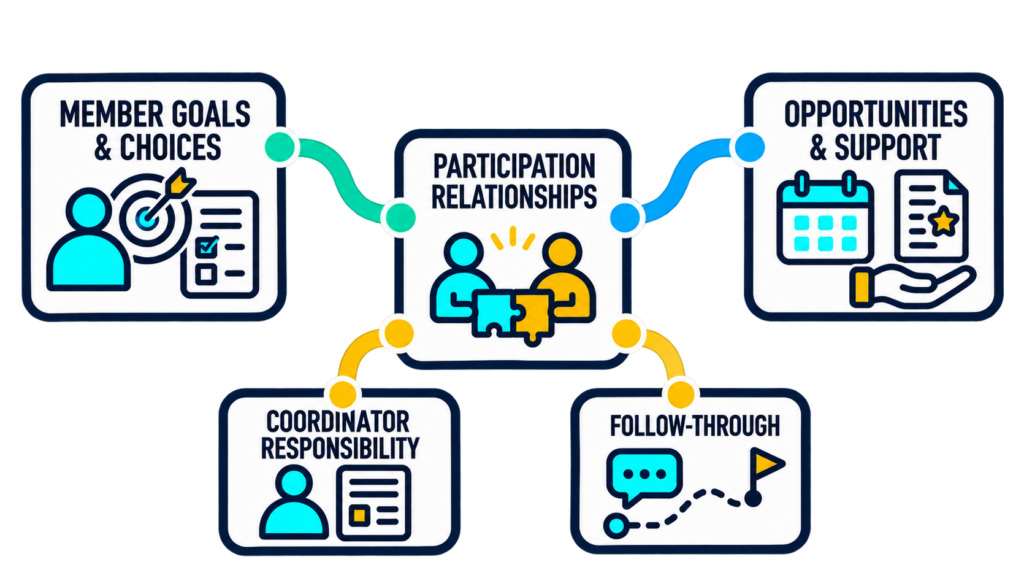
A workshop may reveal that meaningful participation depends on relationships the organization struggles to maintain across separate calendars, forms, member records, staff conversations, and program tools.
A potential Gobekli configuration could connect organizational opportunities and responsibilities in TalentSync with appropriate member goals, experience, interests, and sharing choices through TalentPass.
The starting point is the experience examined during the workshop: what the member needs to understand, which opportunity fits, how participation begins, who provides support, and what should happen next.
Workshop Findings
Identify the member purpose, opportunity, entry requirements, points of friction, support needs, handoffs, and follow-through that should remain visible after the engagement.
Gobekli Setup
Scope relevant member and opportunity profiles, participation relationships, source connections, member choices, coordinator responsibilities, and review processes.
Ongoing Coordination
Maintain the context needed to support participation as opportunities change, members update their interests, relationships develop, and teams review the experience.
Example: helping a mentoring program move beyond expressions of interest
An association receives interest in mentoring, but many members never begin a relationship or stop after the first conversation.
The workshop could examine how the program explains its purpose, gathers relevant interests, introduces participants, establishes expectations, supports coordinators, and handles difficulties or requests to change the arrangement.
A configuration brief could then define participant and mentor profiles, program opportunity records, introduction and acceptance steps, coordinator visibility, check-in responsibilities, and appropriate next steps.
TalentPass could help members express relevant goals and experience. TalentSync could help the organization coordinate the opportunities and relationships in scope. Passport Pages could support appropriate source connections and sharing arrangements. Pythia could help explain opportunities and guide clarification within the information and permissions available.
Specific matching, messaging, reminders, and workflow behavior would be confirmed during solution planning.
A Gobekli setup is an optional continuation. The workshop outputs remain useful independently of product adoption.
The configuration described here includes potential capabilities. Current availability, integration needs, configuration work, and any required development would be confirmed during scoping.
Existing membership, event, learning, and community systems may continue to operate their respective activities. The workshop helps identify which connections would improve the member experience.
Frequently asked questions
Questions membership leaders ask before booking.
It is a configurable, facilitated workshop that helps an organization improve a defined participation experience.
Every engagement begins with Member Engagement Direction and then applies selected problem modules to the organization’s examples. The result is a practical plan for improving discovery, entry, participation, support, or follow-through.
It is designed for professional associations, trade associations, chambers, unions, alumni networks, federated organizations, and other member communities.
Participants may include membership teams, communications staff, program owners, event or learning teams, volunteer coordinators, chapter colleagues, technology teams, and relevant member representatives.
No. Every engagement begins with the required Member Engagement Direction foundation.
A typical workshop then includes two or three modules selected around the participation challenge your organization wants to address.
That depends on the member’s purpose and the opportunity involved. It might mean establishing a useful peer relationship, completing a learning experience, receiving support, contributing expertise, or taking on a volunteer role.
The workshop defines what a useful experience would look like before choosing measures or proposing changes.
No. Members may have limited time, changing circumstances, different preferences, or reasons for membership that involve little visible activity.
The workshop helps distinguish what the available records show from what needs to be understood through member input.
Communication is one possible focus. Participation can also break down because an opportunity is difficult to enter, expectations are unclear, support is missing, or the experience provides no useful next step.
The selected modules follow the problem identified during Member Engagement Direction.
Yes. A new-member journey, mentoring program, annual event, volunteer opportunity, chapter experience, or particular member population can provide a useful scope.
A focused example makes it easier to assign improvements and review their effects.
Yes. It can examine how opportunities are described, how members express interest, what responsibilities involve, and what support helps people begin and continue.
The work also considers whether participation depends too heavily on informal invitations or a small group of familiar contributors.
Yes. The workshop can examine how members discover and enter those activities, who handles introductions, and where responsibility moves between groups.
The aim is to make the relevant handoffs and support arrangements clearer while accounting for local circumstances.
Members may contribute through direct participation, interviews, feedback, or walkthroughs of the experience being examined.
The intake identifies which perspectives are needed and how to involve them appropriately. Staff assumptions remain distinguishable from member accounts.
Begin with one participation challenge, a description of the member population, and examples of the current experience.
Useful materials may include invitations, opportunity descriptions, registration steps, onboarding messages, support arrangements, participation records, and relevant feedback. Complete member records are not required to begin.
No. The workshop produces a practical Member Engagement Path whether or not your organization adopts Gobekli software.
If the findings reveal relationships or processes worth maintaining, an appropriate configuration can be explored afterward.
Member Intelligence examines what the organization understands about its members, their goals, capabilities, relationships, and contributions.
Member Engagement examines how members find relevant opportunities, enter useful experiences, receive support, and continue participating. Missing member context identified here may become a focused Intelligence follow-up.
Member Engagement improves the experience of participating in what the organization offers.
Membership Value examines what those offerings enable, whether the benefit portfolio fits member needs, and what supports the case for joining or renewing. A participation review may reveal a benefit that needs that broader examination.
Your organization leaves with a scoped response and a 30–90 day path.
Next steps may include revising an invitation, simplifying entry, testing a welcome experience, improving a handoff, adjusting program support, or offering a more appropriate route back into participation.
Where useful, the configuration brief becomes the starting point for a Gobekli implementation conversation.
HELP MEMBERS FIND THEIR NEXT STEP
Make it easier to turn interest into meaningful participation.
Identify where members lose their way, what support would help, and which connections your organization needs to maintain.
Begin with Member Engagement Direction, then select the modules that address your organization’s particular challenges.
