
MEMBER ENGAGEMENT WORKSHOP MODULE
Participation Barriers & Inclusive Access
An opportunity can be open to members while remaining difficult to use. Identify practical, informational, social, and accessibility barriers, then define changes that make relevant participation more workable.
Does this sound familiar?
Open invitations hide difficult conditions
Members are welcome to join, but timing, cost, travel, technology, or preparation makes participation difficult.
Essential information arrives too late
Members discover requirements, formats, access arrangements, or commitments only after investing time in the opportunity.
Familiarity becomes an entry requirement
Participation depends on knowing the terminology, unwritten expectations, or people who can explain how things work.
One format becomes the only route
A meeting, document, platform, or activity assumes that everyone can participate in the same way.
Getting help requires extra effort
Members must explain their needs repeatedly, find the right contact, or disclose more personal information than the request requires.
Missing participation stays unexplained
The organization sees who attended or completed an activity but hears little from people who could not begin or continue.
What are participation barriers and inclusive access?
Participation barriers are conditions that make it difficult for a member to discover, enter, use, or continue a relevant opportunity.
They may involve time, cost, location, technology, information, language, social expectations, accessibility, or the way assistance is provided.
Inclusive access concerns how the organization designs and supports participation so that different circumstances and access needs can be considered in practical ways.
An opportunity may be formally available without providing a workable route for everyone it is intended to serve.
This module examines one selected participation experience, identifies barriers that need attention, and defines changes and support arrangements to test.
Availability becomes useful when members can act on it.
An organization may offer a relevant program and communicate that everyone is welcome.
The member still needs to find it, understand what it involves, enter the experience, and take part.
A registration form may be difficult to use. A schedule may exclude members working particular shifts. A discussion may rely on confidence with unfamiliar terminology. Materials may not work with the tools someone uses to access them.
These conditions can appear at different points in the same journey.
A practical review identifies the specific interaction that becomes difficult and connects it to a change the organization can assign, explain, and test.
See the conditions that shape participation.
Information and Understanding
Plain descriptions
Visible requirements
Language and terminology
Preparation information
Ways to ask questions
Practical Conditions
Time and scheduling
Fees and related costs
Travel and location
Work and caring commitments
Notice and preparation time
Formats and Accessibility
Registration and navigation
Documents and materials
Audio and visual content
Physical and digital environments
Alternative participation methods
Social Conditions
Newcomer entry
Unwritten expectations
Ways to contribute
Interaction and facilitation
Comfort seeking assistance
Support and Improvement
Understandable help routes
Necessary information only
Responsible contacts
Feedback from affected members
Changes and review
A barrier becomes easier to address when the team can identify where it occurs, how it affects participation, and who can change the relevant condition.
How participation barriers become normalized
STAGE 1 — An opportunity is built around familiar participants
Teams design the format, schedule, information, and entry process using the circumstances they know best.
STAGE 2 — The same arrangements are repeated
Existing forms, platforms, meeting patterns, and expectations become the default for later offerings.
STAGE 3 — Members work around the difficulties
Some seek individual help or find another route. Others delay, withdraw, or never begin.
STAGE 4 — The missing experience remains unseen
Feedback comes mainly from people who managed to participate, leaving the organization with limited understanding of the barriers others encountered.
Low participation does not identify the barrier.
A participation report can answer an important question:
Who registered, attended, contributed, or completed the activity?
A barrier review also examines who tried to participate, where the route became difficult, and what affected members say would have helped.
The review should clarify:
Locate the issue in discovery, understanding, registration, preparation, interaction, completion, or follow-up.
Identify the relevant information, timing, cost, format, environment, expectation, or support arrangement.
Distinguish a reported experience, an observed problem, and a team assumption that still needs validation.
Consider people who could not enter, stopped partway through, used another route, or did not respond to the usual feedback process.
Examine whether to remove an unnecessary requirement, clarify information, adapt the experience, provide support, or offer another route.
Assign an owner and identify the practical task, member feedback, or specialist review needed to assess whether the difficulty has been reduced.
A useful barrier review needs six forms of clarity.
Location
The team can identify the specific point where participation becomes difficult.
Condition
The review names the feature, requirement, or arrangement contributing to the difficulty.
Experience
Affected members can explain what happened through an appropriate feedback route.
Response
The proposed change addresses the condition rather than relying only on more encouragement.
Ownership
Someone has responsibility for making the change and providing any needed support.
Verification
The team can examine whether members can use the revised route and what remains unresolved.
Workable access
A participation route becomes easier to use when it provides:
- Essential information before members commit.
- Understandable steps and expectations.
- Formats appropriate to the intended experience.
- Practical ways to ask for assistance.
- Clear responsibility for responding.
- Feedback that informs further improvement.
The design and support work together to reduce avoidable effort.
Availability with hidden barriers
An opportunity can remain difficult to use when it relies on:
- A general welcome statement without practical detail.
- Requirements discovered after registration.
- One assumed schedule or participation method.
- Insider knowledge about how to begin.
- Repeated explanations to obtain help.
- Feedback only from successful participants.
The review identifies which conditions need to change for the selected experience.
An evening discussion can be relevant while its participation route excludes members.
An association offers a recurring discussion for members managing small teams.
The topic attracts interest, but participation remains concentrated among a familiar group.
The team selects the route into the discussion for review.
Available feedback suggests that some members cannot attend at the scheduled time. Others are unsure whether they have enough experience to contribute. The registration page provides little detail about the format or support available.
Participants clarify what is known and which assumptions need further member input.
They consider clearer entry information, advance questions, a different session time, and a way to contribute a question without attending live.
They also assign a contact for access questions and identify any materials or technology that need specialist review.
The result is a small set of changes to test against specific barriers, with no assumption that one adjustment will address every member’s circumstances.
A different route should explain what it makes possible.
An alternative format may help a member access information without reproducing every part of the original experience.
A recording may provide the presentation but not the live conversation. A written question may enable contribution without offering immediate discussion.
The review makes those differences understandable.
It asks which part of the experience matters for the selected purpose and whether the alternative provides a useful way to participate.
Where it does not, the team identifies what remains unresolved and who can review another response.
Offering an alternative is a starting point for evaluation, not proof that access is equivalent.
Members should not carry the full burden of making participation work.
Individual assistance can be useful while a recurring design problem remains unresolved.
If many members need help with the same form, instruction, schedule, or activity, the organization can examine the underlying arrangement.
The review also considers how people request support.
Members need an understandable contact route, a clear explanation of what information is necessary, and confidence about who will see it.
A practical improvement may involve both a change to the shared experience and a better process for responding to individual needs.
THE MATCHING WORKSHOP MODULE
Module 11: Participation Barriers & Inclusive Access
This practical minicourse helps membership organizations identify practical, informational, social, and accessibility barriers, then define changes that make relevant participation more workable.
Participants learn a repeatable review method, apply it to one selected participation route, and identify whether the priority response concerns information, conditions, format, interaction, support, or further assessment.
The exercise also defines the opportunity requirements, member-selected access preferences, support responsibilities, and improvement records that a subsequent Gobekli configuration would need to support.
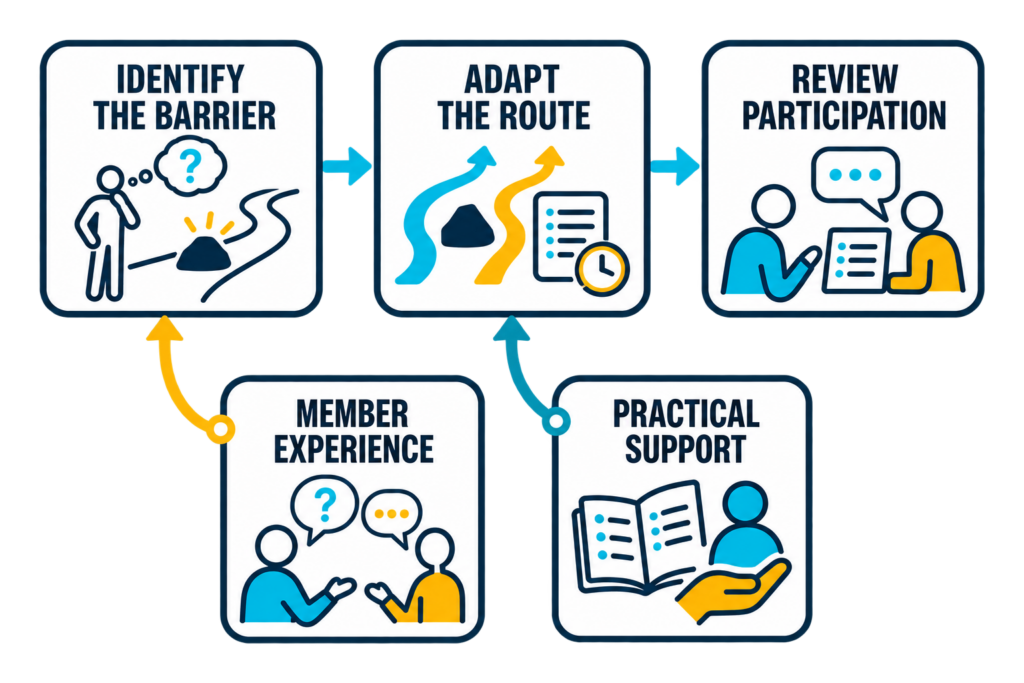
This module helps your team:
- Define the purpose of one participation route.
- Identify where members encounter difficulty.
- Examine practical and informational conditions.
- Review social expectations and newcomer entry.
- Identify format and accessibility questions.
- Distinguish observed barriers from assumptions.
- Include perspectives missing from usual feedback.
- Clarify assistance and information-sharing needs.
- Develop appropriate changes or alternative routes.
- Assign implementation and review responsibilities.
- Create a focused barrier response brief.
- Outline a connected access-support configuration.
What should happen to each identified barrier?
The review leads to a deliberate response based on the participation purpose, the available evidence, and the condition creating difficulty.
Clarify
Make requirements, instructions, formats, and support arrangements understandable before participation.
Remove
Eliminate an unnecessary step or condition that creates avoidable difficulty.
Adapt
Revise timing, materials, interaction, or another aspect of the experience.
Support
Provide appropriate assistance with a clear request and response route.
Offer a Route
Create another workable way to access or contribute to the selected opportunity.
Refer
Assign technical, accessibility, policy, or other specialist review where the issue requires further assessment.
These responses guide practical improvement. Their suitability depends on the experience being supported, and changes should be reviewed with the people affected.
What should a participation barrier review examine?
The intended experience
What should members be able to understand, enter, do, or contribute?
The difficult step
Where does the route become confusing, impractical, inaccessible, or socially difficult to navigate?
The supporting evidence
What do member accounts, observed interactions, support requests, or existing reviews establish?
The missing perspectives
Whose experience is absent from the information currently available?
The proposed response
What change, assistance, alternative, or further assessment addresses the condition?
The verification
Who will test the response, what task or experience will they examine, and how will unresolved issues be handled?
Trace one barrier from member experience to an assigned response.
Your team applies the method to one participation route established through Member Engagement Direction.
STEP 1
Define the participation purpose
Identify the population, opportunity, and intended experience within scope.
STEP 2
Locate the difficult step
Trace where a member encounters difficulty and describe the relevant conditions.
STEP 3
Examine the evidence
Review reported experiences and observations, identify missing perspectives, and mark assumptions requiring validation.
STEP 4
Develop a response
Clarify, remove, adapt, support, offer a route, or refer the issue for further assessment.
STEP 5
Assign the change and support
Identify the owner, resources, communication, and assistance needed to make the response usable.
STEP 6
Test and review
Define how affected members and any relevant specialists will examine the revised route and what happens if the difficulty remains.
The result is a draft Participation Barrier & Response Map connecting the difficult step, supporting evidence, proposed change, responsible owner, and verification plan.
FUTURE PRODUCT CONNECTION
Keep participation conditions connected to support and improvement.
A subsequent Gobekli configuration could help the organization relate opportunities to their participation conditions, available support, and identified improvement needs.
TalentSync could connect program and activity profiles to formats, requirements, responsible contacts, support routes, and assigned changes.
TalentPass could help members express relevant participation preferences and the assistance they choose to request. Pythia could help explain participation information, prepare a question, or identify an available support route using the information and permissions in scope. Passport Pages could support agreed source and sharing connections.
A connected participation support view could potentially show:
- What experience the opportunity is intended to provide.
- Which participation conditions and formats apply.
- What access and support information is available.
- Which preferences or requests a member chooses to share.
- Where a difficulty has been reported or observed.
- What evidence supports the interpretation.
- Who is responsible for assistance or improvement.
- Which alternative routes are available and what they provide.
- What change or further assessment has been assigned.
- Whether the revised route has been reviewed and what remains unresolved.
The workshop produces a starting configuration brief: opportunity conditions, support information, member sharing choices, request routes, barrier records, responsible roles, and improvement review states.
Specific accessible interfaces, alternative formats, integrations, request handling, reminders, and workflows would be confirmed and evaluated during solution planning.
PRODUCT AND DECISION BOUNDARIES
Understanding a barrier does not require profiling the member.
A participation difficulty can be examined through the task, environment, and support needed without assuming a diagnosis or personal explanation.
A member’s request should be handled according to its purpose and the information necessary to respond.
A later configuration should distinguish an expressed preference, a support request, a reported barrier, an observed issue, and a verified improvement.
The workshop and product connection do not establish:
- Disability, health, or personal circumstances inferred from behavior.
- A reason for nonparticipation based only on an activity record.
- Permission to share private support requests broadly.
- Accessibility based only on offering an alternative format.
- Equal usefulness across different participation routes.
- Compliance or certification from the workshop exercise.
- Resolution of a barrier before the response has been evaluated.
The organization remains responsible for its access arrangements and any specialist assessment needed for the selected experience.
The workshop can clarify barriers and proposed responses independently of future product adoption.
What to bring into the conversation
You do not need a complete organization-wide access review before beginning.
Start with one participation route connected to the challenge established through Member Engagement Direction.
Useful inputs may include:
- The purpose of the selected opportunity.
- Descriptions, instructions, and entry requirements.
- Registration forms and participation steps.
- Formats, schedules, costs, and preparation expectations.
- Examples of member questions or difficulties.
- Existing accessibility or usability findings.
- Assistance request and response arrangements.
- Feedback from people who could not participate.
- Available alternatives and what they provide.
- Responsibilities for changing the experience.
- A program owner and affected-member perspective.
- Relevant specialists for issues requiring further review.
The aim is to examine one route in sufficient detail to define a practical response. The foundation module establishes the population, purpose, evidence, and boundaries for that work.
What this module can help clarify
Where participation becomes difficult
Locate the selected barrier and describe the conditions affecting the member’s experience.
What the evidence supports
Distinguish reported and observed difficulties from assumptions, and identify perspectives still needed.
What response to test
Define an appropriate change, support arrangement, alternative route, or specialist review.
Who carries the work forward
Develop an assigned improvement and verification plan, supported by a starting configuration brief.
These outputs begin with the example reviewed during the module. Final scope depends on the modules selected, available inputs, and the participation challenge established through Member Engagement Direction.
Where might the work lead next?
Benefit & Opportunity Discovery
Clarify how members find, understand, and enter opportunities when information and navigation create the barrier.
Peer Connections & Community Belonging
Examine introductions, interaction, and community entry when social expectations make participation difficult.
Lapsed Participation & Re-Engagement
Develop an appropriate return route when a previous participation difficulty has been addressed and members may wish to reconnect.
Your team can combine this module with other parts of the Member Engagement Workshop according to the participation challenge established through Member Engagement Direction.
Frequently asked questions
Questions organizations ask before beginning.
A condition that makes a relevant opportunity difficult to discover, enter, use, or continue. It may concern information, time, cost, location, technology, format, accessibility, social expectations, or support.
No. The aim is to make relevant participation more workable while preserving the member’s choice. A decision not to participate should not automatically be treated as a barrier.
No. The module is a practical review of a selected participation route. It can identify questions and assign specialist assessment, but it does not provide an accessibility certification or replace a technical audit.
Events, learning programs, volunteering, mentoring, community groups, chapter activities, partner programs, and other participation routes. The exercise focuses on one bounded experience.
Activity records alone do not establish the reason. Review member accounts, support requests, observed difficulties, and the experience of people who could not enter or continue.
Identify an appropriate way to invite feedback that does not depend on completing the activity or using the same route that caused difficulty. Keep the request focused and participation voluntary.
The review should begin with the participation task and the assistance needed. It should not assume that detailed personal information is necessary to understand or address the selected difficulty.
Yes. The team can examine schedules, notice, direct and related costs, and other practical commitments, then identify changes or options within the organization’s control.
Yes. The review can examine unfamiliar terminology, unwritten expectations, newcomer entry, discussion formats, and how members ask for help or contribute.
No. It changes the participation conditions and may create different difficulties. The review should examine the actual route, tools, materials, and support involved.
They may provide useful access to content while leaving discussion, questions, or interaction unresolved. Assess the alternative against the purpose of the selected experience.
Clarify why it applies, explain it early, and examine appropriate support or alternative routes. The workshop can identify decisions or specialist input needed without assuming the requirement can be waived.
Consider the effect on participation, the evidence available, how often the difficulty occurs, and what it would take to respond. The exercise develops a focused change and identifies unresolved issues for further review.
That module examines whether member categories and available perspectives support an organizational decision. This module examines the conditions that make a specific participation experience difficult to use.
Other modules follow a particular experience, such as onboarding, mentoring, or learning. This module provides a focused method for examining barriers and evaluating access improvements within one of those experiences.
The outputs can inform a configuration connecting participation conditions, member-selected preferences, support requests, reported barriers, responsible roles, and improvement reviews. Specific capabilities and implementation requirements would be confirmed during scoping.
Your team will review one bounded participation route and develop a draft barrier and response map, assigned improvement and verification plan, and starting configuration brief. Wider assessment, implementation, and ongoing review are subsequent steps.
MAKE RELEVANT PARTICIPATION MORE WORKABLE
Help members reach the opportunity with fewer avoidable barriers.
Connect participation conditions to clear information, practical changes, appropriate assistance, and accountable review.
This module is part of Gobekli’s configurable Member Engagement Workshop.