
MEMBER ENGAGEMENT WORKSHOP MODULE
New Member Onboarding & First Value
They joined for a reason. Does your welcome help them take a useful first step?
Connect joining, welcome, orientation, and a relevant first experience so new members know where to begin and receive useful support.
Module 2 · Member Engagement Workshop
Does this sound familiar?
The welcome explains the organization more than it helps the member
New members receive history, benefits, links, and announcements without a clear starting point connected to why they joined.
Administrative completion becomes the finish line
Payment, account creation, and a completed profile are treated as successful onboarding even when the member has not received useful help.
Every new member receives the same route
Different goals, experience, affiliations, and availability are directed into one orientation sequence.
The first useful experience is difficult to reach
An appealing opportunity requires another login, an unclear registration process, an introduction, or a wait that nobody explains.
Handoffs leave new members waiting
Membership staff, chapter leaders, program teams, or company representatives each assume someone else will help the member begin.
Nobody checks whether the welcome led to anything useful
The organization knows which messages were sent but has little understanding of whether members found a relevant next step or needed help.
What are new member onboarding and first value?
New member onboarding is the experience that helps someone move from joining an organization to understanding how to begin using their membership.
It includes administrative access, welcome, orientation, relevant choices, practical support, and the handoffs needed to reach a useful first experience.
First value is an early experience in which the member receives something useful in relation to their purpose.
That might include:
- Getting an answer to a pressing professional question.
- Meeting a relevant peer.
- Finding and using a needed resource.
- Entering an appropriate learning opportunity.
- Receiving guidance from a program coordinator.
- Understanding how to access a service.
- Making a first contribution that the organization acknowledges.
The appropriate first experience depends on the member and the membership arrangement.
This module examines how the organization helps new members reach that experience and what happens when they need a different route or additional support.
Joining creates access. Onboarding helps someone use it.
A membership confirmation establishes that a relationship has begun.
The member may still need to understand which opportunities fit, how to access them, what participation requires, and whom to ask for help.
An organization can deliver every planned welcome message while leaving those questions unresolved.
To examine the experience, your team may need to connect:
- Why the member joined.
- What the organization promised or explained.
- When access becomes available.
- What the welcome asks the member to do.
- Which choices appear first.
- How the member recognizes a relevant option.
- What steps are required to enter it.
- Who handles questions and introductions.
- What useful experience the route is intended to enable.
- How the organization learns whether the route worked.
These connections help the team distinguish a completed welcome process from a member who has been helped to begin.
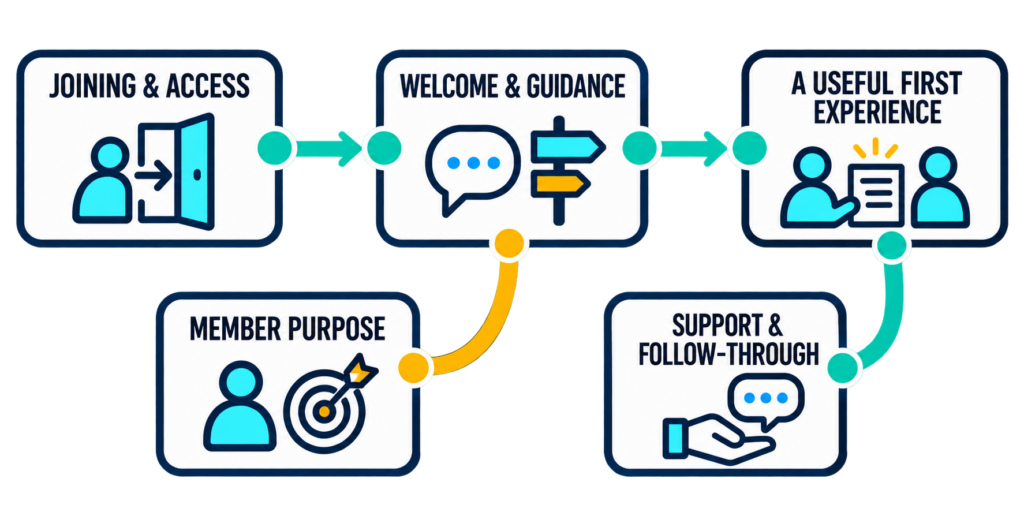
Connect the welcome to a useful first experience.
Joining & Access
Membership confirmation.
Account and service access.
Eligibility and entitlements.
Organization or chapter affiliation.
Administrative questions.
Member Purpose
Reason for joining.
Immediate interests.
Relevant experience.
Availability and preferences.
Information the member chooses to provide.
Welcome & Orientation
Clear explanation of membership.
Relevant starting options.
Essential instructions.
Expected commitments.
A visible help route.
First Experience
Selected resource or opportunity.
Entry requirements.
Introduction or registration.
Preparation and support.
Useful member outcome.
Handoffs & Follow-Through
Responsible staff or volunteers.
Confirmation of the next step.
Questions or stalled progress.
Member feedback.
An appropriate continuation.
The workshop begins with one new-member route. It does not require a redesign of every benefit or the full membership lifecycle.
How a welcome process becomes disconnected from first value
Stage 1 — A member joins with an expectation
The person anticipates help, access, relationships, learning, representation, or another benefit relevant to their circumstances.
Stage 2 — The organization delivers its standard welcome
Administrative instructions and general information arrive according to the organization’s sequence.
Stage 3 — The member must work out the connection
They need to translate the available options into a useful first step, often across unfamiliar pages, systems, and people.
Stage 4 — The organization loses sight of the experience
The welcome sequence ends without establishing whether the member began, encountered difficulty, chose to wait, or needed a different route.
“They received the welcome pack.” What happened next?
A new member joins an association because they want advice about managing their first team.
They receive a welcome email containing links to the directory, events calendar, resource library, learning platform, and local chapter.
The information is relevant to membership broadly. It does not tell them where someone with their immediate question should begin.
They open several pages, encounter unfamiliar program names, and postpone the decision.
A useful onboarding review examines the route from that initial purpose to an experience the member can recognize and enter.
Questions that change the interpretation:
Review the joining context and any expressed purpose. Separate what the member said from what the organization inferred.
Check whether membership status, account setup, eligibility, or affiliation affected access. A welcome message cannot resolve an unexplained access problem.
Examine whether the member could understand which option fit, why it might help, and what taking part involved.
Trace the actual process, including logins, forms, registration, introductions, waiting periods, or preparation.
Identify the support route and the person responsible for carrying questions or handoffs through.
Consider the member’s account and evidence relevant to the purpose. Opening a message or completing a profile does not establish that useful help was received.
Six dimensions of a useful onboarding experience
Starting Context
How did the member join, what arrangement applies, and what do they already understand about the organization?
Purpose & Relevance
What does the member want to accomplish, and which starting options could reasonably help?
Access & Readiness
Can the member reach the opportunity, understand its requirements, and prepare to take part?
Guidance & Choice
Does the welcome provide manageable options and a clear next step while allowing the member to choose differently?
Support & Handoffs
Who handles questions, introductions, access issues, and transitions between teams?
First Value & Continuation
What early experience would be useful, how will the team learn about it, and what appropriate next step could follow?
From a completed welcome sequence to a supported beginning
A process-completion view
- Membership confirmation sent.
- Account invitation delivered.
- Profile fields completed.
- Benefits list distributed.
- Orientation invitation issued.
- Welcome sequence finished.
- Member moved into regular communications.
This view helps the organization track administrative activity but leaves much of the member’s experience unexplained.
A member-experience view
- Access and entitlements are understandable.
- The member can express a relevant purpose.
- Starting options connect to that purpose.
- Entry steps and commitments are clear.
- Someone owns important handoffs.
- Help is available when the route becomes difficult.
- The member can describe what was useful and choose what comes next.
This view connects the organization’s welcome work to the experience it is intended to support.
Helping a new member reach relevant peer advice
An association offers peer circles, learning sessions, a resource library, and mentoring.
New members receive the same welcome sequence regardless of their immediate interests. Staff hear that some members are unsure where to begin, while program coordinators report receiving inquiries that belong elsewhere.
The team chooses one onboarding example: members seeking help with their first management responsibilities.
During the module, participants examine:
- How the member can express that interest.
- Which existing opportunity offers a suitable starting point.
- What the welcome should explain about that opportunity.
- Whether the member can access it immediately.
- Whether an introduction or coordinator conversation is needed.
- What happens while the member waits.
- Who receives the handoff.
- What the member should expect from the first interaction.
- How the organization will ask whether it helped.
The team drafts a route that offers a small number of relevant choices, explains their differences, and assigns responsibility for any introduction.
It also identifies an alternative for members who cannot attend a scheduled activity.
The output is a first-experience plan to test with a defined group. Detailed redesign of the peer program itself can follow through the appropriate engagement module if needed.
The first useful experience will differ among members.
A new member seeking an immediate answer may benefit from a resource or brief conversation.
Another may need a professional introduction, a learning opportunity, or a clear understanding of how to access support later.
These experiences may happen on different schedules.
The module helps your team distinguish:
- Access provided.
- Guidance understood.
- An opportunity selected.
- Participation begun.
- Useful help received.
- A next step chosen.
The organization can use these distinctions to review progress without assuming that every new member must attend the same event or complete the same activity.
The broader question of what membership enables over time belongs in the Membership Value Workshop. This module focuses on helping the member reach an appropriate beginning.
A new membership can involve more than one person.
An organization may join on behalf of employees. A member may enter through a chapter, employer, partner, or existing professional relationship.
The payer, primary contact, eligible participant, and person receiving the welcome may be different people.
An onboarding route needs to make those relationships workable.
The review may ask:
- Who has joined, and who is entitled to participate?
- Who receives the initial communication?
- How do eligible individuals learn about their access?
- What does a company or chapter contact need to do?
- Who can resolve an affiliation or eligibility question?
- How does each participant reach relevant guidance?
The module examines how these arrangements affect onboarding. Deeper uncertainty about whose records describe whom can be addressed through Member Identity & Affiliation Clarity.
MEMBER ENGAGEMENT WORKSHOP MODULE
Module 2: New Member Onboarding & First Value
This practical minicourse helps your team learn a method for connecting a member’s joining context to a useful first experience.
Participants apply the method to one onboarding route. They examine the welcome, trace access and entry steps, identify necessary support, and define how the organization will follow through.
The work builds on the population, purpose, and boundaries established through Member Engagement Direction.
This module helps your team:
- The member population and joining arrangement.
- Expressed reasons for joining.
- Membership confirmation and access.
- Existing welcome messages and materials.
- Orientation content and starting choices.
- The intended first useful experience.
- Entry steps and preparation.
- Support routes and common questions.
- Handoffs across staff, chapters, or programs.
- Different timing and participation preferences.
- Evidence of usefulness and unresolved difficulty.
- A bounded starting configuration.
What might an appropriate response involve?
The response depends on whether the difficulty concerns access, relevance, guidance, support, or follow-through.
Clarify the Meaning
Seek further explanation where a comment, request, or summary is ambiguous.
Preserve the Context
Keep the relevant question, source, experience, and timing attached to the input.
Examine the Pattern
Compare related feedback while retaining meaningful differences and contradictory accounts.
Seek Further Evidence
Identify which missing perspectives or unanswered questions could change the interpretation.
Assign the Response
Route individual issues and broader findings to the people responsible for reviewing and acting.
Communicate the Outcome
Explain what was heard, what happens next, and what remains under consideration.
A useful response may begin with a clearer message, a better handoff, or a simpler entry process. A later configuration can support the arrangement established through that work.
What we review together
Joining Context
Who is joining, how membership begins, and which access or affiliation arrangements apply.
Purpose & Starting Options
What members want and whether the available first steps make their relevance clear.
Welcome & Orientation
The sequence, explanations, choices, and expectations presented to new members.
Access & Entry
The actual steps required to reach the intended first experience.
Support & Responsibility
Who handles questions, introductions, delays, and transitions between teams.
Usefulness & Continuation
How the organization learns what helped and supports an appropriate next choice.
The minicourse: connect one welcome route to a useful first experience
Your team applies the concepts to a defined new-member group and one relevant onboarding route.
STEP 1
Step 1 — Establish the joining context
Identify the member population, joining arrangement, access conditions, and purpose within scope.
STEP 2
Step 2 — Define a useful first experience
Describe what the member could receive or accomplish early in membership. Record where that expectation needs validation.
STEP 3
Step 3 — Walk through the current welcome
Review the messages, materials, orientation, and choices in the order the member encounters them.
STEP 4
Step 4 — Trace access, entry, and support
Follow the route into the selected experience. Identify requirements, handoffs, delays, questions, and responsible people.
STEP 5
Step 5 — Draft an improved route
Choose practical changes to guidance, entry steps, support, or follow-through. Include an appropriate alternative when the initial route does not fit.
STEP 6
Step 6 — Define the test and starting configuration
Assign the next step, identify member feedback and review conditions, and outline the relationships and processes a subsequent implementation would need.
Exercise output
A draft New Member First-Experience Map connecting joining, member purpose, welcome, access, support, handoffs, and an appropriate next step.
- A defined joining context.
- A relevant first-experience goal.
- A review of the current welcome.
- Clear entry and support requirements.
- An improved route with assigned handoffs.
- A practical test and configuration brief.
FUTURE PRODUCT CONNECTION
How this work can connect to Gobekli
The workshop establishes the route a new member should be able to understand and use, along with the responsibilities needed to support it.
That work can inform a scoped Gobekli configuration.
TalentPass could help members express relevant goals, interests, experience, and sharing choices. TalentSync could connect those appropriately shared details to organizational opportunities, onboarding responsibilities, and participation relationships.
Passport Pages could support the source and sharing connections included in scope. Pythia could help explain starting options and guide clarification within the information and permissions available.
The configuration should support the first-experience route established through the workshop.
- Reasons for joining are unavailable or assumed. Member clarification of relevant goals, interests, and immediate questions.
- Different joining arrangements receive the same instructions. Onboarding routes connected to membership type, affiliation, and participant role.
- Members cannot identify a relevant first step. Opportunity profiles explaining purpose, fit, requirements, and entry.
- The welcome presents too many unrelated options. A manageable set of starting views connected to the member’s chosen purpose.
- Access conditions are difficult to understand. Clear relationships among membership arrangements, eligibility, and access guidance.
- Introductions disappear between teams. Assigned handoffs connecting the member, opportunity, and responsible coordinator.
- Members do not know where to ask for help. A visible support route with appropriate context for the receiving person.
- Staff cannot distinguish progress from an unresolved issue. Relevant onboarding status, member questions, and assigned follow-through.
- The organization tracks messages but not usefulness. Member feedback connected to the first experience and its intended purpose.
- The welcome ends without an appropriate continuation. Connections to a next opportunity, alternative route, support conversation, or member-chosen pause.
Specific messaging, reminders, recommendations, access behavior, integrations, and workflow capabilities would be confirmed during solution planning.
PRODUCT AND DECISION BOUNDARIES
What this module does—and its boundaries
The module helps your team:
- Examine one new-member onboarding route.
- Connect the welcome to a relevant member purpose.
- Define an appropriate first useful experience.
- Trace access, entry, support, and handoffs.
- Draft improvements and a practical test.
- Prepare a starting configuration brief.
The module does not complete:
- A redesign of the entire benefit portfolio.
- A full membership communications strategy.
- Detailed operation of every program introduced during onboarding.
- A complete review of all membership records.
- Implementation across every connected system.
- A guarantee of participation, satisfaction, or renewal.
The exercise provides a practical starting point. Wider rollout, detailed program changes, and ongoing operation may require additional work.
What to bring into the conversation
Begin with one question that member input could help answer, or one collection of feedback that has been difficult to turn into a clear next step.
A useful starting question is: “What are members telling us about this experience, what does that evidence support, and who should do what next?”
Useful inputs may include:
- One new-member group or joining arrangement.
- Current welcome messages and materials.
- Orientation content or starting-point guidance.
- Representative account, access, and registration steps.
- Relevant member questions or feedback.
- Current handoff and follow-up responsibilities.
- A membership or onboarding lead.
- Someone familiar with joining and account access.
- A communications or member-experience colleague.
- The owner of a relevant first opportunity.
- A chapter, company-contact, or member perspective where appropriate.
- A person who could own the proposed test.
Use representative materials or anonymized examples where possible. The exercise can begin with an incomplete process; identifying missing steps and responsibilities is part of the work.
What your team can leave with
A New Member Onboarding Brief
A clear account of the member population, joining context, relevant purpose, current welcome, and intended first experience.
A New Member First-Experience Map
A structured view connecting the welcome to access, entry steps, support, handoffs, and continuation.
An Improvement & Test Plan
Assigned changes, an appropriate member group, feedback needs, and review conditions for examining whether the revised route helps.
A Starting Configuration Brief
An outline of the member and opportunity profiles, access context, onboarding relationships, support responsibilities, and sharing arrangements a subsequent Gobekli implementation would need.
These outputs begin with the example examined during the module. Final scope depends on selected modules, available inputs, and the challenge established through Member Engagement Direction.
Where might the work lead next?
An onboarding review may reveal opportunities that are hard to navigate, a first interaction that needs stronger social support, or practical barriers requiring deeper attention.
Benefit & Opportunity Discovery
Examine how members find and understand relevant options when the difficulty extends beyond the initial welcome.
Peer Connections & Community Belonging
Examine how introductions and early interactions help members establish useful relationships and find a place within the community.
Participation Barriers & Inclusive Access
Examine practical, informational, social, or accessibility obstacles that prevent willing members from using the proposed route.
The onboarding map can also inform later work on mentoring, events, learning, volunteering, or chapter participation when one of those experiences provides the member’s starting point.
Frequently asked questions
Questions membership organizations ask before beginning.
It is the experience that helps someone move from joining to understanding and using their membership. It includes access, welcome, orientation, relevant choices, support, and the handoffs needed to begin.
It means an early experience that is useful in relation to the member’s purpose. The workshop defines what that could look like for the population and route in scope.
It may be a useful preparation step, but it does not by itself establish that the member received help. The review connects administrative milestones to the experience they are intended to enable.
No. Different purposes, circumstances, and availability may call for different routes. The module can examine a small set of appropriate options without assuming a unique process for every person.
An orientation may be useful, but its role should be clear. The workshop examines what members need to understand and whether the format helps them reach a relevant next step.
Yes. Reviewing the messages in the order members receive them is a useful starting point. The exercise also traces what happens after a member follows a link or asks for help.
Ask for information that serves an understandable purpose in the route being examined. The workshop distinguishes what is needed to begin from information that can be requested later or left optional.
Examine which decisions need to happen first and what information makes those choices understandable. A manageable set of starting options may be more useful than presenting the full membership offering at once.
Yes. It can distinguish the purchasing organization, primary contact, eligible individuals, and the people receiving onboarding support.
The module examines the handoff: what the receiving team needs to know, who confirms the next step, and how the member gets help if the transition stalls.
Clarify the timing and what the member can do while waiting. The route may need an interim resource, coordinator conversation, or alternative experience.
The appropriate timing depends on the member’s purpose and the opportunity. The workshop establishes a practical expectation for the selected route rather than assuming one deadline fits every membership.
Use evidence suited to the purpose, including the member’s account of what was useful or difficult. Delivery, clicks, registration, and attendance can support the review but do not answer every question.
This module focuses on the transition from joining to a useful beginning. Benefit & Opportunity Discovery examines how members find and understand opportunities throughout their membership.
This module helps members reach an appropriate first experience. Membership Value examines what the organization’s benefits enable more broadly and how that value supports the case for membership.
The outputs can inform a configuration connecting relevant member context, starting opportunities, onboarding relationships, support, and follow-through. Specific capabilities and implementation requirements would be confirmed during scoping.
Your team will examine one bounded example and develop a draft onboarding brief, first-experience map, improvement and test plan, and starting configuration brief. Wider rollout and ongoing operation are subsequent steps.
Help new members turn the decision to join into a useful beginning.
Connect the welcome to a relevant first experience, make the route understandable, and establish who will help members take the next step.
Choose New Member Onboarding & First Value as part of your Member Engagement Workshop.