
MEMBER ENGAGEMENT WORKSHOP MODULE
Relevant Communication & Outreach
Members may receive your messages without understanding why an opportunity matters to them or what to do next. Connect invitations, timing, channels, and follow-up to their circumstances and a clear next step.
Does this sound familiar?
Everyone gets everything
Broad distribution leaves members to sort through messages with little connection to their interests or circumstances.
Relevance is assumed
An invitation announces the program but does not explain whom it could help or why someone would participate.
Timing misses the moment
Messages arrive before members can act, after decisions have been made, or too late to prepare.
Channels compete
Staff, programs, chapters, and partners send overlapping invitations without a shared view of what members receive.
The next step is unclear
Members cannot tell whether to register, ask a question, express interest, prepare, or wait for more information.
Follow-up loses context
Reminders continue after a response, questions go unanswered, or someone who needs help receives another generic message.
What are relevant communication and outreach?
Relevant communication connects a message to a member’s circumstances, an understandable purpose, and an appropriate action.
Outreach is the organization’s effort to bring an invitation, opportunity, request, or support offer to the people it may serve.
Relevance involves more than inserting a name or selecting a membership category. It may depend on expressed interests, current responsibilities, participation history, availability, affiliations, or a question the member has raised.
Timing, channel, frequency, and follow-up shape whether the message is useful and workable.
This module examines those connections for one selected outreach sequence.
A message needs to answer: “Why this, why me, and what next?”
An organization may know why it wants to promote an event, recruit volunteers, invite feedback, or increase program participation.
The member needs a reason of their own to consider the invitation.
That reason might be a current challenge, an expressed interest, a chance to contribute, or a useful next step following an earlier experience.
The message should make that connection understandable without claiming more knowledge about the member than the organization actually has.
A practical review follows the invitation from the reason for contacting someone through to the action, reply, or support it asks the organization to handle.
See the complete outreach sequence.
Member Circumstances
Expressed interests
Current questions and goals
Relevant roles and affiliations
Prior participation context
Communication choices
Invitation and Purpose
Reason for contacting
Opportunity or request
Potential member usefulness
Expected participation
Clear next action
Timing and Channels
Decision and preparation time
Program availability
Preferred contact routes
Frequency and coordination
Relevant moments of contact
Response and Support
Registration or interest
Questions and clarification
Acceptance or decline
Practical assistance
Responsible handoffs
Follow-up and Learning
Response status
Reminder conditions
Stopping or changing contact
Member feedback
Review and ownership
Outreach becomes more useful when the reason for contact, message, timing, response route, and follow-up can be understood together.
How outreach becomes disconnected from members
STAGE 1 — Teams have something to promote
Programs, events, services, and contribution opportunities each create a need to communicate with members.
STAGE 2 — Distribution follows familiar lists
Teams use broad membership categories, past mailing lists, or standard channels to reach potential participants.
STAGE 3 — Activity is measured locally
Each team tracks delivery, opens, clicks, or registrations while having limited visibility into other messages members receive.
STAGE 4 — More contact becomes the default response
Additional reminders are sent without resolving uncertainty about relevance, timing, understanding, entry, or support.
Sending an invitation does not establish that it helped someone decide.
A communication report can answer an important question:
Was the message delivered, opened, or acted on?
An outreach review also examines whether the invitation made sense to the member and whether the organization handled the response appropriately.
The review should clarify:
Identify the information or relationship supporting the invitation. Distinguish an expressed interest from an assumption based on a broad category.
Examine whether the message explains the situation it addresses, what participation involves, and why the member might consider it.
Review notice, preparation, schedules, availability, and any dependency that affects the decision.
Consider member preferences, the purpose of the message, and other contact from the organization.
Trace registration, questions, expressions of interest, declines, and requests for help through to the receiving person or system.
Clarify when another message would help, what it should address, and when contact should stop or change.
A useful invitation supports six judgments.
Reason
Why is the organization bringing this opportunity or request to my attention?
Relevance
How might it connect to my interests, circumstances, responsibilities, or goals?
Commitment
What would I need to do, contribute, prepare, or set aside?
Timing
When must I decide, and do I have enough time to take part?
Action
What is the next step, and where can I ask a question?
Choice
Can I decline, choose another option, or change how I hear about similar opportunities?
Purposeful follow-up
Another message can help when it:
- Answers a question the member raised.
- Provides information needed for a decision.
- Confirms an agreed next step.
- Explains a meaningful change.
- Offers support with an incomplete action.
- Reminds someone of a commitment they chose.
The follow-up reflects what has happened and why further contact is useful.
Repetitive contact
Follow-up becomes unhelpful when it:
- Repeats the same invitation without new context.
- Continues after registration or a decline.
- Ignores a request for assistance.
- Treats silence as evidence of interest.
- Duplicates messages from another team.
- Leaves members unsure how to change their preferences.
The review distinguishes a useful continuation from contact that adds work without resolving the member’s question.
One invitation can be relevant for different reasons.
An association is inviting members to a peer discussion about managing a first team.
Some members have expressed an interest in developing management skills. Others recently asked a related question. Experienced members may be invited to contribute practical advice.
Those are different reasons to participate.
A useful invitation makes the relevant role clear: receive support, explore a question, or share experience.
The team reviews the basis for each invitation, what the message explains, how much preparation is needed, and what happens when someone responds.
The result may be a small set of clearly explained invitations with a shared response route and assigned follow-up.
Member circumstances change faster than mailing categories.
A job title, membership type, or previous registration may provide useful context without explaining what matters to the member now.
Someone may have changed responsibilities, completed a program, paused participation, or developed a new interest.
The review asks which information is current enough for the intended outreach and what remains uncertain.
A message can invite clarification instead of presenting an assumption as fact. Members should have an understandable way to express a different interest or contact preference.
Deeper work on member goals, information currency, and sharing arrangements belongs in the Member Intelligence Workshop.
The invitation creates a responsibility to respond.
An outreach sequence may invite members to ask questions, express interest, request an introduction, or seek help.
Those actions need an owner.
A reply should reach someone who understands the invitation, can explain the opportunity, and can carry the next step through.
The review follows those handoffs across communications staff, program teams, chapter leaders, volunteers, and partners.
It also clarifies how outreach changes when a member has registered, declined, asked for assistance, or chosen to pause contact.
THE MATCHING WORKSHOP MODULE
Module 4: Relevant Communication & Outreach
This practical minicourse helps membership organizations connect outreach to a defined member purpose, appropriate contact, and a workable response.
Participants learn a repeatable review method, apply it to one selected invitation sequence, and identify whether the priority response concerns audience selection, message clarity, timing, channels, or follow-up.
The exercise also defines the member context, opportunity relationships, communication choices, response states, and responsibilities that a subsequent Gobekli configuration would need to support.
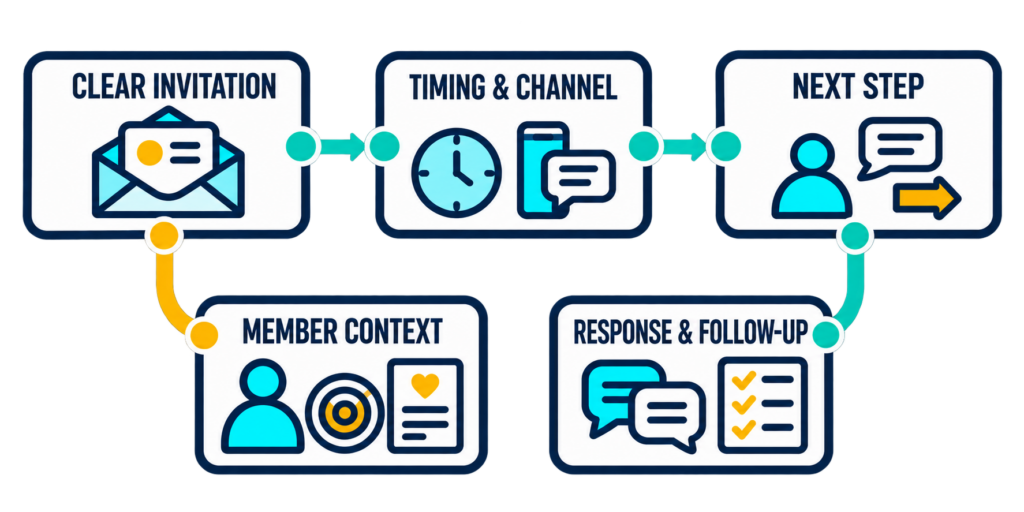
This module helps your team:
- Define the purpose of one outreach sequence.
- Identify whom the invitation could reasonably serve.
- Examine the basis for including members.
- Connect message content to member circumstances.
- Clarify participation and the requested action.
- Review timing and preparation needs.
- Examine channel and contact preferences.
- Identify overlapping outreach from different teams.
- Trace replies, registrations, and requests for help.
- Establish useful follow-up and stopping conditions.
- Develop a focused outreach improvement brief.
- Outline a connected communication configuration.
What should happen to each part of the outreach sequence?
The review leads to a deliberate response based on the reason for contact, the member’s circumstances, and the action the invitation is intended to support.
Confirm
Retain contact with a clear purpose, appropriate basis, and workable response.
Clarify
Explain relevance, participation, timing, or the next action.
Focus
Refine whom the invitation serves using appropriate, current information.
Coordinate
Align timing, channels, and responsibilities across sending teams.
Support
Resolve questions, entry difficulties, or handoffs that need human help.
Pause
Stop or defer contact when it is unwanted, mistimed, duplicative, or no longer useful.
These responses guide the outreach review. They do not establish that a member should participate or that silence has one particular meaning.
What should a communication and outreach review examine?
The purpose
What organizational need prompts the outreach, and what could make it useful to the member?
The audience
Who could reasonably benefit or contribute, and what information supports including them?
The message
Does the invitation explain relevance, participation, commitment, and the next action?
The contact
Are timing, channel, frequency, and coordination appropriate for the purpose and member choices?
The response
What happens when someone registers, replies, declines, asks for help, or does not respond?
The ownership
Who approves the outreach, receives responses, handles handoffs, and decides whether follow-up should continue?
Trace one invitation from its purpose to its follow-up.
Your team applies the method to one outreach sequence and member population established through Member Engagement Direction.
STEP 1
Define the invitation
Identify the opportunity or request, the member purpose, and the decision or action within scope.
STEP 2
Examine the audience
Review whom the invitation is intended to serve, the basis for contact, and assumptions requiring clarification.
STEP 3
Review the message
Examine whether the invitation explains why it may matter, what participation involves, and what to do next.
STEP 4
Trace contact and response
Follow timing, channels, other outreach, entry steps, replies, and support handoffs.
STEP 5
Choose a response
Confirm, clarify, focus, coordinate, support, or pause the parts of the sequence that need attention.
STEP 6
Assign and test the change
Identify the owner, proposed improvement, member feedback needed, follow-up conditions, and starting configuration requirements.
The result is a draft Member Outreach Map connecting purpose, audience, invitation, timing, channels, responses, and responsible follow-up.
FUTURE PRODUCT CONNECTION
Keep invitations connected to member context and response.
A subsequent Gobekli configuration could help the organization connect outreach plans to structured member and opportunity information.
TalentSync could relate invitations to their purposes, intended audiences, program owners, response requirements, and follow-up responsibilities.
TalentPass could help members express relevant interests, goals, and sharing choices. Pythia could help clarify an invitation, explain an available opportunity, or guide a member toward an appropriate next step using the information and permissions in scope. Passport Pages could support agreed source and sharing connections.
A connected outreach view could potentially show:
- What opportunity or request prompted the contact.
- Which member purpose the invitation addresses.
- What information supports the intended audience.
- Which assumptions remain unconfirmed.
- What communication choices apply.
- When contact would be useful.
- Which other teams are contacting the same population.
- What action or reply is expected.
- Who handles questions and subsequent handoffs.
- When follow-up should continue, change, or stop.
The workshop produces a starting configuration brief: the selected audience context, opportunity relationships, contact preferences, response states, source connections, and responsibilities needed to support the sequence.
Specific messaging, delivery, coordination, reminders, and integrations would be confirmed during solution planning.
PRODUCT AND DECISION BOUNDARIES
Relevant outreach preserves member choice.
An interest, role, or previous activity may support an invitation without establishing current intent or willingness to participate.
A later configuration should distinguish contact eligibility, suggested relevance, an expressed interest, a confirmed commitment, and a request to stop.
The workshop and product connection do not establish:
- Permission to contact someone based only on a profile.
- Current interest based only on a job title or past activity.
- Consent or willingness inferred from silence.
- A need for more reminders whenever participation is low.
- Useful member outcomes based only on opens or clicks.
- Automatic resolution of communication obligations or organizational policies.
Member choices and applicable communication requirements remain part of implementation planning and organizational review.
The workshop can clarify the outreach sequence and its responsibilities independently of future product adoption.
What to bring into the conversation
You do not need a complete communications strategy or a new messaging platform.
Begin with one invitation sequence connected to the participation challenge established through Member Engagement Direction.
Useful inputs may include:
- The opportunity or request being promoted.
- Current invitation and reminder messages.
- The intended audience and selection basis.
- Relevant member questions or feedback.
- Timing, deadlines, and preparation requirements.
- Examples of other contact reaching the same members.
- Channels and communication preferences.
- Registration, reply, and support routes.
- Available response and participation records.
- Follow-up and stopping rules, if established.
- A communications and program-owner perspective.
- The owner of a proposed improvement.
The aim is to examine one sequence in sufficient detail to make a practical change. The foundation module establishes the population, purpose, evidence, and boundaries for that work.
What this module can help clarify
Why the invitation matters
Connect the organizational reason for outreach to a credible member purpose.
Whom and how to contact
Clarify the audience basis, timing, channels, preferences, and coordination needed.
What follows the message
Establish clear actions, response routes, support responsibilities, and follow-up conditions.
What should change next
Develop an assigned improvement and test plan, supported by a starting configuration brief.
Final outputs depend on the modules selected and the participation challenge established through the workshop’s required Member Engagement Direction module.
Where might the work lead next?
Benefit & Opportunity Discovery
Clarify the descriptions and entry routes members encounter after following an invitation.
Chapter, Committee & Partner Participation
Coordinate participation responsibilities when outreach and member support span different organizational groups.
Lapsed Participation & Re-Engagement
Examine outreach that helps previously active members consider an appropriate return.
Explore the full Member Engagement Workshop to combine this module with the other parts of the participation experience that need attention.
Frequently asked questions
Questions organizations ask before beginning.
A clear connection among the reason for contact, the member’s circumstances, and an appropriate next action. Timing, channel, preferences, and follow-up also affect whether the communication is useful.
Invitations to events, learning, mentoring, volunteering, committees, services, feedback opportunities, and other forms of participation. The exercise focuses on one manageable sequence.
Message wording is part of the review. The module also examines audience selection, timing, channels, responses, support, and follow-up so that stronger wording leads to a workable experience.
No. Begin with the information available for the selected invitation. The review identifies what supports the audience choice, what remains uncertain, and what clarification would be useful.
The appropriate level depends on the purpose and available information. A clearly explained invitation for a relevant group may be sufficient. Personalization should have an understandable basis and avoid presenting assumptions as facts.
Examine what makes the invitation useful and whether the category captures that circumstance. Member-selected interests, questions, or relevant participation context may provide additional information where appropriately available.
Review the combined contact experience for the selected population. Identify duplication, competing deadlines, unclear priorities, and opportunities to coordinate or pause outreach.
Yes. The review can trace who contacts members, which information is shared, who handles replies, and how teams coordinate the next step. Broader operating arrangements can follow through Chapter, Committee & Partner Participation.
Consider the member’s choices, the purpose of the message, the action requested, and practical access. The workshop examines those factors for the selected sequence rather than assuming one channel suits every interaction.
There is no single frequency established by this module. Define what another contact would help the member do, what has already happened, and what conditions should stop or change the sequence.
It leaves several possibilities unresolved. The invitation may be irrelevant, mistimed, unclear, unseen, or difficult to act on. A member may also choose not to participate. The review avoids assigning one explanation without supporting information.
Examine whether members understand why the invitation may matter, know what to do next, and receive appropriate help after responding. Delivery and response records can support that review alongside member feedback.
This module examines how the organization brings an invitation to an appropriate member. Discovery examines how members locate, interpret, and enter available options. The invitation’s destination connects the two.
Segmentation examines whether categories support a decision and reveal missing perspectives. This module uses appropriate audience information to examine a specific contact sequence and the participation it is intended to support.
This module addresses outreach generally. Re-engagement focuses on understanding changed circumstances and helping previously active members consider a suitable return.
The outputs can inform a configuration connecting member-selected context, opportunities, contact preferences, response states, source systems, and responsible follow-up. Specific capabilities and implementation requirements would be confirmed during scoping.
Your team will review one bounded sequence and develop a draft outreach map, assigned improvement and test plan, and starting configuration brief. Wider rollout and ongoing operation are subsequent steps.
MAKE EACH INVITATION USEFUL
Give members a clear reason to consider the next step.
Connect outreach to member circumstances, appropriate contact, and follow-up that responds to what happens.
This module is part of Gobekli’s configurable Member Engagement Workshop.
