
WORKFORCE PATHWAY & SERVICE CONTINUITY WORKSHOP MODULE
Advisor Capacity & Case Continuity
Keep support understandable when workloads, staff, or circumstances change. Examine how responsibilities, relevant context, coverage, and escalation connect so participants know whom to contact and the next responsible person can act.
Does this sound familiar?
Caseload totals hide the work involved
Two advisors carry similar numbers of participants, but the timing, complexity, coordination, and unresolved actions within their workloads differ substantially.
Important context stays with one person
An advisor understands the participant’s goals and current arrangements, but a colleague cannot easily identify what matters or what should happen next.
A staff change restarts the conversation
A participant is assigned to someone new and must reconstruct previous discussions, decisions, and outstanding questions.
Coverage exists without a clear responsibility
Someone is named as a backup, but it is unclear which actions they should handle, what information they can use, or when they should seek help.
Unresolved issues have nowhere clear to go
A question exceeds an advisor’s authority or requires another team, but the escalation route and expected response are uncertain.
The record shows activity without the current position
Notes describe past conversations while leaving the participant’s present goal, next action, responsible person, and unresolved dependencies difficult to find.
What are advisor capacity and case continuity?
Advisor capacity concerns the work required to support participants and the time, skills, authority, and resources available to carry it out.
Case continuity concerns whether support can remain understandable and actionable as staff assignments, workloads, and participant circumstances change.
A useful review looks beyond the number of people assigned to each advisor. It considers the activities, deadlines, coordination, unresolved questions, and support responsibilities within the selected workload.
It also examines what another responsible staff member needs to understand when covering an absence, receiving a reassignment, or helping resolve an issue.
This module connects those questions through one selected example so your team can identify a practical improvement to workload visibility, coverage, information continuity, or escalation.
Continuity depends on what the next person can understand and do.
A participant may have a productive relationship with an advisor while the wider service remains dependent on that individual’s memory and availability.
When the advisor is absent or leaves, colleagues may find extensive notes without a clear account of the current position.
The person providing coverage needs to know what the participant is trying to accomplish, what has been agreed, what remains outstanding, and which actions fall within their responsibility.
They also need a route for questions they cannot resolve themselves.
That continuity takes staff time. Preparing a handoff, reviewing context, contacting a participant, and coordinating with partners are part of the workload.
The workshop examines how those responsibilities can become more visible and workable within the team’s actual operating conditions.
What needs to connect?
Workload
Activities requiring attention
Time-sensitive commitments
Coordination requirements
Unresolved dependencies
Available time and capability
Current participant context
Participant’s current goal
Agreed next step
Relevant previous decisions
Appropriate contact preferences
Information needing confirmation
Coverage and reassignment
Primary responsibility
Temporary coverage
Permanent reassignment
Receiving acknowledgment
Participant introduction
Decision authority
What the advisor can decide
What requires approval
What needs specialist input
Where an issue goes next
Who resolves conflicting instructions
Review
Outstanding actions
Coverage gaps
Escalations awaiting response
Workload changes
Context needing an update
The review focuses on the responsibilities and information needed for the selected service situation. It does not assume that a caseload count alone describes demand or capacity.
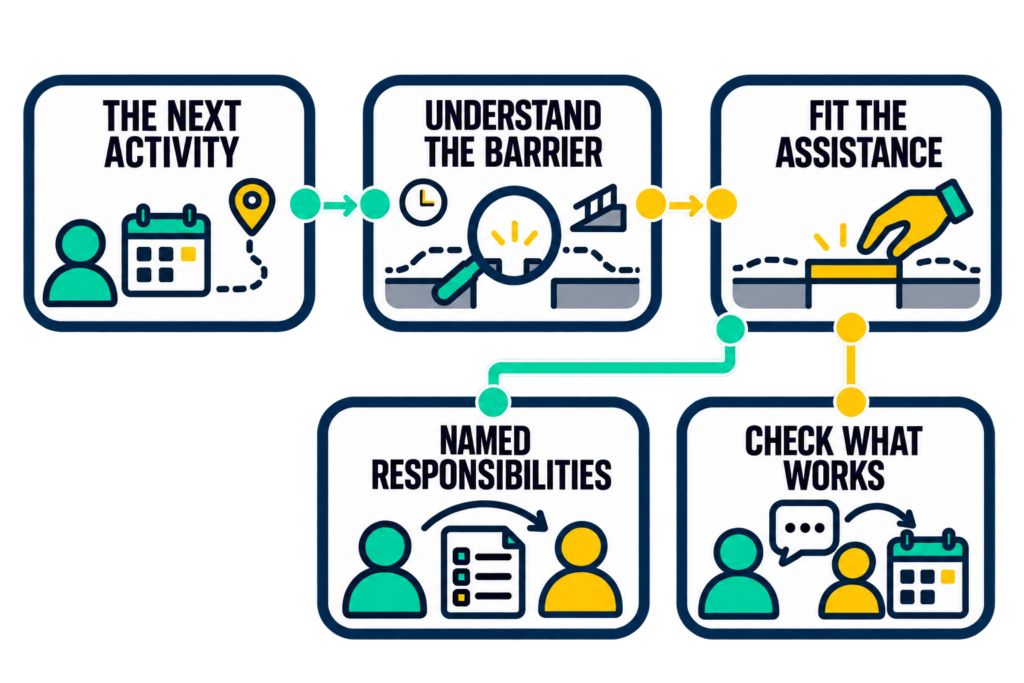
Four moves toward more dependable continuity
1. Understand the work requiring attention
Identify the activities, commitments, coordination, and unresolved issues within the selected workload.
2. Make the current position understandable
Clarify the relevant participant context, agreed actions, responsibilities, and information that needs confirmation.
3. Define coverage and escalation
Establish who acts during an absence or reassignment and where questions go when they exceed that person’s authority.
4. Review whether the arrangement holds
Check whether responsibilities are accepted, actions receive attention, and the participant understands who is supporting them.
Start with one situation where continuity becomes difficult.
The module begins with a selected example, such as an advisor absence, staff departure, reassignment, or period of increased demand.
Your team brings the relevant workflow, current records or templates, assignment practices, and escalation arrangements.
Together, we examine what work needs attention and whether another responsible person could understand and carry it forward.
Questions we examine together
Identify the activities, deadlines, coordination, and unresolved matters that shape the selected workload. Note what current counts leave unexplained.
Examine whether the record makes the person’s goal, agreed next step, relevant decisions, and outstanding questions understandable.
Identify the commitments that need attention, the responsibilities that can be transferred, and the decisions requiring review.
Clarify the relevant context, access, authority, time, and introduction needed to take responsibility.
Define the route for issues requiring a supervisor, specialist, partner, or another authorized decision-maker.
Establish how the team confirms responsibility, reviews outstanding actions, and learns whether the participant understands the new arrangement.
Six dimensions of dependable case continuity
Workload context
The team can describe the work involved, including coordination and unresolved actions.
Current-state clarity
The record makes the participant’s present position and next step understandable.
Ownership
Each selected action has a responsible person or team.
Coverage readiness
Another authorized staff member can identify what needs attention and how to proceed.
Escalation clarity
Questions beyond the current owner’s authority have a defined receiving route.
Review and correction
The team can identify gaps, update context, and adjust responsibilities when conditions change.
When continuity depends on individual memory
The service may function well until a workload or staffing change exposes its dependencies.
- Caseload counts stand in for the work required.
- Current commitments are buried in historical notes.
- Backup staff are named without defined duties.
- Reassignment changes an owner field without a receiving review.
- Participants discover the staff change when they try to get help.
- Escalated questions remain open without a clear response owner.
The next person may have access to the record while still lacking what they need to support the participant.
When continuity is supported by the team
A clearer arrangement connects responsibilities, context, and authority.
- Workload discussions include the activities requiring attention.
- The current goal and next actions are easy to identify.
- Coverage specifies what needs to continue.
- Receiving staff confirm outstanding responsibilities.
- Participants receive an understandable introduction or contact update.
- Escalations identify the decision needed and who will respond.
The team has a stronger basis for maintaining support and identifying where capacity remains insufficient.
Example: An advisor leaves before a participant’s next milestone
An advisor has been helping a participant prepare for a training-to-employment transition.
The participant has an upcoming employer conversation and is waiting for clarification from a training partner about a relevant record.
The advisor leaves the organization, and the participant is assigned to another staff member.
The new advisor can access previous notes but cannot easily identify which partner question remains open or what the participant expects before the employer conversation.
The participant assumes the new advisor has been briefed. The new advisor assumes the previous arrangements are complete.
In the workshop, the team traces the commitments that should carry through the reassignment.
The review identifies a need for a concise current-position summary, a review of outstanding actions, and a direct introduction to the new advisor.
It also identifies a partner question requiring escalation and the staff member responsible for obtaining a response.
The proposed improvement gives the receiving advisor time to review the selected context and confirm the next actions with the participant.
The team tests whether the reassignment preserves those commitments and reduces avoidable reconstruction. It does not assume that a better handoff resolves the underlying staffing gap or guarantees an employment outcome.
Caseload counts need context.
The number of participants assigned to an advisor can be useful information.
It does not, by itself, explain the time and coordination required to support them.
Some participants may need a brief check-in. Others may have several time-sensitive transitions or unresolved questions involving different organizations.
Workload also includes documentation, partner communication, preparation, coverage, and follow-up.
The workshop examines a selected portion of that work and identifies what leaders need to understand before changing assignments or expectations.
It does not establish a universal caseload ratio or infer staff performance from participant counts alone.
A useful handoff preserves the current position.
Continuity does not require every staff member to read every historical note.
It requires an appropriate account of what matters to the responsibility being transferred.
That account should distinguish participant-stated information, recorded decisions, staff interpretations, and questions still awaiting confirmation.
It should also identify what the receiving person is expected and authorized to do.
The participant may need an introduction, an explanation of the change, and a way to correct information that no longer reflects their circumstances.
The workshop defines those needs for the selected transition while keeping access and sharing boundaries explicit.
WORKSHOP MODULE
Advisor Capacity & Case Continuity
This module is a practical minicourse in maintaining understandable support as workloads and staff responsibilities change.
Your team learns a repeatable method, applies it to one selected operating situation, and develops a focused improvement with an owner and a way to test it.
The work also identifies the current context, responsibility, coverage, escalation, and review requirements that a subsequent Gobekli configuration would need to support.
What can this module help clarify?
Scope is established through Workforce Pathway Direction and narrowed to a workload or continuity question your team can meaningfully examine.
- The participant population and selected service situation.
- The work behind current caseload counts.
- Time-sensitive actions and commitments.
- Coordination and documentation responsibilities.
- The participant’s current goal and next step.
- Information needed to understand the present position.
- Primary ownership and temporary coverage.
- Responsibilities during permanent reassignment.
- Receiving acknowledgment and participant introductions.
- Decisions requiring approval or specialist input.
- Escalation ownership and response expectations.
- Review triggers for changed workload, staffing, or circumstances.
What kinds of responses might follow?
The selected example may point to changes in workload understanding, team practice, records, or decision routes.
A more useful workload view
Make relevant activities, deadlines, and coordination demands visible alongside participant counts.
A current-position summary
Clarify the participant’s goal, agreed actions, relevant decisions, and outstanding questions.
Defined absence coverage
Identify which responsibilities need attention and who can act while the primary advisor is unavailable.
A reviewed reassignment
Build in receiving review, confirmation of outstanding actions, and an appropriate participant introduction.
A clearer escalation route
Identify the decision needed, the authorized recipient, and responsibility for following up.
A continuity review
Check whether coverage, context, and ownership remain workable as conditions change.
The workshop may identify operating changes or resource questions that need attention before a product configuration is introduced.
What will we review?
The selected workload
Activities, deadlines, coordination, and unresolved matters within the example.
The current record
How the participant’s present position and next actions are represented.
The assignment process
How primary responsibility, temporary coverage, and reassignment are established.
The receiving experience
What another staff member needs to understand and accept the responsibility.
The escalation arrangements
Where questions go when they require authority or expertise beyond the current owner.
The continuity checks
How the team identifies missed commitments, outdated context, or responsibilities without an owner.
The workshop exercise
Your team works through one selected workload or staffing transition using the materials and responsibilities available.
STEP 1
Select the operating situation
Define the absence, reassignment, workload change, or continuity difficulty to examine.
STEP 2
Identify the work requiring attention
List the relevant commitments, deadlines, coordination, and unresolved questions.
STEP 3
Establish the current position
Clarify the participant context and next actions another responsible staff member needs to understand.
STEP 4
Map coverage and authority
Identify who can act, what responsibility transfers, and which questions need escalation.
STEP 5
Improve one weak point
Choose a concrete change to the record, handoff, workload discussion, or escalation process.
STEP 6
Define the review
Specify how the team will check receiving understanding, ownership, participant communication, and outstanding actions.
An Advisor Continuity Map, one assigned improvement, and a validation plan that can also inform an initial product configuration brief.
FROM WORKSHOP INSIGHT TO A POSSIBLE GOBEKLI SETUP
Configure continuity around the work and its owners.
The workshop establishes what the team needs to understand and carry forward before deciding how technology should support it.
Depending on confirmed capabilities and implementation scope, a future setup could explore TalentPass for participant-held context, Pythia-guided preparation and review, and TalentSync or Passport Pages for appropriate organizational coordination.
The configuration brief identifies the information, relationships, and responsibilities needed for the selected workflow while preserving authoritative records and human decision-making.
- The selected participant population and continuity situation.
- The activities and commitments requiring attention.
- The participant’s current goal and agreed next steps.
- Relevant source context and information needing confirmation.
- Primary ownership and temporary coverage.
- Reassignment and receiving acknowledgment.
- Access boundaries for each staff role.
- Escalation questions and authorized decision owners.
- Follow-up triggers and unresolved dependencies.
- The review process for changed circumstances or outdated context.
Any implementation would require confirmation of product availability, integrations, permissions, and operating responsibilities.
A Gobekli setup would support the agreed workflow. It would not create staffing capacity by itself or replace the judgment needed to allocate work and support participants.
SCOPE & RESPONSIBILITY
What this module does—and what it does not decide
This module helps your team examine a selected workload or continuity problem.
It connects the work requiring attention to the context, ownership, coverage, and escalation needed to carry it forward.
Staffing, employment, and authorized service decisions remain with the responsible organization.
- The workshop does not establish a universal caseload ratio.
- It does not infer advisor performance from participant counts or outcomes alone.
- It does not prescribe staffing reductions or guarantee productivity gains.
- It does not authorize access to all participant records.
- It does not replace specialist judgment or supervisory responsibility.
- It does not commit absent partners to respond or take ownership.
- It does not guarantee that every capacity gap can be solved through process changes.
- It does not deploy a complete case management or workforce allocation system.
Questions requiring leadership, specialist, or partner decisions are assigned to the appropriate owner.
The output distinguishes improvements the team can make directly from resource needs and dependencies requiring further action.
What should you bring?
Bring a selected workload or staffing transition and enough material to understand what needs to continue.
A de-identified example can reveal gaps in context, coverage, or escalation without exposing a complete participant history.
Useful inputs
- The selected service situation and participant population.
- Current assignment or caseload practices.
- Examples of the activities behind those assignments.
- Relevant deadlines or commitments.
- A current record or summary template.
- Examples of information that is difficult to find.
- Absence and backup arrangements.
- Reassignment instructions or practices.
- Participant communication about staff changes.
- Existing escalation routes.
- Known limits on authority or access.
- Examples of unresolved responsibilities or missed handoffs.
Bring the context necessary to examine the selected question. The workshop does not require individual staff rankings or a complete audit of all cases.
What can you leave with?
Advisor Continuity Map
A shared account connecting the selected work, current participant context, ownership, coverage, and escalation routes.
Assigned Continuity Improvement
A focused change to workload visibility, records, coverage, reassignment, or escalation, with an owner and next action.
Validation Plan
A way to check whether receiving staff understand the current position, responsibilities are accepted, and participants know whom to contact.
Initial Configuration Brief
The activity relationships, source context, access boundaries, staff responsibilities, and review requirements a subsequent Gobekli implementation would need to support.
These outputs begin with the example reviewed during the module. Final scope depends on the modules selected, available inputs, and the decision established through Workforce Pathway Direction.
Where might the work lead next?
Repeated Intake & Participant Story Continuity
When a staffing transition requires participants to reconstruct earlier conversations, examine which relevant information can be reused, confirmed, updated, or appropriately shared.
Referrals & Follow-Through
When outstanding work depends on another service, clarify the introduction, receiving response, and ownership of the next action.
Participant Progress, Outcomes & Program Improvement
When leaders need to understand how continuity problems affect the wider service journey, connect available evidence to a focused improvement decision.
These modules can be combined within the Workforce Pathway & Service Continuity Workshop according to the selected journey and organizational decision.
Frequently asked questions
Questions organizations ask before beginning.
Workforce programs, public agencies, training providers, community organizations, and service partnerships where advisors or case staff support participants over time. Useful contributors understand the work or hold responsibility for assignments, coverage, and escalation.
Yes. The foundation establishes the participant population, selected journey, organizational decision, evidence, responsibilities, and boundaries that guide this module.
Not by default. The module examines one selected workload or continuity situation. It may identify questions about staffing or resources that require a separate leadership decision or more detailed analysis.
No. The review examines the work behind the count, including timing, coordination, and unresolved responsibilities. It does not assume one ratio is appropriate across different programs and participant circumstances.
Yes. The example can examine planned leave, unexpected absence, or another situation requiring temporary coverage.
Yes. The module can review what needs to transfer, how receiving staff confirm responsibility, and how the participant learns about the change.
The question is whether another responsible person can identify the current position and act appropriately. A large amount of historical information may still leave the next action unclear.
No. The workshop first defines the information and responsibilities that need to connect. Different systems may remain in use, subject to agreed access and operating arrangements.
The selected example can identify observable work demands, dependencies, and coordination needs. The workshop does not turn those differences into an automatic score or universal allocation rule.
The coverage arrangement should make that limit clear and identify the authorized person or team to receive the question.
The review identifies who follows up, what remains unresolved, and when the issue needs further attention. The workshop cannot assume another person or organization has accepted responsibility without confirmation.
The selected process should define an appropriate communication and introduction so the participant understands whom to contact and what happens to existing commitments.
That module focuses on information participants repeatedly explain or document. This module examines how staff workload, coverage, reassignment, and escalation affect the continuity of support.
The referral module examines a connection to another service. This module examines the team arrangements needed to maintain responsibilities as staff availability or assignments change.
Potentially, subject to confirmed capabilities and permissions. Any generated summary would need appropriate source context and human review, particularly before it guides a handoff or decision.
The validation plan can check whether receiving staff identify the current goal and next actions, responsibilities have owners, participants understand contact arrangements, and unresolved issues reach the appropriate decision-maker.
No. The continuity map, assigned improvement, and validation plan should be useful independently. They can also establish a clearer starting point for a later Gobekli configuration.
KEEP SUPPORT CONNECTED THROUGH CHANGE
Help the next responsible person carry the work forward.
Continuity improves when the current position, outstanding commitments, and decision routes remain understandable beyond a single staff member.
Use Advisor Capacity & Case Continuity within the Workforce Pathway & Service Continuity Workshop to examine one operating situation and define a practical improvement your team can take forward.
