
WORKFORCE PATHWAY & SERVICE CONTINUITY WORKSHOP
Help People Move Forward Without Repeatedly Starting Over.
Your organization helps people build skills, find work, and access support. Progress can still stall when programs, information, and responsibilities become disconnected.
Connect the steps within your organization and across relevant partners. Build a practical plan for clearer navigation, accountable handoffs, and support that follows the person’s goals.

Dedicated programs. Disconnected journeys.
People do not know where to begin
Available services are difficult to compare, entry requirements are unclear, and the person must work out which organization can help.
The same story is told repeatedly
Participants explain their experience, goals, circumstances, and previous support each time they encounter a new program or advisor.
Existing capability goes unrecognized
Work, learning, military, caregiving, and community experience may be overlooked when records do not explain what the person has done.
Separate plans pull in different directions
Individual programs establish their own activities and milestones without a clear connection to the participant’s broader goal.
Referrals leave unanswered questions
A contact is provided or a form is sent, but nobody knows whether the person connected, received help, or encountered another obstacle.
Practical barriers interrupt participation
Transport, childcare, schedules, language, accessibility, or digital access make an otherwise relevant pathway difficult to follow.
Support depends on who is available
Staff changes, caseloads, and fragmented information leave participants waiting, repeating work, or losing continuity.
Completion does not reveal what happens next
The organization can report services delivered or training completed while the next opportunity, remaining support, and longer-term progress stay unclear.
A useful service should connect to a workable next step.
A person may need several organizations to help them move toward employment, further learning, or greater stability.
Each organization contributes something different. A workforce advisor may help clarify direction. A training provider may develop relevant capability. A community partner may address a practical barrier. An employer may offer an opportunity.
The pathway becomes difficult when those contributions do not connect in a way the person can understand and use.
Improving continuity means clarifying the next step, the support needed to reach it, the information that can appropriately travel, and who remains responsible when something does not work.
To understand that pathway, your organization may need to examine:
- Where people first discover relevant help.
- What they need to understand before entering a service.
- Which information they repeatedly provide.
- What prior experience and capability deserve closer review.
- How program activities relate to the person’s goals.
- Where eligibility or enrollment decisions interrupt movement.
- What happens after a referral is made.
- Which practical barriers require coordinated support.
- How advisors maintain continuity across staff changes.
- What connects training to an employment opportunity.
- How people return after interrupted participation.
- What evidence reveals meaningful progress and needed improvements.
Workforce pathway and service continuity means helping relevant support connect over time, while keeping the person’s goals, choices, and circumstances visible to those appropriately involved.
Start with the pathway your organization needs to improve.
The Workforce Pathway & Service Continuity Workshop is configured around a defined participant journey and an organizational decision.
Every engagement begins with the required Workforce Pathway Direction foundation. Your organization then selects the modules that address its most important questions about navigation, intake, recognition, planning, handoffs, support, or progress.
Each selected module combines a short practical lesson with an applied exercise using a bounded example. Participants examine where the journey becomes difficult, what the available evidence supports, and which changes they can carry forward.
Required
1. Establish the Workforce Pathway Direction
Define the participant population, intended goal, selected journey, organizational decision, available evidence, responsible roles, and boundaries of the engagement.
Choose 2–3
2. Select the Problem Modules
Examine the navigation, intake, experience recognition, planning, enrollment, referral, support, continuity, transition, or outcome questions that matter most.
Outcome
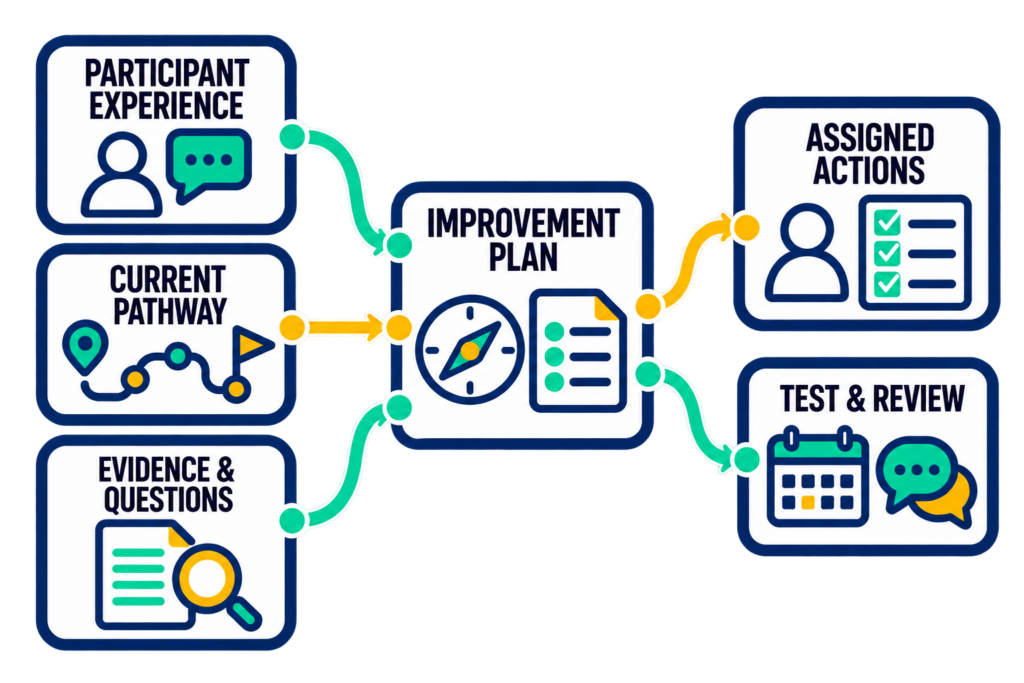
3. Build a 30–90 Day Pathway Improvement Plan
Leave with priorities, responsible owners, partner dependencies, practical changes, validation needs, review points, and a starting configuration brief.
A typical engagement combines the required foundation with two or three problem modules. Your organization does not need to complete all 12.
One agency can begin with the parts of the journey it operates. Relevant partners can participate where the selected question requires shared decisions. The consultation establishes the appropriate format, preparation, participants, and fee.
Make the pathway more workable for everyone involved.
For participants
Understand available options, build on prior experience, receive clearer support, and carry relevant progress into the next step.
For frontline staff and program teams
Clarify responsibilities, reduce avoidable repetition, identify stalled handoffs, and maintain continuity when circumstances change.
For partner organizations
Understand what each organization contributes, what information is needed, and how referrals and shared responsibilities should work.
For agency leaders and coalition sponsors
Prioritize improvements, distinguish internal actions from partner dependencies, and connect service activity to a clearer account of participant progress.
Explore the 12 Workforce Pathway & Service Continuity Workshop Modules
The modules address how people discover help, enter programs, build on experience, receive coordinated support, and move toward an appropriate next step.
Choose the modules that help answer your particular question. Each produces a practical working brief and identifies the records, relationships, responsibilities, and sharing arrangements a future Gobekli configuration would need.
CLARIFY ENTRY AND BUILD ON WHAT PEOPLE BRING
Workforce Pathway Direction
Define the participant population, intended goal, selected service journey, organizational decision, available evidence, responsibilities, and boundaries the workshop should address. (Required foundation)
Service Discovery & Entry Navigation
Make relevant services, entry routes, requirements, and available help easier to find and understand so people can identify a workable place to begin.
Repeated Intake & Participant Story Continuity
Examine what participants repeatedly explain or document, then define which relevant information can be reused, confirmed, updated, and appropriately shared.
Prior Experience & Capability Recognition
Make relevant work, learning, military, caregiving, and community experience easier to understand, with appropriate evidence and clear boundaries around recognition.
CONNECT PLANS, HANDOFFS, AND SUPPORT
Participant Goals & Pathway Planning
Connect program activities, participant choices, support, and milestones into a workable route toward the person’s goals.
Eligibility & Enrollment Handoffs
Clarify requirements, documentation, decision responsibilities, and transitions between programs so people understand what is needed and who can help.
Referrals & Follow-Through
Define how referrals are introduced, received, acknowledged, and followed up so a recommendation can lead to an accountable next step.
Support Barriers & Coordinated Assistance
Identify practical, informational, and accessibility barriers, then define the assistance, responsible partners, and follow-up needed to make participation more workable.
SUSTAIN CONTINUITY AND LEARN FROM PROGRESS
Advisor Capacity & Case Continuity
Examine how caseloads, staff changes, information gaps, and escalation routes affect the continuity of support participants receive.
Training-to-Employment Transitions
Connect preparation, reviewed evidence, applications, employer conversations, and continuing support into a clearer route beyond training completion.
Interrupted Participation & Return Routes
Examine why participation pauses and define respectful routes back that account for changed goals, circumstances, preferences, and availability.
Participant Progress, Outcomes & Program Improvement
Connect service activity to meaningful milestones, participant experience, supported outcomes, and the evidence needed to decide what should improve.
The right response depends on where the pathway becomes difficult.
Clarify
Explain the service, requirement, choice, or next step in terms the participant can understand.
Recognize
Identify relevant prior experience and the evidence needed to understand what it may support.
Connect
Relate separate activities and milestones to the participant’s goals and current circumstances.
Coordinate
Define what each organization contributes and how responsibilities connect across the selected journey.
Support
Assign a practical response to a barrier affecting participation or progress.
Follow Through
Establish what happens after a referral, transition, unanswered request, or missed connection.
Adapt
Revise the plan when circumstances change, participation pauses, or the original route becomes unsuitable.
Review
Examine what happened, what remains uncertain, and which improvement the evidence supports.
These responses organize practical action. A referral, enrollment, completion, placement, or reported outcome describes a particular part of the journey. Its meaning depends on the participant’s goal, the available evidence, and what happened next.
How the workshop comes together
-
1
Free Discovery Call Identify the pathway challenge, the people affected, and the decision your organization needs to make. -
2
Focused Intake & Direction Agree on the selected example, relevant participants, available materials, partner dependencies, and modules needed to examine it. -
3
Collaborative Workshop Learn the review method, apply it to the selected journey, and develop practical responses with clear responsibilities. -
4
Pathway Improvement Plan Bring the findings into an assigned 30–90 day plan with validation needs, review points, and a starting configuration brief.
What you can leave with
Workforce Pathway Decision Foundation
A shared definition of the participant population, goal, organizational decision, selected journey, boundaries, and criteria for a useful result.
Participant Journey & Handoff Map
A view of the relevant steps, services, decisions, transitions, and points where progress becomes difficult.
Experience & Information Reuse Brief
An account of which prior experience and information can help the next step, what needs confirmation, and what should remain outside the exchange.
Evidence & Assumption Register
A distinction among source records, participant accounts, staff observations, interpretations, and questions requiring further validation.
Service & Support Improvement Plan
Practical changes to navigation, intake, planning, enrollment, referrals, assistance, or transition arrangements.
Ownership & Partner Decision Plan
Assigned responsibilities that distinguish actions the organization can take from proposals requiring partner participation or approval.
Starting Gobekli Configuration Brief
An outline of the participant, service, opportunity, evidence, milestone, source, and sharing relationships worth maintaining.
30–90 Day Pathway Improvement Plan
Sequenced actions, responsible owners, dependencies, validation needs, decision points, and review conditions.
Final outputs depend on the selected modules, available information, participants, and question established through Workforce Pathway Direction.
The workshop creates a practical starting point within that scope. Partner decisions, implementation, and review of longer-term outcomes continue afterward.
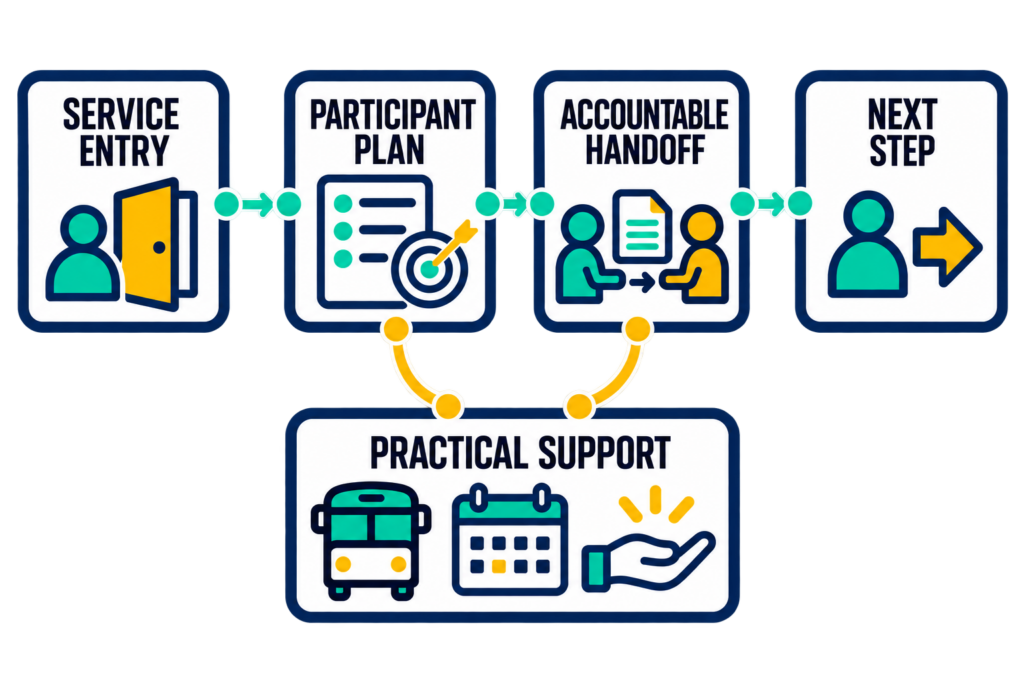
Build the pathway around the person moving through it.
We help workforce and support-service organizations examine how their work connects to the goals, experience, choices, and progress of the people they serve.
The work should make the next step easier for participants to understand and help organizational teams coordinate the responsibilities within their control.
Participant-centered
Begin with the person’s goal and circumstances. Include a practical way to hear from people who have experienced the pathway.
Purpose-limited
Identify the information needed for a defined step. Keep sharing understandable and respect the boundaries of the participating organizations.
Evidence-aware
Distinguish recorded activity, reported experience, reviewed evidence, and assumptions. Use each at the scope it can support.
Practical & accountable
Choose improvements people can operate. Name who acts, who decides, what depends on a partner, and when the arrangement should be reviewed.
When the workshop reveals something worth maintaining
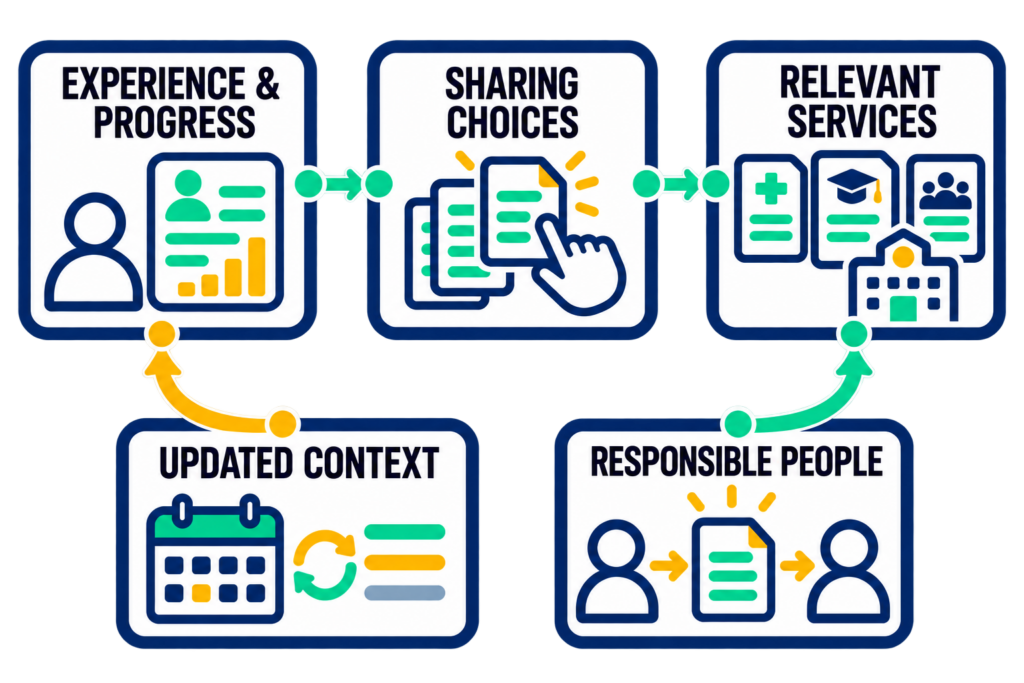
Keep useful context connected as people move forward.
A workshop may reveal that continuity depends on information and relationships that are difficult to maintain across intake forms, advisor conversations, training records, referrals, and employer interactions.
A potential Gobekli configuration could connect participant-controlled experience, goals, and progress through TalentPass with appropriate service, opportunity, and organizational context through TalentSync.
The starting point is the journey examined during the workshop: what the person needs to do next, what information supports that step, who is involved, and what each party should be able to understand.
Workshop Findings
Identify the selected journey, information gaps, relevant prior experience, support needs, handoff states, and responsibilities that should remain clear after the engagement.
Gobekli Setup
Scope relevant profiles, service and opportunity descriptions, source connections, evidence, milestones, participant sharing choices, and authorized organizational views.
Ongoing Review
Maintain the context needed to coordinate support as people progress, plans change, services become unavailable, or new information requires a response.
Worked example: connecting training preparation to an employer conversation
A workforce nonprofit helps an adult learner explore a new occupation and enroll in a local training program.
The participant has relevant experience from previous work, but that experience is described differently in the intake form, training application, and résumé.
A community partner provides transport assistance. The training provider records completion. An employer asks what the participant can demonstrate and what preparation remains.
The workshop could examine the points where the participant repeats information, where the transport referral needs follow-through, and what evidence would support the employer conversation.
The resulting configuration brief could define a participant-selected experience account, relevant training and opportunity descriptions, a limited referral status, source records, and responsible contacts.
TalentPass could help the participant organize experience and evidence they choose to share. TalentSync could help participating organizations connect the relevant services, opportunities, and responsibilities.
Passport Pages could support appropriate presentation and source connections. Pythia could help the participant explain their experience or help authorized staff prepare questions using the information within scope.
The employer-facing account would not need to include private details about the participant’s support arrangements. Training completion would remain distinguishable from evidence of capability.
The organization would test whether the revised arrangement makes the next step clearer and reduces avoidable repetition. It would not assume that the configuration guarantees employment.
A Gobekli setup is an optional continuation. The workshop outputs remain useful independently of product adoption.
The configuration described here includes potential capabilities. Current availability, integration needs, configuration work, and required development would be confirmed during scoping. Existing case-management, eligibility, learning, and employer systems can retain their responsibilities.
Frequently asked questions
Questions organizations ask before beginning.
It is a configurable, facilitated workshop that helps an organization improve a defined journey through workforce programs and supporting services.
Every engagement begins with Workforce Pathway Direction and then applies selected problem modules to a bounded example. The result is a practical plan grounded in participant goals, available evidence, and accountable next steps.
It is designed for workforce agencies, workforce boards, employment-service providers, community nonprofits, training intermediaries, and organizations providing support that helps people participate and progress.
It can also serve partnerships involving educators, employers, local government, and other relevant service providers.
Yes. Your organization can begin with the part of the pathway it operates.
The workshop distinguishes changes your team can make from proposals that require another organization’s involvement. You do not need a statewide initiative to begin.
Yes. Partners can participate when the selected question involves shared handoffs, information, or responsibilities.
Preparation should clarify who is convening the engagement, who can make decisions, and which commitments need further approval.
No. Every engagement begins with the required Workforce Pathway Direction foundation.
A typical workshop then includes two or three modules selected around the journey and decision your organization wants to address.
Yes. A selected population, program, referral route, or transition can provide a useful scope.
Examples might include adults returning to learning, people changing occupations, veterans translating prior experience, or participants moving from training into employer conversations. The workshop examines the circumstances of the selected group rather than assuming one pathway fits everyone.
Begin with one pathway question and examples of how the journey currently works.
Useful materials may include service descriptions, intake questions, participant guidance, referral procedures, program requirements, training information, staff responsibilities, feedback, and existing measures. Complete records are not required to begin.
Not necessarily. A de-identified example, process description, or selected sample can often establish where the pathway becomes difficult.
If personal information is needed for a particular exercise, its purpose, access, and handling should be agreed during preparation.
The workshop can use existing feedback, appropriately selected participant accounts, or direct participation where suitable.
Additional interviews or testing can be scoped when needed. Staff assumptions about the journey should remain distinguishable from what participants have reported or demonstrated.
The workshop can clarify requirements, documentation, handoffs, and decision responsibilities.
It does not itself change eligibility rules or replace the systems and professionals responsible for program administration. Findings may identify a process improvement or a question that needs review by the appropriate owner.
Yes. It can identify where a barrier affects the selected journey, what assistance may be relevant, and which organization is responsible for the next action.
The workshop does not create service capacity by itself. It helps distinguish an information or coordination problem from a resource shortage that partners need to address.
No. The workshop produces a practical Pathway Improvement Plan whether or not your organization adopts Gobekli software.
If the findings identify information and relationships worth maintaining, a suitable configuration can be explored afterward.
This workshop examines how people move through a selected service pathway.
Regional Workforce & Industry Alignment examines employer demand, available talent, training capacity, and partner commitments across a sector or region. A pathway review may reveal a wider capacity or alignment question for that workshop.
This workshop defines the service experience, information needs, and responsibilities around a selected journey.
LER & Trusted Workforce Infrastructure examines how records, identities, systems, permissions, and operating arrangements can support reliable exchange across institutions. A service-continuity review can provide a concrete use case for that work.
Your organization leaves with a scoped response and a 30–90 day improvement plan.
Next steps may include clarifying entry guidance, revising intake, testing a referral procedure, resolving a support handoff, improving an employer transition, or gathering missing evidence. Where appropriate, the configuration brief becomes the starting point for a Gobekli implementation conversation.
MAKE THE NEXT STEP EASIER TO REACH
Help people build on their progress.
Connect relevant services, information, and responsibilities around the journey your organization wants to improve.
Begin with Workforce Pathway Direction, then select the modules that address your organization’s particular challenges.
Let’s Start with the Pathway You Want to Improve.
Tell us where people encounter difficulty, which part of the journey your organization supports, and what you want to make more workable.
During a free discovery call, we will clarify the decision, identify relevant participants and partners, and discuss the workshop scope that fits.