
WORKFORCE PATHWAY & SERVICE CONTINUITY WORKSHOP MODULE
Referrals & Follow-Through
Help a recommendation become an accountable next step. Clarify how referrals are introduced, received, acknowledged, and followed up so participants understand the connection and staff know who is responsible for helping it move forward.
Does this sound familiar?
A referral is complete before a connection exists
The sending team records its action, but no one knows whether the participant reached the receiving service or received a useful response.
The participant receives a contact without an introduction
Someone is given a phone number, website, or organization name without understanding whom to ask for, what to explain, or what to expect.
The receiving service lacks the context it needs
Staff receive an inquiry without a clear purpose, appropriate background, or an explanation of what the participant is seeking.
Both teams assume the other will follow up
The sending organization expects the receiving team to make contact. The receiving team expects the participant to initiate the next step.
An unresolved referral disappears behind a status
“Sent,” “contacted,” or “closed” appears in the record without explaining whether the connection worked or what remains outstanding.
The original route stops working
A service is unavailable, a contact changes, or the participant’s circumstances shift, but no one has defined how to reconsider the recommendation.
What are referrals and follow-through?
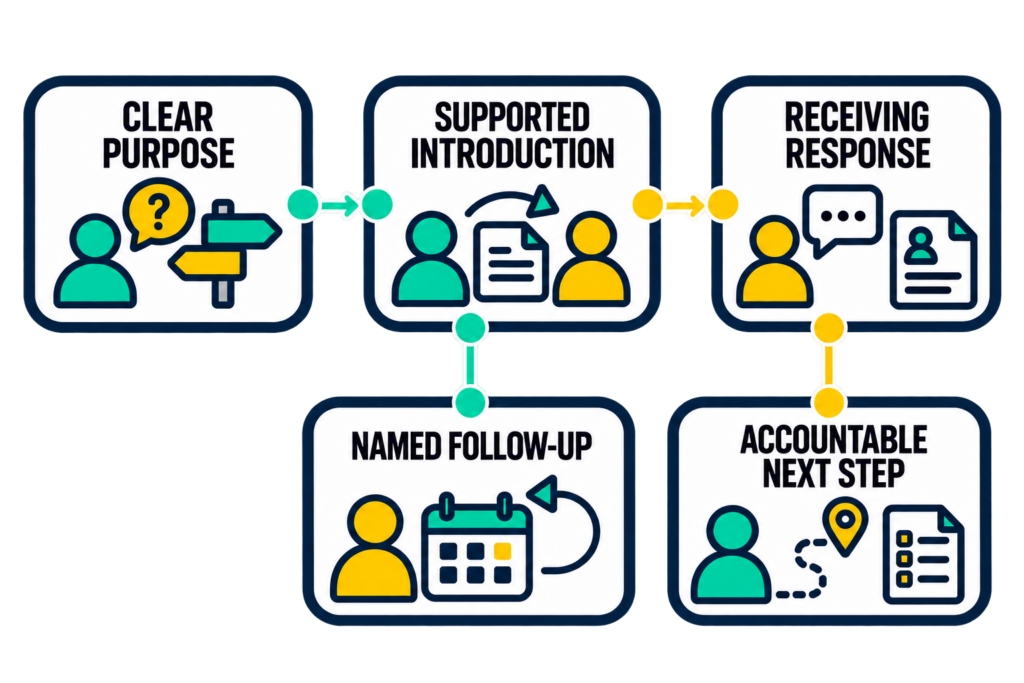
Referrals and follow-through connects a recommendation for another service to an understandable introduction, a receiving response, and an accountable next action.
A referral may involve another team within the same organization or a separate agency, training provider, employer, or support service.
The appropriate process depends on the participant’s purpose, preferences, and circumstances, along with the receiving service’s arrangements. Some situations need a simple introduction. Others require more active coordination.
Follow-through establishes who checks whether the intended connection happened and what to do when it remains unresolved. It does not require every organization to see every part of the participant’s service record.
This module examines one selected referral route so your team can clarify the introduction, acknowledgment, responsibilities, and follow-up needed to make it useful.
Sending a referral is only one part of the connection.
A participant may leave a conversation with a recommendation and still be unsure how to act on it.
They may not know whether someone will contact them, whether they need to explain their situation again, or what to do if they receive no response.
The receiving organization may also lack clarity. It may not know why the person was referred, which help was discussed, or whether the proposed service matches what it can provide.
The sending team needs enough feedback to support the transition without assuming that it should receive the person’s full service history.
A workable referral connects these perspectives through a clear purpose, an appropriate introduction, a receiving response, and a named next action.
The workshop identifies which parts your team can improve directly and which arrangements require agreement with a partner.
Where can a referral lose continuity?
Referral purpose
What the participant wants
Why this service is relevant
What remains uncertain
Whether the person wants the connection
What the service can confirm
Introduction
Who makes contact
What the participant expects
What context is appropriate
Which channel is workable
Who helps with the introduction
Receiving response
Who receives the inquiry
Whether receipt is acknowledged
Whether the route is suitable
What the next action is
Who explains limitations
Follow-through
Who checks progress
When a check is useful
Which information is needed
How difficulties are addressed
When the recommendation is revisited
Resolution
What happened to the connection
What remains unresolved
Whether another route is needed
How the participant is informed
What closure means
The review focuses on the information and actions needed to support the selected connection. A referral status should not imply more than the available evidence establishes.
Four moves toward accountable follow-through
1. Clarify the purpose and preferred route
Identify what the participant is seeking, why the receiving service may help, and how the person wants the introduction to happen.
2. Make the introduction understandable
Define who initiates contact, what appropriate context accompanies it, and what each party should expect next.
3. Establish receipt and responsibility
Identify the receiving contact, the acknowledgment needed, and who owns the next action.
4. Follow up and resolve the connection
Agree on how to check progress, respond to difficulties, and record a meaningful resolution or another route.
Start with one referral that is difficult to follow.
The module begins with a selected referral route and an example of how the connection currently happens.
Your team brings the instructions, messages, status descriptions, and staff responsibilities involved. Together, we examine what the participant, sending team, and receiving service can each understand.
A de-identified example can reveal where the process needs attention without requiring a complete case history or unrestricted sharing between organizations.
Questions we examine together
Describe the person’s purpose and the reason for recommending the receiving service. Identify assumptions about suitability or availability that still need confirmation.
Examine whether the person knows who will make contact, what will be explained, what response to expect, and where to ask for help.
Identify the appropriate context needed to understand the inquiry, while distinguishing that need from access to a broader participant record.
Clarify who responds, what the response should establish, and how the participant and relevant staff learn what happens next.
Define a responsible person, a suitable check-in point, and the actions available when there is no response or the original route does not work.
Distinguish a completed introduction, an agreed next step, a participant decision not to continue, an unavailable service, and an unresolved connection.
Six dimensions of a useful referral
Purpose clarity
The referral has an understandable connection to what the participant is trying to accomplish.
Participant understanding
The person knows what is being proposed, how contact will happen, and what choices remain available.
Appropriate context
The introduction provides relevant information with an appropriate basis for sharing it.
Receiving accountability
The route identifies who receives the inquiry and how the next action is acknowledged.
Follow-up ownership
Someone knows when to check the connection and how to respond if it stalls.
Resolution clarity
The record explains what happened without confusing an administrative action with a service result.
When the referral ends at “sent”
The record may show that staff completed a task while leaving the connection itself uncertain.
- The reason for the referral is broadly described.
- The participant receives a contact without clear expectations.
- Relevant context is missing or unnecessarily extensive.
- The receiving responsibility is assumed.
- Follow-up depends on someone remembering to ask.
- Closure means the record was updated rather than the connection understood.
The team has limited evidence about whether the referral helped the person reach a useful next step.
When the referral supports a connection
A clearer approach makes the purpose, responsibilities, and result easier to understand.
- The recommendation connects to the participant’s stated purpose.
- The introduction explains who will act next.
- Shared context is relevant to the selected connection.
- A receiving response establishes the next responsibility.
- A named person checks unresolved transitions.
- Resolution describes what actually happened and what remains.
The team can then improve the route using evidence about the transition itself.
Example: A support referral with no confirmed next step
A participant preparing to begin training tells an advisor that transportation may make attendance difficult.
The advisor recommends a community service that may be able to help and records the referral as sent.
The participant expects the service to call. The community service normally expects people to initiate contact through its intake number.
Several days later, the participant has received no response and assumes the assistance is unavailable.
The advisor sees the completed referral in the record and does not realize that the introduction never happened.
In the workshop, the team traces the route from the initial recommendation to the point where the participant should receive a next step.
The review identifies a mismatch in expectations about who makes contact. It also identifies the information needed to explain the request without sharing an unnecessary case history.
The proposed improvement gives the participant a clear introduction, confirms a workable contact method, and assigns a staff check-in if the connection remains unresolved.
Where the partner agrees, a limited acknowledgment establishes that the inquiry was received and identifies the next responsible action. Assistance availability remains a separate question for the receiving service.
The team tests whether the revised route produces clearer introductions and fewer unresolved handoffs. It does not treat a received referral as proof that transportation support was provided or that training attendance improved.
Follow-through needs a useful definition of closure.
A referral can reach several different conclusions.
The participant may receive an introduction and choose to continue independently. The receiving service may establish an appointment or another agreed next action.
The participant may decide not to proceed, or the service may be unavailable or unsuitable for the stated purpose.
A connection may also remain unresolved because the team does not yet know what happened.
Those situations should not be collapsed into a single status that suggests the same result.
The workshop helps define closure for the selected route, including what can be confirmed, what remains unknown, and whether another action is needed.
Accountability can respect participant choice and privacy.
Following through does not mean requiring a participant to accept every recommendation.
The person should understand the proposed connection and have an appropriate way to express a preference, raise a concern, or decide not to continue.
The team should also define what information is necessary to support the transition and who needs access to it.
A receiving service may be able to acknowledge an inquiry or explain a next step without sharing detailed information about subsequent services.
The appropriate arrangement depends on the purpose, participant permissions, and responsibilities of the organizations involved.
The workshop identifies those boundaries and the questions requiring confirmation before a shared process or configuration is introduced.
WORKSHOP MODULE
Referrals & Follow-Through
This module is a practical minicourse in turning a service recommendation into an understandable and accountable connection.
Your team learns a repeatable method, applies it to one referral route, and develops a focused improvement with an owner and a way to test whether it works.
The work also identifies the referral context, acknowledgment, status meanings, permissions, and follow-up responsibilities that a subsequent Gobekli configuration would need to support.
What can this module help clarify?
Scope is established through Workforce Pathway Direction and narrowed to a referral route your team can meaningfully examine.
- The participant population and selected referral route.
- The purpose of the recommendation.
- Assumptions about service suitability or availability.
- The participant’s preferences and understanding.
- Who initiates contact and through which channel.
- The appropriate context accompanying the introduction.
- The receiving contact or team.
- What acknowledgment should establish.
- Who owns the next action.
- When and how unresolved connections are followed up.
- What happens if the original route is unsuitable or unavailable.
- What resolution and closure mean for the selected referral.
What kinds of responses might follow?
The appropriate response depends on where the connection becomes unclear.
A clearer referral explanation
Revise how staff explain the purpose, contact route, expectations, and available help.
A supported introduction
Define when a participant needs assistance making contact and who provides it.
A focused referral summary
Identify the relevant context needed by the receiving service and the boundaries around sharing it.
An agreed acknowledgment
Establish what the receiving response should communicate and who is responsible for providing it.
A defined follow-up route
Assign a suitable check-in point and a response when the connection remains unresolved.
A more meaningful resolution record
Distinguish what happened to the referral from later service activity or outcomes.
The workshop may identify changes to staff practice or partner arrangements that should happen before any product configuration is introduced.
What will we review?
The referral purpose
Why the service is recommended and how that relates to the participant’s goal or immediate need.
The participant-facing explanation
What the person is told about contact, timing, expectations, choices, and help.
The introduction and shared context
How the connection is made and which information accompanies it.
The receiving arrangements
Who receives the referral, responds, and establishes the next action.
The follow-up process
Who checks unresolved connections and what they can do when the route stalls.
The resolution record
How the team describes the result, remaining uncertainty, and any further action.
The workshop exercise
Your team works through one selected referral using the materials and responsibilities available.
STEP 1
Select the connection
Define the participant situation, sending team, receiving service, and intended purpose of the referral.
STEP 2
Trace the introduction
Examine what the participant is told, who initiates contact, and what context is appropriately shared.
STEP 3
Identify the receiving response
Clarify who receives the inquiry and what acknowledgment or next-step explanation is needed.
STEP 4
Assign follow-through
Name the person responsible for checking unresolved connections and the circumstances that trigger a check.
STEP 5
Improve one weak point
Choose a concrete change within the team’s control or prepare a proposal for the responsible partner.
STEP 6
Define resolution and the test
Agree on what the team should be able to confirm and how it will check understanding, acknowledgment, and follow-up.
A Referral Follow-Through Map, one assigned improvement, and a validation plan that can also inform an initial product configuration brief.
FROM WORKSHOP INSIGHT TO A POSSIBLE GOBEKLI SETUP
Configure the connection around agreed responsibilities.
The workshop establishes how the selected referral should work before deciding how technology should support it.
Depending on confirmed capabilities and implementation scope, a future setup could explore TalentPass for participant-held context, Pythia-guided preparation, and TalentSync or Passport Pages for appropriate coordination.
The configuration brief identifies the information each party needs, the actions that need ownership, and the limits on what can be inferred from a referral record.
- The selected participant population and referral purpose.
- The sending and receiving organizations or teams.
- The participant’s preferred contact route.
- The relevant context for the introduction.
- The permissions and boundaries for sharing information.
- The receiving contact and acknowledgment responsibility.
- The meanings of referral statuses and next actions.
- The owner and trigger for follow-up.
- The route for updating or reconsidering the referral.
- The evidence needed to describe resolution accurately.
Any implementation would require confirmation of product availability, partner participation, integrations, and operating responsibilities.
A Gobekli setup would support the agreed connection. It would not guarantee that another organization accepts the referral, provides a service, or achieves a participant outcome.
SCOPE & RESPONSIBILITY
What this module does—and what it does not decide
This module helps your team improve a selected referral route.
It makes the introduction, receiving response, follow-up, and resolution responsibilities more explicit.
Participants and responsible organizations retain their respective choices and decision authority.
- The workshop does not determine eligibility for the receiving service.
- It does not guarantee service availability or acceptance.
- It does not require participants to act on every recommendation.
- It does not authorize unrestricted sharing of participant records.
- It does not assume every partner will use the same system.
- It does not commit absent organizations to response times or responsibilities.
- It does not treat referral completion as proof of a service outcome.
- It does not deploy a complete referral network or case management system.
Questions requiring partner agreement are recorded with the appropriate owner and next action.
The resulting plan distinguishes confirmed arrangements from proposals, assumptions, and unresolved dependencies.
What should you bring?
Bring enough material to make one referral route concrete. A de-identified example can show how the introduction and follow-up work without exposing a complete participant history.
The foundation module establishes the selected journey, appropriate inputs, and responsibilities needed for the review.
Useful inputs
- A selected participant situation and referral purpose.
- The sending and receiving services.
- Current referral instructions or guidance.
- Example participant-facing messages.
- A referral form or summary, if used.
- The context normally shared with the receiving service.
- Known contact and acknowledgment arrangements.
- Current staff and partner responsibilities.
- Examples of referral status labels.
- Existing follow-up practices.
- Examples of unresolved or unsuccessful connections.
- Known sharing boundaries and partner dependencies.
Missing information can become a focused follow-up question. The workshop does not require a complete inventory of every referral your organization makes.
What can you leave with?
Referral Follow-Through Map
A shared account of the referral purpose, introduction, appropriate context, receiving response, follow-up, and resolution.
Assigned Referral Improvement
A focused change with an owner, any required partner agreement, and a clear next action.
Validation Plan
A way to check participant understanding, receiving acknowledgment, ownership of unresolved actions, and the accuracy of referral closure.
Initial Configuration Brief
The referral information, sharing boundaries, status meanings, responsibilities, and review triggers a subsequent Gobekli implementation would need to support.
These outputs begin with the example reviewed during the module. Final scope depends on the modules selected, available inputs, and the decision established through Workforce Pathway Direction.
Where might the work lead next?
Eligibility & Enrollment Handoffs
When the connection reaches a program but requirements, documentation, or decision responsibilities remain unclear, examine the route into enrollment.
Support Barriers & Coordinated Assistance
When practical, informational, or accessibility barriers prevent the participant from acting on the referral, examine the assistance and coordination needed.
Advisor Capacity & Case Continuity
When follow-up breaks down because of caseloads, staff changes, or unclear coverage, examine how the continuity of support can be maintained.
These modules can be combined within the Workforce Pathway & Service Continuity Workshop according to the selected journey and organizational decision.
Frequently asked questions
Questions organizations ask before beginning.
Workforce programs, public agencies, community organizations, training providers, and service partnerships that recommend or connect participants to other services. Useful participants understand the referral route or have responsibility for improving it.
Yes. The foundation establishes the participant population, journey, organizational decision, evidence, responsibilities, and boundaries that guide this module.
Yes. Handoffs between internal teams can create the same uncertainty about introductions, acknowledgment, and follow-up as referrals between organizations.
Not necessarily. Your team can improve the parts it controls and identify the arrangements needing partner confirmation. The workshop cannot make commitments for an absent organization.
No. The appropriate route depends on the participant’s preferences, circumstances, and the service involved. The workshop helps distinguish when a clear self-directed next step is sufficient and when additional support may be useful.
That depends on the selected route. It might confirm receipt, identify the receiving contact, or explain the next action. It should not imply eligibility, enrollment, or service delivery unless those events have actually been established.
The team can examine whether a more limited acknowledgment or next-step explanation is appropriate. Detailed service records are not automatically necessary to support a referral.
The process should allow that preference to be expressed and understood. A decision not to proceed should not automatically be recorded as noncompliance or a failed service outcome.
The workshop defines who follows up, which contact route to try, and when to reconsider the recommendation. It does not assume the sending organization can compel a partner to respond.
The resolution should make that limitation clear and identify whether another route needs exploration. An unavailable service is different from a participant choosing not to continue.
That module focuses on finding and understanding a workable starting point. This module examines how a specific recommendation becomes an introduction and an accountable connection.
The eligibility module examines requirements, documentation, authorized decisions, and enrollment actions. This module focuses on the referral introduction, receiving response, and follow-through around the connection.
This module defines responsibilities for a selected referral route. The advisor capacity module examines broader staffing, coverage, information, and escalation arrangements affecting continuity.
No. The workshop can improve instructions, staff responsibilities, and partner arrangements using existing tools. A future shared configuration is an optional implementation decision.
Bring a de-identified example, the instructions and messages used, current responsibilities, and any available evidence about where the connection becomes unclear. A complete participant case file is not required.
The validation plan can examine whether participants understand who acts next, receiving teams acknowledge inquiries, unresolved actions have owners, and closure reflects what actually happened. Measures are selected for the referral route.
No. The map, assigned improvement, and validation plan should be useful independently. They can also provide a clearer starting point for a later Gobekli configuration.
TURN RECOMMENDATIONS INTO ACCOUNTABLE CONNECTIONS
Give the referral a clear next step.
A useful referral connects the participant, sending team, and receiving service through understandable expectations and named responsibilities.
Use Referrals & Follow-Through within the Workforce Pathway & Service Continuity Workshop to examine one connection and define a practical improvement your team can take forward.
