
MEMBERSHIP VALUE WORKSHOP MODULE
Benefit Portfolio Relevance & Gaps
A longer benefit list does not always provide better support. Examine which offerings still serve a clear purpose, where they overlap, and what is missing so investment can follow the needs membership should address.
Does this sound familiar?
New benefits accumulate without review
The organization adds programs and services while earlier offerings continue without a clear decision about their ongoing purpose.
Different teams provide similar support
Programs, chapters, committees, and partners address related needs without understanding where their offerings complement or duplicate one another.
Low use becomes the only argument
A benefit is questioned because participation is limited, without examining its intended audience, availability, or the circumstances in which it becomes useful.
Familiar offerings outlast their purpose
A resource or service remains in the portfolio because it has always been there, even as the need, delivery conditions, or available alternatives change.
Important needs fall between benefits
Members can find several related offerings but still lack the support needed to accomplish the purpose those benefits are meant to serve.
Investment follows the loudest request
A new idea gains attention without a shared way to compare its relevance, existing coverage, operating requirements, and evidence.
What are benefit portfolio relevance and gaps?
A benefit portfolio is the collection of programs, services, resources, access arrangements, and other offerings associated with membership.
Portfolio relevance concerns how those offerings relate to the needs membership is intended to serve.
A portfolio gap exists when an important need lacks appropriate support, or when the available combination of offerings leaves a necessary part of that support unresolved.
Several benefits may serve the same need for valid reasons. Their relationship requires examination before describing them as duplication.
This module reviews a selected part of the portfolio and identifies what should be retained, improved, coordinated, combined, retired, or investigated further.
A portfolio needs a reason for each offering and an account of what remains uncovered.
An organization may have a well-established learning program, a resource library, peer discussions, and access to specialist advice.
Those offerings can work together, serve different audiences, or repeat the same support in different places.
Their titles alone do not explain the relationship.
The review connects each selected benefit to its intended audience, purpose, conditions, and place within the wider offering.
It then examines where the combination provides useful coverage and where the team lacks enough evidence to judge.
That shared view helps the organization make deliberate choices about investment instead of treating every new need as a reason to add another benefit.
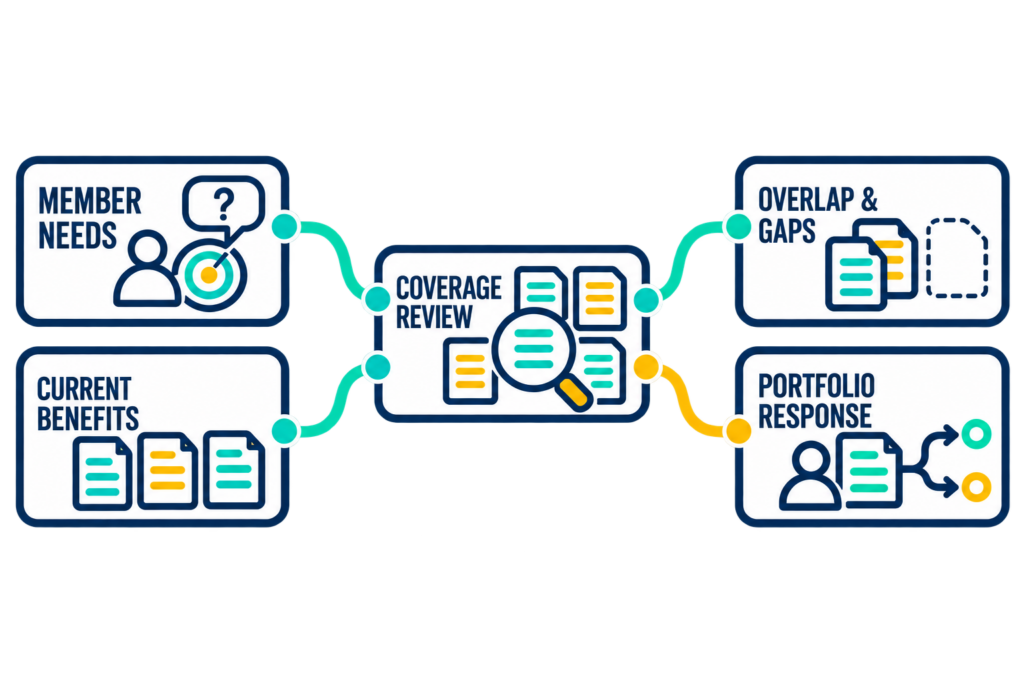
See the relationships across the benefit portfolio.
Needs and Priorities
Member purposes
Organizational commitments
Different audience needs
Changing circumstances
Questions requiring validation
Current Offerings
Programs and services
Resources and advice
Access arrangements
Chapter and partner benefits
Current ownership
Coverage and Relationships
Needs each benefit serves
Complementary support
Audience or format differences
Potential duplication
Uncovered requirements
Evidence and Conditions
Member accounts
Use and availability
Access requirements
Delivery capacity
Limits of the available evidence
Response and Investment
Retain or improve
Coordinate or combine
Retire with a transition
Investigate a gap
Assign and review changes
A useful portfolio review makes both the purpose of existing benefits and the questions about missing support visible.
How a benefit portfolio becomes difficult to manage
STAGE 1 — Offerings respond to particular requests
Teams introduce benefits to address a need, opportunity, partnership, or member concern.
STAGE 2 — The portfolio grows in separate places
Programs, chapters, and partners develop their offerings with different information and priorities.
STAGE 3 — Needs and conditions change
The audience, available alternatives, delivery capacity, or original purpose shifts while the benefit remains in place.
STAGE 4 — Investment becomes difficult to compare
The organization lacks a shared view of what each offering serves, how benefits relate, and where additional support would matter most.
A benefit inventory does not explain portfolio coverage.
An inventory can answer an important question:
What do we currently offer?
A portfolio review also asks whom those offerings serve, what support they provide together, and which important needs remain unresolved.
The review should clarify:
Begin with the audience and purposes established through Membership Value Direction. Mark priorities that require further member input.
Describe the practical support, access, or experience involved. Include relevant conditions and responsibilities.
Identify benefits that support different parts of a purpose, different audiences, or different circumstances.
Examine repeated content, competing services, or separate administration. Distinguish apparent similarity from duplication that matters.
Identify unsupported needs and offerings whose purpose, information, or delivery arrangements may have become outdated.
Connect the available evidence to a proposed action, responsible owner, transition needs, and questions that should be resolved before investment changes.
A useful portfolio review needs six forms of clarity.
Purpose
Each selected benefit has an understandable relationship to a need membership should serve.
Audience
The team knows who the offering is intended for and which differences affect its usefulness.
Coverage
The review identifies what the benefits support together and what remains unresolved.
Relationship
Complementary support is distinguishable from potential duplication.
Feasibility
Proposed changes account for ownership, delivery capacity, commitments, and dependencies.
Review
The team knows what evidence or member input should inform the next decision.
A portfolio the organization can explain
A useful portfolio account provides:
- A defined set of needs and audiences.
- A purpose for each selected offering.
- Understandable relationships among benefits.
- Evidence and assumptions kept distinguishable.
- Visible gaps and delivery constraints.
- Assigned decisions and review responsibilities.
Investment can then be considered against the support the organization intends to provide.
A portfolio that grows by accumulation
A benefit list becomes difficult to manage when it relies on:
- Program names without a clear account of purpose.
- Separate teams interpreting the same need independently.
- Usage counts as the only evidence of relevance.
- Familiarity as the reason to retain an offering.
- New benefits proposed before existing coverage is examined.
- Changes made without considering affected members.
The review turns that list into a set of relationships the team can assess.
Several introductory resources can still leave a practical support gap.
An association wants to help members taking on their first operational leadership responsibilities.
The portfolio includes introductory webinars, a resource library, and a partner course.
Staff believe the organization needs another introductory program.
The team selects this part of the portfolio for review.
It maps what each offering covers, whom it serves, and how members are expected to use it.
Available feedback suggests that introductory information is reasonably well covered, but members struggle to apply it to unfamiliar situations after completing the learning.
The team distinguishes useful differences among the existing resources from repeated material that creates maintenance work.
It considers whether updating the resource library and testing a small case-based support session would address the need more directly than adding another introductory course.
Before recommending a wider change, participants identify the member input, delivery capacity, and partner arrangements that require review.
The result is a focused portfolio response grounded in a particular need and a clear account of what remains uncertain.
Similar benefits can serve different purposes.
Two offerings may cover the same subject while serving different audiences, levels of preparation, or access needs.
A short reference guide, a facilitated discussion, and specialist advice may all be relevant to the same issue.
Their value depends on what each makes possible and under which conditions.
The review examines those differences before recommending consolidation.
It also asks whether the organization can coordinate content or administration while preserving useful choices.
Combining benefits is appropriate only when the proposed arrangement continues to support the purposes that matter.
Low use and missing support both need context.
A benefit may be relevant to a small audience or become useful only under particular circumstances.
Limited use can also reflect an unclear purpose, difficult access, outdated information, or a need the offering no longer serves.
The review distinguishes those possibilities rather than treating one measure as a decision.
A reported gap requires similar care.
The organization may need a new offering, a change to an existing one, a better connection between benefits, or a more appropriate source of support.
The team identifies which interpretation the evidence supports and what needs validation before committing resources.
THE MATCHING WORKSHOP MODULE
Module 3: Benefit Portfolio Relevance & Gaps
This practical minicourse helps membership organizations review the benefit portfolio for relevance, duplication, outdated offerings, and missing support so investment can follow the needs membership should serve.
Participants learn a repeatable review method, apply it to a selected part of the portfolio, and identify whether the priority response concerns an existing benefit, relationships among offerings, or a gap requiring further investigation.
The exercise also defines the benefit records, audience and purpose relationships, evidence, dependencies, and responsibilities that a subsequent Gobekli configuration would need to support.
This module helps your team:
- Define a manageable part of the benefit portfolio.
- Connect selected offerings to member purposes.
- Identify intended audiences and important conditions.
- Examine how benefits complement one another.
- Locate potential duplication and maintenance burdens.
- Identify offerings requiring a currency review.
- Describe missing or incomplete support.
- Distinguish evidence from assumptions about relevance.
- Consider delivery capacity and dependencies.
- Develop appropriate portfolio responses.
- Assign validation and transition responsibilities.
- Outline a connected benefit-portfolio configuration.
What should happen to each offering or gap?
The review leads to a deliberate response based on the intended need, available evidence, relationships among benefits, and practical delivery conditions.
Retain
Keep an offering that serves an understood purpose, with its ownership and review needs clear.
Improve
Update the content, support, format, or arrangements needed for an existing benefit to remain useful.
Coordinate
Clarify how related offerings work together while preserving meaningful differences.
Combine
Bring overlapping support together where the evidence and operating conditions justify it.
Retire
Plan the conclusion of an offering whose continued role is no longer justified, including an appropriate transition.
Investigate
Validate an apparent gap or proposed addition before deciding how to address it.
These responses guide a portfolio decision. A workshop finding does not automatically authorize a budget change, service withdrawal, or new commitment.
What should a benefit portfolio review examine?
The need
Which member purpose or organizational commitment should the selected benefits support?
The offering
What does each benefit provide, for whom, and under which access or delivery conditions?
The coverage
What parts of the need are addressed, and where is support incomplete or uncertain?
The overlap
Which similarities are useful, and which may create avoidable duplication or confusion?
The operating implications
Who maintains the offering, what resources or agreements support it, and what would a change affect?
The response
What action is justified, what requires validation, and how will affected members and delivery teams be supported?
Map one part of the portfolio before choosing what to change.
Your team applies the method to the audience and value question established through Membership Value Direction.
STEP 1
Define the portfolio boundary
Select the audience, need, and group of offerings the exercise will examine.
STEP 2
Describe the current benefits
Record what each offering provides, whom it serves, its conditions, and its owner.
STEP 3
Map coverage and relationships
Identify complementary support, potential duplication, dependencies, and apparent gaps.
STEP 4
Examine the evidence
Review member accounts, use, availability, currency, and delivery information while marking assumptions.
STEP 5
Choose a portfolio response
Retain, improve, coordinate, combine, retire, or investigate according to the selected issue.
STEP 6
Assign validation and transition
Identify the decision owner, further input, operating changes, affected members, and review conditions.
The result is a draft Benefit Coverage & Response Map connecting selected needs, offerings, relationships, evidence, proposed actions, and responsible owners.
FUTURE PRODUCT CONNECTION
Keep benefits connected to the needs they serve.
A subsequent Gobekli configuration could help the organization maintain an understandable account of its benefits and their relationships.
TalentSync could connect benefit and program records to intended audiences, member purposes, responsible teams, delivery conditions, and portfolio review decisions.
TalentPass could help members express relevant goals and share experience of the support they have used. Pythia could help explain the available benefits, surface questions about coverage, or support a review using the information and permissions in scope. Passport Pages could support agreed source connections across relevant systems and partners.
A connected portfolio review could potentially show:
- Which needs and audiences are in scope.
- What each selected benefit provides.
- Which conditions affect access or usefulness.
- How offerings complement or depend on one another.
- Where potential duplication has been identified.
- Which gaps are reported, observed, or still assumed.
- What evidence supports the current interpretation.
- Who maintains each offering and related information.
- Which response or further investigation has been assigned.
- When a change should trigger another review.
The workshop produces a starting configuration brief: benefit records, audience and purpose relationships, coverage questions, evidence sources, dependencies, ownership, and review states.
Specific integrations, portfolio views, feedback collection, and change workflows would be confirmed during solution planning.
PRODUCT AND DECISION BOUNDARIES
A portfolio map supports judgment about investment.
The review helps the organization make the purpose and relationships of selected benefits easier to examine.
It does not establish that an offering should be removed solely because it overlaps another or has limited recorded use.
A later configuration should distinguish a stated need, an existing benefit, observed use, member feedback, potential duplication, a proposed gap, and an approved decision.
The workshop and product connection do not establish:
- The same benefit priorities across all members.
- Irrelevance based only on low participation.
- Duplication based only on similar titles or subjects.
- Demand for a new offering based on one request.
- Cost savings without examining delivery and transition implications.
- Authority to change partner agreements or membership commitments.
- An organization-wide conclusion from a selected portfolio example.
- Automatic approval to retire, combine, or fund a benefit.
The organization retains responsibility for investment decisions, service commitments, and changes affecting members.
The portfolio brief remains useful independently of future product adoption.
What to bring into the conversation
You do not need a complete organization-wide benefit audit before beginning.
Start with a selected group of offerings connected to the question established through Membership Value Direction.
Useful inputs may include:
- The audience and needs within scope.
- A list of the selected benefits.
- Descriptions of what each offering provides.
- Access conditions and intended users.
- Relevant program, chapter, or partner information.
- Current ownership and maintenance responsibilities.
- Available use and feedback records.
- Known currency or quality concerns.
- Examples of reported gaps or duplication.
- Delivery resources and practical constraints.
- Commitments or dependencies a change could affect.
- Benefit owners and relevant member perspectives.
The aim is to examine one part of the portfolio in sufficient detail to define a practical response and the evidence needed for the next decision.
What this module can help clarify
What the portfolio is meant to support
Connect selected benefits to defined audiences, needs, and conditions.
How the offerings work together
Distinguish complementary support, useful differences, dependencies, and potential duplication.
Where relevance or coverage needs attention
Identify outdated arrangements, incomplete support, and questions requiring further validation.
What to change or investigate next
Develop an assigned portfolio response, transition considerations, and starting configuration brief.
These outputs begin with the example reviewed during the module. Final scope depends on the selected modules, available information, and question established through Membership Value Direction.
Where might the work lead next?
Membership Value Proposition & Differentiation
Clarify the membership promise when portfolio findings change what the organization can meaningfully explain to its audience.
Professional Learning & Development Value
Examine what learning offerings help members understand and apply when the selected portfolio question concerns professional development.
Dues, Tiers & Benefit Packaging
Review how benefits are grouped and presented when the portfolio response affects membership choices or access arrangements.
Your team can combine this module with other parts of the Membership Value Workshop according to the value question established through Membership Value Direction.
Frequently asked questions
Questions organizations ask before beginning.
Programs, services, resources, advice, recognition, access arrangements, and other offerings associated with membership. The exercise selects the part relevant to the agreed question.
No. One audience, need, or group of related offerings provides a manageable starting point. A wider portfolio review can be scoped separately.
Its relationship to an intended need, audience, and purpose. The review also considers the conditions under which it becomes useful and the evidence available about that relationship.
No. Limited use may reflect a small intended audience, occasional need, access difficulty, or other conditions. The review examines those possibilities before recommending a response.
Compare purpose, audience, content, format, access, and the role each offering plays. Similar subject matter may support different needs or stages of use.
Yes. Include the relevant offering and the responsibilities or agreements that affect it. A portfolio recommendation does not override another group’s authority or commitments.
An important need that lacks appropriate support, or a necessary part of that support left unresolved by the current combination of offerings. An apparent gap should be validated before assuming a new benefit is needed.
It can identify a need to investigate and possible responses. A launch decision may require further member input, delivery planning, financial analysis, or a pilot.
Yes. The review can identify content, references, formats, or support arrangements that require updating, along with ownership and review responsibilities.
Consider its intended purpose and the significance of the support to that group. Portfolio relevance should not be reduced to a comparison of participation totals.
Yes, where suitable information is available. The review can consider operating requirements and dependencies, while marking estimates and questions requiring further analysis.
Identify affected members, existing commitments, alternatives, communication, and transition responsibilities before implementation. The workshop can frame those requirements without assuming withdrawal is already authorized.
That module examines the promise made to an audience. This module examines the relevance and relationships of the offerings behind it.
That Member Engagement module examines how members find, understand, and enter opportunities. This module examines whether the selected offerings provide appropriate coverage in the first place.
This module examines what the portfolio should support and which offerings need attention. The packaging module examines how benefits are grouped into understandable membership choices and commitments.
The outputs can inform a configuration connecting benefits, audiences, purposes, evidence, dependencies, ownership, and review decisions. Specific capabilities and implementation requirements would be confirmed during scoping.
Your team will review a selected part of the portfolio and develop a draft Benefit Coverage & Response Map, assigned validation and transition considerations, and starting configuration requirements. Wider assessment and implementation continue afterward.
GIVE EACH BENEFIT A CLEAR ROLE
Invest in the support membership needs to provide.
Connect your offerings to member purposes, understand where they overlap, and identify what needs improvement or further investigation.
This module is part of Gobekli’s configurable Membership Value Workshop.
