
MEMBERSHIP VALUE WORKSHOP MODULE
Professional Learning & Development Value
Attendance and completion tell part of the story. Examine what professional learning helps members understand, apply, and develop—and what evidence can support a clearer account of its value.
Does this sound familiar?
Reports stop at participation
The organization knows how many members attended or completed an offering but has little information about what they learned or used.
Positive feedback carries the whole value claim
Members liked the speaker or found the session interesting, but the organization cannot explain what became clearer or more workable afterward.
Different learning purposes are treated alike
An introductory briefing, a practical workshop, and an extended development program are evaluated through the same questions.
Application depends on support that is missing
Members encounter useful ideas but lack the practice, feedback, resources, or opportunity needed to use them.
Development disappears between offerings
Courses and events are recorded separately, making it difficult to understand how members build on earlier learning.
The learning promise exceeds the evidence
An offering is described as building professional capability when the available record establishes attendance, completion, or a narrower learning result.
What is professional learning and development value?
Professional learning and development value concerns what membership-supported learning helps people understand, practice, apply, or develop in relation to a relevant purpose.
That learning may happen through courses, webinars, workshops, guided practice, professional discussions, or other structured development opportunities.
Different offerings serve different purposes. A briefing may help members interpret a change. A practical workshop may help them try an approach. An extended program may support development through repeated practice and feedback.
The value review connects the intended purpose to the learning experience and the evidence available afterward.
This module examines one selected offering without assuming that attendance establishes understanding, completion establishes capability, or every learning activity needs to demonstrate a workplace outcome.
Learning value becomes clearer when the intended change is specific.
An association may offer a well-attended professional development program.
Its members may leave satisfied with the experience.
The next question is what the program helped them understand or do.
Did it clarify a difficult issue? Help them compare approaches? Give them an opportunity to practice? Support a change in how they handle a relevant situation?
The answer depends on the purpose of the offering and the circumstances in which members might use the learning.
A useful review identifies that purpose, examines the support provided, and selects evidence proportionate to the claim.
See the relationships behind professional learning value.
Member Purpose
Professional question
Current responsibilities
Prior understanding
Development goal
Relevant circumstances
Learning Experience
Intended learning
Explanations and examples
Practice opportunities
Feedback and reflection
Resources for later use
Application Conditions
Relevant situations
Opportunity to apply
Time and resources
Support from others
Constraints requiring attention
Development Over Time
Understanding clarified
Approaches practiced
Application attempted
Feedback considered
Further development identified
Evidence and Responsibility
Source and timing
Member reflection
Reviewed work where appropriate
Limits of interpretation
Ownership of follow-up
A credible account connects the learning purpose, experience, and evidence while keeping the conditions for application visible.
How professional learning value becomes difficult to explain
STAGE 1 — An offering receives a broad development promise
A course, webinar, or program is described as helping members grow professionally without specifying the change it is intended to support.
STAGE 2 — Participation becomes the main record
Attendance, completion, and satisfaction are captured more consistently than understanding, practice, or application.
STAGE 3 — The record stands in for the result
Hours completed or positive feedback are used to support claims that require different evidence.
STAGE 4 — Improvement becomes difficult to direct
The organization cannot easily distinguish an unclear purpose, a weak learning experience, missing application support, or a gap in what it knows.
A completion record opens the review.
A program report can answer an important question:
Who completed the offering?
A learning-value review also asks what the offering intended to help those members understand or do, what support it provided, and what evidence is appropriate to that purpose.
Questions that make the value clearer
Define a specific purpose relevant to the selected audience. Distinguish awareness, understanding, practice, application, and development through repeated use.
Identify the explanations, examples, exercises, feedback, or resources that were intended to help members progress.
Examine relevant reflections, responses, practice work, or reviewed examples. Keep satisfaction and completion records distinct from evidence of understanding or performance.
Consider whether members encountered a relevant situation and had the time, resources, authority, or support needed to act.
Connect the account to the evidence available, including its source, timing, scope, and limitations.
Identify a focused change to purpose, learning experience, application support, or evidence collection, with an owner and a way to review it.
A useful learning-value review needs six forms of clarity.
Purpose
The offering addresses a learning need that members and program owners can recognize.
Experience
The activities and support relate to the understanding or development being promised.
Evidence
The information collected can inform the specific question under review.
Application
The account considers where members might use the learning and what would make that possible.
Development
Further practice, feedback, or learning needs remain visible where they matter.
Boundary
The value claim stays within what the offering and evidence can reasonably support.
Learning value members can understand
A useful account explains:
- Whom the offering is intended to help.
- What members can expect to understand or practice.
- How the experience supports that purpose.
- Where the learning may become useful.
- What evidence supports the account.
- What further support or development may be needed.
Members can judge whether the offering fits their needs and what it asks of them.
Learning value described through activity alone
The value becomes difficult to assess when it relies on:
- Hours of content provided.
- Attendance or completion totals.
- Satisfaction presented as learning.
- The same promise for every audience.
- Application assumed without considering circumstances.
- Broad capability claims from limited evidence.
The review identifies which relationships need clarification and which claims need better support.
A workshop can help members make better judgments before it changes a workplace result.
An association offers a workshop on evaluating new tools used in its profession.
The program has strong attendance and positive feedback, but its description promises that members will be ready to make effective adoption decisions.
The team selects one audience and one learning purpose for review: helping members identify relevant questions when comparing a proposed tool with an existing approach.
Participants work through an example, explain their reasoning, and receive feedback.
The available work suggests that some participants can identify considerations they had previously overlooked. Others need more support distinguishing useful evidence from unsupported claims.
Later feedback indicates that some members used the questions in a real discussion. Other members have not yet encountered a relevant decision.
The review keeps those findings distinct. It identifies learning within the workshop, reported application afterward, and circumstances where application has not yet been possible.
The team narrows the public promise, improves one exercise, and offers an optional follow-up reflection.
The resulting account explains what the learning supported without claiming that attendance established professional competence or caused a successful adoption decision.
The evidence should fit the learning purpose.
Not every offering needs the same form of evaluation.
A short briefing intended to introduce an issue may need a different review from a program intended to support practical performance.
Members’ questions and reflections may help reveal what became clearer. Practice work may show how they approached a defined task. A later example may help explain application in a particular setting.
Each source answers a different question.
The review selects evidence that can inform the decision without creating unnecessary work for members or staff.
The strength and breadth of the claim should remain consistent with what that evidence establishes.
An opportunity to learn is different from an opportunity to apply.
A member may understand an approach and still lack a suitable situation in which to use it.
Application may depend on responsibilities, resources, equipment, permission, team practices, or the timing of a relevant task.
Those conditions matter when interpreting follow-up.
An absence of reported application does not, by itself, explain whether the learning was useful or effective.
The review distinguishes what happened during the offering from what became possible afterward.
That distinction helps the organization decide whether to improve the learning experience, provide additional support, or investigate an unresolved question.
THE MATCHING WORKSHOP MODULE
Module 5: Professional Learning & Development Value
This practical minicourse helps membership organizations examine what professional learning helps members understand, apply, and develop beyond attendance or completion.
Participants learn a repeatable review method, apply it to one selected offering, and identify whether the priority response concerns purpose, learning experience, application conditions, evidence, or continued development.
The exercise also defines the learning purposes, offering records, member reflections, evidence relationships, and review responsibilities that a subsequent Gobekli configuration would need to support.
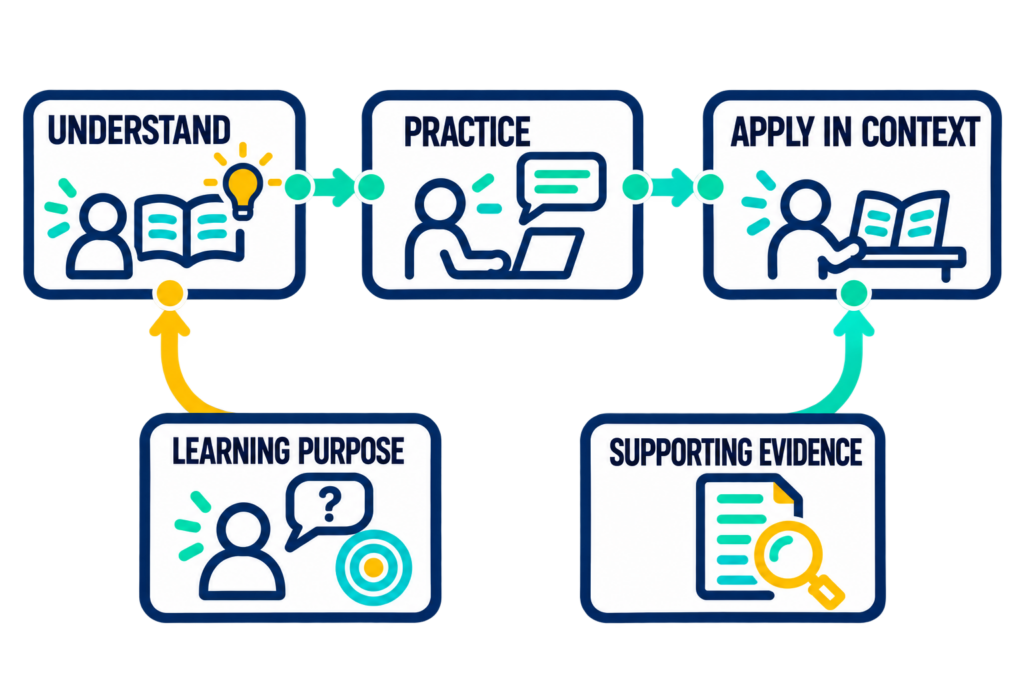
This module helps your team:
- Define the learning-value question within scope.
- Identify the relevant member population.
- Clarify the offering’s intended learning purpose.
- Examine the experience supporting that purpose.
- Distinguish participation from learning evidence.
- Review opportunities for practice and feedback.
- Consider where members might apply the learning.
- Identify application conditions and missing support.
- Interpret evidence with its source and limits.
- Recognize further development needs.
- Assign a focused improvement and validation plan.
- Outline a connected learning-value configuration.
What should happen to each part of the learning-value account?
The review leads to a deliberate response based on the learning purpose, experience provided, available evidence, and circumstances affecting application.
Clarify
Make the intended audience, learning purpose, and scope of the promise more specific.
Strengthen
Improve explanations, examples, practice, or feedback where the experience needs to better support its purpose.
Support
Address resources, guidance, or other conditions that could help members use the learning.
Substantiate
Gather appropriate evidence about understanding, practice, or application where a decision requires it.
Extend
Identify a useful next opportunity for practice, feedback, or continued development.
Reframe
Adjust the value claim when the offering or available evidence supports a narrower conclusion.
These responses help improve and explain the offering. The appropriate response depends on the example reviewed.
What should a professional learning value review examine?
The member need
What question, responsibility, or development purpose makes this learning relevant?
The intended learning
What should the offering help members understand, practice, or become better prepared to do?
The learning experience
Which activities, examples, resources, and feedback support that purpose?
The application conditions
Where could members use the learning, and what support or constraints affect that opportunity?
The available evidence
What is known about learning or application, from which sources, and with what limits?
The improvement decision
What should change, who can act, and what evidence would help assess the response?
Trace one learning offering from its purpose to the value it can support.
Your team applies the method to the audience and value question established through Membership Value Direction.
STEP 1
Define the learning purpose
Select one offering and clarify the member need, intended audience, and learning claim within scope.
STEP 2
Examine the experience
Identify how explanations, activities, practice, feedback, and resources support the intended learning.
STEP 3
Review the evidence
Separate participation and satisfaction records from evidence relevant to understanding, practice, or application.
STEP 4
Consider application and development
Identify relevant situations, supporting conditions, barriers, and further learning needs.
STEP 5
Assess the value claim
Describe what the evidence supports, which conclusions need qualification, and what remains unknown.
STEP 6
Assign and test the response
Choose an improvement, responsible owner, proportionate follow-up, and review point.
The result is a draft Learning Value & Application Map connecting member purpose, intended learning, learning experience, application conditions, supporting evidence, and assigned improvements.
FUTURE PRODUCT CONNECTION
Keep learning connected to purpose, application, and development.
A subsequent Gobekli configuration could help the organization maintain an understandable account of what its learning offerings are intended to support and what is known about their contribution.
TalentSync could connect offerings to learning purposes, activities, responsible owners, source records, and review needs. TalentPass could help members organize relevant learning experiences, reflections, and examples they choose to retain or share.
Pythia could help members clarify a learning goal, reflect on an experience, or identify questions for a next step using the information and permissions in scope. Passport Pages could support agreed source connections and sharing arrangements.
A connected learning-value review could potentially show:
- Which member need an offering addresses.
- What learning purpose has been defined.
- Which activities and resources support it.
- What participation records establish.
- What learning evidence is available.
- Where application might be relevant.
- What members choose to report about use.
- Which conditions affect application.
- What further development or support is indicated.
- Who owns each improvement or review.
The workshop produces a starting configuration brief: offering records, learning purposes, activity and evidence relationships, member contributions, source context, sharing choices, and review responsibilities.
Specific reflection tools, learning-system connections, review workflows, and product capabilities would be confirmed during solution planning.
PRODUCT AND DECISION BOUNDARIES
A learning record needs an interpretation that fits the evidence.
The review helps the organization explain and improve the contribution of a selected learning offering.
A later configuration should distinguish attendance, completion, member reflection, reviewed practice, reported application, and any broader outcome.
Those records may relate to one another, but they establish different things.
The workshop and product connection do not establish:
- Understanding based only on attendance.
- Capability based only on completion.
- Application based only on satisfaction.
- The same learning result for every participant.
- Sustained development from one isolated example.
- Workplace results caused solely by the offering.
- Credential eligibility or professional standing.
- Permission to collect confidential workplace material.
The organization remains responsible for its learning promises and the interpretation of evidence used to support them.
The learning-value brief remains useful independently of future product adoption.
What to bring into the conversation
You do not need a complete learning-evaluation system before beginning.
Start with one offering connected to the question established through Membership Value Direction.
Useful inputs may include:
- The audience and learning need within scope.
- The offering’s current description.
- Intended learning purposes or outcomes.
- Example content or learning activities.
- Practice and feedback arrangements.
- Resources provided for later use.
- Available participation and completion records.
- Relevant member feedback or reflections.
- Appropriate examples of learning or application.
- Known application barriers or support needs.
- Current claims about development value.
- Program owners and relevant member perspectives.
The aim is to examine one offering in sufficient detail to explain its intended contribution and identify a practical improvement or validation need.
What this module can help clarify
What the learning is intended to support
Connect the selected offering to a defined member need and a specific learning purpose.
How the experience and application conditions fit
Describe the activities, practice, feedback, and circumstances that influence what members can learn and use.
What value the evidence supports
Distinguish participation records, learning evidence, member accounts, and unresolved questions.
What to improve or investigate next
Develop an assigned response, proportionate validation plan, and starting configuration brief.
These outputs begin with the example reviewed during the module. Final scope depends on the selected modules, available information, and question established through Membership Value Direction.
Where might the work lead next?
Career & Opportunity Value
Examine how learning and preparation contribute to a career purpose when the next question concerns professional opportunities.
Credentials, Recognition & Professional Standing
Clarify what a certificate, designation, or other recognition communicates when the learning offering leads to a formal claim.
Portable Member Progress & Lasting Value
Define how members can retain and share an understandable account of learning, application, and development over time.
Your team can combine this module with other parts of the Membership Value Workshop according to the value question established through Membership Value Direction.
Frequently asked questions
Questions organizations ask before beginning.
The contribution an offering makes to what members understand, practice, apply, or develop in relation to a relevant purpose. The review examines that contribution using appropriate evidence.
No. A webinar, workshop, guided discussion, practical session, or extended development program can provide a bounded example when it has a learning purpose.
Yes, as evidence of participation within the limits of the record. It does not, by itself, establish what the member understood or could apply.
It indicates that the recorded completion conditions were met. Understanding its meaning requires knowing those conditions and whether they included any review of learning.
They can provide useful information about the experience and perceived relevance. Their findings should be interpreted alongside the specific questions asked, without treating satisfaction as proof of learning.
No. Evidence should fit the purpose and decision. Reflection, discussion, practice work, or another appropriate source may provide useful information without a formal test.
Define that purpose clearly. The review can examine what members noticed or understood without imposing a claim about practical performance.
Identify a relevant situation and an appropriate way to understand what members tried or used. Preserve the distinction between a member’s account and independently reviewed evidence.
Record that context. It leaves an application question unresolved and may point to timing or support needs; it does not automatically establish a failure of learning.
Yes. The review can examine the learning purpose and contribution of a continuing education offering. Credit eligibility and external recognition requirements are separate questions.
Use an appropriate alternative, such as a hypothetical exercise, a redacted example, or a reflection that avoids sensitive details. Collection and sharing arrangements should be defined before requesting material.
A selected sequence can be in scope if it remains manageable. Begin with a clear development purpose and examine how the offerings build on one another.
That Member Engagement module examines the route into enrollment, participation, completion, and a next step. This module examines what the learning contributes and what supports that account.
That Learning Alignment module examines whether activities, practice, and assessment reflect intended outcomes. This module focuses on the value of a membership learning offering, including application conditions and the evidence supporting its promise.
That module examines what recognition communicates and the criteria supporting it. This module examines learning and development value whether or not a credential is issued.
The outputs can inform a configuration connecting learning purposes, offerings, experiences, evidence, member reflections, and review responsibilities. Specific capabilities and implementation requirements would be confirmed during scoping.
Your team will examine one selected offering and develop a draft Learning Value & Application Map, an assigned improvement and validation plan, and starting configuration requirements. Wider evaluation and implementation continue afterward.
MAKE PROFESSIONAL LEARNING’S CONTRIBUTION CLEAR
Show what members can take forward from learning.
Connect a relevant learning purpose to the experience provided, the conditions for application, and an account the evidence can support.
This module is part of Gobekli’s configurable Membership Value Workshop.
