
MEMBERSHIP VALUE WORKSHOP MODULE
Membership Value Proposition & Differentiation
Education, networking, resources, and advocacy describe an offering. Examine whether your membership promise explains why those benefits matter to a particular audience—and what makes your organization a meaningful choice.
Does this sound familiar?
The promise could belong to anyone
Your membership description uses the same broad benefits as other associations, communities, and professional services.
One message serves very different members
New professionals, established practitioners, business owners, and paying employers receive a promise that leaves their particular needs unclear.
The benefit list does the explaining
The organization names programs and services without connecting them to what the intended audience wants to accomplish.
Distinctive features lack a clear purpose
The team highlights history, size, exclusivity, or technology without explaining why those differences improve the member’s experience or options.
The comparison misses real alternatives
The organization compares itself with similar associations while members also consider free resources, informal networks, employer support, or doing nothing.
The claim reaches beyond the offering
The promise suggests outcomes or access that depend on conditions the member cannot readily see and the organization may not control.
What are a membership value proposition and differentiation?
A membership value proposition explains whom membership is intended to serve, what it helps them accomplish, and why the offering deserves consideration.
Differentiation concerns the differences that matter to that audience when choosing among available ways to address a need.
A difference may involve the people involved, the relevance of the support, the structure of an experience, a form of recognition, or the organization’s ability to act collectively.
A feature becomes meaningful when its connection to the audience’s purpose is understandable.
This module examines one membership promise, the offering behind it, and the alternatives the intended audience may consider.
A meaningful difference answers a member’s practical question.
An organization may describe itself as a leading professional community with education, networking, and resources.
A prospective member may be asking something more specific:
Will this help me handle a new responsibility? Can I learn from people facing the same conditions? Is the support relevant to the kind of organization I work in?
The value proposition needs to connect the offering to a recognizable purpose.
The differentiation needs to explain why the particular combination of people, benefits, conditions, and support matters.
The review examines both connections, then identifies what the organization can substantiate and what it still needs to learn from the intended audience.
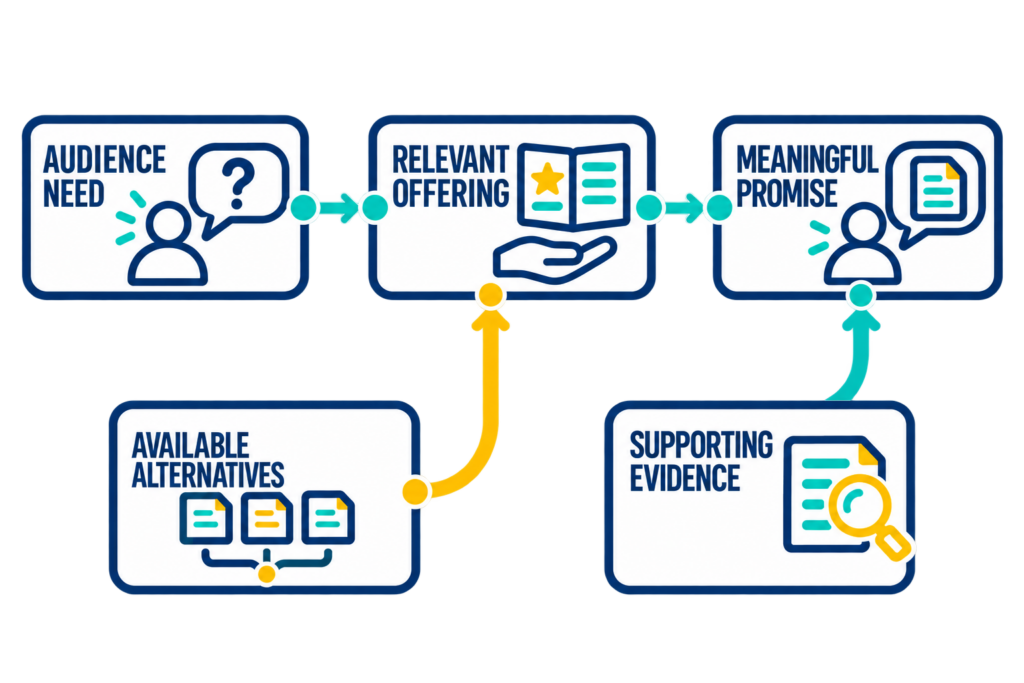
See the relationships behind the membership promise.
Audience and Situation
Intended member population
Current goals or responsibilities
Relevant circumstances
Decision being considered
Perspectives requiring input
Need and Intended Benefit
Problem to address
Progress the audience seeks
Support that could help
Conditions affecting usefulness
Limits of the intended benefit
Offering and Delivery
Relevant benefits
People and expertise
Program or service arrangements
Access and eligibility
Commitments the organization can support
Alternatives and Differences
Other memberships
Free or paid resources
Employer or internal support
Informal networks
Continuing without a new solution
Evidence and Explanation
Support for the claim
Member interpretation
Meaningful distinctions
Unresolved assumptions
A proposition to test
A clear proposition connects these elements without expecting the member to translate a benefit list into a reason to join.
How a membership promise becomes generic
STAGE 1 — Benefits become the description
The organization summarizes its activities using familiar categories such as education, networking, and advocacy.
STAGE 2 — More audiences enter the message
The description expands to accommodate different members without clarifying how their needs differ.
STAGE 3 — Broad claims replace specific explanations
Words such as leading, comprehensive, or unique carry more of the message while the practical difference becomes harder to see.
STAGE 4 — Members make the connection themselves
People must infer whether the membership fits their situation and how it compares with other ways to get help.
A distinctive statement needs a relevant difference behind it.
A communications review can ask an important question:
Does this description sound clear and compelling?
A proposition review also asks whether the audience recognizes the need, whether the offering addresses it, and whether the claimed difference matters in the decision.
The review should clarify:
Define the audience and situation precisely enough to examine relevance. Avoid assuming that one description serves every membership arrangement.
Identify the practical need or intended progress. Distinguish member-provided context from the organization’s interpretation.
Connect the promise to actual benefits, people, arrangements, and support. Make important access conditions visible.
Include relevant options beyond similar membership organizations. Consider existing support and the choice to make no change.
Examine why a feature or combination of features matters to the audience. Avoid treating difference alone as evidence of value.
Identify evidence for the claim, its limitations, and the member input needed to test whether the explanation is understood and useful.
A useful membership proposition needs six forms of clarity.
Audience
The intended member can recognize the situation the promise addresses.
Purpose
The proposition names a need or form of progress that matters to that audience.
Offering
The organization can identify what provides the proposed support.
Difference
The explanation connects a relevant distinction to the audience’s decision.
Support
The claim is consistent with available evidence and delivery conditions.
Validation
The team knows what to test and whose perspective is needed.
A proposition members can evaluate
A useful explanation provides:
- A recognizable audience and situation.
- A practical purpose for membership.
- Relevant benefits connected to that purpose.
- A meaningful difference from realistic alternatives.
- Understandable conditions and commitments.
- Claims the organization can support.
The member can consider whether the offering fits without relying on broad promotional language.
A proposition members must interpret
A promise becomes difficult to evaluate when it relies on:
- General benefits with no defined audience.
- A long list of programs and internal names.
- Claims of uniqueness without a useful comparison.
- Features presented without their practical relevance.
- Outcomes stated without important conditions.
- Staff agreement as the only evidence of clarity.
The review identifies what needs stronger definition, support, or audience validation.
A professional community can explain the relevance of its peer support.
An association describes its membership as providing education, networking, and professional resources.
The team selects professionals entering their first supervisory role as the audience for review.
Available member conversations suggest that these professionals want help handling unfamiliar situations and access to peers working under similar conditions.
The association offers facilitated case discussions, experienced contributors, and practical resources for that audience.
Participants examine alternatives, including general management content, employer-provided support, and informal advice from colleagues.
They consider whether the relevant difference lies in the combination of profession-specific cases, recurring peer discussion, and guided access to experienced practitioners.
The team checks which parts of that description reflect the current offering and which depend on arrangements that need improvement.
It drafts a proposition that explains the support and its conditions without promising a promotion or a particular performance result.
The next step is to test whether the intended audience recognizes the need, understands the offering, and considers the difference useful.
An alternative does not have to resemble your organization.
Members compare ways of meeting a need.
A paid association may be considered alongside an employer’s learning program, a free online resource, a trusted colleague, or an existing professional group.
The audience may also decide that the need is not pressing enough to justify another commitment.
The review identifies the alternatives relevant to the selected question.
It does not require an exhaustive market comparison or assume that every alternative is a direct competitor.
Understanding those choices helps the team explain where membership fits and which claims require better support.
Different audiences may need different explanations of the same offering.
A member and a paying employer may value different aspects of a professional development program.
An early-career professional and an experienced practitioner may use the same community for different purposes.
The review can develop an audience-specific explanation while preserving a consistent account of what the organization provides.
It also identifies when the difference concerns the offering itself rather than the wording.
A revised description cannot resolve a benefit that does not meet the selected need.
Where that issue appears, the team records the improvement or portfolio question that needs further work.
THE MATCHING WORKSHOP MODULE
Module 2: Membership Value Proposition & Differentiation
This practical minicourse helps membership organizations examine whether the membership promise connects to the intended audience’s needs and explains a meaningful difference from available alternatives.
Participants learn a repeatable review method, apply it to one audience and proposition, and identify whether the priority response concerns relevance, the offering, comparison, evidence, or explanation.
The exercise also defines the audience context, intended benefits, offering relationships, supporting evidence, and review responsibilities that a subsequent Gobekli configuration would need to support.
This module helps your team:
- Define the audience for one membership promise.
- Clarify the need or progress it should address.
- Connect the promise to the relevant offering.
- Identify important access and delivery conditions.
- Examine realistic alternatives.
- Distinguish features from meaningful differences.
- Identify evidence supporting the proposed claim.
- Mark assumptions requiring audience input.
- Recognize where the offering needs improvement.
- Draft a clearer proposition for review.
- Assign a focused validation plan.
- Outline a connected value-proposition configuration.
What should happen to each part of the membership promise?
The review leads to a deliberate response based on audience relevance, the offering, available evidence, and the decision established through Membership Value Direction.
Clarify
Make the audience, need, intended benefit, or conditions easier to understand.
Connect
Explain how the relevant offering supports the purpose named in the promise.
Differentiate
Identify a meaningful distinction from the alternatives the audience may consider.
Substantiate
Locate appropriate support for the claim and make its limits clear.
Revise
Change wording or an underlying commitment that the current offering does not adequately support.
Validate
Test the explanation and its assumptions with the intended audience.
These responses develop a proposition worth examining. A clearer statement does not establish demand, willingness to pay, or a guaranteed membership outcome.
What should a value proposition review examine?
The audience
Who is considering membership, in what situation, and with which need or decision?
The intended progress
What does the audience want to accomplish, access, understand, or address?
The offering
Which benefits, people, and arrangements provide relevant support?
The alternatives
What other ways of addressing the need are available or already in use?
The meaningful difference
Which distinction could matter to the audience, and what evidence supports that interpretation?
The validation
How will the team examine understanding, relevance, credibility, and unresolved questions?
Trace one membership promise from audience need to a proposition to test.
Your team applies the method to one audience and value question established through Membership Value Direction.
STEP 1
Define the audience and situation
Identify the member population, circumstances, and decision within scope.
STEP 2
Clarify the intended progress
Describe the need the promise should address and distinguish known member input from assumptions.
STEP 3
Connect the offering
Identify the benefits, people, support, and conditions that make the proposed value possible.
STEP 4
Examine alternatives and differences
Compare relevant ways of meeting the need and identify distinctions that may affect the choice.
STEP 5
Draft a supported proposition
Explain whom membership serves, what it helps them do, and why the particular offering matters, within the evidence available.
STEP 6
Assign and test the explanation
Identify the audience input, questions, responsible owner, and review conditions needed to evaluate the draft.
The result is a draft Membership Proposition & Difference Brief connecting audience context, intended benefit, the offering, relevant alternatives, supporting evidence, and a validation plan.
FUTURE PRODUCT CONNECTION
Keep the membership promise connected to what supports it.
A subsequent Gobekli configuration could help the organization maintain the relationship between its audience-specific promise, relevant offerings, and supporting evidence.
TalentSync could connect benefit and program information to intended audiences, purposes, delivery conditions, responsible roles, and reviewed claims.
TalentPass could help members express goals and relevant experience they choose to share. Pythia could help explain how an offering relates to a stated purpose or identify questions requiring clarification within the information and permissions in scope. Passport Pages could support agreed source connections and sharing arrangements.
A connected proposition review could potentially show:
- Which audience and situation the promise addresses.
- What need or intended progress is in scope.
- Which benefits support that purpose.
- What access or delivery conditions apply.
- Which alternatives were considered.
- What difference the organization is proposing.
- Which evidence supports the explanation.
- Which assumptions require validation.
- Who owns the offering and its value statement.
- When a change in the offering or audience should trigger review.
The workshop produces a starting configuration brief: audience and purpose definitions, benefit relationships, delivery conditions, claim support, source context, responsible roles, and validation states.
Specific interfaces, audience views, evidence workflows, and review processes would be confirmed during solution planning.
PRODUCT AND DECISION BOUNDARIES
A compelling proposition still needs an offering that supports it.
The review helps the organization explain a relevant promise and identify what needs improvement or validation.
It does not establish that the audience will choose membership or that the organization is uniquely able to meet the need.
A later configuration should distinguish an audience-stated need, a staff interpretation, an offering feature, a proposed difference, supporting evidence, and a validated finding.
The workshop and product connection do not establish:
- The same priorities across all members.
- A member’s motivation inferred from a profile alone.
- Superiority over alternatives without appropriate support.
- Demand based only on a positive reaction to wording.
- Willingness to pay without relevant testing.
- Guaranteed career, business, or development outcomes.
- Permission to use private member experience as promotional evidence.
- An improved offering solely because its description has changed.
The organization remains responsible for its promises, comparisons, and delivery commitments.
The proposition brief remains useful independently of future product adoption.
What to bring into the conversation
You do not need a complete positioning study before beginning.
Start with one audience and membership promise connected to the question established through Membership Value Direction.
Useful inputs may include:
- The intended audience and membership arrangement.
- Current membership descriptions or recruitment materials.
- Relevant benefit and program information.
- Access conditions and delivery commitments.
- Questions prospective or current members ask.
- Appropriate member accounts of needs and experiences.
- Alternatives members mention or currently use.
- Existing claims about what makes membership different.
- Evidence supporting those claims.
- Known gaps between the promise and the offering.
- An owner of the proposition and relevant benefit owners.
- Audience perspectives needed for validation.
The aim is to examine one proposition in sufficient detail to draft a clearer explanation and a practical validation plan.
What this module can help clarify
Whom the promise serves
Define the audience, situation, and intended progress the proposition should address.
What makes the offering relevant
Connect the promise to specific benefits, support, and delivery conditions.
Which differences are meaningful
Identify distinctions worth explaining, the alternatives they relate to, and the evidence needed to support them.
What to test or improve next
Develop a draft proposition, assigned validation plan, and starting configuration brief.
These outputs begin with the example reviewed during the module. Final scope depends on the selected modules, available information, and question established through Membership Value Direction.
Where might the work lead next?
Benefit Portfolio Relevance & Gaps
Examine the underlying offerings when the proposed promise reveals duplication, missing support, or benefits that need improvement.
Employer & Organizational Membership Value
Review the distinct needs of the paying organization and the people using membership when those perspectives require different value explanations.
Dues, Tiers & Benefit Packaging
Examine how membership choices present the relevant benefits and commitments when the proposition needs to work across different packages.
Your team can combine this module with other parts of the Membership Value Workshop according to the value question established through Membership Value Direction.
Frequently asked questions
Questions organizations ask before beginning.
It is an explanation of whom membership serves, what it helps them accomplish, and why the offering deserves consideration. It connects benefits to an audience’s purpose.
A difference that matters to the intended audience when evaluating ways to address a need. A feature is not automatically valuable because it is unusual.
The exercise includes drafting a proposition, but it also examines the audience need, underlying offering, alternatives, and supporting evidence. Better wording may be one response.
No. A relevant combination of people, support, subject matter, access, or delivery arrangements may provide a meaningful difference. The claim should match what the organization can support.
Yes. One audience and situation provide a useful scope. Other audiences may require separate explanations or additional review.
Identify the differences that matter to the decision. The module can focus on one audience while recording where another proposition or offering review may be needed.
No. Relevant alternatives may include employer support, free resources, paid services, informal networks, or continuing without a new solution.
No. Begin with the alternatives relevant to the selected need. More extensive market research can be identified as subsequent work if the decision requires it.
Depending on the claim, useful evidence may include delivery arrangements, program information, access conditions, reviewed examples, and appropriately shared member accounts. The evidence should support the specific statement being made.
They can provide a member’s account of an experience when used with appropriate permission and context. One account does not establish the same result for everyone.
Identify the gap. The response may involve revising the claim, improving the offering, clarifying conditions, or undertaking a more focused benefit review.
Ask intended audience members to explain what they understand, whom they think it serves, why it may matter, what they would compare it with, and what remains unclear. Positive reactions alone do not establish a purchase decision.
That Member Engagement module examines how members find, understand, and enter particular opportunities. This module examines the membership promise and the meaningful differences supporting the choice of membership.
This module examines the promise made to an audience. The portfolio module examines the relevance and coverage of the offerings behind it. A proposition review may identify a portfolio question that needs further work.
No. It can clarify the audience and intended benefit that inform those decisions. Dues, Tiers & Benefit Packaging examines the membership choices and assumptions requiring testing.
The outputs can inform a configuration connecting audiences, purposes, benefits, delivery conditions, supporting evidence, and review responsibilities. Specific capabilities and implementation requirements would be confirmed during scoping.
Your team will examine one audience and promise, develop a draft Membership Proposition & Difference Brief, and assign a validation plan and starting configuration requirements. Broader research and implementation continue afterward.
MAKE THE REASON TO BELONG UNDERSTANDABLE
Connect your membership promise to a difference that matters.
Clarify whom the offering serves, what it helps them accomplish, and what supports the reason to choose it.
This module is part of Gobekli’s configurable Membership Value Workshop.
