
MEMBER INTELLIGENCE WORKSHOP MODULE
Changing Work & Emerging Member Needs
Work is changing. Which changes matter to your members?
Examine how changes in a profession, industry, or community may affect members, then identify the questions that need validation with them.
Module 9 · Member Intelligence Workshop
Does this sound familiar?
Broad trends become assumed member needs.
A prominent technology or industry development becomes a proposed program before the organization understands how members are experiencing it.
Different members face different changes.
The same development may create new responsibilities for some members, new opportunities for others, and little immediate change for another group.
Early signals remain scattered.
Member conversations, employer observations, professional discussions, and external reports point toward change without being examined together.
Yesterday’s understanding guides tomorrow’s decisions.
Existing categories and assumptions continue to shape priorities even as members’ work, circumstances, and expectations evolve.
Uncertainty disappears in the summary.
A possible effect becomes a confident statement about what members need, while source limitations and unanswered questions fall away.
Responses get ahead of validation.
The organization begins designing training, resources, or services before clarifying the problem, affected population, or kind of support that would help.
What are emerging member needs?
Emerging member needs are developing requirements, challenges, or opportunities that may affect how members work, participate, adapt, or pursue their goals.
They can arise from changes in technology, professional practice, industry structure, organizational expectations, or community conditions.
An external development is a signal to examine. Understanding whether it creates a member need requires connecting it to the circumstances of particular people or groups.
Useful questions include:
- What appears to be changing?
- What information supports that account?
- Which members may be affected?
- What part of their work or circumstances could change?
- What are members already experiencing?
- What remains a hypothesis?
- What should be validated before the organization responds?
The aim is to build a clearer basis for inquiry and decision-making while preserving uncertainty.
A trend becomes relevant through its connection to members’ lives and work.
An industry report may describe a new tool, a changing business model, or a shift in professional expectations.
That information does not explain how the development affects every member.
Its relevance may depend on the work people perform, their organizational setting, available resources, career stage, location, or responsibilities. Members with the same title may experience the change differently.
The organization therefore needs a way to connect external signals to what it knows about its members—and identify where that understanding is incomplete.
This module helps your team examine one change, develop plausible member implications, and define the questions needed to test them.
Where relevant change may originate
Technology & Tools
New systems, automation, information tools, and ways of delivering work may alter tasks, expectations, or the support members need.
Professional Practice & Expectations
Changes in methods, quality expectations, professional guidance, or recognized responsibilities may affect how members perform and explain their work.
Industry & Organizational Conditions
Changes in business models, employer priorities, workforce arrangements, or supply relationships may create different pressures and opportunities.
Career & Work Arrangements
Shifts in roles, entry routes, independent work, leadership responsibilities, or career pathways may affect how members prepare and progress.
Community & Service Needs
Changes in the people, places, or communities members serve may alter the problems they encounter and the resources they need.
The workshop begins with the changes relevant to your organizational question. It does not require a comprehensive forecast of the profession or industry.
How changing work becomes disconnected from member understanding
1. A signal attracts attention.
A report, announcement, member observation, or professional discussion suggests that something important may be changing.
2. The signal is generalized.
Differences among roles, settings, and member populations are compressed into a broad account of what the change means.
3. A need is assumed.
The organization interprets the development as a demand for training, guidance, connections, or another response without enough member context.
4. The response rests on an untested premise.
Resources are committed while uncertainty remains about who is affected, what they are experiencing, and whether the proposed support addresses the problem.
“Members will need help with this.” What still needs to be understood?
A trade association hears that more member companies are introducing a new digital workflow.
Staff propose a training series. But the implications may differ across the membership.
Some members may need help using the tool. Others may be responsible for reviewing its outputs, coordinating a changed process, or deciding whether it is suitable for their organization. Some may not encounter it at all.
The useful next step is to clarify these possibilities and identify what needs to be checked with members.
Questions that change the interpretation:
Identify the specific development and distinguish an announcement, a reported pattern, and an observed change in practice.
Consider relevant roles, work settings, responsibilities, organizational circumstances, and other distinctions. Avoid assuming that the entire membership faces the same implications.
Examine tasks, decisions, handoffs, tools, expectations, or conditions. A broad statement about an industry may hide several different effects.
Look for appropriate member accounts and examples. Separate direct experience from expectations about what may happen.
State the possible need clearly enough to examine. “More training” is a proposed response; the underlying issue may concern understanding, coordination, confidence, access, or a different constraint.
Define a question, identify relevant member perspectives, and decide what information would support, challenge, or refine the proposed need.
Six dimensions of an understandable change signal
Change & Source
What development is being examined, where did the information come from, and what does the source actually establish?
Affected Members
Which people or groups may encounter the change, and what is known about their relevant circumstances?
Work & Context
Which activities, responsibilities, decisions, or conditions could be affected? Explain the connection between the change and the member.
Possible Implications
What challenge, opportunity, or support need might arise? Keep a proposed implication distinguishable from a validated finding.
Timing & Uncertainty
Is the change already being experienced, developing unevenly, or still a possibility? Identify assumptions and questions that could alter the interpretation.
Validation & Ownership
Who should be consulted, what needs to be asked, and who is responsible for reviewing the evidence and deciding what happens next?
From trend collection to member-informed inquiry
A limited trend view
- Headlines collected without a defined question.
- Prominent developments treated as universally relevant.
- Broad industry categories used as member context.
- Predictions presented as current experience.
- A proposed solution described as a confirmed need.
- Contradictory examples left out of the summary.
- No assigned validation or review step.
This view may create urgency without establishing what the organization needs to understand.
A contextual emerging-needs view
- A specific change and its sources.
- Relevant member populations and circumstances.
- The work or conditions potentially affected.
- Plausible implications stated clearly.
- Direct experience separated from assumptions.
- Questions that could confirm or challenge the interpretation.
- Assigned validation and review responsibilities.
This view gives the organization a practical basis for learning before committing to a response.
Worked example: examining a new workflow before designing support
A professional association is considering a program about a new tool appearing in member workplaces.
Available inputs include an industry article, several employer comments, and a small number of member requests.
The initial proposal is an introductory course for all members.
During the module, the team examines:
- What the sources establish about actual use.
- Which member roles are likely to encounter the tool.
- Whether members use it, supervise its use, or receive its outputs.
- Which activities or decisions may change.
- What difficulties members have directly reported.
- Whether the requests concern tool use or a wider work problem.
- Which perspectives are missing.
- What would challenge the assumption that a course is the right response.
The team develops several questions for member validation. These may concern the work being performed, the point at which difficulty occurs, and the support already available.
The output is a focused validation plan. A training program remains one possible response to examine after the underlying need is better understood.
A possible future and an observed member experience are different kinds of information.
A scenario can help the organization explore what might happen. A forecast can provide an external view of likely developments. A member account can describe a particular experience.
These inputs can inform one another, but they should remain distinguishable.
The workshop helps participants preserve:
- What has been observed.
- What has been reported.
- What is anticipated.
- What the team is inferring.
- What remains unknown.
This makes it easier to revisit an interpretation as information changes and prevents a possibility from becoming an unsupported statement about all members.
Members may describe a request before the underlying need is clear.
A request for a webinar may reflect difficulty understanding a new expectation. A request for a template may reflect uncertainty about how to apply it. A request for introductions may reflect a need for practical peer experience.
The requested response is useful information. It also creates an opportunity to understand the circumstances behind it.
This module helps the team formulate questions about:
- What the member is trying to accomplish.
- What has changed.
- Where difficulty or opportunity appears.
- What support is already available.
- What the member has tried.
- What a useful improvement would look like.
The purpose is to clarify the need with members while keeping their own explanation central to the inquiry.
THE MATCHING WORKSHOP MODULE
Changing Work & Emerging Member Needs
This practical minicourse helps your team examine one relevant change, connect it to member circumstances, and build a focused plan for validating possible needs.
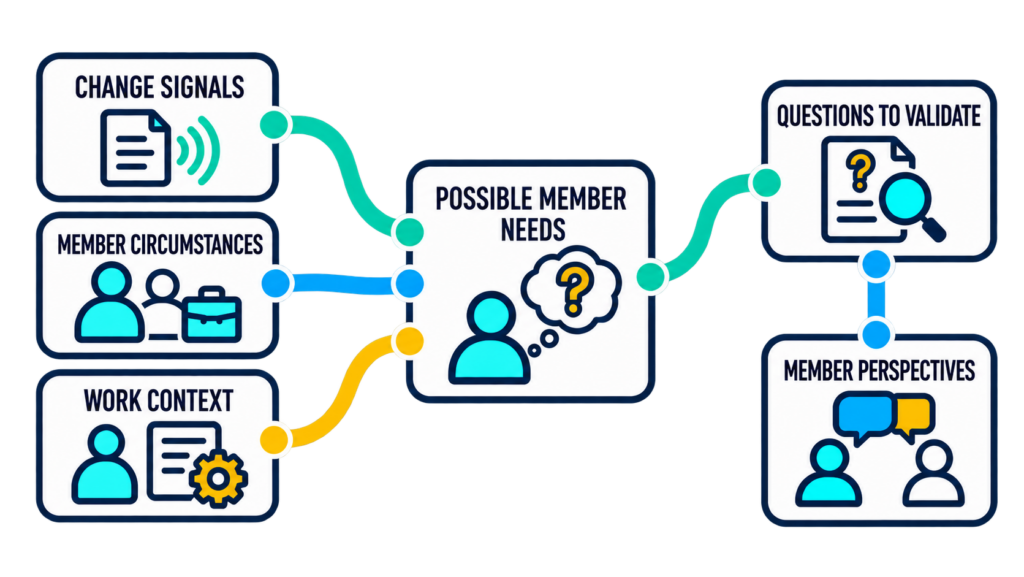
This module helps your team:
- The organizational decision the inquiry should support.
- The specific change or signal in scope.
- Available sources and their limitations.
- Potentially affected member populations.
- Relevant work, responsibilities, and circumstances.
- Direct accounts of member experience.
- Possible challenges and opportunities.
- Assumptions about emerging needs.
- Differences among member groups.
- Timing and uncertainty.
- Questions and perspectives needed for validation.
- Ownership and review responsibilities.
What might an appropriate response involve?
The response depends on what is known, what remains uncertain, and the decision the organization needs to make.
Clarify the Meaning
Seek further explanation where a comment, request, or summary is ambiguous.
Preserve the Context
Keep the relevant question, source, experience, and timing attached to the input.
Examine the Pattern
Compare related feedback while retaining meaningful differences and contradictory accounts.
Seek Further Evidence
Identify which missing perspectives or unanswered questions could change the interpretation.
Assign the Response
Route individual issues and broader findings to the people responsible for reviewing and acting.
Communicate the Outcome
Explain what was heard, what happens next, and what remains under consideration.
A useful outcome may be a clearer question, a small member inquiry, or a decision to monitor a development. Not every signal requires a new program.
What we review together
Question & Decision
Why the organization is examining the change and what decision the work could inform.
Signals & Sources
The reports, observations, announcements, and member accounts being used to describe the development.
Member Circumstances
The roles, settings, responsibilities, and other distinctions that may affect how members experience it.
Implications & Assumptions
The possible challenges and opportunities, including where interpretation exceeds the available evidence.
Validation & Coverage
The questions, member perspectives, and source gaps that need attention before concluding what support is needed.
Ownership & Review
Who will carry the inquiry forward, interpret the findings, and revisit the question as conditions change.
The minicourse: turn one change signal into a useful member inquiry
Your team applies the concepts to a bounded example, such as a changing workflow, a new professional expectation, or a shift in the communities members serve.
STEP 1
Step 1 — Define the decision and change.
Select the organizational question and describe the development clearly enough to examine.
STEP 2
Step 2 — Review what the sources establish.
Separate observed developments, reported experiences, forecasts, and assumptions. Identify relevant limitations.
STEP 3
Step 3 — Connect the change to member circumstances.
Identify which members may be affected and what part of their work or situation could change.
STEP 4
Step 4 — State the possible needs.
Develop clear, provisional accounts of the challenges or opportunities members may face. Preserve differences among groups.
STEP 5
Step 5 — Build the validation questions.
Identify what to ask, whose perspectives are needed, and what information could support or challenge each interpretation.
STEP 6
Step 6 — Define the next step and starting configuration.
Assign the inquiry and review responsibilities, then outline the records and relationships a subsequent implementation would need.
Exercise output
A draft Change-to-Member-Need Map, with source context, provisional implications, validation questions, and an assigned next step.
- A defined decision and change signal.
- Clear source distinctions.
- Relevant member circumstances.
- Provisional needs and assumptions.
- A focused validation plan.
- An assigned review step.
FUTURE PRODUCT CONNECTION
How this work can connect to Gobekli
The workshop establishes how a relevant change connects to member circumstances and what needs to be validated. That work can inform a scoped Gobekli configuration.
A TalentSync configuration could connect change signals, member populations, work context, possible implications, and reviewed findings. TalentPass could support member-provided context and selective sharing where appropriate. Pythia could guide clarification and inquiry within the information and access included in scope.
The configuration should help the organization maintain a traceable connection between a signal, its proposed relevance, and what members actually report.
Potential configuration mapping
- Change signals are scattered across sources. Structured signal records with source references, dates, and relevant context.
- Broad trends are treated as universally relevant. Connections between signals and the member populations potentially affected.
- Job titles provide insufficient context. Relevant activity, responsibility, and work-setting information.
- Several implications are combined into one assumed need. Separate provisional needs linked to their underlying circumstances.
- Predictions and observed experiences are mixed together. Clear distinctions among forecasts, observations, reports, and inferences.
- Member questions are disconnected from the original signal. Validation questions linked to the change and interpretation they examine.
- Findings lack source context. Member input and reviewed findings connected to the relevant inquiry.
- Some perspectives are missing. Coverage notes and follow-up questions for the populations requiring further attention.
- Interpretation changes without a visible record. Review history showing how proposed needs were refined, supported, or challenged.
- The inquiry has no ongoing owner. Assigned responsibilities, review dates, and next-step tracking.
Specific capabilities, integrations, and implementation scope would be confirmed during solution planning.
PRODUCT AND DECISION BOUNDARIES
What this module does—and its boundaries
The module helps your team:
- Examine one relevant change or signal.
- Connect it to member circumstances.
- Distinguish source information from inference.
- State possible emerging needs clearly.
- Plan focused validation with members.
- Prepare a starting configuration brief.
The module does not establish:
- A definitive forecast of the profession or industry.
- A confirmed need from an external trend alone.
- A complete member research study.
- A ranking of members by adaptability or readiness.
- A finished training, service, or benefit design.
- An automated decision about the organization’s response.
The exercise provides a practical starting point. Collecting new member input, conducting broader research, designing a response, or implementing a configuration may require additional work.
What to bring into the conversation
Begin with one question that member input could help answer, or one collection of feedback that has been difficult to turn into a clear next step.
A useful starting question is: “What are members telling us about this experience, what does that evidence support, and who should do what next?”
Useful inputs may include:
- A decision involving changing member circumstances.
- One specific change or signal to examine.
- Relevant reports, announcements, or observations.
- Existing member requests or experience accounts.
- Available information about potentially affected members.
- Any proposed response the organization is considering.
- The person responsible for the decision.
- Someone familiar with the profession, industry, or community.
- A membership, research, or program lead.
- A member perspective relevant to the change.
- Someone familiar with the available sources.
- A person who could own the validation step.
Bring what is available and appropriate to share. The exercise can begin with incomplete information; identifying the gaps is part of the work.
What this module can help your team produce
A Changing Work & Emerging Needs Brief
A clear account of the decision, change signal, sources, potentially affected members, and limits of the review.
A Change-to-Member-Need Map
A structured view connecting the development to member circumstances, possible effects, provisional needs, and supporting context.
A Member Validation Plan
Focused questions, relevant perspectives, and assigned next steps for testing and refining the proposed needs.
A Starting Configuration Brief
An outline of the signal records, member context, provisional implications, validation links, and review responsibilities a subsequent Gobekli implementation would need.
These outputs begin with the example examined during the module. Final scope depends on available inputs, selected modules, and the decision established through Member Intelligence Direction.
Where might the work lead next?
An emerging-needs review may reveal a need to understand individual circumstances more deeply, examine member feedback, or improve the coverage of a validation inquiry.
Member Goals, Needs & Career Transitions
Clarify the goals and circumstances that shape how particular members experience a change and what they are trying to accomplish.
Member Listening & Feedback Intelligence
Connect the resulting member input to defined questions, source context, careful interpretation, and responsible follow-up.
Member Segmentation & Representation Gaps
Examine which member categories support the inquiry and whose experiences or perspectives may be missing.
Findings may also inform the Membership Value Workshop when validated needs suggest changes to benefits or programs, or Member Intelligence Governance & Currency when the inquiry needs ongoing ownership and review.
Frequently asked questions
Questions membership organizations ask before beginning.
They are developing challenges, requirements, or opportunities that may affect members as their work or circumstances change. Establishing their relevance requires examining member context and validating important assumptions.
Trend collection identifies developments. This module examines how a selected development could affect particular members and what needs to be checked before the organization decides how to respond.
No. The module can examine changes already being experienced as well as developments that may matter later. It focuses on member relevance and validation rather than producing a definitive forecast.
Examples include technology, workflows, professional practice, employer expectations, career arrangements, industry conditions, and community needs. The selected change should connect to a defined organizational question.
Not by itself. A report may provide a useful signal, but its relevance depends on the members involved, their circumstances, and the evidence supporting the proposed implication.
Begin with the work, responsibilities, settings, or circumstances connected to the change. Existing membership categories may help, but they may need refinement for the question being examined.
Preserve those differences. Organizational resources, responsibilities, location, experience, and other conditions may change how the development affects them.
Yes. Requests can provide useful signals. The module helps examine what members are trying to accomplish and whether the requested response reflects a wider need that should be clarified.
No. Existing information can support the exercise. The output may identify a focused inquiry to conduct afterward.
Available member perspectives may help refine an interpretation during the session. Broader validation usually requires follow-up with the relevant population; the module creates a practical plan for that work.
Ask about members’ experiences, circumstances, difficulties, and existing support. Include questions that allow them to reject or reshape the proposed interpretation.
Examine whether the accounts describe different situations, timing, or expectations. Differences can reveal important distinctions rather than a single answer that must be averaged.
AI may assist with organizing information or proposing questions, but the sources and interpretations require review. A generated implication should remain distinguishable from a member-validated finding.
It develops the understanding and validation plan that can inform later design. A proposed program remains a possible response until the underlying need is sufficiently understood.
The next step may be monitoring, gathering a missing perspective, or revisiting the question at an agreed point. The module does not assume every signal requires a new initiative.
The outputs can inform a scoped configuration connecting signals, member circumstances, proposed implications, validation questions, and reviewed findings. Appropriate access and maintenance would be defined according to the agreed purpose and available capabilities.
Your team will examine one bounded example and create a draft brief, change-to-member-need map, validation plan, and starting configuration brief. Wider research, response design, and implementation are subsequent steps.
Understand what changing work could mean for your members.
Start with one relevant change, connect it to member circumstances, and define the questions that will help your organization choose a useful response.
Choose Changing Work & Emerging Member Needs as part of your Member Intelligence Workshop.
