
MEMBERSHIP VALUE WORKSHOP MODULE
Credentials, Recognition & Professional Standing
A title, badge, or award needs an understandable meaning. Examine what your recognition represents, what supports it, and how members and other audiences can interpret it appropriately.
Does this sound familiar?
The name carries more meaning than the explanation
Members recognize a designation or award, but its description leaves unclear what someone needed to do to receive it.
Different forms of recognition look equivalent
Participation, assessed learning, professional experience, and service are presented in ways that obscure their different meanings.
Criteria are difficult to find or interpret
Requirements sit across application materials, committee guidance, and staff knowledge without a clear explanation for recipients or outside audiences.
Supporting evidence disappears behind the badge
The recognition is visible, but the basis for the decision, review process, or relevant context is difficult to understand.
The intended audience reads something different
An employer, client, peer, or member interprets the recognition more broadly—or more narrowly—than the organization intended.
Changes in status are difficult to explain
A past achievement, a current designation, and a membership-dependent status are displayed without making their different time conditions clear.
What are credentials, recognition, and professional standing?
Credentials and recognition communicate that an organization has acknowledged a person’s learning, achievement, experience, contribution, affiliation, or status according to a defined basis.
That basis may involve participation, completion, assessment, documented experience, nomination, selection, or another review process.
Different forms of recognition make different statements. A completion certificate, a professional designation, and a service award may each provide value while representing very different things.
Professional standing concerns the status a recognition communicates within a particular community or context, including any conditions that apply to maintaining it.
This module examines one selected recognition and the connection among its intended meaning, criteria, supporting evidence, audience, and limitations.
Recognition becomes useful when people can understand what it represents.
An association may invest substantial effort in a credential or awards program.
Recipients may be proud to display it.
An outside audience may still need to ask: What does this tell me?
Does it acknowledge participation? A reviewed demonstration? Experience meeting defined conditions? A contribution recognized by peers? A current status within the organization?
The explanation needs to make the basis understandable without expecting the audience to know the program’s internal language.
A useful review connects the recognition to a specific statement and examines whether the available information supports that interpretation.
See the relationships behind meaningful recognition.
Meaning and Purpose
What is being recognized
Intended value to recipients
Scope of the statement
Relevant professional context
Distinctions from other recognition
Criteria and Process
Eligibility conditions
Required activities or experience
Submission requirements
Review or selection process
Decision responsibility
Supporting Evidence
Records of participation
Submitted work or experience
Reviewed demonstrations
Nominations and supporting accounts
Source and review context
Audience and Interpretation
Recipients
Professional peers
Employers or clients
Other institutions or partners
Likely questions and assumptions
Status and Limitations
Date of achievement
Applicable criteria version
Maintenance conditions
Current status where relevant
Limits of the recognition
A credible explanation connects what the recognition says to how it was awarded and the context needed to interpret it.
How recognition becomes difficult to interpret
STAGE 1 — A recognition is created for a specific purpose
The organization establishes a certificate, designation, award, or status to acknowledge something it considers valuable.
STAGE 2 — The visible label becomes the main explanation
A name, badge, or short description travels more easily than the criteria and review context behind it.
STAGE 3 — Audiences fill in the missing meaning
Recipients and other audiences make assumptions about capability, authority, selectivity, or current standing.
STAGE 4 — The value becomes difficult to substantiate
The organization struggles to explain what the recognition establishes, correct misunderstandings, or distinguish it from other forms of acknowledgment.
A visible badge starts the conversation.
A recognition record can answer an important question:
What did this organization award or acknowledge?
A recognition-value review also asks what the statement means, how the decision was made, and what an audience needs to understand before relying on it.
Questions that make the meaning clearer
Identify whether the recognition concerns participation, learning, demonstrated performance, experience, contribution, affiliation, or a defined status.
Clarify the requirements and relevant version. Distinguish eligibility to be considered from the basis for receiving the recognition.
Identify the records, submissions, observations, or accounts used, along with their sources and the scope of the review.
Explain the responsible body or role and the nature of the review or selection sufficiently for the intended audience.
Describe the statement it supports, its relevant context, and assumptions that would go beyond its meaning.
Clarify time conditions, maintenance requirements, status changes, and boundaries on what the recognition establishes.
A useful recognition-value review needs six forms of clarity.
Meaning
The recognition makes a specific statement about what has been acknowledged.
Criteria
The requirements and basis for the decision are understandable.
Evidence
The supporting information relates to the statement being made.
Process
The nature of the review and decision responsibility are clear.
Audience
The explanation answers the questions of the people expected to interpret it.
Boundary
Status conditions and limitations remain visible wherever the recognition is presented.
Recognition people can interpret
A useful account explains:
- What the recognition acknowledges.
- Which criteria applied.
- What kind of evidence supported the decision.
- How the review or selection worked.
- Whether any ongoing conditions apply.
- What the recognition does and does not establish.
Recipients can explain their achievement, and other audiences can assess its relevance.
Recognition that depends on assumptions
The meaning becomes difficult to assess when it relies on:
- A title without a clear description.
- A badge without accessible criteria.
- Eligibility presented as achievement.
- Selection presented as a broader competence judgment.
- Historical achievement presented as current status.
- Audience assumptions that exceed the supporting evidence.
The review identifies where the explanation, supporting information, or recognition claim needs attention.
Two certificates can represent different achievements.
An association offers an introductory seminar and a separate program involving reviewed practical work.
Both issue certificates with similar names and visual treatment.
Members use them in professional profiles, where an employer may have little context about either offering.
The team selects the practical program’s recognition for review.
It identifies the criteria that applied, the submitted work, the review process, and the specific scope of the demonstration.
The team also examines how the recognition differs from the seminar’s completion certificate.
The review reveals that the public description uses a broad phrase—“recognized professional expertise”—while the reviewed work supports a more specific statement about performance on a defined task.
The team revises the description, makes the criteria easier to find, and clarifies the context of the review.
It also identifies how recipients could present the recognition with that explanation.
The result is a more understandable statement of achievement. The review does not turn one assessed task into evidence of competence across an entire profession.
An award can be meaningful without being a competence credential.
Recognition may acknowledge service, leadership, innovation, professional contribution, or another achievement.
Its value does not depend on presenting it as proof of every capability associated with that contribution.
An award based on nominations and committee selection should explain that basis.
A designation based on defined requirements should explain those requirements and any conditions for maintaining it.
The review preserves the distinctions that make each form of recognition meaningful.
It helps the organization communicate the achievement accurately while respecting the recipient’s contribution.
Past achievement and current standing need different explanations.
Some recognitions acknowledge something completed or contributed at a particular time.
Others communicate a status that depends on continuing conditions.
A recipient may retain a historical achievement even when a separate membership or designation status changes, depending on the program’s rules.
An audience needs to understand which statement it is seeing.
The review identifies relevant dates, applicable criteria, maintenance conditions, and responsibility for status information.
It also examines how a correction or change should be explained without obscuring the original achievement or implying that every recognition has the same lifecycle.
THE MATCHING WORKSHOP MODULE
Module 6: Credentials, Recognition & Professional Standing
This practical minicourse helps membership organizations clarify what credentials, designations, awards, and other recognition mean, including their criteria, supporting evidence, intended audiences, and limitations.
Participants learn a repeatable review method, apply it to one selected recognition, and identify whether the priority response concerns meaning, criteria, evidence, audience interpretation, or status information.
The exercise also defines the recognition records, criteria relationships, source context, review responsibilities, and sharing arrangements that a subsequent Gobekli configuration would need to support.
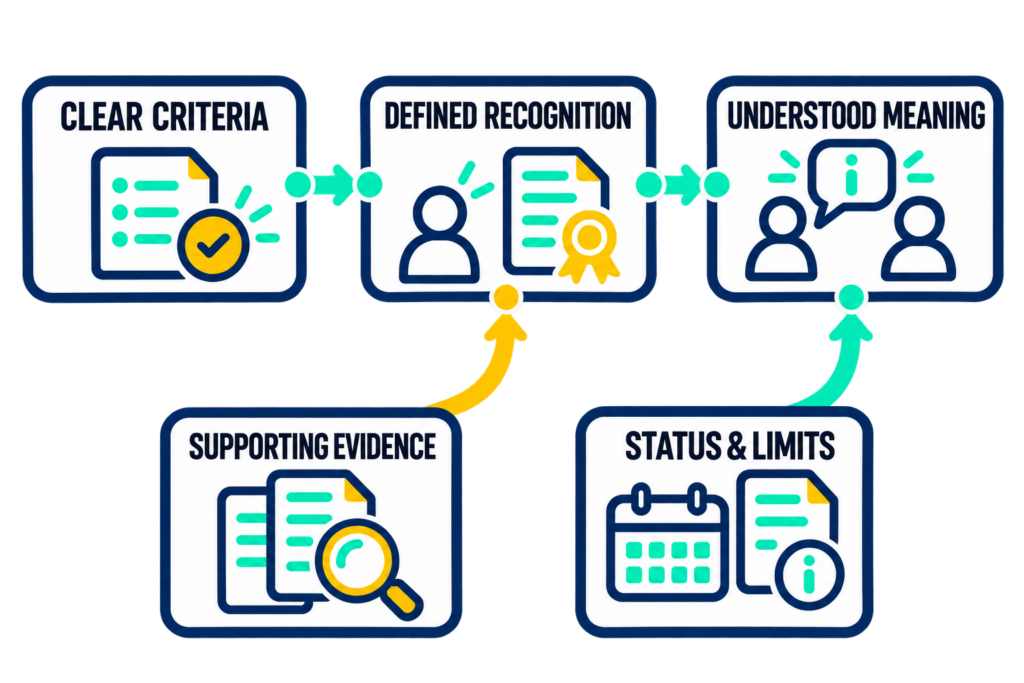
This module helps your team:
- Define the recognition-value question within scope.
- Identify the recognition and intended recipients.
- Clarify what the recognition acknowledges.
- Distinguish eligibility from award criteria.
- Identify the applicable criteria and version.
- Examine supporting evidence and review context.
- Clarify decision responsibility.
- Identify the intended audiences.
- Examine likely interpretation gaps.
- Distinguish historical achievement from current status.
- Assign an explanation or evidence improvement.
- Outline a connected recognition-value configuration.
What should happen to each part of the recognition account?
The review leads to a deliberate response based on the intended statement, criteria, supporting evidence, audience, and relevant status conditions.
Clarify
Explain what the recognition acknowledges and the scope of its meaning.
Distinguish
Make differences among participation, achievement, selection, and current standing understandable.
Substantiate
Connect the recognition to the criteria, evidence, and review context supporting it.
Explain
Improve the information recipients and other audiences need to interpret the recognition.
Maintain
Define responsibility for criteria updates, corrections, and status information where relevant.
Reframe
Adjust a claim or description when it exceeds what the recognition establishes.
These responses improve the recognition’s explanation and supporting account. Changes to program requirements or award decisions remain with the responsible organization.
What should a credentials and recognition value review examine?
The statement
What is the organization acknowledging, and what value is that intended to provide?
The criteria
Which requirements applied, and how did eligibility differ from the basis for receiving the recognition?
The evidence
What information supported the decision, and what does it establish within the review’s scope?
The process
Who reviewed or selected the recipient, and how should that process be explained?
The audience
Who is expected to interpret the recognition, and what context do they need?
The continuing conditions
Which dates, maintenance requirements, correction routes, or status changes affect the statement?
Trace one recognition from its criteria to the meaning it communicates.
Your team applies the method to the audience and value question established through Membership Value Direction.
STEP 1
Define the recognition’s purpose
Select one recognition and identify what it is intended to acknowledge and for whom.
STEP 2
Examine the criteria
Clarify eligibility, award requirements, applicable versions, and any continuing conditions.
STEP 3
Trace the supporting basis
Identify evidence, review or selection arrangements, and decision responsibility.
STEP 4
Examine audience interpretation
Compare the intended meaning with the explanation available to recipients and other audiences.
STEP 5
Assess the claim and boundaries
Describe what the recognition establishes, what needs qualification, and what remains unclear.
STEP 6
Assign and test the response
Choose an improvement, responsible owner, audience feedback, and review point.
The result is a draft Recognition Meaning & Evidence Map connecting the recognition statement, criteria, supporting basis, intended audiences, status conditions, and assigned improvements.
FUTURE PRODUCT CONNECTION
Keep recognition connected to the meaning behind it.
A subsequent Gobekli configuration could help the organization maintain an understandable account of its recognition and the information supporting it.
TalentSync could connect recognition programs to criteria, responsible roles, source records, and review needs. TalentPass could help recipients organize recognitions alongside relevant experiences and evidence they choose to retain or share.
Pythia could help explain a recognition using the descriptions and source information in scope. Passport Pages could support agreed source connections and presentation arrangements.
A connected recognition review could potentially show:
- What a recognition is intended to acknowledge.
- Which organization issued or awarded it.
- Which criteria and version applied.
- What eligibility conditions were relevant.
- What evidence or selection basis supported it.
- Who held review and decision responsibility.
- Which audiences the explanation should serve.
- What dates and ongoing conditions matter.
- Which source provides status information where applicable.
- Who owns corrections or further clarification.
The workshop produces a starting configuration brief: recognition records, criteria references, evidence relationships, issuer and reviewer roles, relevant dates, status sources, sharing choices, and audience explanations.
Specific credential formats, issuance or verification functions, integrations, and status workflows would be confirmed during solution planning.
PRODUCT AND DECISION BOUNDARIES
An understandable recognition still has a defined scope.
The review helps the organization explain what a selected recognition represents and how its meaning is supported.
A later configuration should distinguish the issuer’s statement, the evidence behind it, and the interpretation an audience may draw.
Checking the source of a record is a different question from determining whether its criteria are sufficient for a particular decision.
The workshop and product connection do not establish:
- Competence based only on participation.
- Broad professional ability from a narrowly reviewed task.
- Equivalent meaning across different recognitions.
- Professional authority beyond the issuer’s role.
- Current standing from an undated historical record.
- Acceptance by every employer, client, or institution.
- An award as the sole cause of career or business outcomes.
- Permission to disclose confidential submissions or review material.
The organization remains responsible for its recognition programs, award decisions, and public claims.
The recognition-value brief remains useful independently of future product adoption.
What to bring into the conversation
You do not need a complete credential infrastructure before beginning.
Start with one recognition connected to the question established through Membership Value Direction.
Useful inputs may include:
- The selected recognition and its purpose.
- Current public descriptions.
- Intended recipients and audiences.
- Eligibility and award criteria.
- Relevant criteria versions or dates.
- Application or nomination materials.
- Evidence requirements or appropriate examples.
- Review and decision responsibilities.
- Maintenance or status conditions.
- Recipient presentation examples.
- Known questions or misunderstandings.
- Program owners and relevant audience perspectives.
The aim is to examine one recognition in sufficient detail to explain its meaning and identify a practical improvement or validation need.
What this module can help clarify
What the recognition represents
Define the achievement, contribution, or status being acknowledged and its intended value.
How the statement is supported
Connect applicable criteria, evidence, and review responsibility to the recognition.
What audiences need to understand
Clarify the explanation, context, time conditions, and limitations relevant to interpretation.
What to improve or investigate next
Develop an assigned response, audience validation plan, and starting configuration brief.
These outputs begin with the example reviewed during the module. Final scope depends on the selected modules, available information, and question established through Membership Value Direction.
Where might the work lead next?
Professional Learning & Development Value
Examine the learning contribution behind a recognition when the next question concerns what members understood, practiced, or applied.
Career & Opportunity Value
Examine how a recognition supports a defined career purpose when its relevance to professional opportunities needs clarification.
Portable Member Progress & Lasting Value
Define how recipients can retain and share an understandable account of recognition alongside relevant experience and progress.
Your team can combine this module with other parts of the Membership Value Workshop according to the value question established through Membership Value Direction.
Frequently asked questions
Questions organizations ask before beginning.
A certificate, designation, badge, award, fellowship, or other defined acknowledgment can provide a bounded example. The review begins by clarifying what that recognition is intended to represent.
No. The method applies to recognition communicated through documents, directories, letters, badges, or other formats. Digital presentation is a possible later implementation question.
Yes. The review can clarify the contribution being acknowledged, the nomination or selection basis, and how recipients and other audiences should understand it.
Eligibility determines who can be considered. Award criteria explain the basis for receiving the recognition. A program may need to communicate both clearly.
Its meaning depends on the completion conditions. The review examines whether those conditions included a relevant assessment and what that assessment supports.
Yes. Recognition may meaningfully acknowledge participation, service, contribution, or another achievement. Its explanation should reflect that purpose.
The audience needs enough information to understand the basis of the recognition. That does not require publishing all underlying submissions or confidential review material.
Identify which criteria applied at the relevant time. The review can clarify version references and how later changes affect interpretation under the program’s rules.
No. Some acknowledge historical achievement; others communicate a status with ongoing conditions. The review identifies the appropriate distinction for the selected program.
Examine the wording, presentation, and missing context. The response may involve a clearer description, recipient guidance, or feedback from the intended audience.
Yes. The workshop can define the interpretation questions and an audience validation plan. Actual employer acceptance should be investigated rather than assumed.
A verification process may establish particular facts about a record, its source, or status. Whether the recognition is relevant and sufficient for a decision also depends on its criteria, evidence, and context.
That Learning Alignment module examines whether a credential’s learning requirements support its claims. This module examines membership recognition more broadly, including awards, contributions, audiences, and professional standing.
That module examines what learning helps members understand and apply. This module examines what the resulting recognition—or another form of acknowledgment—communicates.
That module examines what members can retain and carry forward. This module first clarifies the meaning, supporting basis, and limitations of the recognition they may wish to share.
The outputs can inform a configuration connecting recognition records, criteria, evidence references, responsible roles, and audience explanations. Specific capabilities and implementation requirements would be confirmed during scoping.
Your team will examine one recognition and develop a draft Recognition Meaning & Evidence Map, an assigned improvement and validation plan, and starting configuration requirements. Wider program changes and implementation continue afterward.
MAKE RECOGNITION’S MEANING CLEAR
Help members explain what their recognition represents.
Connect a credential, designation, or award to its criteria, supporting basis, and an explanation the intended audience can understand.
This module is part of Gobekli’s configurable Membership Value Workshop.
