
MEMBERSHIP VALUE WORKSHOP MODULE
Portable Member Progress & Lasting Value
Help members carry the value of membership forward. Define how learning, recognition, contributions, and progress can become an understandable account members can retain and appropriately share over time.
Does this sound familiar?
Progress is scattered across different places
Learning records, awards, committee service, and project contributions live in separate systems, leaving members to reconstruct their own story.
A record says what happened, but not what it means
An event title, badge, or service date provides little explanation of what the member learned, earned, or contributed.
Members start from scratch when an opportunity appears
Applications, introductions, and professional reviews require members to find old records and explain achievements all over again.
Leaving a role or changing membership disrupts access
Members are unsure what they can retain when they change employers, finish a volunteer term, or stop using an organizational account.
Sharing means sending everything—or almost nothing
Available records provide few ways to select relevant information while protecting private details, other people’s information, or confidential work.
Past achievement and current standing become confused
An enduring accomplishment can be mistaken for an active designation, current membership, or continuing authorization.
What is portable member progress?
Portable member progress is an understandable account of what a person has learned, earned, contributed, or developed through membership that they can retain and appropriately use beyond the original activity or system.
It brings relevant experiences together with enough context to explain their meaning. That may include the member’s role, the work involved, the source of a recognition, supporting evidence, and when the activity occurred.
Different records support different statements. Attendance, completion, assessed learning, recognition, and contribution should remain distinguishable.
Portability also involves practical arrangements: how a member accesses a record, selects what to share, requests a correction, and understands any limits on continued access or verification.
The purpose is to help membership-supported progress remain useful as people move between roles, organizations, opportunities, and stages of life.
Membership can end. Its contribution to a person’s progress should remain understandable.
A member may spend years learning through an association, serving on committees, contributing to projects, and receiving recognition.
Much of that experience remains visible only inside the organization’s programs and systems.
When the member needs to explain their progress elsewhere, a list of transactions rarely tells the whole story.
A useful account connects an experience to a clear statement about what happened, who can support that statement, and what the available evidence establishes.
It also preserves distinctions over time. Completing a program in a particular year is different from holding a designation that remains current today.
Making those distinctions clear helps members carry forward meaningful progress while protecting the credibility of the organization and its recognitions.
Where lasting member value can become fragmented
Learning & Development
Course participation
Completed programs
Practice and application
Reviewed evidence
Development milestones
Recognition & Standing
Certificates and badges
Professional designations
Awards and honors
Issuing criteria
Status and validity dates
Service & Contribution
Committee responsibilities
Volunteer activities
Projects and deliverables
Mentoring contributions
Leadership experience
Records & Access
Member accounts
Learning platforms
Event and community systems
Historical records
Retention arrangements
Sharing & Continued Meaning
Intended audiences
Member-selected information
Supporting context
Current status checks
Corrections and updates
A useful account may draw from several sources. The workshop begins with a selected example and defines which connections are necessary to preserve its meaning.
Four steps toward progress members can carry forward
1. Select meaningful progress
Choose an experience, contribution, or recognition that a member may reasonably need to explain or use later.
2. Establish what the record supports
Clarify the statement, source, evidence, dates, and limitations needed to describe that progress accurately.
3. Define retention and sharing
Determine what the member can keep, how they can access it, and what they can appropriately share with a selected audience.
4. Plan for continued meaning
Assign responsibilities for corrections, status information, source changes, and other conditions that affect how the record should be understood.
Start with one experience a member should be able to carry forward.
The module uses a bounded example to help your team learn how portable progress works in practice.
That example might be a completed development program, a period of committee service, a reviewed project contribution, or an earned recognition.
Your team follows the example from its original source to a future use, identifying where information, responsibilities, or access arrangements need to become clearer.
Questions that help define the example.
Identify the learning, contribution, recognition, or development milestone involved. Establish what makes it meaningful beyond the original activity.
Distinguish a member’s account from an organizational confirmation or reviewed finding. Define the wording each source can reasonably support.
Consider the member’s role, dates, requirements, evidence, issuing organization, and any qualifications needed to avoid misunderstanding.
Select a plausible audience and purpose, such as a professional introduction, employer conversation, volunteer application, or further learning opportunity.
Clarify the record, supporting material, access method, sharing choices, and restrictions relevant to the example.
Consider expiring standing, corrected information, unavailable source systems, changed responsibilities, or evidence that can no longer be shared.
Six dimensions of portable member progress
Meaningful experience
A clear description of what the member did, learned, earned, or contributed.
Supported statements
Wording that reflects the available evidence and identifies who is making or confirming the statement.
Source context
The organization, program, reviewer, dates, and conditions needed to interpret the record.
Member choice
Understandable options for selecting relevant information and deciding when and with whom to share it.
Continued usability
A practical route to retain and access the account as roles, accounts, systems, and membership arrangements change.
Trust over time
Clear distinctions among historical achievement, current status, corrections, and information that requires fresh review.
When progress remains trapped in organizational records
The organization may retain extensive information while members still struggle to use it.
- Records are organized around internal program names.
- Attendance and demonstrated learning look similar.
- Contributions lack a description of individual responsibility.
- Supporting material is difficult to locate.
- Access depends on a current account or staff request.
- Old achievements appear without relevant status information.
The member must reconstruct both the history and its meaning.
When progress has a clear route forward
A selected record is designed around a supported statement and an appropriate future use.
- The experience has a plain-language description.
- Participation, learning, and recognition remain distinct.
- The member’s role and contribution are explained.
- Sources and supporting evidence are identified.
- Retention and sharing arrangements are understandable.
- Historical facts and current standing are clearly labeled.
The member has a more useful starting point for explaining their progress.
What this can look like in practice
A professional association offers a development program that combines workshops, a team project, and a final presentation.
Members receive a completion certificate, while project materials remain in a learning platform.
One participant later applies for a volunteer leadership role and wants to explain what they contributed.
The certificate confirms completion, but it does not describe the participant’s project responsibility or establish that every skill discussed in the program was demonstrated.
During the module, the team selects this experience as its working example.
It separates three statements: the member completed the program, contributed to a particular project, and received feedback on specified work.
For each statement, the team identifies an appropriate source and the evidence available to support it.
The team also identifies material that should remain private, including other participants’ work and details supplied by an external project partner.
The resulting plan defines a member-facing account, a permitted project summary, a correction contact, and an access arrangement to test.
The member would have a clearer way to explain the experience. Whether a future reviewer accepts it for a particular purpose remains that reviewer’s decision.
A portable record needs enough context to remain credible.
A title alone can be difficult to interpret outside the organization that created it.
“Leadership program,” “committee member,” or “award recipient” may mean very different things in different settings.
A useful record explains the relevant activity, responsibility, criteria, or basis for recognition.
It should identify whether a statement comes from the member, the organization, a reviewer, or another source.
Supporting evidence should be included or referenced where appropriate, with access limits made clear.
The workshop helps your team define the minimum context a selected record needs to remain useful without making it unnecessarily complex.
Lasting value does not require permanent access to everything.
A member may be able to retain an account of an achievement without retaining unrestricted access to every system or supporting document.
Some materials involve confidential projects, licensed resources, other people’s information, or access arrangements that change over time.
An earned achievement may remain part of a person’s history even when a related designation expires or their membership ends.
These distinctions should be understandable before a member relies on the record.
The team identifies what can be retained, what remains dependent on a source, and what needs a current status check.
The aim is a practical and credible arrangement that members and the organization can explain.
THE MATCHING WORKSHOP MODULE
Portable Member Progress & Lasting Value
This module is a focused minicourse and working session within the Membership Value Workshop. It helps your team understand how membership-supported progress can remain useful beyond its original program, platform, or relationship.
Using a selected example, participants examine meaning, evidence, source context, retention, sharing, and responsibilities over time.
The work produces a practical response and an initial configuration brief that can inform a subsequent Gobekli implementation.
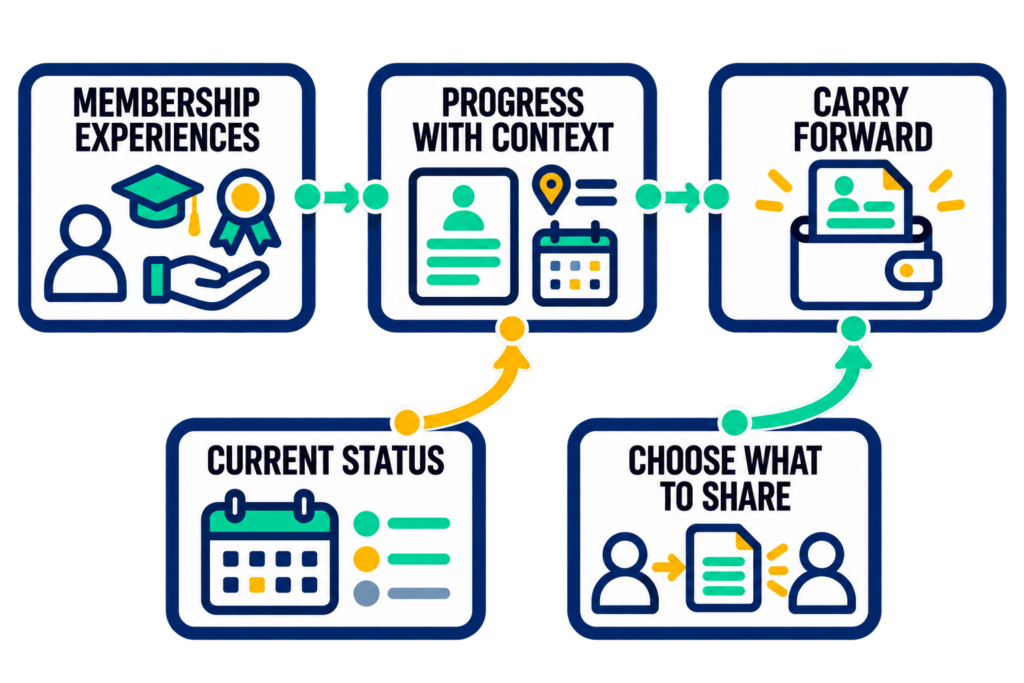
Final scope follows the value question established through Membership Value Direction.
- Learning and development records members may use later.
- Recognition and achievement descriptions.
- Committee, volunteer, and leadership contributions.
- Individual responsibility within shared work.
- Member-authored and organization-confirmed statements.
- Supporting evidence and source references.
- Historical achievement and current standing.
- Retention after account or membership changes.
- Member-selected sharing for a defined purpose.
- Confidentiality and third-party information boundaries.
- Corrections, status updates, and source responsibilities.
- Requirements for a future portable progress configuration.
What responses might the work reveal?
The example may point to changes in record design, organizational practice, member guidance, or supporting technology.
Clarify the progress statement
Rewrite a record so it accurately describes the experience, contribution, or recognition involved.
Add essential context
Include the role, source, dates, criteria, or evidence needed to interpret the statement.
Define a retention route
Establish how members can keep a useful account when access to the original system changes.
Make sharing choices clearer
Specify what a member can select and share for a particular audience and purpose.
Separate achievement from current status
Distinguish enduring historical information from standing that may expire or require confirmation.
Assign ongoing responsibilities
Name who handles corrections, source questions, status information, and changes to the arrangement.
The workshop identifies which response fits the example and what needs validation before broader use.
What your team will review
The member’s future use
Why the member might need the account and what a recipient would need to understand.
The proposed statement
What the record says and whether the wording matches the available support.
The supporting information
Which evidence and source details are necessary, available, and appropriate to retain.
The member’s choices
How the person accesses, selects, and shares relevant information.
The arrangement over time
What happens when membership, employment, systems, or recognition status changes.
The organization’s responsibilities
Who maintains source information, responds to corrections, and explains limitations.
Working exercise — Build a Portable Progress Map
Your team works through one selected example, using available records and a plausible future use.
STEP 1
Choose the experience and future use
Select one learning experience, recognition, or contribution and identify why a member may want to use it later.
STEP 2
Write the supported statement
Describe what happened, who is making the statement, and what the available information establishes.
STEP 3
Identify essential context
List the role, dates, source, evidence, criteria, and limitations needed to interpret the account.
STEP 4
Define retention and sharing
Specify what the member can retain, how access would work, and what can be shared with the selected audience.
STEP 5
Examine changes over time
Consider corrections, expired standing, account changes, unavailable sources, and other conditions that could affect meaning.
STEP 6
Assign the response and validation
Choose an improvement, name the responsible person, and define how the team will test whether the arrangement works.
A Portable Progress Map connecting the selected experience, supported statement, source context, member choices, continuing responsibilities, and an assigned next step.
FUTURE PRODUCT CONNECTION
What could this help configure in Gobekli?
The workshop can define requirements for a subsequent Gobekli setup that connects organizational records with an account members can understand and appropriately use.
Depending on the agreed scope and available capabilities, this could inform TalentSync source and review arrangements, TalentPass member records, Passport Pages presentation and sharing, and Pythia-guided reflection or explanation.
Product availability, integrations, verification methods, and implementation responsibilities would be confirmed during scoping.
The configuration brief may identify:
- The member population and selected progress records.
- The statements each record is intended to support.
- The organization or person responsible for each source.
- The context and evidence associated with each statement.
- Distinctions among self-reported, confirmed, and reviewed information.
- How historical achievement and current status are presented.
- Member-facing descriptions and explanation prompts.
- Retention, access, and member-selected sharing requirements.
- Correction, status, and update responsibilities.
- A pilot use and evidence needed to assess whether it works.
A first implementation can focus on a bounded record type and member group before considering broader coverage.
The workshop defines the requirements and decisions needed for that next step. It does not assume that every desired capability or connection is already available.
PRODUCT AND DECISION BOUNDARIES
What this module does—and does not—establish
This module helps your team define how selected membership-supported progress can remain understandable and appropriately usable over time.
It examines the record, its meaning, the member’s choices, and the responsibilities needed to support it.
The workshop does not automatically establish:
- A complete history of every member’s achievements.
- New credentials or independent verification of every statement.
- Evidence of capability from attendance alone.
- Acceptance by employers, institutions, or professional bodies.
- Continued validity of an expired designation or authorization.
- Unlimited rights to confidential or third-party material.
- Permanent availability of every source system.
- A completed technical integration or production deployment.
Questions that require policy, contractual, credentialing, or technical review are recorded for the appropriate owner.
The practical goal is a defined example, an improvement to test, and a credible route toward implementation.
What to bring
Bring a selected example of progress a member may want to retain and use beyond the original activity.
Existing records and descriptions are useful starting points; the team does not need to assemble a complete member history.
Useful inputs may include:
- A relevant program or activity description.
- Example completion or participation records.
- Recognition criteria, where applicable.
- A description of the member’s role.
- Available contribution or project evidence.
- Existing member-facing record wording.
- Relevant dates and status information.
- Source systems and responsible contacts.
- Current access or retention arrangements.
- Sharing restrictions that affect the example.
- A plausible audience and future use.
- Known questions, complaints, or correction needs.
Use appropriately selected or de-identified examples when records involve private information.
What this module can help clarify
Portable Progress Map
A structured account of the selected experience, supported statement, essential context, member choices, and responsibilities over time.
Assigned Improvement
A proposed change to the record, access arrangement, sharing route, or supporting process, with an accountable owner.
Validation Plan
A defined way to test whether members can use the account and intended recipients can understand it without drawing unsupported conclusions.
Initial Configuration Brief
The records, sources, presentation needs, sharing choices, and ongoing responsibilities a subsequent Gobekli implementation would need to address.
These outputs begin with the example reviewed during the module. Final scope depends on the selected modules, available inputs, and the value decision established through Membership Value Direction.
Where might the work lead next?
Professional Learning & Development Value
Examine what learning helped members understand, apply, and develop before deciding how that progress should be described and carried forward.
Credentials, Recognition & Professional Standing
Clarify the meaning, criteria, supporting evidence, and limitations of recognition that may become part of a member’s lasting account.
Member Consent, Sharing & Trust
Explore the broader choices, purposes, audiences, and responsibilities needed to keep member information sharing understandable and trustworthy.
Your workshop combines the modules relevant to your organization’s value question. Membership Value Direction establishes the shared scope and boundaries.
Frequently asked questions
Questions organizations ask before beginning.
It means a member has a practical way to retain and appropriately use an understandable account beyond its original activity or system. The workshop defines the access, format, context, and sharing requirements for the selected example.
A transcript may be one useful format. The module also examines what its entries mean, what supports them, and what members or recipients need to understand.
Examples include learning, recognition, committee service, volunteer contributions, leadership experience, and project work. The team starts with a bounded example relevant to the workshop’s value question.
Participation can establish that someone took part. A stronger statement about capability requires appropriate support, which the module helps your team distinguish.
Yes, where appropriate. Member-authored reflections should be clearly distinguished from organizational confirmations and reviewed findings.
That module develops a credible account for a current renewal decision. This module focuses on what members can retain and appropriately use across future contexts and over time.
That module examines what recognition means and the basis for awarding it. This module examines how recognition and other progress can travel with sufficient context and appropriate status information.
The team defines what the member should be able to retain, what access depends on continuing arrangements, and what information remains available from the original source.
The record should distinguish the historical achievement from current standing. The workshop identifies the dates, wording, and status information needed for that distinction.
The team examines what can appropriately be retained or shared. A permitted contribution summary may be useful when the underlying work cannot be disclosed.
No. The module can begin with existing examples and manual processes, then identify which connections would improve the arrangement.
Acceptance depends on the recipient and purpose. The workshop can define a test of clarity and usefulness, but it does not guarantee recognition or acceptance.
The team identifies responsibilities for the selected record, including how members raise an issue and who can review or amend the relevant information.
Yes. The work can define requirements for member records, presentation, access, and sharing. Available capabilities and implementation scope would be confirmed before deployment.
The workshop produces practical decisions and a response your team can use. It can also establish a clearer starting point for a subsequent Gobekli implementation.
Useful participants may include membership, learning, credentialing, volunteer program, operations, and system owners, along with people who understand the member’s intended use.
A worked example, a Portable Progress Map, an assigned improvement, and a validation plan. Broader coverage and implementation would follow the agreed scope.
MAKE MEMBERSHIP-SUPPORTED PROGRESS USEFUL OVER TIME
Help members carry forward what membership helped them build.
Learning, recognition, and contributions become more useful when members can explain them with clear context and appropriate support.
Use Portable Member Progress & Lasting Value to define one practical route from a meaningful experience to an account a member can retain, understand, and share.
