
REGIONAL WORKFORCE & INDUSTRY ALIGNMENT WORKSHOP MODULE
Critical Roles & Capability Requirements
Clarify what people need to do in priority roles, what they should bring at entry, and how relevant capability can be demonstrated—so employers and preparation partners can work from a clearer set of expectations.
Does this sound familiar?
The same title describes different work.
Employers request technicians, operators, or specialists while referring to different activities, equipment, responsibilities, and operating conditions.
A skills list does not explain successful performance.
Requirements mention communication, problem-solving, or technical knowledge without showing where those capabilities matter in the work.
Everything appears to be required on day one.
Job descriptions combine essential entry expectations, preferences, and capabilities that could be developed through supported onboarding.
Preparation partners interpret requirements differently.
Employers, educators, and workforce organizations use familiar terminology while attaching different meanings to it.
Relevant experience is difficult to compare.
A candidate may have performed similar work elsewhere, but the requirements do not explain which activities or evidence would establish its relevance.
No one has agreed what would demonstrate readiness.
Partners discuss preparing people for a role without identifying what a reviewer needs to observe, under which conditions, and with what limitations.
What are critical roles and capability requirements?
Critical roles are the roles whose readiness matters to the selected regional initiative.
A role may be a priority because it enables a planned operation, supports a consequential activity, constrains delivery, or provides an important entry point into the workforce opportunity.
Capability requirements describe what people need to understand and do in that work, including relevant activities, judgment, tools, conditions, and responsibilities.
A useful requirement also distinguishes what is expected at entry from what may be developed through training, supervision, or experience.
This module helps partners create a reviewed description of a selected role that can inform preparation, recognition, and later readiness decisions.
A role becomes easier to prepare for when its work is understandable.
“Problem-solving” can mean many things.
In one role, it may involve noticing an abnormal reading and reporting it through an established process. In another, it may involve diagnosing an unfamiliar fault and deciding how to respond.
Those activities involve different expectations, evidence, and levels of responsibility.
A general skill label does not make those differences visible on its own.
The workshop connects capability language to examples of the work, the conditions in which it occurs, and the judgment or support involved.
That context helps partners determine what preparation should address and what evidence could support a relevant readiness conversation.
What needs to connect?
Role and purpose
Selected role
Operating purpose
Employer or site context
Responsibilities
Reason for prioritization
Work and activities
Consequential tasks
Typical situations
Tools and equipment
Decisions and handoffs
Expected results
Capabilities and conditions
Knowledge and skills
Applied judgment
Work environment
Quality expectations
Support and supervision
Entry and development
Essential entry expectations
Employer preferences
Learnable requirements
Preparation responsibilities
Progression expectations
Evidence and review
Relevant experience
Observable demonstrations
Review criteria
Authorized reviewers
Unresolved questions
The aim is a usable description of one selected role. Differences among employers and sites should remain visible where they affect preparation or readiness.
How this module helps
1. Understand the requirement problem
Learn why job titles, credentials, and skill labels can leave important expectations unclear.
2. Examine the actual work
Use a selected role to connect activities, conditions, responsibilities, and expected results.
3. Clarify entry and evidence expectations
Distinguish what people need before beginning from what can be developed, and identify evidence relevant to those expectations.
4. Prepare the next step
Develop a role brief that can inform employer review, preparation planning, recognition of experience, and a future Gobekli configuration.
Begin with one role that matters to the initiative.
Choose a role whose requirements affect a concrete decision, such as what an initial preparation program should cover or which experience employers should review.
For example, several employers may request maintenance technicians while expecting different combinations of inspection, routine servicing, fault diagnosis, documentation, and escalation.
The exercise makes those differences explicit before partners assume that one preparation route can serve every requirement.
Questions to review together
Connect the role to the selected initiative and decision. Identify the work it enables and the consequences of unclear or unmet requirements.
Describe meaningful activities and situations, including important decisions, handoffs, and expected results. Use examples from people who understand the work.
Identify relevant equipment, environments, procedures, pace, supervision, and organizational context. Note which conditions materially change the requirement.
Separate confirmed entry expectations from preferences and capabilities that could be developed through agreed preparation or supported onboarding.
Identify experience, demonstrations, work samples, credentials, or other sources that could help a reviewer understand the selected capability.
Identify employers, supervisors, experienced workers, preparation partners, and others whose input is necessary before the brief guides action.
Six dimensions of useful role requirements
Purpose
A clear explanation of why the role matters to the selected operation or initiative.
Activity specificity
An understandable description of the work people perform and the results expected.
Operating context
The conditions, tools, procedures, and support that affect how the work is carried out.
Entry clarity
A distinction among essential starting expectations, preferences, and capabilities to be developed.
Evidence relevance
A connection between each selected requirement and information that could reasonably help demonstrate it.
Review ownership
Named people responsible for confirming the description and revisiting it when the work changes.
When requirements remain broad
Partners may rely on:
- Job titles with different meanings across employers.
- Skill labels without examples of their use.
- Credentials whose relationship to the work is unclear.
- Entry requirements mixed with preferences.
- Experience measured only by time or title.
- Readiness expectations without agreed evidence.
Preparation can then appear aligned while leaving important work expectations unresolved.
When requirements become usable
Partners can establish:
- A selected role with a clear operating purpose.
- Meaningful activities and expected results.
- Conditions that affect performance.
- Confirmed entry and development expectations.
- Relevant evidence and review questions.
- Visible employer differences and update responsibilities.
The resulting brief gives preparation and employer conversations a more specific starting point.
What this can look like in practice
A regional partnership is exploring preparation for maintenance technicians across three manufacturing employers.
The employers use similar titles and refer to troubleshooting, mechanical knowledge, and communication.
Preparation partners initially interpret these as a shared set of requirements.
During the module, participants examine examples of routine work and common problems at each site.
One employer expects new entrants to conduct defined inspections, document observations, and escalate abnormalities under supervision.
Another expects entrants to carry out selected servicing activities after site-specific instruction.
A third is seeking experienced workers who can independently diagnose particular faults.
The group separates a possible shared entry foundation from employer-specific and more advanced expectations.
It identifies evidence that could be reviewed for the shared activities, while recording unresolved questions about equipment, supervision, and preparation responsibilities.
The partnership leaves with a role brief that can guide further employer validation and a more realistic discussion of which preparation route serves which need.
Shared requirements should preserve meaningful differences.
A regional initiative may benefit from identifying activities that recur across employers.
Those common activities can help partners explore shared preparation, transferable experience, or a clearer description of an occupational pathway.
However, similar titles do not establish identical roles.
Equipment, operating environments, procedures, responsibility, and supervision may change what someone needs to know or demonstrate.
The brief should distinguish the shared foundation from employer-specific requirements.
That distinction helps partners coordinate without promising that one preparation experience establishes readiness for every site.
Entry expectations should have an explicit basis.
A requirement may appear in a job description because it is essential, preferred, customary, or copied from an earlier version.
The workshop asks partners to explain its relationship to the work.
Some expectations may be necessary before a person begins. Others may be developed through agreed instruction, supervised practice, or onboarding.
Where a requirement reflects an external obligation or a specialist judgment, the appropriate owner must confirm how it applies.
The exercise records that distinction without assuming that the workshop can waive requirements.
Clearer entry expectations help employers and preparation partners understand what each is responsible for providing.
WORKSHOP MODULE 3
Turn priority roles into clearer preparation requirements.
Critical Roles & Capability Requirements is a focused minicourse in connecting role expectations to actual work. Participants examine one selected role, clarify its activities and entry expectations, and identify relevant evidence and review responsibilities using the foundation established in Regional Workforce Direction.
What can this module address?
The module examines requirements for one selected role or a tightly related role group. Topics may include:
- The role’s purpose within the regional initiative.
- Reasons the role has been prioritized.
- Meaningful work activities and situations.
- Expected results and quality considerations.
- Relevant tools, equipment, and environments.
- Decisions, handoffs, and responsibilities.
- Knowledge, skills, and applied judgment.
- Entry expectations and employer preferences.
- Capabilities developed through preparation or onboarding.
- Relevant experience and demonstration options.
- Shared and employer-specific requirements.
- Review ownership and change triggers.
What responses might emerge?
The appropriate response depends on which requirements remain unclear and what decision they affect.
Specify
Replace a broad label with an understandable activity, condition, or expected result.
Distinguish
Separate shared expectations from requirements that apply to particular employers, sites, or levels of responsibility.
Reclassify
Identify whether an expectation belongs at entry, represents a preference, or can be developed through agreed support.
Validate
Seek confirmation from people who understand the work and have responsibility for the requirement.
Connect
Relate a selected requirement to relevant experience, preparation, or evidence a reviewer could examine.
Update
Revise the brief when equipment, work activities, responsibilities, or operating expectations change.
These responses clarify the basis for later preparation and readiness decisions. They do not automatically establish a person’s suitability for a role.
What will we review?
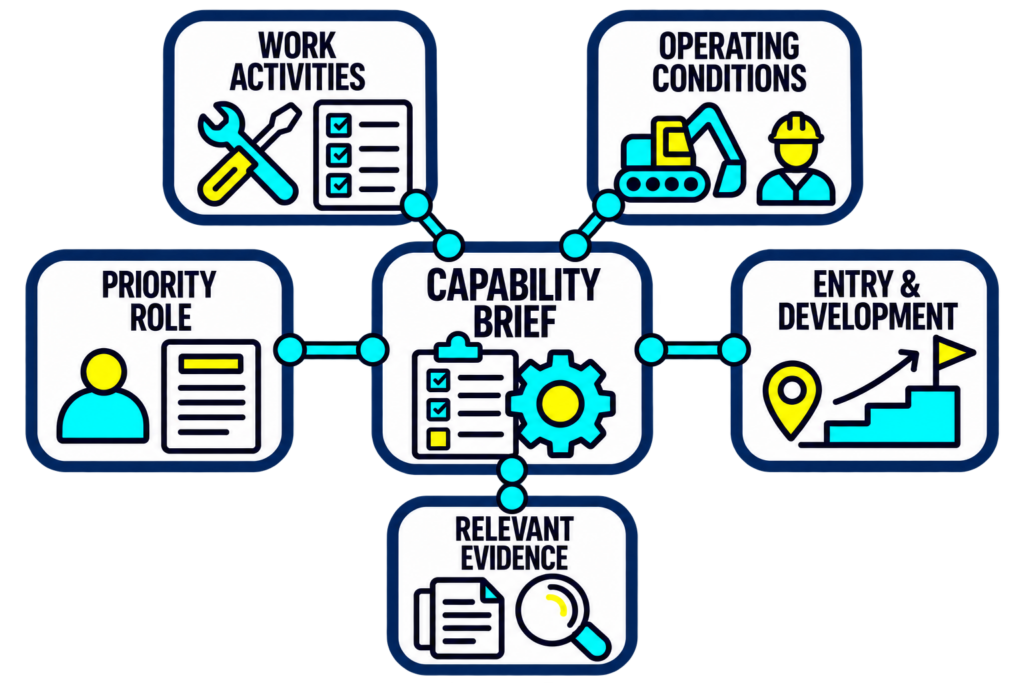
The priority role
Its title, purpose, employer context, and relationship to the selected initiative.
The work examples
Typical activities, consequential situations, decisions, and handoffs that reveal what the role involves.
The operating conditions
Tools, environments, procedures, supervision, and other conditions affecting the requirements.
The entry expectations
What employers expect before beginning, what is preferred, and what could be developed.
The evidence options
Experience, demonstrations, work samples, credentials, and other material relevant to selected requirements.
The review arrangement
Who should confirm the brief, resolve disagreements, and maintain it as the work changes.
A practical exercise: create a Critical Role & Capability Brief.
Participants select one priority role and develop a description that preparation and employer partners can review together.
STEP 1
Establish the role and decision
Name the role, its operating purpose, and the preparation or readiness decision the brief should support.
STEP 2
Describe meaningful activities
Identify a manageable set of activities and situations that reveal the work’s important expectations.
STEP 3
Add conditions and responsibility
Record relevant tools, environments, supervision, decisions, and expected results.
STEP 4
Clarify entry and development
Distinguish confirmed entry expectations, preferences, and capabilities developed through agreed support.
STEP 5
Connect evidence and review
Identify what could help demonstrate selected capabilities, who should review it, and what the evidence would not establish.
STEP 6
Confirm differences and next steps
Record shared and employer-specific requirements, unresolved questions, owners, and the next review point.
A draft Critical Role & Capability Brief connecting role purpose, activities, conditions, entry expectations, evidence, and review responsibilities.
CONNECT THE WORKSHOP TO A PRACTICAL NEXT STEP
Define the role context a future Gobekli configuration would need.
A useful role configuration should help people understand the work behind a requirement. This module identifies the relationships and review questions needed to connect organizational expectations with relevant experience and preparation.
- Priority roles and their organizational purposes.
- Employer and operating-site relationships.
- Meaningful work activities and expected results.
- Knowledge, skills, and judgment connected to activities.
- Relevant tools, conditions, and supervision.
- Entry expectations, preferences, and development needs.
- Shared and employer-specific requirements.
- Evidence types and their interpretation boundaries.
- Requirement owners and authorized reviewers.
- Source references, review dates, and change triggers.
Where appropriate, these requirements can inform a TalentSync configuration connecting roles, activities, capabilities, and evidence. TalentPass may support individuals who choose to describe and share relevant experience in relation to reviewed requirements.
The workshop develops the starting brief. Product functionality, configuration scope, integrations, access arrangements, and review processes are confirmed separately.
SCOPE AND BOUNDARIES
What this module does—and what requires further work
This module clarifies the requirements associated with a selected priority role.
It helps partners connect those expectations to work activities, entry conditions, development responsibilities, and relevant evidence.
It does not certify an individual’s competence, authorize them to perform particular work, or replace an employer’s selection and supervision responsibilities.
Further work may be needed to:
- Validate requirements with additional employers or sites.
- Conduct detailed occupational or task analysis.
- Confirm externally defined requirements.
- Develop or revise preparation programs.
- Design and validate assessment methods.
- Review an individual’s experience or demonstrations.
- Establish hiring, onboarding, or supervision arrangements.
- Implement and maintain the supporting configuration.
Evidence should be interpreted within its context. A credential, work sample, or account of experience may support a particular conclusion while leaving other requirements unconfirmed.
The workshop identifies questions requiring employer or specialist review. It does not assume authority to remove essential requirements or approve independent performance.
What should participants bring?
Bring a selected role and examples that explain what the work involves.
Existing documents are useful starting points, especially when someone familiar with the work can explain where they are accurate, incomplete, or outdated.
Useful inputs
- The Regional Workforce Direction Brief.
- Relevant employer demand or requirement summaries.
- Current job descriptions or role profiles.
- Examples of typical work activities.
- Supervisor or experienced-worker input.
- Relevant procedures or task descriptions.
- Existing entry requirements and preferences.
- Onboarding or preparation expectations.
- Applicable credential or qualification references.
- Examples of evidence currently reviewed.
- Known differences among employers or sites.
- Questions about requirements that need confirmation.
Use authorized materials and appropriate summaries. The module can examine work expectations without exposing confidential operating details or identifiable candidate records.
What can you leave with?
Critical Role & Capability Brief
A reviewed starting description of the role’s purpose, activities, conditions, and relevant capability requirements.
Entry & Development Map
A distinction among confirmed entry expectations, preferences, and capabilities developed through agreed preparation or support.
Evidence & Review Plan
Potential evidence sources, interpretation boundaries, requirement owners, and questions needing further validation.
Preparation & Configuration Priorities
Next questions for preparation partners and starting requirements for a possible Gobekli role and capability configuration.
These outputs begin with the role examined during the module. Broader role coverage, detailed assessment design, and implementation require additional work.
Where might the work lead next?
Career Transitions & Transferable Experience
Compare the reviewed role with selected source occupations to identify relevant experience and additional preparation.
Training Capacity & Delivery Bottlenecks
Examine whether providers have the people, equipment, facilities, and schedules needed to support the identified preparation.
Cross-Provider Pathway & Credential Alignment
Clarify how preparation, evidence, and credentials connect across providers serving the selected role or pathway.
Regional Workforce Direction provides the required foundation. Employer Demand & Hiring Commitment can help establish which requirements are sufficiently current and relevant to prioritize.
Frequently asked questions
Questions regional partners ask before beginning.
Its importance to the selected initiative and decision. A role may enable an operation, constrain delivery, support a consequential activity, or provide an important entry route. Priority should have an explicit basis.
The exercise focuses on one role or a tightly related role group. That provides enough detail to learn the method and produce a usable brief before applying it more broadly.
Yes. It provides a starting point. Input from people familiar with the work helps identify which statements are useful, incomplete, or in need of confirmation.
Include people who understand the work and its requirements, such as supervisors, experienced workers, employer representatives, and preparation partners. The right combination depends on the selected role.
That module examines the strength, timing, and conditions of employer demand. This module examines the work and capabilities associated with the roles the initiative intends to serve.
The module produces a focused role and capability brief. Detailed analysis across many tasks, sites, or occupations may require additional work.
Yes. The exercise examines activities, conditions, responsibility, and entry expectations so those differences can be represented clearly.
Yes. Partners can identify a possible shared foundation while preserving differences that affect preparation or readiness. Employer review is needed before treating the shared description as agreed.
Ask what must be present before beginning, why it is needed, and what preparation or supervision the employer or provider can support. Record unresolved questions for the responsible owner.
It can examine their relationship to the selected work and identify questions about their purpose. Changes remain subject to the employer’s responsibilities and any applicable external requirements.
Connect them to activities and situations. Specify what the person needs to communicate or decide, with whom, under which conditions, and toward what result.
Its relevance depends on what it represents and how that relates to the selected requirements. The brief identifies what the credential supports and which expectations require other evidence.
Yes. The module clarifies which activities and conditions would make that experience relevant. Reviewing an individual’s evidence or making a recognition decision is further work.
Participants identify evidence options and review questions. Developing and validating a complete assessment process requires additional scope and appropriate expertise.
Record the current and proposed expectations separately, identify who can confirm them, and establish review triggers so preparation does not rely on an outdated role description.
It can produce starting configuration requirements. Implementation is scoped separately based on the intended use, product fit, source material, permissions, and operating responsibilities.
Review the brief with the appropriate employers, resolve priority questions, confirm development responsibilities, and use the requirements to guide the next preparation or transition module.
PREPARE FOR THE WORK BEHIND THE TITLE
Give partners a clearer definition of readiness.
Connect priority roles to meaningful activities, entry expectations, and evidence that can be reviewed in context.
Use that shared understanding to guide preparation, recognize relevant experience, and identify what needs to happen next.