
REGIONAL WORKFORCE & INDUSTRY ALIGNMENT WORKSHOP MODULE
Cross-Provider Pathway & Credential Alignment
Clarify what each provider contributes, how learning and evidence carry into the next stage, and which progression decisions need confirmation—so a regional preparation route offers understandable connections between programs.
Does this sound familiar?
The pathway map connects programs that do not have an agreed transition.
Arrows suggest progression, but the receiving provider has not confirmed what completion of the earlier stage allows someone to do next.
People repeat preparation because prior learning is difficult to interpret.
Providers cannot readily understand the activities, evidence, or review behind another organization’s course or credential.
A gap appears between one program’s completion and the next program’s entry.
Participants finish the first stage without meeting an expectation that the receiving provider assumes has already been addressed.
Credentials look stackable without a defined relationship.
Badges, certificates, and qualifications are grouped into a sequence without explaining recognition, remaining requirements, or decision authority.
Different providers use the same language for different expectations.
Terms such as foundational, proficient, or job-ready conceal differences in scope, practice, assessment, and independence.
The handoff depends on staff working around the system.
A coordinator explains each case individually because the pathway lacks clear information, review responsibilities, or an accountable receiving contact.
What is cross-provider pathway and credential alignment?
Cross-provider alignment concerns how preparation offered by different organizations connects within a selected regional workforce route.
It examines what each stage is intended to develop, what participants do, what evidence is reviewed, and what any resulting credential represents.
It also clarifies how the receiving stage interprets that preparation and which entry or progression requirements remain.
A useful pathway makes these relationships understandable to participants, providers, and relevant employers.
This module helps partners examine one selected sequence and develop a pathway brief that identifies confirmed connections, unresolved gaps, and responsibilities for making transitions workable.
A pathway connection needs more than an arrow.
A regional map may show a short course leading to a technical program and then to an employer opportunity.
That sequence expresses an intended route.
For the connection to be usable, people need to know what the first stage establishes, what the next stage requires, and who reviews the relationship.
They also need clear information about any application, evidence submission, additional preparation, or decision that remains.
The workshop examines those conditions at a selected provider boundary.
It turns a proposed connection into a specific question partners can review and, where appropriate, confirm.
What needs to connect?
Pathway purpose
Selected regional opportunity
Intended destination
Participant starting points
Provider contributions
Boundaries of the review
Learning and activities
Intended capabilities
Required learning
Practice opportunities
Conditions and supervision
Expected results
Evidence and credentials
Assessment or review
Supporting evidence
Credential meaning
Issuer responsibilities
Limits of the claim
Progression requirements
Receiving-stage expectations
Recognition arrangements
Remaining preparation
Entry decisions
Participant instructions
Handoffs and maintenance
Sending responsibilities
Receiving contacts
Information exchange
Unresolved questions
Change and review owners
Connections should distinguish what partners propose, what receiving providers have reviewed, and what has been formally confirmed through the appropriate process.
How this module helps
1. Understand the connection problem
Learn why relevant programs and credentials may still leave gaps in progression.
2. Examine a selected provider boundary
Compare the preparation and evidence from one stage with the expectations of the next.
3. Define the transition conditions
Identify recognition questions, remaining requirements, participant instructions, and responsible reviewers.
4. Prepare a connected next step
Develop a pathway and handoff brief that can guide partner decisions and a possible Gobekli configuration.
Begin with one transition in the regional preparation route.
Choose a boundary where participants move, or are expected to move, from one provider’s preparation into another provider’s program.
For example, a community organization may offer foundational preparation before participants enter a technical college’s maintenance program.
The exercise examines what the first stage contributes, what the receiving stage expects, and which parts of the proposed connection are still assumptions.
Questions to review together
Describe the purpose, learning, activities, and expected results of the sending and receiving stages in relation to the regional opportunity.
Review the evidence and conditions behind completion. Clarify what any credential represents and what it does not claim.
Identify entry expectations, assumed prior learning, evidence requirements, and the person or process responsible for reviewing them.
Compare specific requirements and supporting evidence. Distinguish useful reinforcement from unnecessary repetition and identify missing preparation.
Clarify applications, documentation, reviews, additional preparation, contacts, and decisions that remain between stages.
Name the providers and authorized reviewers responsible for recognition, participant information, handoffs, and updates when either stage changes.
Six dimensions of a usable pathway connection
Purpose alignment
A clear explanation of how each stage contributes to the selected regional preparation goal.
Learning continuity
An understandable relationship between what one stage develops and what the next expects.
Evidence clarity
Enough information about activities, assessment, and review to interpret completed preparation.
Credential meaning
A defined account of what recognition represents, including its scope and limitations.
Progression clarity
Visible entry conditions, remaining requirements, and decisions affecting the next step.
Handoff ownership
Named responsibilities for communicating, reviewing, receiving, and maintaining the connection.
When programs are connected only on paper
Participants and partners may encounter:
- Unconfirmed assumptions about recognition.
- Similar labels with different learning expectations.
- Missing preparation between stages.
- Repeated learning without a clear reason.
- Credentials whose progression value is unclear.
- Handoffs without a responsible receiving contact.
The regional route may appear complete while people still have to discover its conditions one transition at a time.
When the pathway connection becomes usable
Partners can establish:
- A clear contribution from each stage.
- Reviewed relationships between learning requirements.
- Understandable evidence and credential claims.
- Explicit remaining preparation or entry conditions.
- Participant-facing progression instructions.
- Named review and handoff responsibilities.
The resulting brief gives people a clearer basis for understanding what completion enables and what comes next.
What this can look like in practice
A regional partnership presents a route from a community provider’s introductory manufacturing course into a technical college’s maintenance program.
The pathway map describes the introductory certificate as a first step toward the college qualification.
Participants and advisors interpret that description as meaning that the certificate satisfies the next program’s entry expectations.
During the module, partners compare the first course’s activities and reviewed evidence with the college’s starting requirements.
They identify preparation that appears relevant, including workplace documentation and selected foundational concepts.
They also identify a practical expectation that the introductory course does not currently address.
The college explains that the certificate has not been approved as an automatic basis for entry or recognition.
The partners define the review needed to determine what can be recognized and whether additional preparation could address the gap.
They also draft clearer participant instructions and identify contacts responsible for the transition.
The partnership leaves with a reviewed connection brief and assigned decisions before describing the route as an agreed progression pathway.
Credential visibility is different from credential recognition.
Making a certificate or badge easy to find can help people explain their preparation.
A receiving provider still needs to understand what it represents and how it relates to its own expectations.
The issuer’s claim, supporting evidence, learning conditions, and review process may all matter.
The receiving organization determines what recognition it can provide through its own authorized arrangements.
The workshop makes those questions explicit and identifies the information needed for review.
It does not treat a digital format, shared label, or place on a pathway map as automatic acceptance.
Alignment should preserve purposeful differences.
Providers may contribute different types of learning and experience to the same regional route.
One may focus on initial preparation. Another may provide technical depth, supervised practice, or a different level of responsibility.
Those differences can be useful when they are understood.
The review examines whether overlap supports progression or creates avoidable repetition, and whether differences leave a gap that someone must address.
Partners do not need identical programs to form a connected pathway.
They need a clear account of how their contributions relate and what participants must do between them.
WORKSHOP MODULE 7
Make progression across providers easier to understand.
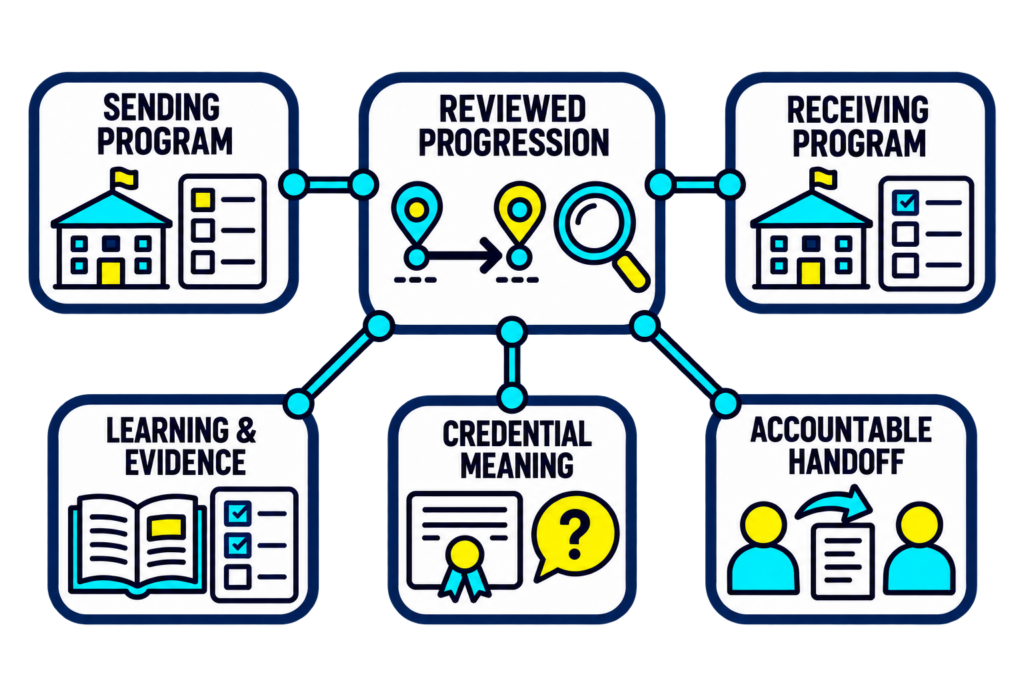
Cross-Provider Pathway & Credential Alignment is a focused minicourse in examining the connections between preparation stages. Participants review one selected provider boundary, clarify learning and credential relationships, and define progression and handoff responsibilities using the foundation established in Regional Workforce Direction.
What can this module address?
The module examines one selected sequence or provider-to-provider transition. Topics may include:
- Each provider’s contribution to the regional route.
- Intended learning and capability requirements.
- Required activities and opportunities for practice.
- Assessment and evidence-review arrangements.
- Completion conditions and credential claims.
- Receiving-stage entry expectations.
- Proposed or confirmed recognition relationships.
- Gaps and repetition between stages.
- Remaining preparation and review requirements.
- Participant-facing progression information.
- Sending and receiving responsibilities.
- Change triggers and connection-maintenance roles.
What responses might emerge?
The appropriate response depends on what the selected transition reveals.
Clarify
Explain what each stage develops, what its credential represents, and what completion enables.
Compare
Examine specific learning requirements, activities, and evidence across the provider boundary.
Bridge
Identify additional preparation or review needed between the sending and receiving stages.
Review recognition
Define the information and authorized process needed to consider acceptance, credit, exemption, or another form of recognition.
Coordinate
Assign participant instructions, sending responsibilities, receiving contacts, and unresolved decisions.
Maintain
Establish who revisits the connection when programs, credentials, requirements, or operating arrangements change.
The workshop develops a basis for partner review. Recognition and progression arrangements remain subject to confirmation by the responsible organizations.
What will we review?
The proposed pathway connection
The stages being linked, the regional purpose they serve, and how the connection is currently described.
The learning requirements
What participants are expected to understand and do at each stage.
The activities and evidence
How participants practice, demonstrate, and receive review of the relevant learning.
The credential claims
What completion or recognition represents and which conclusions the supporting information can establish.
The progression conditions
Entry expectations, remaining preparation, applications, and decisions between stages.
The handoff arrangement
Who communicates the next step, receives the participant, reviews information, and maintains the connection.
A practical exercise: create a Cross-Provider Pathway & Handoff Brief.
Participants examine one provider boundary and define the work needed to make its progression conditions understandable.
STEP 1
Define the connection and purpose
Name the sending and receiving stages and explain how they contribute to the selected regional route.
STEP 2
Describe learning and completion
Record the first stage’s activities, evidence, completion conditions, and credential meaning.
STEP 3
Compare receiving expectations
Review the next stage’s entry requirements and identify what it expects participants to bring.
STEP 4
Identify alignment, repetition, and gaps
Examine which relationships are supported, which need further review, and what preparation may remain.
STEP 5
Define progression and handoff responsibilities
Clarify participant actions, information needs, recognition decisions, and sending and receiving contacts.
STEP 6
Assign confirmation and maintenance
Name the authorized reviewers, unresolved decisions, review points, and changes that should trigger an update.
A draft Cross-Provider Pathway & Handoff Brief connecting learning, evidence, credential meaning, progression conditions, and partner responsibilities.
CONNECT THE WORKSHOP TO A PRACTICAL NEXT STEP
Define how pathway connections could retain their meaning and status.
A useful pathway configuration should explain the relationship between stages and preserve the conditions attached to progression. This module identifies the context a subsequent Gobekli implementation would need to represent.
- The selected pathway and its regional purpose.
- Participating providers and their contributions.
- Programs, learning requirements, and activities.
- Evidence types and review responsibilities.
- Credentials, issuers, and the claims they represent.
- Receiving-stage entry expectations.
- Proposed, reviewed, and confirmed recognition relationships.
- Remaining preparation and participant actions.
- Sending contacts, receiving contacts, and decision owners.
- Source references, effective dates, and change-review triggers.
Where appropriate, these requirements can inform a TalentSync configuration connecting provider offerings, learning expectations, evidence, and progression responsibilities. TalentPass and Passport Pages may support people who choose to retain and share relevant learning records for a receiving provider’s review.
The workshop defines the starting requirements. Product availability, credential handling, integrations, access arrangements, and recognition processes are confirmed separately.
SCOPE AND BOUNDARIES
What this module does—and what requires further work
This module examines how selected preparation stages connect across providers.
It helps partners identify learning relationships, evidence questions, progression conditions, and handoff responsibilities.
It does not independently award credit, authorize admission, establish credential equivalence, or bind a receiving organization to recognize prior preparation.
Further work may be needed to:
- Review detailed learning and assessment materials.
- Confirm recognition through authorized processes.
- Develop formal articulation or partnership arrangements.
- Revise curriculum or bridging preparation.
- Confirm entry and progression requirements.
- Examine delivery capacity and participant support.
- Implement record-sharing and handoff processes.
- Maintain the supporting configuration and agreements.
A proposed relationship should remain distinguishable from a confirmed arrangement. Participant-facing information should reflect the current status and conditions.
Issuers remain responsible for their credential claims. Receiving organizations retain responsibility for recognition and progression decisions within their authority.
What should participants bring?
Bring one proposed or existing connection between preparation stages.
Existing pathway maps are useful starting points when partners can also explain the learning, evidence, and decisions behind the arrows.
Useful inputs
- The Regional Workforce Direction Brief.
- The selected pathway map or sequence.
- Sending and receiving program descriptions.
- Relevant role or preparation requirements.
- Learning outcomes and activity summaries.
- Assessment or evidence-review descriptions.
- Completion and credential information.
- Receiving-stage entry requirements.
- Existing recognition or articulation arrangements.
- Current participant instructions and handoff materials.
- Examples of gaps, repetition, or unclear transitions.
- Provider contacts and review responsibilities.
Use authorized program information and de-identified examples. Individual learner records are usually unnecessary for examining the initial connection.
What can you leave with?
Cross-Provider Pathway Brief
A clear account of the selected stages, their contributions, and the intended progression relationship.
Learning, Evidence & Credential Map
Reviewed starting connections among requirements, activities, evidence, and credential claims, with gaps and limitations visible.
Progression & Handoff Plan
Participant actions, remaining requirements, recognition questions, and named sending and receiving responsibilities.
Confirmation & Configuration Priorities
Assigned provider decisions, maintenance triggers, and starting requirements for a possible Gobekli configuration.
These outputs begin with the provider boundary examined during the module. Formal recognition, detailed program redesign, and wider pathway coverage require additional work.
Where might the work lead next?
Training Capacity & Delivery Bottlenecks
Examine whether the connected preparation stages can be delivered in the volume and time frame the regional route requires.
Apprenticeship & Work-Based Learning Capacity
Clarify authentic work activities, supervision, and employer responsibilities where they form part of the pathway.
Investment, Partner Commitments & Mobilization
Connect proposed pathway changes to the decisions, resources, and partner commitments needed to implement them.
Regional Workforce Direction provides the required foundation. Critical Roles & Capability Requirements can help establish the destination expectations the provider sequence is intended to support.
Frequently asked questions
Questions regional partners ask before beginning.
It means understanding how preparation from different organizations connects within a selected route, including learning, evidence, credentials, entry conditions, and handoff responsibilities.
The exercise focuses on one provider boundary or a tightly bounded sequence. Wider pathway review may require additional sessions and partner input.
No. Different contributions can form a useful pathway when their relationships, remaining requirements, and progression conditions are clear.
No. It describes a proposed or existing route. The receiving organization must confirm the conditions under which people can progress.
The relationship needs to be defined: what earlier recognition contributes, what remains, and who authorizes the next step. A sequence of credential names alone does not establish that relationship.
No. Being able to receive or inspect a record does not determine how an organization will recognize its learning or apply it to requirements.
It can identify overlap and evidence that may support a recognition review. Decisions about exemptions, credit, or revised preparation belong to the responsible organizations.
Record the missing expectation, its importance to progression, and who should determine an appropriate response. That may involve bridging preparation, changed entry information, or further evidence review.
Include people who understand the learning, assessment, entry requirements, and progression decisions on both sides. Operational contacts may also be needed to clarify the handoff.
Yes. It can examine its own contribution and identify questions for the receiving organization. Assumptions about recognition or entry should remain provisional until reviewed.
It can identify the substance and questions an agreement would need to address. Formal arrangements require the participating organizations’ authorized processes.
Yes. The review can examine different types of preparation and recognition. The relevant question is what each stage establishes and how the receiving organization interprets it.
Yes. Employer preparation may form part of the selected route. Its activities, evidence, responsibilities, and relationship to other stages need the same clarity.
This module examines the meaning and conditions of progression between stages. The capacity module examines whether those stages can be delivered with available people, resources, and schedules.
Assign review owners and identify changes that matter, such as revised outcomes, assessments, credentials, entry requirements, or recognition arrangements.
It can identify starting configuration requirements. Product fit, integrations, record handling, permissions, and operating responsibilities are agreed separately.
Review unresolved connections with the authorized providers, confirm recognition and entry conditions, update participant instructions, and assign responsibility for the handoff and future changes.
MAKE THE CONNECTION BETWEEN PROGRAMS USABLE
Give people a clearer route from one stage to the next.
Connect learning, evidence, and credentials to understandable progression conditions and accountable provider handoffs.
Use that shared understanding to confirm what the pathway enables and what still needs to happen.