
REGIONAL WORKFORCE & INDUSTRY ALIGNMENT WORKSHOP MODULE
Employer Demand & Hiring Commitment
Clarify what employers need, when they may need it, and what they have actually confirmed—so training, recruitment, and partner investment follow an appropriately supported demand picture.
Does this sound familiar?
A forecast becomes a target without employer validation.
Regional projections identify a possible need, but the partnership has not confirmed which employers, roles, locations, or time periods the proposed response would serve.
Positive conversations are treated as hiring commitments.
Employers support the initiative in principle. The plan assumes they will hire participants without establishing what they have agreed to do.
Job postings are counted as separate opportunities.
Repeated, overlapping, or ongoing advertisements create uncertainty about how many distinct positions are involved and whether they remain active.
The numbers have no clear time frame.
Partners discuss “needed workers” without distinguishing current vacancies, replacement needs, proposed expansion, or longer-term expectations.
The person providing input cannot confirm the decision.
A useful employer contact shares an estimate, but hiring authority, budget approval, or operating requirements sit elsewhere.
The workforce response outlasts the original demand.
Training and recruitment continue after an employer changes its schedule, location, requirements, or plans.
What are employer demand and hiring commitment?
Employer demand describes an organization’s need for people to perform particular work under relevant conditions and within a meaningful time frame.
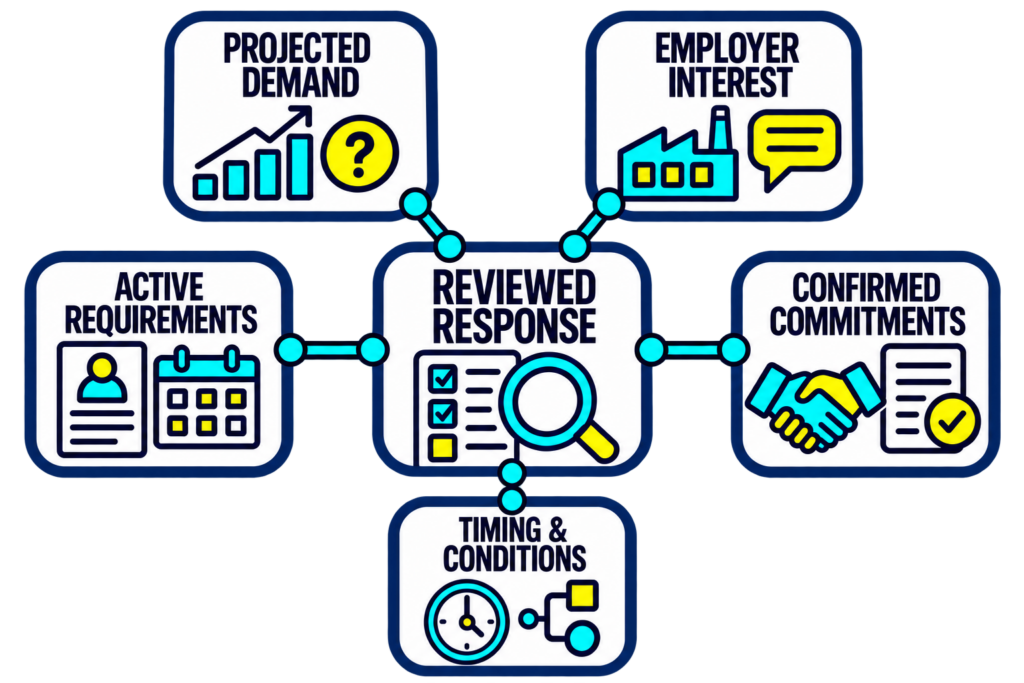
That need may be suggested by a forecast, expressed in a conversation, represented by an active hiring requirement, or supported by a more specific employer commitment.
These forms of evidence answer different questions. A projection can help identify where to investigate. An employer conversation can clarify an emerging need. An active requirement can support a more immediate preparation or recruitment decision.
A hiring commitment adds a defined statement about what an employer intends or agrees to do, including its scope, conditions, timing, and responsible contact.
This module helps partners distinguish those situations and determine what they can reasonably plan around.
Support for an initiative does not establish the jobs it will create.
An employer may welcome a new training program because it could improve the future talent supply.
That support is useful, but it does not establish a particular number of vacancies or a decision to hire program completers.
The employer may instead be willing to review requirements, advise on preparation, provide work-based learning, or interview suitable candidates.
Each contribution should be described accurately.
Partners need to understand what has been confirmed, what remains conditional, and which decisions have not yet been made.
A clearer account of demand allows the workforce response to develop in proportion to the evidence.
What needs to connect?
Demand source
Regional projection
Employer conversation
Survey response
Current requirement
Confirmed employer statement
Work and location
Role or activity
Operating site
Relevant work conditions
Requirement owner
Questions needing clarification
Quantity and timing
Distinct positions
Current or future need
Expected hiring window
Expansion or replacement
Review date
Status and conditions
Interest or active need
Approval status
Business dependencies
Candidate requirements
Unresolved assumptions
Responsibility and response
Employer contact
Decision authority
Partner planning decision
Validation owner
Change notification route
These elements help interpret a demand statement. They should remain connected so that a number or quotation is not separated from its source, timing, and conditions.
How this module helps
1. Understand different demand signals
Learn what projections, expressions of interest, active requirements, and employer commitments can reasonably support.
2. Examine a selected demand claim
Trace one statement or estimate to its sources, employer context, timing, and unresolved questions.
3. Define the validation needed
Identify what must be confirmed before partners set preparation targets, recruit participants, or commit resources.
4. Prepare a proportionate response
Develop a demand brief, follow-up plan, and review arrangement that can guide subsequent workshop modules.
Begin with one claim the partnership is planning around.
Choose a statement that materially affects the initiative, such as “regional employers need 150 technicians” or “these employers will hire graduates.”
Identify how that statement entered the plan and what decisions it is being used to support.
The exercise examines its underlying evidence and determines what the partnership needs to confirm before relying on it.
Questions to review together
Identify the source, date, geography, and method behind the statement. Distinguish an estimate assembled from several sources from a statement confirmed by a named employer.
Clarify the organizations, locations, roles, and work involved. Record where the description remains broad or where different employers mean different things.
Determine whether the figure concerns positions, postings, expected turnover, possible expansion, or another measure. Identify possible duplication and uncertainty.
Review the expected hiring window and the events that could change it. Compare that timing with the proposed preparation and participation schedule.
Record the action, scope, conditions, and responsible contact. Distinguish reviewing a program, offering interviews, hosting placements, and making hiring commitments.
Determine whether the evidence supports further investigation, a limited test, preparation planning, recruitment, or another defined response.
Six dimensions of credible demand evidence
Source context
An identifiable source, collection date, and explanation of how the information was obtained.
Employer specificity
A clear relationship to the organizations, locations, and requirements the initiative intends to serve.
Quantity meaning
An understandable account of what is being counted, including possible duplication and uncertainty.
Timing relevance
A hiring window that can be compared with preparation, recruitment, and delivery schedules.
Commitment clarity
An accurate description of the employer’s confirmed action, its conditions, and who can authorize it.
Currency and review
A named route for confirming changes before partners continue relying on the information.
When demand is treated as one number
A partnership may combine different signals without preserving:
- The source of each estimate.
- The employers and locations involved.
- The meaning of the quantities.
- The expected hiring periods.
- The conditions attached to employer statements.
- The dates and responsibilities for review.
The resulting total may appear more actionable than its underlying evidence supports.
When demand becomes usable for planning
Partners can establish:
- Separate records for different demand sources.
- Clear employer and requirement context.
- Reviewed quantities with duplication questions visible.
- Hiring windows and relevant dependencies.
- Explicit descriptions of employer commitments.
- Assigned validation and update responsibilities.
The partnership can then explain why a proposed response is appropriate and what might cause it to change.
What this can look like in practice
A regional partnership is considering a preparation program for industrial maintenance roles.
Its initial planning document refers to 120 opportunities assembled from job advertisements, employer conversations, and an industry forecast.
The group has begun discussing recruitment targets based on that total.
During the module, participants trace the figure to its component sources.
Some advertisements appear to concern the same requirements, while part of the forecast describes a broader area and a longer period than the proposed initiative.
One employer identifies a current requirement but needs to confirm the number of positions and hiring window with its operations team.
Another employer supports the program and offers to review the preparation plan. It has not committed to hiring.
A third describes possible expansion that depends on a business decision still under review.
The partnership replaces the single planning total with a demand brief that separates current requirements, conditional future needs, and contributions to program development.
It assigns employer follow-up and postpones the recruitment target until the demand and delivery timing can be reviewed together.
A commitment needs an action, an owner, and conditions.
“Employer committed” is too broad to guide a workforce response on its own.
The employer may have committed to a conversation, a curriculum review, a site visit, a placement, an interview, or a particular hiring arrangement.
Each action has a different implication for the partnership and prospective participants.
The record should identify what was confirmed, by whom, for which roles or activities, within what period, and subject to which conditions.
Where the contact needs additional approval, that step should remain visible.
The workshop clarifies the statement and its planning implications. Any formal agreement requires the organizations’ own authorization and review processes.
A confirmed need can still change.
An employer can describe a real hiring requirement that later changes.
Operating schedules, business conditions, staffing decisions, location plans, and other dependencies may affect the requirement.
Preparation and recruitment decisions therefore need a way to check whether the underlying need remains current.
The partnership should agree who will seek updates and which changes require attention.
A delayed start date may affect cohort timing. A revised role may change the preparation question. A withdrawn requirement may require a different response.
Keeping those changes visible helps partners adjust before outdated assumptions become participant expectations.
WORKSHOP MODULE 2
Build a demand picture your partnership can use responsibly.
Employer Demand & Hiring Commitment is a focused minicourse in interpreting employer demand before building a workforce response around it. Participants examine a selected demand claim, distinguish its evidence and commitment status, and develop a practical validation and review plan using the direction established in Regional Workforce Direction.
What can this module address?
The module examines the demand evidence relevant to one selected regional initiative. Topics may include:
- Projections and other regional demand indicators.
- Employer conversations and expressions of interest.
- Survey responses and their source context.
- Active requirements and their responsible contacts.
- Job-posting interpretation and possible duplication.
- Expansion, replacement, and other sources of need.
- Role, location, and operating context.
- Quantities and expected hiring windows.
- Employer contributions and hiring commitments.
- Conditions, dependencies, and approval status.
- Validation responsibilities and missing evidence.
- Update routes and demand-review triggers.
What responses might emerge?
The appropriate response depends on the claim being examined and the decision it is expected to support.
Clarify
Rewrite a demand statement so its source, meaning, scope, and uncertainty are understandable.
Separate
Distinguish projections, active requirements, conditional plans, and partner contributions that have been combined.
Validate
Confirm quantities, timing, requirements, and authority with the appropriate employer contacts.
Reconcile
Review overlapping records or conflicting statements before using them in a planning total.
Phase
Develop an initial response that fits the current evidence while leaving room for later confirmed needs.
Refresh
Update or retire demand information when its timing, conditions, or relevance changes.
The workshop may identify a useful opportunity while also showing that further employer confirmation is needed before recruitment or investment decisions.
What will we review?
The planning claim
The statement or quantity the partnership currently uses to explain the opportunity.
The underlying sources
Forecasts, postings, conversations, surveys, and employer documents relevant to that claim.
The requirement context
Employers, roles, operating sites, work conditions, and questions requiring clarification.
The timing and dependencies
Hiring windows, preparation schedules, pending decisions, and events that may change the need.
The commitment record
What employers have confirmed, who provided the confirmation, and what conditions remain.
The proposed response
The recruitment, preparation, capacity, or investment decision that relies on the demand evidence.
A practical exercise: create an Employer Demand & Commitment Brief.
Participants select one demand claim and examine whether its evidence supports the proposed workforce response.
STEP 1
State the claim and decision
Write the demand statement and identify the decision the partnership expects it to support.
STEP 2
Trace the sources
Record where the information came from, when it was obtained, and which employers or populations it describes.
STEP 3
Clarify quantities and timing
Examine what is counted, identify possible duplication, and establish the relevant hiring period.
STEP 4
Describe the confirmed action
Separate employer interest, active requirements, proposed contributions, and confirmed commitments with their conditions.
STEP 5
Assign validation and updates
Identify the questions, employer contacts, responsible partners, and review dates needed to maintain the brief.
STEP 6
Define the planning implication
State what the evidence can support now, what remains provisional, and which further modules or decisions should follow.
A draft Employer Demand & Commitment Brief connecting a selected demand claim to its evidence, timing, conditions, validation responsibilities, and planning implications.
CONNECT THE WORKSHOP TO A PRACTICAL NEXT STEP
Define how employer demand could remain connected to its context.
A workforce response needs more than a list of employers and a total number of opportunities. This module identifies the relationships and review responsibilities a subsequent Gobekli configuration would need to preserve.
- Employer organizations and relevant operating locations.
- Named contacts and their decision responsibilities.
- Roles, activities, and requirement references.
- Demand sources and collection dates.
- Quantities and the meaning of each measure.
- Expected hiring windows.
- Interest, requirement, and commitment status.
- Conditions and unresolved validation questions.
- Partner response decisions linked to the evidence.
- Review owners, update dates, and change triggers.
Where appropriate, these requirements can inform a TalentSync configuration connecting employer context, requirements, evidence, and regional planning. Later work may identify a role for TalentPass when individuals choose to share relevant experience against reviewed requirements.
The workshop establishes a starting configuration brief. Product functionality, integrations, source access, permissions, and implementation scope are confirmed separately.
SCOPE AND BOUNDARIES
What this module does—and what requires further work
This module helps partners interpret and validate the demand evidence behind a selected initiative.
It develops an understandable account of what employers have expressed or confirmed and what that information can support.
It does not establish that every potential opportunity will become a vacancy or that a particular participant will receive an offer.
Further work may be needed to:
- Conduct additional employer research.
- Validate detailed role and capability requirements.
- Confirm employer approvals or formal agreements.
- Assess training and work-based learning capacity.
- Examine participant interest and access conditions.
- Review recruitment and selection arrangements.
- Make investment or delivery commitments.
- Implement systems and ongoing data-maintenance processes.
An invitation to interview, placement offer, program endorsement, and hiring commitment should remain distinct in both internal planning and participant-facing communication.
The module supports responsible interpretation and coordination. Employers retain responsibility for their hiring decisions and authorized commitments.
What should participants bring?
Bring the demand statements and source material currently influencing the initiative.
You do not need a complete employer dataset. The exercise can begin with one consequential estimate, requirement, or proposed commitment.
Useful inputs
- The initiative’s current demand summary.
- Relevant forecasts or industry reports.
- Employer survey questions and responses.
- Notes from employer conversations.
- Available job-posting or vacancy summaries.
- Employer requirement descriptions.
- Statements of support or proposed contributions.
- Existing commitment documentation.
- Expected hiring and preparation schedules.
- Relevant employer contacts and responsibilities.
- Known conditions or pending decisions.
- Questions partners have not yet resolved.
Use information participants are authorized to review. Commercially sensitive details can be summarized where appropriate while preserving the context necessary for the exercise.
What can you leave with?
Employer Demand & Commitment Brief
A reviewed description of the selected demand claim, its employer context, timing, status, and planning implications.
Source & Validation Register
An account of supporting information, possible duplication, unresolved assumptions, and employer questions requiring confirmation.
Commitment & Review Plan
Named contacts, confirmation responsibilities, relevant conditions, review dates, and routes for identifying changes.
Response & Configuration Priorities
A statement of what partners can plan around now, which further modules fit, and what a later Gobekli configuration would need to represent.
These outputs begin with the demand claim examined during the module. Broader employer coverage and continuing validation require additional work by the responsible partners.
Where might the work lead next?
Critical Roles & Capability Requirements
Clarify the work and capabilities behind the demand so preparation responds to meaningful requirements.
Training Capacity & Delivery Bottlenecks
Compare the timing and scope of employer needs with what providers can realistically deliver.
Investment, Partner Commitments & Mobilization
Connect validated needs and proposed contributions to the decisions, resources, and responsibilities required to act.
Regional Workforce Direction provides the required foundation. The demand review helps determine which preparation, participation, or mobilization questions deserve attention next.
Frequently asked questions
Questions regional partners ask before beginning.
They support different decisions. A regional projection can guide investigation, while an active employer requirement can support a more specific response. Combining them without context can make the evidence appear stronger than it is.
Yes. Its usefulness depends on its geography, time frame, method, and relationship to the selected initiative. It should be interpreted alongside the employer questions the partnership needs to answer.
They can provide useful signals, but partners should examine whether they represent distinct, current requirements and whether the employer context is clear. A posting count should not automatically become a recruitment target.
Interest indicates that an employer sees potential relevance or value. An active requirement describes a current hiring need with meaningful role, timing, and organizational context.
The brief should describe the employer’s actual statement, its scope, conditions, timing, and authorized owner. The workshop does not assign a universal meaning to every document labeled a commitment.
No. An interview is a defined opportunity to enter a selection process. It should be described separately from an offer or other hiring arrangement.
Yes. The module can identify the evidence available and the confirmation needed. Its output may recommend further validation before partners make particular planning decisions.
Employer participation can help clarify requirements and resolve questions. When the relevant employer cannot attend, the exercise should record what needs confirmation and who will seek it.
Their information may still be useful. Record their role and identify which statements require confirmation from the appropriate decision owner.
Use authorized summaries or appropriately limited access. The exercise needs enough context to interpret the demand without assuming that every partner should receive all underlying information.
Yes. Participants can compare source dates, definitions, locations, and time periods to identify why figures differ and what needs further investigation.
Yes, when the underlying records remain distinguishable and the aggregation makes sense for the decision. Differences in roles, timing, conditions, and possible duplication should stay visible.
The review plan identifies who should seek updates and which changes affect the workforce response. A changed requirement may lead to revised timing, scope, or partner decisions.
It clarifies the demand evidence relevant to that decision. Delivery capacity, participant interest, access conditions, costs, and other considerations may require additional modules.
This module examines whether the demand is sufficiently understood and confirmed. Critical Roles & Capability Requirements examines the work, capabilities, and evidence relevant to the roles themselves.
It can produce starting configuration requirements. Any implementation is scoped separately based on the intended use, product fit, source access, and operating responsibilities.
Confirm unresolved employer questions, review the brief with the decision owner, update the proposed response, and continue with the modules most relevant to the remaining uncertainty.
BUILD ON DEMAND YOUR PARTNERS CAN EXPLAIN
Give the workforce response a credible starting point.
Connect employer needs to their sources, timing, conditions, and confirmed commitments.
Use that clearer picture to decide what to investigate, prepare, and coordinate next.