
A PROGRAM RELEVANCE WORKSHOP MODULE
Employer Demand & Hiring Reality:
Look Beyond the Job Posting
Education and training providers are often told to align programs with employer demand. But employer demand is rarely as simple or stable as a list of open positions, projected occupations, or frequently requested skills.
Job postings may repeat outdated requirements. Employers may struggle to describe the work they need performed. Hiring practices may screen out people who could do the work. A reported talent shortage may reflect compensation, scheduling, location, job design, retention, or working conditions—not an absence of trainable people.
Programs need a more complete view of what employers need, how hiring actually works, and which signals are reliable enough to influence a consequential program decision.
Does this sound familiar?
Job postings are treated as definitive evidence
Program decisions rely on posted titles, skills, degrees, and experience requirements without checking whether they reflect the work employers actually need performed.
Employers describe urgent vacancies, not future capability
Conversations focus on positions that are difficult to fill today rather than how work, technology, and capability needs are changing.
Every hiring problem is called a skills gap
Recruiting difficulty is attributed to education even when pay, scheduling, location, job design, supervision, or retention may be contributing.
Employer input is broad but not decision-useful
Advisory groups confirm that communication, teamwork, and technical skills matter without clarifying the activities, standards, or evidence behind them.
Hiring requirements differ from workplace requirements
A degree, credential, or number of years may be used to screen candidates even when it is not essential to performing the work.
One influential employer speaks for the market
A single organization’s immediate needs shape a program even when other employers, industries, or operating environments require something different.
What is employer demand and hiring reality?
Employer demand describes the work, capacity, capabilities, credentials, and operating conditions organizations expect to need from current or future workers.
Hiring reality describes how employers actually identify, attract, screen, select, onboard, deploy, develop, and retain people in response to that demand.
The two are related, but they are not identical.
An employer may need someone capable of maintaining automated equipment but advertise for a familiar job title. A hiring team may require a degree because it is an established screening convention, not because the work depends on that degree. A company may report a labor shortage while offering schedules, wages, locations, or advancement conditions that limit the available candidate pool.
A useful employer needs assessment examines both the work that must be accomplished and the organizational practices affecting who can enter and succeed in it.
The goal is not to design a program around every vacancy. It is to determine whether employer evidence reveals a durable, consequential need that the institution can responsibly address.
The problem is not a lack of employer input. It is the distance between employer signals and real work.
Labor-market data, job postings, employer surveys, advisory boards, and interviews can all provide valuable evidence. None should be interpreted in isolation.
To understand employer demand, program leaders need to connect business, operational, public-service, or industry outcomes; the work activities required; technical and human capabilities; tools and technologies; credentials and regulations; hiring criteria; working conditions; onboarding; advancement; recruiting and retention patterns; future change; and the strength and limits of the evidence.
Without these connections, an institution may respond to a hiring symptom while missing the underlying workforce problem.
The program could teach the right subject at the wrong level, emphasize a screening requirement that employers do not truly need, prepare learners for jobs with weak retention, or react to short-term vacancies that disappear before the program can respond.
See the complete demand picture—not just the job count.
Organizational Need
- Growth and expansion
- Operational capacity
- Service delivery
- Technology adoption
- Succession and continuity
Work and Capabilities
- Critical activities
- Technical capabilities
- Human capabilities
- Tools and systems
- Performance expectations
Hiring Reality
- Sourcing and screening
- Required qualifications
- Selection practices
- Time to hire
- Candidate availability
Workplace Conditions
- Pay and scheduling
- Location and transportation
- Supervision and support
- Job design and workload
- Retention and advancement
Evidence and Decisions
- Labor-market data
- Employer observations
- Hiring and turnover records
- Confirmed patterns
- Unresolved questions
Employer demand becomes useful for program decisions when organizations can connect business and service needs to real work, hiring practices, workplace conditions, and evidence that extends beyond a single vacancy.
How employer alignment becomes superficial
STAGE 1
Institutions look for demand signals
Program teams examine job counts, growth projections, postings, wage data, employer surveys, or advisory-board feedback.
STAGE 2
Signals are translated into requirements
Common titles, skills, credentials, and experience requirements are treated as descriptions of what employers need.
STAGE 3
Hiring friction is labeled a talent shortage
Persistent vacancies or employer frustration are attributed to a lack of qualified workers without examining the complete hiring and employment system.
STAGE 4
Programs respond to an incomplete picture
Curriculum, credentials, recruitment targets, facilities, or partnerships change without enough evidence that the response addresses the underlying need.
Why job postings do not tell the whole story
Job postings are an important source of employer evidence. They can reveal demand patterns, occupational language, requested skills, credentials, tools, and geographic variation.
But a posting is also a recruiting artifact created within a particular organization and hiring process. It may not provide an accurate description of the work.
A responsible employer demand review asks several additional questions.
Clarify the outputs, services, responsibilities, problems, and workplace outcomes the role must support.
Identify what people do repeatedly, occasionally, collaboratively, independently, or under pressure.
Distinguish capabilities needed on the first day from those that can reasonably be developed through onboarding, supervision, or experience.
Examine whether degrees, credentials, licenses, experience thresholds, physical conditions, or other prerequisites are necessary for the work, legally required, or simply familiar.
Consider candidate awareness, compensation, scheduling, location, transportation, application friction, screening criteria, hiring speed, competition, and job reputation.
Examine onboarding, performance support, advancement, turnover, and the conditions that determine whether a hiring solution lasts.
Not every employer signal should carry the same weight.
Specific
The employer can connect the stated need to actual work, outcomes, operating conditions, and performance expectations.
Repeated
The need appears across multiple conversations, postings, organizations, sectors, locations, or periods of time.
Consequential
The capability affects meaningful organizational outcomes, public services, safety, productivity, continuity, or growth.
Durable
The need is likely to remain relevant long enough for a program, pathway, or partnership to respond.
Actionable
The institution can identify a realistic educational, partnership, or evidence response within its role and resources.
Corroborated
Employer observations are supported by labor-market data, hiring records, worker perspectives, program evidence, or other credible sources.
Capability-related demand
Education or training may help when employers consistently need:
- Capabilities that are genuinely scarce
- Specialized technical knowledge
- Required licenses or certifications
- Experience with emerging tools or processes
- Capabilities that take significant time to develop
- Entry-level preparation employers cannot provide alone
- Reliable evidence of critical work
- A sustainable pathway into an occupation
These conditions may support a program, revised curriculum, applied-learning experience, credential, or partnership.
Employment-system friction
Training alone may not resolve:
- Compensation below competing opportunities
- Unpredictable or inaccessible schedules
- Geographic or transportation barriers
- Unnecessarily restrictive requirements
- Slow or confusing applications
- Weak onboarding or supervision
- Limited advancement
- Unsafe or undesirable conditions
- Turnover caused by job design
- Temporary or poorly defined demand
These issues matter to program planning but should not be misrepresented as curriculum problems.
Move employer conversations from familiar skills to observable work.
Employers often begin with broad statements: applicants need better communication, stronger problem-solving, more technical skills, or greater professionalism.
A stronger conversation examines the outcome, the activity, the context, the capability, the performance standard, and the evidence a learner could demonstrate.
This translation helps educators decide whether existing curriculum already addresses the need, whether a change is justified, and whether employers are prepared to participate in a credible response.
Employer interest is not the same as employer commitment.
A meaningful partnership makes responsibilities, contributions, constraints, and next steps visible.
Institutions should clarify whether employers will provide recurring insight, applied-learning access, mentors, instructors, equipment, scholarships, paid experiences, hiring-process alignment, recognition of learner evidence, and sustained relationship ownership.
See the work
behind the demand.
Connect employer signals to real work, hiring practices, conditions, and evidence.
THE MATCHING WORKSHOP MODULE
Module 3: Employer Demand & Hiring Reality
This module examines what employers need people to accomplish, how work and capability requirements are changing, and what hiring and workplace conditions shape the demand an education or training program may address.
Participants compare labor-market signals with employer observations, job requirements, workplace evidence, and hiring practices. The purpose is not to let employers dictate curriculum or to treat every vacancy as proof of a program need.
The purpose is to distinguish durable workforce demand from short-term pressure, conventional requirements, and hiring friction—then determine what evidence is strong enough to inform the program decision.
This module helps your team:
- Connect employer demand to organizational outcomes and real work
- Translate jobs and titles into activities and capabilities
- Distinguish entry requirements from capabilities that can be developed
- Examine how employers source, screen, hire, onboard, and retain people
- Identify where hiring friction may be mistaken for a skills gap
- Compare demand across employers, industries, and operating contexts
- Evaluate the strength, consistency, and durability of employer signals
- Clarify where employer participation is necessary
- Identify questions requiring additional evidence
- Develop an evidence-backed employer demand response
What should the employer evidence mean for the program?
Employer demand can support several different responses. The appropriate choice depends on the work involved, the strength of the evidence, the durability of the need, learner value, and the institution’s ability to respond.
Confirm
Employer evidence supports the program’s existing outcomes, curriculum, credential, or pathway without requiring a significant change.
Update
The work has changed enough to justify adjustments to curriculum, tools, equipment, learning outcomes, assessments, or faculty development.
Connect
The program is broadly relevant, but learners and employers need stronger recruiting, advising, work-based learning, evidence, or hiring connections.
Partner
The need requires sustained employer participation through instruction, equipment, projects, placements, mentoring, hiring alignment, or other commitments.
Challenge
Evidence suggests that a degree, credential, experience threshold, job title, or other hiring convention may not accurately reflect what the work requires.
Investigate
The institution lacks enough evidence about scale, persistence, work requirements, hiring conditions, or employer commitment to act responsibly.
These categories structure institutional judgment. Employer demand is one part of the program decision and should be considered alongside learner demand, community need, future work, program outcomes, feasibility, and other relevant evidence.
What should an employer demand review examine?
The organizational need
What outcome, service, growth commitment, operational requirement, or future change is creating demand?
The work
What activities, responsibilities, decisions, tools, and operating conditions define the work employers need performed?
The capabilities
Which technical and human capabilities are genuinely required, and which can be developed after entry?
The hiring system
How do employers attract, screen, select, onboard, deploy, and retain people?
The market pattern
How widespread, persistent, consequential, and geographically relevant is the demand?
The partnership
What will employers contribute, recognize, change, or sustain if the institution responds?
From employer signal to program evidence
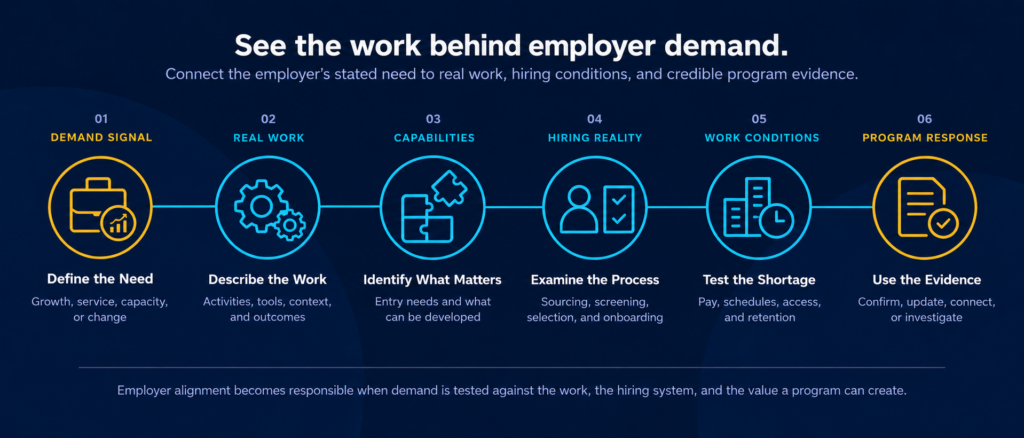
An employer needs assessment becomes useful when it connects reported demand to observable work, hiring reality, and a bounded program decision.
STEP 1
Define the demand
Identify the organizational outcome, service requirement, vacancy pattern, or future change creating the question.
STEP 2
Describe the work
Clarify the activities, responsibilities, tools, context, and performance standards behind the title.
STEP 3
Identify capabilities
Distinguish entry-level requirements from capabilities that can be developed through onboarding or experience.
STEP 4
Examine hiring reality
Review sourcing, screening, pay, scheduling, location, onboarding, retention, and other conditions shaping the shortage.
STEP 5
Test the evidence
Compare employer accounts across organizations, workers, market data, time horizons, and contradictory findings.
STEP 6
Define the program response
Clarify whether the evidence supports confirmation, updating, connection, partnership, challenge, or further investigation.
The result is not a curriculum dictated by job postings. It is an evidence-backed account of employer demand and the part of that demand the program can responsibly influence.
- Connect demand to organizational outcomes
- Translate titles into observable work
- Separate essential from conventional requirements
- Examine hiring and retention conditions
- Test patterns across evidence sources
- Define the institution’s responsible response
EMPLOYER VOICE AND WORKER VOICE
Employers understand demand. Workers understand how the work is experienced.
Employer leaders, hiring managers, supervisors, recruiters, and workers may each see a different part of the same workforce need.
Executives may understand growth plans and future strategy. Hiring teams may see applicant flow and screening constraints. Supervisors may understand performance breakdowns. Experienced workers may recognize the tacit knowledge, real activities, working conditions, and learning curve hidden behind a job description.
A credible review may include:
- Business and organizational leaders
- Hiring managers and recruiters
- Frontline supervisors
- Experienced and recent workers
- Former workers
- Industry and professional associations
- Labor representatives
- Workforce-development partners
- Regulators or licensing bodies
- Learners and graduates entering the field
The module compares these accounts, identifies where they reinforce or contradict one another, and determines what additional evidence is needed.
PROGRAM AND DECISION BOUNDARIES
Employer alignment does not mean employer control.
Education and training institutions have responsibilities that extend beyond filling current vacancies.
This module should not be presented as:
- Allowing one employer to define the program
- Treating every vacancy as evidence of a skills shortage
- Guaranteeing employment or wages
- Predicting future demand with certainty
- Equating job postings with real work
- Removing faculty judgment
- Replacing academic, regulatory, accreditation, or governance processes
- Making legal determinations about hiring requirements
- Assuming employer-stated qualifications are inherently necessary
- Redesigning curriculum around short-term demand without broader evidence
Employer demand should inform institutional mission without replacing it.
Labor, employment, accessibility, licensing, accreditation, antitrust, privacy, and other questions may require review by qualified specialists. The workshop structures evidence and decision-making; it does not substitute for those professional determinations.
What to bring into the conversation
You do not need a perfect labor-market forecast or commitments from every employer in the region.
We begin with the demand signals, relationships, and program evidence the institution already has. The workshop then helps distinguish confirmed patterns from assumptions, contradictions, missing perspectives, and questions requiring additional investigation.
Useful inputs may include:
- Labor-market and occupational projections
- Job posting analyses
- Wage and employment data
- Employer surveys
- Advisory-board notes
- Employer interview or focus-group findings
- Program partner lists
- Hiring, vacancy, and time-to-fill information
- Turnover and retention observations
- Common job descriptions
- Required and preferred qualifications
- Licensing or regulatory requirements
- Employer technology and equipment changes
- Internship, apprenticeship, clinical, or placement information
- Graduate employment and advancement evidence
- Faculty and staff observations
- Learner and graduate feedback
- Worker or labor perspectives
- Known recruiting and onboarding challenges
- Existing employer commitments
The Decision Foundation establishes the program question, affected learners and stakeholders, evidence boundary, and decision this module must support.
What this module can help clarify
What employers actually need
Connect organizational goals and service requirements to the work, activities, capabilities, and conditions behind hiring demand.
Which demand signals are credible
Distinguish durable, repeated, consequential needs from isolated vacancies, conventional language, or short-term pressure.
Where hiring friction changes the interpretation
Reveal when compensation, scheduling, location, screening, onboarding, retention, or job design may contribute to the reported shortage.
What the program should do next
Organize evidence into options to confirm, update, connect, partner, challenge, or investigate.
Final outputs depend on the modules selected and the program decision established through the workshop’s required Decision Foundation.
Where might the work lead next?
Questions institutions ask about employer demand.
An employer needs assessment examines the work, capabilities, credentials, capacity, and operating conditions organizations need from current or future workers. It connects demand to organizational outcomes, actual work, hiring practices, workplace conditions, retention, and evidence about whether the need is durable and widespread.
Labor-market demand is generally described through aggregate evidence such as employment levels, projected growth, job postings, wages, openings, and occupational trends. Employer demand adds the operational context of specific organizations, real work, technology, hiring, and performance. Strong program decisions often require both.
Job postings are useful but incomplete evidence. They may contain duplicated listings, aspirational requirements, outdated language, inflated qualifications, or descriptions that do not accurately represent the work. Compare them with employer conversations, worker perspectives, occupational data, hiring outcomes, and direct work evidence.
A talent shortage means an employer cannot access enough people under current recruiting and employment conditions. A skills gap means available people lack capabilities genuinely required for the work. A shortage may also result from compensation, scheduling, location, restrictive requirements, hiring delays, weak onboarding, turnover, or competition.
Begin with the outcome and the work rather than preferred qualifications. Ask what must be accomplished, which activities produce the outcome, where performance breaks down, which capabilities are required at entry, and what can be learned after hiring. Compare responses across roles, organizations, and evidence sources.
No. Employers provide essential evidence about work, technology, hiring, and performance, but faculty and academic leaders remain responsible for educational coherence, quality, disciplinary standards, learner development, transferability, and institutional mission.
There is no universal number. The appropriate mix depends on the program question, industry structure, geographic market, employer concentration, occupational diversity, and consequences of the decision. Include enough variation to identify repeated needs, important differences, contradictions, and dominant-employer effects.
Small employers may need broader combinations of activities and have less capacity for formal onboarding or advisory participation. Institutions can include them through associations, chambers, sector partnerships, short interviews, shared projects, facilitated groups, or intermediaries that reduce the participation burden.
Conflicting requests may mean organizations use similar titles for different work or operate in different contexts. Examine the activities behind each request. Some capabilities may form a common foundation; others may belong in specializations, electives, employer-specific training, or post-entry development.
Possibly, but concentration risk should be explicit. Examine the durability of demand, transferability of learning, employer commitments, consequences if plans change, and whether learners will gain value beyond a single organization.
Wages, scheduling, benefits, safety, stability, supervision, advancement, and other conditions affect whether learners can access and benefit from an opportunity. Employer demand should therefore be considered alongside program outcomes, learner goals, access, and community conditions.
Current workers can explain activities, tacit knowledge, workarounds, learning curves, performance expectations, and conditions that may not appear in job descriptions. Their perspective should complement employer and market evidence.
The cycle depends on how quickly work, technology, regulation, and the market are changing. Defined triggers may include technology adoption, regulatory change, declining placement, employer withdrawal, wage shifts, or new regional investment.
No. The module can improve the evidence connecting a program to demand, work, capabilities, and hiring conditions. It cannot guarantee employer decisions, economic conditions, learner outcomes, wages, or future vacancies.
Program Relevance Direction first establishes the outcome, program boundary, affected learners and stakeholders, evidence foundation, and decision. Employer Demand & Hiring Reality is selected when the institution needs to understand what employers need, how hiring actually works, and whether demand evidence is strong enough to influence the program.
LOOK BEYOND THE JOB POSTING
Turn employer demand into evidence your program can responsibly use.
Connect organizational needs to real work, capabilities, hiring practices, workplace conditions, and credible evidence—then decide what the program should do next.
Employer Demand & Hiring Reality is part of Gobekli’s configurable Program Relevance Workshop.
