
LER & TRUSTED WORKFORCE INFRASTRUCTURE WORKSHOP MODULE
Shared Governance, Funding & Operational Sustainability
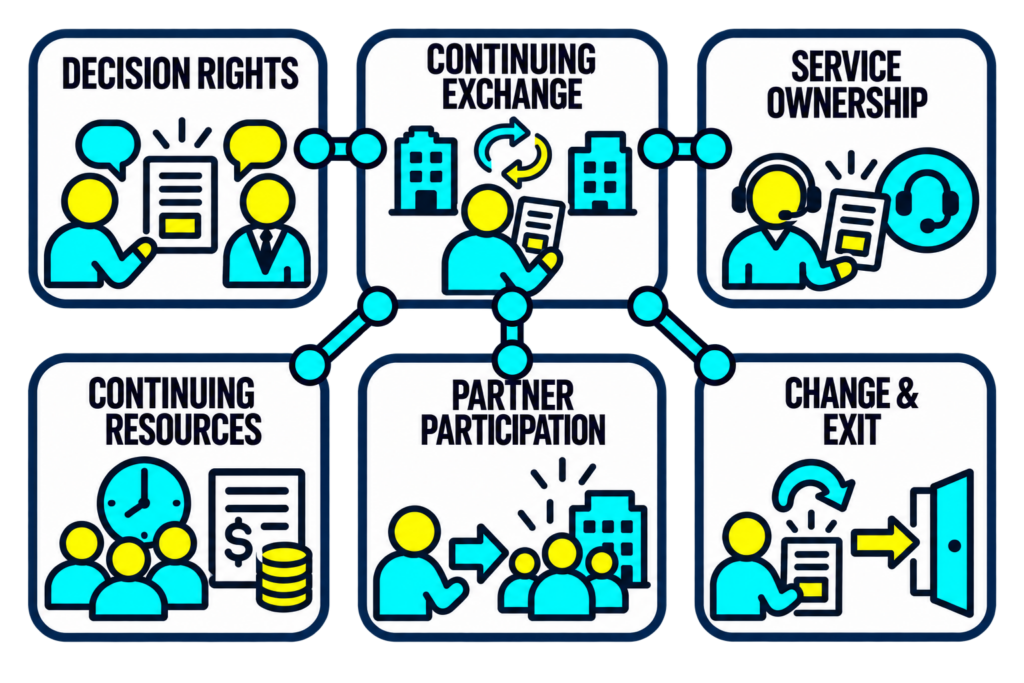
Connect decision rights, service ownership, continuing resources, support, partner onboarding, change review, and exit arrangements so the selected exchange can remain useful beyond launch.
Does this sound familiar?
The pilot has an owner, but the continuing service does not
A project team can coordinate launch while responsibility for everyday operation, partner questions, and service performance remains unsettled.
Partners participate without clear decision rights
Meetings bring people together, but it is unclear who can approve changes, commit resources, resolve disagreements, or stop an exchange that is no longer appropriate.
Funding covers implementation more clearly than operation
Initial funding supports setup and testing, while support, maintenance, onboarding, review, and eventual transition have no agreed resource plan.
A few people hold the partnership together
Essential knowledge and relationships sit with individual staff members. Their departure could leave partners unsure how to obtain help or make decisions.
Every new partner becomes a separate project
Entry requirements, responsibilities, preparation, and acceptance steps are negotiated repeatedly, making expansion slow and difficult to support.
Nobody has planned for a partner leaving
The arrangement describes joining more clearly than withdrawal, replacement, service closure, or what happens to people who still depend on their records.
What is shared governance and operational sustainability?
Shared governance defines how participating organizations make and carry out decisions about an exchange they rely on together.
Operational sustainability concerns the people, resources, responsibilities, and review needed to keep that exchange working for its intended purpose.
The two are connected. A partnership can have an active steering committee while lacking an accountable service owner. It can also have a capable operator without a legitimate route for partners to challenge priorities or approve consequential changes.
Sustaining the exchange requires an understandable relationship among authority, service delivery, funding, partner obligations, and the people affected.
This module examines those relationships for a selected exchange, using the scope established through Workforce Infrastructure Direction.
An exchange needs an operating arrangement that outlasts the project.
Launch establishes that partners can begin.
Continuing operation requires them to answer recurring questions: who responds, who decides, who pays, who updates, and who remains accountable when circumstances change?
Those answers may involve several organizations. They still need to connect into a workable arrangement.
Some responsibilities belong to an operator. Others remain with issuing organizations, receiving organizations, funding bodies, or the people presenting their records.
The workshop makes those distinctions visible and identifies where agreement or further review is needed.
The goal is a practical starting point for continuing operation that reflects the exchange’s actual purpose and dependencies.
Where sustainability depends on connected responsibilities
Decision authority
Purpose and priorities
Approval responsibilities
Partner representation
Disagreement routes
Authority to pause or stop
Service ownership
Accountable operator
Everyday responsibilities
Support coverage
Escalation routes
Operational reporting
Continuing resources
Staff time
Platform and service costs
Maintenance and review
Partner contributions
Funding assumptions
Partner lifecycle
Entry requirements
Preparation and onboarding
Continuing obligations
Change notifications
Departure and replacement
Review and continuity
Use and service evidence
Scheduled reviews
Change assessment
Staff succession
Transition or closure
These responsibilities may sit in different organizations. The important question is whether their handoffs and dependencies are understood.
What clearer arrangements can help your partnership do
Make decisions with accountable authority
Distinguish participation in a discussion from responsibility for approving, implementing, or reviewing a decision.
Expose the work that continuing operation requires
Make support, maintenance, coordination, onboarding, and review visible before they become unfunded expectations.
Bring partners into a repeatable arrangement
Define what organizations need to understand, provide, and accept when joining or changing their participation.
Respond when the arrangement needs to change
Create routes for revising scope, replacing dependencies, resolving problems, or ending an exchange responsibly.
Start with the exchange people will still depend on after launch
A sustainability discussion becomes more useful when it follows a specific service.
Choose one exchange and identify what must continue to happen for its intended benefit to remain available.
Then examine who is expected to do that work, what authority they have, and which resources are actually committed.
Example: a regional credential exchange approaches the end of pilot funding
Several training providers issue records that participating employers can review during hiring.
A regional intermediary coordinates the pilot. A technology provider operates part of the infrastructure. Each issuing organization remains responsible for its records.
The pilot budget is nearing its end, and additional providers want to join.
Partners need to decide what will continue, who will operate it, how support and onboarding will be resourced, and what happens if continuing funding is insufficient.
Questions to review together
Identify the organization accountable for coordinating operation and distinguish its responsibilities from those retained by each partner.
Examine changes to purpose, participation, service expectations, funding, and information use. Identify the appropriate approval route for each.
Review staff time, technical operation, support, maintenance, partner preparation, and periodic review, including work currently absorbed informally.
Clarify onboarding requirements, responsible contacts, preparation, acceptance, and continuing obligations.
Identify service problems, changing demand, funding changes, unresolved complaints, or partner departures that require review.
Examine notice, support, records, ongoing dependencies, transition assistance, and the responsibilities that may continue after withdrawal.
Six dimensions of a sustainable exchange
Authority
The decisions that need owners, the limits of their authority, and the route for resolving disagreement.
Accountability
The service responsibilities that must be performed and how partners know whether they are being met.
Resources
The funding, staff capacity, and other contributions needed to support the agreed scope.
Participation
The conditions for organizations to join, remain involved, change roles, or leave.
Adaptation
The evidence, review cycles, and change processes that keep the arrangement aligned with its purpose.
Continuity
The preparation needed for staff turnover, supplier changes, funding interruptions, or service closure.
When the arrangement remains informal
Partners may rely on:
- A project sponsor to make decisions outside a defined authority.
- Staff goodwill to absorb continuing support.
- Future grants that have not been secured.
- Personal relationships to resolve service problems.
- Ad hoc negotiations for every new participant.
- An assumption that current partners and providers will remain available.
These arrangements can conceal dependencies until a change makes them difficult to manage.
When the arrangement becomes explicit
Partners can identify:
- Who proposes, approves, implements, and reviews each important decision.
- Which organization owns each continuing service responsibility.
- Which resources are committed and which remain uncertain.
- How questions and unresolved problems reach the appropriate owner.
- What joining, changing participation, and leaving require.
- When to continue, adjust, reduce, pause, or close the exchange.
Making these matters explicit gives partners a basis for agreement and accountable follow-through.
A worked example: turning a pilot into an operating decision
A regional partnership wants to continue exchanging training records after a grant-funded pilot.
The initial proposal is to keep the technology running and invite more providers.
During the module, partners identify work that the proposal has not yet assigned: answering participant questions, preparing new issuers, reviewing service issues, and coordinating changes.
The intermediary has performed much of this work during the pilot, but its continuing capacity is unconfirmed.
The technology provider can describe its proposed service scope, while issuing organizations identify responsibilities they must retain for record accuracy and updates.
Partners separate governance decisions from operational tasks. A named group would review changes to the shared purpose, while an accountable service owner would coordinate everyday delivery within the agreed scope.
They also separate confirmed contributions from funding possibilities. Expansion remains conditional on resources for onboarding and support.
The group chooses a limited continuation scenario to examine before committing to wider rollout.
Its draft arrangement identifies owners, unresolved commitments, a review date, and the conditions that would require a reduced scope or transition.
The workshop produces a concrete operating decision for the responsible organizations to review and authorize.
Shared responsibility still needs identifiable owners.
A partnership may distribute work without distributing every decision equally.
Different organizations bring different authority, obligations, capabilities, and resources.
An issuer may control corrections to its records. A receiving organization may retain judgment over how it uses them. A service operator may coordinate technical support.
A shared governance arrangement should recognize these differences and clarify where coordination is necessary.
It should also identify how affected people and participating organizations can raise concerns and obtain a response.
Listing an organization as a proposed owner does not establish its commitment. Responsibilities need confirmation from the appropriate people.
Sustainability includes knowing when to change or stop.
Continuing an exchange is a decision that should remain connected to its usefulness and available resources.
A technically functioning service may no longer support a meaningful receiving use. A valuable exchange may need a smaller scope to remain supportable.
Partners need evidence that helps them distinguish those situations.
Review can examine practical use, service reliability, support demands, partner capacity, and the continuing benefit to people using the arrangement.
It should also surface unresolved dependencies and assumptions about future funding.
A responsible transition or closure may be the appropriate result when an arrangement can no longer be sustained.
WORKSHOP MODULE 12
Shared Governance, Funding & Operational Sustainability
This minicourse helps partners understand the operating decisions behind a continuing workforce exchange.
Participants examine one selected arrangement, identify gaps in authority and resources, and develop a draft response that the responsible organizations can review.
The work builds on Workforce Infrastructure Direction and can draw on findings from other selected infrastructure modules.
What this module can examine
Scope follows the selected exchange, participating organizations, available evidence, and the decisions established through Workforce Infrastructure Direction.
- The selected exchange and its continuing purpose.
- Decision categories and approval responsibilities.
- Partner representation and disagreement routes.
- Accountable service ownership.
- Operational responsibilities and support coverage.
- Staff succession and retained knowledge.
- Continuing costs and resource contributions.
- Confirmed commitments and funding assumptions.
- Partner entry and onboarding requirements.
- Change review and communication.
- Withdrawal, replacement, and exit arrangements.
- Evidence and triggers for continuation or adjustment.
Different findings call for different responses
The workshop helps partners identify a response that fits the gap they uncover.
Decision rights clarification
Define who can approve a consequential change and how affected partners participate in its review.
Service ownership agreement
Identify an accountable service owner and the responsibilities that remain with other organizations.
Continuing resource plan
Connect the proposed operating scope to staff capacity, funding, contributions, and unresolved dependencies.
Partner onboarding arrangement
Define preparation, acceptance, contacts, and continuing obligations for new participants.
Review and escalation process
Establish how service issues, changing circumstances, and unresolved disagreements reach an accountable decision.
Transition or exit plan
Clarify how partners reduce, replace, withdraw from, or close an arrangement while addressing continuing responsibilities.
A workshop response may require changes to agreements, budgets, staffing, procedures, or product configuration.
What participants learn to review
Decision categories
Distinguish routine operational decisions from changes requiring wider approval.
Ownership and handoffs
Identify who performs the work, who remains accountable, and where responsibilities connect.
Resource assumptions
Separate committed capacity from proposals, expectations, and unconfirmed future funding.
Partner readiness
Examine what joining and continuing participation require from each organization.
Change consequences
Trace how a proposed change affects people, partners, services, costs, and dependencies.
Continuing usefulness
Identify the evidence needed to judge whether the exchange should continue in its current form.
A practical exercise: build a continuing-operation brief
Follow one exchange beyond its launch date.
Participants use a selected example to develop a draft arrangement for review.
STEP 1
Define the continuing service
Describe who depends on the exchange, what it needs to provide, and the boundary of the proposed operation.
STEP 2
Map decisions and responsibilities
Identify important decisions, operational tasks, proposed owners, and responsibilities retained by partners.
STEP 3
Connect work to resources
Review costs, staff time, contributions, and uncertainties against the proposed service scope.
STEP 4
Trace the partner lifecycle
Examine joining, preparation, ongoing participation, changes, and departure.
STEP 5
Test a disruption
Consider a realistic event such as staff turnover, funding reduction, supplier replacement, or an issuing partner leaving.
STEP 6
Define the next operating decision
Record what can be proposed now, which commitments need confirmation, who must review them, and when the arrangement should be reassessed.
The result is a draft continuing-operation brief with visible owners, dependencies, and unresolved decisions.
FROM WORKSHOP FINDINGS TO A POSSIBLE GOBEKLI CONFIGURATION
Make the operating arrangement part of the implementation scope.
Workshop findings can inform a subsequent Gobekli setup by clarifying how organizational workspaces, individual record experiences, and partner connections would need to be administered and supported.
A configuration brief may identify:
- Participating organizations and their roles.
- Proposed workspace and service administrators.
- Source responsibilities and partner contacts.
- Access responsibilities and approval routes.
- Support ownership and escalation handoffs.
- Partner onboarding and acceptance requirements.
- Review responsibilities for shared information.
- Change notifications and coordination needs.
- Record access, export, and transition requirements.
- Service expectations and dependencies requiring confirmation.
TalentSync, TalentPass, and Passport Pages may form part of the proposed arrangement where their available capabilities fit the selected use case.
Specific functionality, integrations, service commitments, costs, and implementation responsibilities would be confirmed separately. The workshop provides a basis for that discussion.
WORKSHOP BOUNDARIES
A practical operating proposal needs the right commitments behind it.
This module helps partners examine an arrangement and prepare decisions.
It does not commit an organization’s resources, transfer authority, establish funding, or approve contractual terms.
The responsible organizations retain their decisions and review responsibilities. The module does not itself provide:
- A binding governance agreement.
- A confirmed funding award or continuing budget.
- A procurement decision or contract approval.
- A negotiated service-level agreement.
- A complete operating manual.
- A security or compliance certification.
- Guaranteed partner participation.
- An approved closure or records-disposition plan.
Draft responsibilities and contributions remain proposals until the appropriate organizations confirm them.
Any subsequent implementation would be scoped around agreed responsibilities, available resources, and confirmed product and service capabilities.
What to bring
Bring enough information to discuss one selected exchange and its expected continuing operation.
Incomplete information is useful when gaps are identified clearly.
Helpful inputs include:
- The scope established through Workforce Infrastructure Direction.
- A description of the current pilot or exchange.
- Participating organizations and responsible contacts.
- Existing governance or partnership arrangements.
- Current service and support responsibilities.
- Known technical and organizational dependencies.
- Available budgets or cost estimates.
- Funding periods and proposed contributions.
- Staff capacity and succession concerns.
- Partner onboarding materials.
- Service issues, usage evidence, or feedback.
- Existing change, withdrawal, or transition provisions.
Use summaries or appropriately redacted examples where detailed agreements or budgets are not suitable for group review.
What you can leave with
Decision and ownership map
A draft account of important decisions, proposed authority, service responsibilities, and partner handoffs.
Continuing resource and dependency view
An outline of operating work, required resources, confirmed contributions, and assumptions needing validation.
Partner lifecycle and continuity outline
A practical starting point for onboarding, change review, escalation, withdrawal, and transition.
Implementation and review brief
The responsibilities, configuration questions, unresolved commitments, and review triggers a subsequent implementation would need to address.
These outputs begin with the example reviewed during the module. Final scope depends on selected modules, available inputs, and the decision established through Workforce Infrastructure Direction.
Where might the work lead next?
Workforce Infrastructure Direction
Return to the required foundation when governance or resource findings change the exchange’s purpose, participants, intended benefit, or boundaries.
Security, Procurement & Integration Readiness
Connect the proposed operating arrangement to implementation reviews, technical dependencies, purchasing questions, and acceptance responsibilities.
Employer & Institutional Acceptance
Review whether receiving organizations can use the exchange in practice and whether that use supports the case for continuing operation.
The workshop can also lead to a scoped Gobekli implementation discussion once the relevant responsibilities, resources, and decisions are sufficiently clear.
Frequently asked questions
Questions organizations ask before beginning.
LER initiative sponsors, state and regional technology leaders, workforce and education partnerships, shared-service operators, and organizations responsible for sustaining an exchange across institutional boundaries.
No. The module can examine a proposed exchange before launch or an existing arrangement approaching a continuation, expansion, or funding decision.
No. Workforce Infrastructure Direction establishes the use case, intended benefit, participating organizations, and boundaries that this module uses.
The discussion benefits from people who understand service delivery, decision authority, funding, and partner obligations. Absent organizations’ responsibilities should remain proposals requiring their confirmation.
The module does not assume a particular structure. It identifies the decisions and responsibilities that need an arrangement, leaving formal organizational choices to the appropriate review.
Yes. The workshop can examine whether its mandate, representation, authority, and connection to operations fit the selected exchange.
No. It helps connect the proposed service to resource needs, existing commitments, and funding questions that responsible organizations must address.
Yes. Participants can compare proposed contributions or funding approaches against the operating scope, identifying assumptions, dependencies, and questions for further review.
Service ownership concerns accountability for operation. Governance concerns how important decisions are authorized and reviewed. The module examines how those responsibilities connect.
Security, Procurement & Integration Readiness focuses on preparation for an implementation commitment. This module focuses on the continuing authority, resources, partner arrangements, and review needed after launch.
Yes. The exercise can identify undocumented knowledge, backup responsibilities, escalation contacts, and handover needs.
Yes. Participants can define entry expectations, preparation, responsible contacts, acceptance steps, and obligations that new partners need to understand.
The module helps identify questions about notice, service dependencies, support, records, and transition. The responsible organizations must review and agree any resulting arrangements.
No. Review should allow partners to continue, change, reduce, pause, or close the arrangement based on its usefulness, responsibilities, and available resources.
No. Initial ranges, known cost categories, funding periods, and capacity estimates can support the discussion if their limitations are clear.
The workshop develops requirements that can inform a later configuration. Product availability, implementation scope, service commitments, and costs are confirmed separately.
A draft continuing-operation brief that connects decision rights, service ownership, resources, partner responsibilities, and review triggers to the selected exchange.
Build the arrangement that keeps the exchange useful.
Make continuing operation an accountable decision.
Shared Governance, Funding & Operational Sustainability helps partners identify who will decide, deliver, support, fund, and review the exchange as circumstances change.
Include this module in your LER & Trusted Workforce Infrastructure Workshop to turn those questions into a practical brief for agreement and follow-through.
