
WORKFORCE PATHWAY & SERVICE CONTINUITY WORKSHOP MODULE
Interrupted Participation & Return Routes
Make returning a clear and respectful choice. Examine what is known about a pause, what may have changed, and how current goals, preferences, support needs, and service availability can inform a workable next step.
Does this sound familiar?
A pause is treated as a lack of interest
Missed activity or an unanswered message becomes an explanation for the person’s intentions, even when the reason remains unknown.
Outreach assumes the original plan still fits
Messages ask someone to resume the same activity without checking whether their goals, circumstances, or preferences have changed.
The person wants to return but cannot find a route
A participant knows whom they worked with before but does not know whether to contact that person, reapply, or begin somewhere else.
Previous progress is difficult to carry forward
Records show earlier participation, but no one can clearly explain what remains relevant, what needs confirmation, or which steps must be repeated.
A welcome message implies unavailable support
An invitation suggests that a place, service, or arrangement is ready before the responsible organization has confirmed it.
No response leads to more messages without a decision
Outreach continues without a clear contact boundary, a way to express preferences, or a point for reviewing whether further contact is appropriate.
What are interrupted participation and return routes?
Interrupted participation describes a pause or discontinuity in a person’s involvement with a selected program, activity, or service journey.
The available record may show that participation stopped without establishing why. The person may have encountered a difficulty, changed direction, found work, chosen another service, or decided that continuing was no longer useful.
A return route explains how someone can explore participation again and what needs to be reviewed before a next step is confirmed.
That review may involve current goals, earlier progress, changed requirements, available services, and the support needed to make the proposed route workable.
This module examines one selected interruption and return process so your team can define a respectful invitation, an appropriate review, and an accountable next action.
Returning should begin with the person’s current position.
The circumstances recorded before a pause may no longer describe the person’s life.
A previous training goal may have changed. A new work schedule may affect availability. An earlier support arrangement may no longer be needed or may no longer exist.
The service may also have changed, including its staff, requirements, delivery arrangements, or capacity.
A useful return conversation makes room to understand those changes.
It distinguishes what can appropriately carry forward from what needs to be confirmed, updated, or reconsidered.
The workshop helps your team make that process understandable without assuming that resuming the original activity is the right outcome for everyone.
What needs to connect?
The interruption
What activity paused
When participation changed
What the participant reported
What remains unknown
What the record can establish
Contact and preferences
Whether contact is appropriate
Which channel is suitable
What the message offers
How preferences can be expressed
When outreach should be reviewed
Current direction
What the person wants now
What has changed
What earlier progress still means
Which options merit discussion
Whether returning is useful
Return conditions
What remains available
Which requirements need review
What can carry forward
What needs updating
What assistance is needed
Continuing responsibility
Who receives the inquiry
Who confirms the next step
Who coordinates support
Who follows up
What happens if the route changes
A pause, a stated reason, a wish to return, and a confirmed return arrangement are different pieces of information.
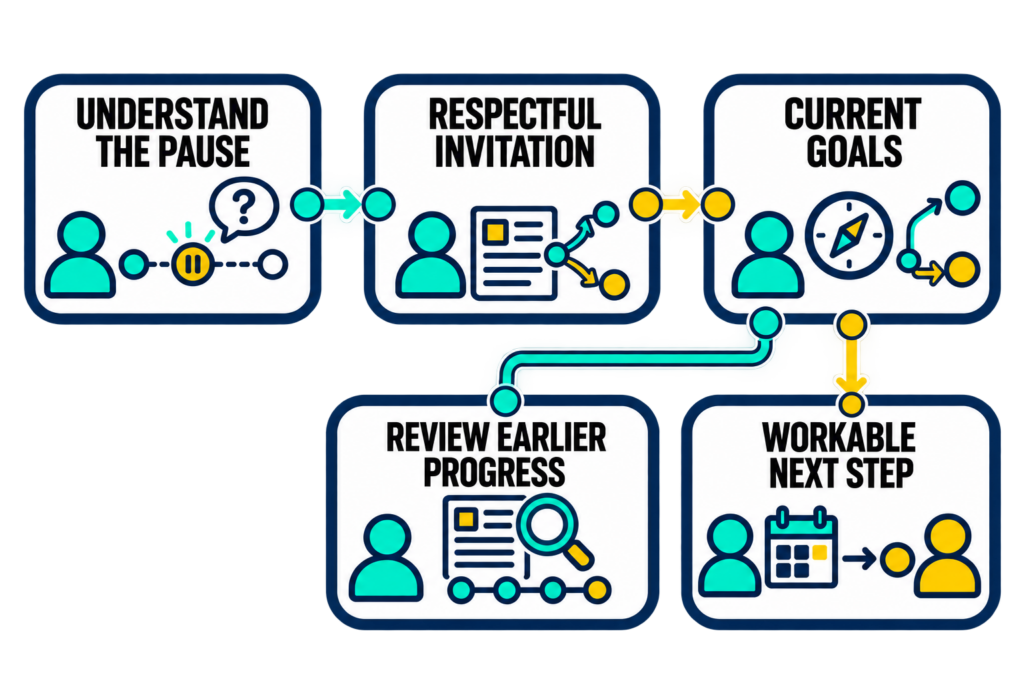
Four moves toward a respectful return route
1. Understand what is known about the pause
Review the selected interruption, available participant input, and assumptions that should remain unresolved until confirmed.
2. Define an appropriate invitation
Clarify whether and how to make contact, what the invitation can honestly offer, and how the person can express a preference.
3. Reconsider the route together
Review current goals, earlier progress, changed conditions, available options, and any support needed.
4. Confirm the next action
Identify the responsible person, outstanding decisions, follow-up arrangement, and what happens if the participant chooses another direction.
Start with one route back that is unclear.
The module begins with a selected example, such as a participant contacting a program after an absence or an organization reviewing how it invites former participants to reconnect.
Your team brings the relevant messages, return instructions, available records, and staff responsibilities.
Together, we examine whether the person can understand their options and whether the organization can support the next step it proposes.
Questions we examine together
Distinguish observed activity, participant-reported reasons, staff interpretations, and information that remains unknown.
Review the purpose, contact preferences, available permissions, and boundaries of the proposed outreach. Avoid implying that services or places are already confirmed.
Identify the current goals, circumstances, interests, and availability that matter to a return conversation.
Examine relevant records and evidence while identifying what the responsible program needs to confirm before relying on them.
Clarify current requirements, service availability, timing, and assistance needs rather than assuming the previous arrangement can resume.
Define the receiving contact, review responsibilities, next action, and follow-up for the selected route.
Six dimensions of a workable return route
Interpretation discipline
A pause is described without inventing a reason or treating silence as a complete account of the person’s intentions.
Respectful contact
The invitation has a clear purpose, suitable channel, and appropriate way to express preferences.
Current direction
The conversation begins with what the participant wants and can consider now.
Progress continuity
Relevant earlier work is reviewed so the person can understand what carries forward and what needs confirmation.
Confirmed conditions
Requirements, availability, timing, and support are checked before a return arrangement is presented as settled.
Accountable next action
The person knows whom to contact, what happens next, and who will help resolve outstanding questions.
When return means restarting the old plan
The process may assume that the earlier route remains appropriate.
- An inactive status is treated as a reason for the pause.
- Outreach asks for a return without acknowledging that circumstances may have changed.
- The person cannot express a different preference easily.
- Earlier progress is either ignored or assumed to remain fully valid.
- Service availability is implied before it is checked.
- Success is defined only as resuming the original activity.
The participant may receive an invitation without a useful opportunity to reconsider the route.
When return begins with a current conversation
A clearer approach helps the person and supporting team make an informed decision.
- Known facts and unresolved reasons remain distinct.
- Contact explains its purpose and offers a manageable next step.
- The participant can express current goals and preferences.
- Earlier progress receives an appropriate review.
- Requirements and arrangements are confirmed by their owners.
- The next action may involve returning, exploring another route, or choosing not to continue.
The team can then support the decision without overstating what the invitation or response establishes.
Example: A participant returns with a different schedule
A participant pauses a training program after their work schedule changes.
Several months later, the organization sends a message inviting them to resume.
The message refers to the original program but does not explain whether the schedule, entry requirements, or support arrangements have changed.
The participant is interested, yet now works different hours and wants to understand whether earlier completed activities can count toward a return.
In the workshop, the team selects the route from that first response to an informed return decision.
The review identifies a need for a conversation about current goals and availability before proposing the original schedule.
It also identifies which program owner can confirm how earlier progress will be treated and what remains available.
The proposed improvement offers a named contact, explains what the conversation will cover, and identifies the questions that must be resolved before a place or start date can be confirmed.
The participant and advisor review the confirmed options together and agree on a next action that fits the person’s current circumstances.
The team tests whether the revised route supports understanding and an accountable decision. It does not assume that the participant should return to the original program or that earlier participation guarantees a place.
The reason for a pause may remain unknown.
A record can show that attendance stopped or messages went unanswered.
That information does not necessarily explain what happened.
The participant may choose to share a reason, but the return process should not depend on collecting an exhaustive account of their personal circumstances.
The team needs enough relevant context to understand the current decision and offer appropriate support.
Where a reason is unknown, the record should preserve that uncertainty rather than replace it with an assumption.
The workshop helps define which questions are useful and how to avoid turning a pause into a lasting judgment about the person.
Earlier progress deserves review before repetition.
Returning participants may have completed activities, gathered evidence, or resolved questions that remain relevant.
They should be able to understand how that progress will be considered.
The responsible program may need to check changes in requirements, the currency of evidence, or the conditions under which earlier work was completed.
Some steps may carry forward. Others may need updating or further review.
The workshop does not make those determinations on the program’s behalf. It identifies who can decide and how the explanation reaches the participant.
That clarity helps distinguish necessary preparation from repetition caused by missing information or an unclear process.
WORKSHOP MODULE
Interrupted Participation & Return Routes
This module is a practical minicourse in understanding participation pauses and creating respectful routes to reconsider involvement.
Your team learns a repeatable method, applies it to one selected return process, and develops a focused improvement with an owner and a way to test it.
The work also identifies the contact preferences, current context, previous progress, program decisions, and follow-up responsibilities that a subsequent Gobekli configuration would need to support.
What can this module help clarify?
Scope is established through Workforce Pathway Direction and narrowed to an interruption and return question your team can meaningfully examine.
- The participant population and selected activity.
- What the record shows about the interruption.
- Reasons the participant has shared and what remains unknown.
- Whether contact is appropriate for the selected purpose.
- Suitable contact channels and preference choices.
- What the invitation can offer without overpromising.
- The participant’s current goals and circumstances.
- Relevant earlier progress and evidence.
- Requirements or arrangements that may have changed.
- Decisions needed to confirm a return option.
- Staff responsibilities and support connections.
- Follow-up, closure, and review of further contact.
What kinds of responses might follow?
The selected example may point to changes in outreach, review, information continuity, or support.
A more respectful invitation
Explain the purpose of contact, acknowledge that circumstances may have changed, and offer an understandable next step.
A current-goals conversation
Give the participant space to discuss what matters now before proposing a return arrangement.
A review of earlier progress
Identify what may carry forward, what needs confirmation, and who can make that determination.
Clearer return instructions
Explain the contact route, relevant questions, requirements, and decisions involved.
A confirmed support arrangement
Connect the proposed return step to the assistance and responsible partners needed to make it workable.
An appropriate contact boundary
Define how preferences, unanswered messages, and decisions not to continue affect further outreach.
The workshop may identify operating changes that should happen before any product configuration is introduced.
What will we review?
The selected interruption
What activity paused and what the available evidence can establish.
The contact approach
Messages, channels, preferences, and the purpose of outreach.
The return conversation
How current goals, circumstances, and options are discussed.
The earlier progress
Records or evidence relevant to deciding what can carry forward.
The return conditions
Requirements, availability, timing, support, and decisions needing confirmation.
The follow-up process
Ownership of the next action and the boundaries around continued contact.
The workshop exercise
Your team works through one selected return route using the materials and responsibilities available.
STEP 1
Select the interruption
Define the activity, participant population, and beginning and end of the review.
STEP 2
Separate facts from assumptions
Identify what is recorded, what the participant has reported, and what remains unknown.
STEP 3
Examine the invitation
Review the purpose, channel, wording, preferences, and next step offered.
STEP 4
Reconsider the route
Connect current goals and circumstances to earlier progress, available options, and questions requiring confirmation.
STEP 5
Assign the next responsibilities
Name who reviews requirements, confirms arrangements, coordinates support, and responds to the participant.
STEP 6
Define the review and contact boundary
Agree on how to check understanding, follow up on outstanding actions, and respect the participant’s decision about further contact.
A Participant Return Route Map, one assigned improvement, and a validation plan that can also inform an initial product configuration brief.
FROM WORKSHOP INSIGHT TO A POSSIBLE GOBEKLI SETUP
Connect previous progress to a current decision.
The workshop defines how the selected return process should work before deciding how technology should support it.
Depending on confirmed capabilities and implementation scope, a future setup could explore TalentPass for participant-held context and progress, Pythia-guided preparation for a return conversation, and TalentSync or Passport Pages for appropriate organizational coordination.
The configuration brief identifies what should remain visible, what needs updating, and which decisions belong to the participant or responsible program.
- The selected participant population and return situation.
- The activity history relevant to the conversation.
- The distinction between recorded facts and inferred reasons.
- Contact preferences and appropriate sharing boundaries.
- The participant’s current goals and circumstances.
- Earlier progress and the context supporting it.
- Requirements or arrangements needing review.
- Confirmed options and unresolved availability.
- Staff and partner responsibilities for the next step.
- Follow-up, contact boundaries, and review triggers.
Any implementation would require confirmation of product availability, permissions, integrations, and operating responsibilities.
A Gobekli setup would support an understandable return process. It would not infer a person’s intentions from inactivity or guarantee renewed eligibility, a place, or continued participation.
SCOPE & RESPONSIBILITY
What this module does—and what it does not decide
This module helps your team examine one interrupted participation and return process.
It connects respectful contact, current goals, earlier progress, and confirmed arrangements to an accountable next step.
Participants and responsible organizations retain their respective choices and decision authority.
- The workshop does not assume why a person paused.
- It does not require disclosure of a complete personal history.
- It does not treat nonresponse as consent to continued outreach.
- It does not guarantee renewed eligibility, funding, or availability.
- It does not decide whether earlier work satisfies current program requirements.
- It does not require the participant to resume the original route.
- It does not commit absent partners to provide support.
- It does not treat returning as proof of a later learning or employment outcome.
Questions requiring a program decision or partner confirmation are assigned to the appropriate owner.
The output distinguishes a possible return route from a confirmed arrangement and preserves the person’s choice about whether to proceed.
What should you bring?
Bring one selected interruption and the process currently used when someone reconnects or is invited to return.
A de-identified example can reveal useful gaps without requiring a detailed explanation of why a particular person stopped participating.
Useful inputs
- The selected activity and participant population.
- The relevant participation history.
- Any appropriate participant-reported context.
- Current return invitations or outreach messages.
- Contact preference and outreach practices.
- Instructions for participants seeking to reconnect.
- Relevant records of earlier progress.
- Program requirements needing review.
- Known changes in schedules or availability.
- Staff and partner responsibilities.
- Support arrangements associated with returning.
- Existing follow-up and closure practices.
Bring the context needed to examine the selected route. Record missing information as a question rather than filling it with assumptions.
What can you leave with?
Participant Return Route Map
A shared account connecting the interruption, appropriate contact, current goals, earlier progress, return conditions, and next responsibilities.
Assigned Return Improvement
A focused change to outreach, review, instructions, support, or follow-up, with an owner and next action.
Validation Plan
A way to check whether the invitation is understandable, preferences are respected, options are confirmed, and the next step has an owner.
Initial Configuration Brief
The contact preferences, source context, progress records, decision responsibilities, and review requirements a subsequent Gobekli implementation would need to support.
These outputs begin with the example reviewed during the module. Final scope depends on the modules selected, available inputs, and the decision established through Workforce Pathway Direction.
Where might the work lead next?
Participant Goals & Pathway Planning
When the person’s direction or circumstances have changed, connect current priorities to a revised sequence of activities, support, and milestones.
Eligibility & Enrollment Handoffs
When returning requires a new program review, clarify requirements, documentation, authorized decisions, and enrollment steps.
Support Barriers & Coordinated Assistance
When practical, informational, or accessibility conditions affect the proposed return, examine the assistance and coordination needed.
These modules can be combined within the Workforce Pathway & Service Continuity Workshop according to the selected journey and organizational decision.
Frequently asked questions
Questions organizations ask before beginning.
Workforce programs, public agencies, training providers, community organizations, and service partnerships that support people whose participation has paused. Useful contributors understand outreach, return arrangements, or the decisions required to resume services.
Yes. The foundation establishes the participant population, selected journey, organizational decision, evidence, responsibilities, and boundaries that guide this module.
Not necessarily. A record may show interrupted activity without explaining the person’s intentions or circumstances. The workshop keeps those distinctions visible.
Yes. A participant-initiated return is a useful example for examining the receiving contact, current-goals conversation, and decisions needed for a next step.
The module can examine a selected invitation and the return process behind it. It does not default to designing a broad campaign or increasing message volume.
That uncertainty can remain explicit. The process should ask only what is relevant to understanding the current situation and supporting an appropriate decision.
The return conversation should make room for that change. A different activity, service, or decision not to continue may be appropriate.
The contact approach should define an appropriate review point and boundary for further outreach. Nonresponse should not be treated as a complete explanation of the person’s intentions.
The process should identify how that preference is recorded and acted on by the responsible team, including any relevant organizational requirements that need clarification.
Potentially. The responsible program needs to determine what remains relevant and whether any requirements or evidence need updating. The workshop clarifies that review route.
The invitation and conversation should make that limitation clear. The team can explore another option without presenting it as confirmed until the responsible service responds.
That depends on the program and situation. The module identifies the question and the authorized owner rather than assuming that previous participation establishes current eligibility.
The planning module connects goals to a workable route. This module examines the interruption, contact, review, and confirmation needed when someone considers participation again.
The support module examines assistance needed for a selected activity. This module considers whether and how to return, including changed goals, previous progress, contact preferences, and current availability.
The validation plan can examine whether participants understand the invitation, can express preferences, receive accurate information about options, and have a clear next action. Returning to the original program is not the only possible useful result.
No. The return route map, assigned improvement, and validation plan should be useful independently. They can also establish a clearer starting point for a later configuration.
A reviewed return example, a Participant Return Route Map, one assigned improvement, and a validation plan. Broader outreach or implementation follows the agreed scope and responsible decisions.
MAKE ROOM FOR A DIFFERENT NEXT STEP
Offer a route back that starts with where the person is now.
A useful return process recognizes earlier progress while making room for changed goals, circumstances, and choices.
Use Interrupted Participation & Return Routes within the Workforce Pathway & Service Continuity Workshop to examine one route back and define a practical improvement your team can take forward.
