- Home
- /
- Workshops
- /
- WORKFORCE PATHWAY & SERVICE CONTINUITY WORKSHOP Module
- /
- Eligibility & Enrollment Handoffs
Eligibility & Enrollment Handoffs
WORKFORCE PATHWAY & SERVICE CONTINUITY WORKSHOP MODULE
Eligibility & Enrollment Handoffs
Help people understand what is needed to enter a program and who can help them move forward. Clarify requirements, documentation, decision responsibilities, and enrollment handoffs so participants receive a clear next step through each transition.
Does this sound familiar?
A referral sounds like an approval
A participant is encouraged to pursue a program without understanding which requirements still need review or who will make the decision.
Document requests arrive in pieces
Someone submits what they were asked for, then receives another request without a clear explanation of what remains or why it is needed.
Different programs give different answers
Staff use different instructions, interpretations, or versions of requirements, leaving participants unsure which guidance applies.
No one owns the transition
The referring team believes its work is complete while the receiving program is waiting for an action the participant did not understand.
A status does not explain the next step
“Pending,” “incomplete,” or “not enrolled” appears in a system without showing what needs attention, who can help, or when to check again.
Eligibility does not lead directly to enrollment
A participant receives an eligibility decision but still needs a place, appointment, orientation, or other confirmed step before participation can begin.
What are eligibility and enrollment handoffs?
Eligibility and enrollment handoffs are the transitions through which a person learns about program requirements, provides relevant information, receives an authorized decision, and completes the steps needed to enter a service.
These transitions may involve the participant, an advisor, an intake team, a program administrator, and staff from another organization. Each may hold a different part of the information needed to move forward.
A useful handoff makes those responsibilities understandable. It explains what has happened, what remains unresolved, who is responsible for the next action, and where the participant can receive help.
It also distinguishes guidance from a decision. An initial conversation may identify a possible fit without establishing eligibility, and an eligibility decision may leave additional enrollment steps outstanding.
This module examines one selected transition so your team can identify where requirements, documentation, responsibilities, or next steps need to become clearer.
People need a clear route through the decision.
A person may understand why a program could help and still be unsure how to enter it.
They may receive instructions from several organizations, each explaining only its own part of the process. The participant is then left to work out how those parts connect.
Staff may face similar uncertainty. A referring advisor may not know which information the receiving program needs, what it can accept, or when responsibility changes hands.
The problem becomes harder to resolve when a status is treated as a complete explanation. “Awaiting documentation” does not tell someone which item is outstanding or how to get help with it.
A clearer route connects requirements, evidence requests, decision ownership, and enrollment actions to an understandable next step.
The workshop begins with the transition your organization can influence and identifies the partner decisions needed to improve the rest.
Where can the transition become unclear?
Requirements
Which program applies
Which requirements apply
Where guidance comes from
When guidance was reviewed
Who maintains it
Documentation
What is requested
Why it is needed
What the program accepts
What remains outstanding
Where questions go
Decision responsibility
Who reviews information
Who can make the decision
Who resolves uncertainty
How the result is explained
What happens after the result
Enrollment
What follows a decision
Whether a place is available
What must be completed
When participation can begin
Who confirms enrollment
Handoff support
Who introduces the next step
Who receives the handoff
How receipt is acknowledged
Who helps if progress stalls
When follow-up happens
The workshop selects the parts of this landscape that affect the transition under review. It does not assume every program uses the same requirements or decision process.
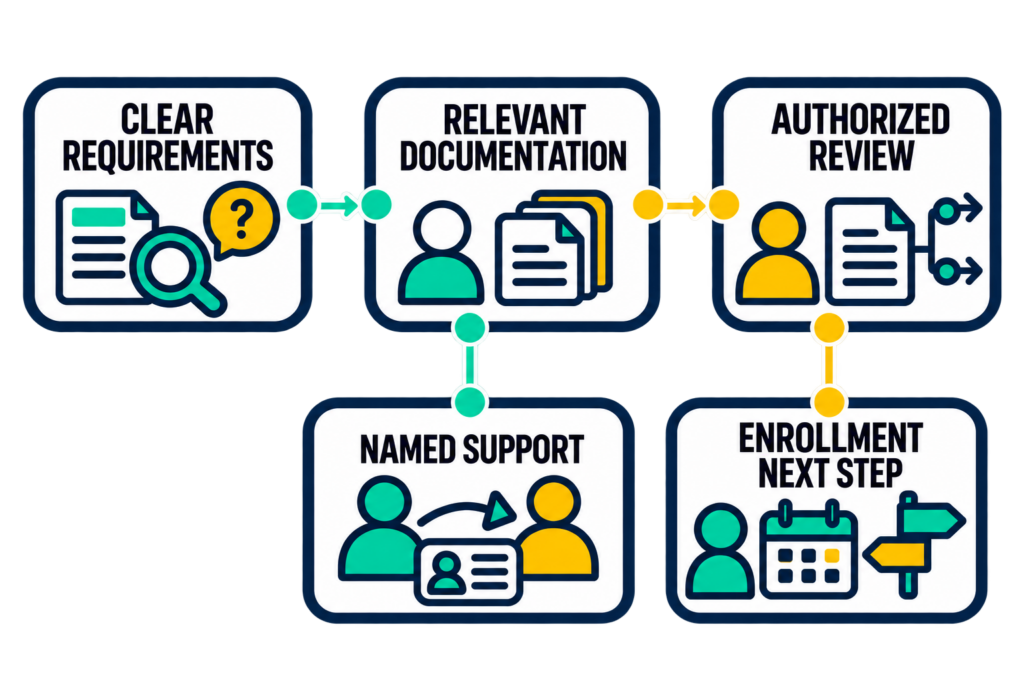
Four moves toward a clearer transition
1. Establish the applicable requirements
Identify the program, participant situation, authoritative sources, and questions that need confirmation from the responsible organization.
2. Explain the information needed
Connect each request to its purpose, the receiving program’s expectations, and an appropriate route for questions or assistance.
3. Assign the decision and handoff
Clarify who reviews, who decides, who explains the result, and who supports the participant through the next transition.
4. Confirm the next enrollment action
Make the next step, responsible person, outstanding dependency, and follow-up point understandable to everyone involved.
Start with one real enrollment transition.
The module begins with a selected transition into a program or between two services. Your team brings the instructions, requests, status messages, and responsibilities that shape that experience.
Together, we examine how a participant would understand the process and how staff would know what to do next.
A de-identified example can reveal useful gaps without requiring the workshop to review a person’s full case file or make an eligibility decision.
Questions we examine together
Identify the selected program and relevant requirements, including their source, owner, and any interpretation that needs confirmation.
Review the documentation requests and explanations participants receive. Identify unclear purposes, inconsistent instructions, and questions about what the receiving program accepts.
Distinguish staff who provide guidance, staff who review information, and the person or organization authorized to determine the outcome.
Examine whether the status communicates what has happened, what remains, and which action is expected from the participant or staff.
Review the introduction, transfer of appropriate context, acknowledgment, and follow-up needed to make the handoff accountable.
Clarify the next route for enrollment, clarification, an available review process, or exploration of another suitable option.
Six dimensions of an understandable enrollment handoff
Requirement clarity
The participant and supporting staff can identify the requirements relevant to the selected program and where questions should be resolved.
Documentation clarity
Requests explain what is needed, its purpose, and where to ask about accepted evidence or difficulties obtaining it.
Decision ownership
The process makes clear who provides guidance, who reviews information, and who has authority to decide.
Status meaning
A status connects to an explanation, an outstanding action, and a responsible person.
Transition accountability
The sending and receiving teams understand the handoff and how to confirm that the next step has been received.
Participant support
The person has an understandable route for help when instructions, documentation, timing, or next steps become difficult.
When the transition leaves people guessing
A process can contain the necessary forms and still leave important questions unanswered.
- Program guidance has no clear source or review date.
- Participants cannot distinguish an initial indication from a decision.
- Documentation requests do not explain what remains outstanding.
- Staff cannot tell who owns an unresolved question.
- A handoff has no acknowledgment or follow-up point.
- An eligibility decision is recorded without a clear enrollment action.
These gaps make it difficult to identify whether the next improvement belongs in the instructions, staff responsibilities, partner agreement, or supporting system.
When the transition supports action
A clearer process gives participants and staff enough context to understand what should happen next.
- Requirements point to a responsible source.
- Preliminary guidance is clearly identified.
- Information requests include a useful explanation.
- Decisions remain with the authorized person or organization.
- Handoffs identify the receiving contact and follow-up responsibility.
- Enrollment steps remain visible after the eligibility decision.
The team can then test whether people understand the process and whether the proposed responsibilities work in practice.
Example: A training referral with an unfinished enrollment route
A participant meets with an advisor to explore a training program.
The advisor believes the program may be a useful option and directs the participant to its enrollment team.
The participant understands the referral as confirmation that they can begin. The receiving program still needs to review its requirements and the information supporting the application.
The program requests additional documentation. The participant is unsure why an item is needed and asks the original advisor for help.
The advisor does not know what the receiving program will accept. The application remains pending while each team assumes the other is supporting the next step.
In the workshop, the team maps the transition from the initial conversation through the enrollment decision and preparation to begin.
The review separates the advisor’s initial guidance from the program’s authorized determination. It also identifies the documentation question that must return to the receiving program.
The proposed improvement introduces a clear handoff summary: the purpose of the referral, what has been explained, what remains to be reviewed, and who can answer the outstanding question.
The receiving program confirms its requirements and the next action. A named staff member follows up if the participant has not received an understandable response.
The team tests whether the revised process improves understanding and handoff completion. It does not assume that the participant will qualify, obtain a place, or begin on a particular date.
Eligibility and enrollment need separate explanations.
Different programs may use different terms and sequences. The workshop makes the selected process explicit.
Initial guidance may help a person decide whether to apply. It should explain which questions remain open.
An application may be received while information is still outstanding. The participant needs to understand what is missing and where to get help.
An eligibility decision may establish that certain requirements have been met while leaving other enrollment actions unresolved.
Those actions might involve confirming availability, accepting a place, attending orientation, or completing another program-specific step.
The team identifies the actual stages and responsibilities for its example, then checks the explanation with the organization that owns the process.
Shared support does not create shared decision authority.
Several organizations may help a participant move through the same transition.
That support can include explaining the route, helping the person understand a request, or connecting them with the appropriate staff member.
The organization responsible for a requirement still needs to confirm how it applies and what evidence it accepts.
A workshop can identify uncertainty and propose a better route for resolving it. It cannot assign authority to a partner that has not agreed to take responsibility.
The resulting plan separates changes the participating team can make from questions or commitments that require partner confirmation.
This keeps the improvement useful while making its dependencies visible.
WORKSHOP MODULE
Eligibility & Enrollment Handoffs
This module is a practical minicourse in examining how people move through requirements, documentation, decisions, and enrollment transitions.
Your team learns a repeatable method, applies it to one selected example, and develops a focused improvement with responsibilities and a way to test it.
The work also identifies the information, status meanings, permissions, and handoff arrangements that a subsequent Gobekli configuration would need to support.
What can this module help clarify?
Scope is established through Workforce Pathway Direction and narrowed to a transition your team can meaningfully examine.
- The participant population and selected program.
- The purpose and boundaries of the enrollment transition.
- The requirements relevant to the example.
- The sources and owners of those requirements.
- The information requested and its purpose.
- Questions about accepted documentation or available help.
- The distinction between preliminary guidance and a decision.
- The people authorized to review and decide.
- The meaning of each relevant status.
- The responsibilities of sending and receiving teams.
- The actions needed after a decision.
- The follow-up route when the transition remains unresolved.
What kinds of responses might follow?
The appropriate response depends on what the example reveals.
Clearer participant instructions
Revise the explanation of requirements, documentation, responsibilities, and next steps for the selected transition.
A reviewed requirements guide
Identify the authoritative source, responsible owner, review point, and route for resolving uncertain guidance.
A documentation support route
Clarify who answers questions about requested information and how participants can seek appropriate assistance.
An accountable handoff
Define the introduction, receiving contact, acknowledgment, outstanding action, and follow-up responsibility.
More useful status explanations
Connect status labels to what has happened, what remains, and who should act next.
A focused configuration pilot
Test whether a bounded Gobekli setup can support the agreed information, permissions, and staff workflow.
The workshop may identify operational changes that should happen before any product configuration is introduced.
What will we review?
Participant-facing instructions
The explanations, forms, messages, and next-step guidance someone receives.
Requirement sources
The materials and responsible owners staff rely on when describing the program.
Documentation requests
What is requested, how it is explained, and where uncertainty or assistance needs arise.
Decision responsibilities
Who provides guidance, reviews information, determines the result, and communicates it.
Handoff arrangements
How the transition is introduced, received, acknowledged, and followed up.
Enrollment actions
The steps and dependencies that remain before participation can begin.
The workshop exercise
Your team works through one selected example using the materials and responsibilities available.
STEP 1
Select the transition
Define the participant situation, sending and receiving services, and the beginning and end of the review.
STEP 2
Trace the requirements
Identify the applicable guidance, its source, and the questions requiring confirmation.
STEP 3
Follow the information requests
Examine what the participant is asked to provide, what the request means, and where help is available.
STEP 4
Map decisions and handoffs
Assign the review, decision, explanation, acknowledgment, and follow-up responsibilities.
STEP 5
Improve one unresolved step
Choose a concrete change that the participating team can own or take to the responsible partner for agreement.
STEP 6
Define the test
Specify how the team will check participant understanding, staff usability, handoff completion, and remaining dependencies.
A reviewed enrollment transition map, one assigned improvement, and a validation plan that can also inform an initial product configuration brief.
FROM WORKSHOP INSIGHT TO A POSSIBLE GOBEKLI SETUP
Configure support around a clear process.
The workshop defines what the selected transition needs before deciding how technology should support it.
Depending on confirmed capabilities and implementation scope, a future setup could explore TalentPass for participant-held context, Pythia-guided explanations, and TalentSync or Passport Pages for appropriate organizational coordination.
The configuration brief would identify which information belongs with the participant, which remains in the program’s authoritative system, and what supporting staff need to understand.
- The selected participant and program context.
- The sources used to explain requirements.
- The owners responsible for reviewing those sources.
- The distinction between preliminary guidance and official decisions.
- The information requested for the selected transition.
- The relevant source and review context for that information.
- The meanings of status labels and outstanding actions.
- The staff roles and partner responsibilities involved.
- The permissions and boundaries for sharing information.
- The follow-up and correction routes the process needs.
Any implementation would require confirmation of product availability, integrations, partner participation, and operating responsibilities.
A Gobekli setup would support the agreed process. It would not itself establish eligibility or replace the organization’s authorized decision process.
SCOPE & RESPONSIBILITY
What this module does—and what it does not decide
This module helps your team understand and improve a selected enrollment transition.
It makes requirements, documentation questions, decision ownership, and handoff responsibilities more explicit.
Program owners remain responsible for confirming their requirements, determining outcomes, and approving changes within their authority.
- The workshop does not determine an individual’s eligibility.
- It does not interpret unresolved program rules on behalf of the responsible organization.
- It does not guarantee enrollment, funding, placement, or service availability.
- It does not establish that one program must accept another program’s documentation.
- It does not authorize access to participant information.
- It does not require a complete participant case file for the exercise.
- It does not commit absent partners to new responsibilities.
- It does not replace an existing system of record or official decision process.
Where a question requires an authorized interpretation or decision, the output identifies who needs to resolve it.
The team distinguishes confirmed arrangements from proposals and outstanding dependencies.
What should you bring?
Bring enough material to make one transition concrete. A de-identified example and the instructions used by participating staff are usually a useful starting point.
The foundation module establishes which materials are appropriate to include and which responsibilities need representation.
Useful inputs
- A selected program and participant situation.
- A description of the transition to be reviewed.
- Current participant-facing instructions.
- Relevant requirement sources.
- Example documentation requests.
- A list of known questions or points of confusion.
- The roles involved in reviewing information.
- The roles authorized to make decisions.
- Examples of status messages.
- Existing handoff or referral instructions.
- The steps required to complete enrollment.
- Known partner dependencies or unresolved responsibilities.
Use only the information appropriate for the exercise. Missing materials can be recorded as questions for follow-up.
What can you leave with?
Enrollment Transition Map
A shared account of requirements, information requests, decision points, enrollment actions, and the responsibilities connecting them.
Assigned Handoff Improvement
A focused change with an owner, the necessary partner confirmations, and a clear next action.
Validation Plan
A way to check whether participants understand the transition, staff can support it, and the handoff reaches the intended next step.
Initial Configuration Brief
The information, source responsibilities, permissions, status meanings, and staff workflows a subsequent Gobekli implementation would need to support.
These outputs begin with the example reviewed during the module. Final scope depends on the modules selected, available inputs, and the decision established through Workforce Pathway Direction.
Where might the work lead next?
Repeated Intake & Participant Story Continuity
When documentation questions reveal repeated requests for the same context, examine what can appropriately be reused, confirmed, updated, or shared.
Referrals & Follow-Through
When the main gap is whether an introduction reaches a receiving service and leads to an accountable next step, examine the broader referral process.
Support Barriers & Coordinated Assistance
When the route is clear but practical, informational, or accessibility barriers make it difficult to complete, examine the assistance and coordination needed.
These modules can be combined within the Workforce Pathway & Service Continuity Workshop according to the selected journey and organizational decision.
Frequently asked questions
Questions organizations ask before beginning.
Workforce programs, public agencies, community organizations, training providers, and service partnerships that help people enter programs or move between them. The most useful participants understand the selected transition or hold responsibility for improving it.
Yes. The foundation establishes the participant population, selected journey, organizational decision, evidence, responsibilities, and boundaries that guide this module.
No. It examines how requirements and decisions are explained and supported. Individual determinations remain with the authorized organization.
Yes. One program can provide a useful example, particularly where several staff roles or teams contribute to its enrollment process.
Yes. The workshop can map the transition and identify improvements. Responsibilities or changes involving another organization need confirmation from that organization.
The exercise makes those differences visible and identifies their sources. It does not assume that requirements or accepted documentation should be identical.
That is not the default outcome. The module first clarifies the selected process and its responsibilities. Any later system work would need a separately agreed scope.
A de-identified example is often sufficient. Bring only the information appropriate to the review and the boundaries established in the foundation module.
The team examines how the person can ask for help and who can clarify the program’s accepted options. The workshop does not invent substitutes or assume another form of evidence will be accepted.
That module focuses on information people repeatedly explain or document. This module focuses on requirements, authorized decisions, and the steps through which enrollment moves forward.
The referral module examines introductions, receipt, acknowledgment, and subsequent action across services. This module examines the requirements and decision responsibilities within a selected enrollment transition.
The review separates the eligibility result from remaining enrollment dependencies, such as availability or required preparation. The output identifies who can explain the next route.
Yes. The team can define what a status should communicate, including its source, outstanding action, responsible person, and follow-up point.
The team can examine its own part of the transition and prepare focused questions or proposals. Unconfirmed partner responsibilities remain identified as dependencies.
No. The process map and improvement plan should be useful on their own. A subsequent Gobekli setup is an optional implementation path.
The validation plan can examine whether participants understand the next step, staff know their responsibilities, receiving teams acknowledge handoffs, and unresolved actions become easier to identify. Measures are selected for the example.
Yes. It often connects with repeated intake, referrals, participant pathway planning, or support barriers. The foundation helps select the combination needed for the journey under review.
BUILD A CLEARER ROUTE INTO SUPPORT
Help people understand what comes next.
An enrollment transition should make requirements, responsibilities, and the next action understandable to the people moving through it.
Use Eligibility & Enrollment Handoffs within the Workforce Pathway & Service Continuity Workshop to examine one transition and define a practical improvement your team can take forward.