
WORKFORCE SCALABILITY PROBLEM
Key Person Risk: Protect the Work Before One Person Becomes a Single Point of Failure
Critical work often depends on knowledge, relationships, judgment, access, and informal practices held by only one or two people.
The organization may not recognize the dependency until someone leaves, takes an extended absence, changes roles, becomes overloaded, or is simply unavailable when something goes wrong.
Critical Knowledge & Role Coverage helps leaders see where work is fragile and determine what continuity actually requires.
Workshop Module 4 — Critical Knowledge & Role Coverage
Does this sound familiar?
Only one person knows how the work really happens
The documented process omits the exceptions, decisions, relationships, and workarounds required to keep it operating.
A named backup is not actually prepared
Someone appears on the coverage list but lacks the knowledge, access, experience, authority, or time to take over.
Critical relationships belong to individuals
Customers, vendors, partners, regulators, and internal stakeholders rely on connections that have not been transferred or shared.
Experienced employees carry undocumented knowledge
Important context lives in memory, personal files, inboxes, conversations, and habits rather than accessible systems.
Departure reveals the dependency too late
Knowledge transfer begins during a resignation, retirement, reorganization, leave, or emergency—when time is already limited.
Critical people are chronically overloaded
The same people solve exceptions, approve decisions, train others, repair failures, and compensate for weak coverage.
What is key person risk?
Key person risk exists when an organization’s ability to perform important work depends disproportionately on one person or a very small number of people.
The dependency may involve technical or operational knowledge, historical context, relationships, credentials, decision authority, system access, specialized judgment, informal coordination, exception handling, manual workarounds, leadership, or trust developed over time.
The risk is not simply that a valuable employee might leave. It exists when the work cannot continue at an acceptable level because the required knowledge, relationships, authority, access, or capability is not sufficiently distributed.
A person should not be treated as the problem. The organizational condition surrounding the work creates the exposure.
The problem is not that some people are indispensable. It is that critical work lacks sufficient coverage.
Experienced employees naturally develop expertise, judgment, relationships, and context that others do not possess. Their contributions should be recognized rather than treated as an organizational defect.
The problem begins when leaders assume that a job description, process document, organizational chart, or named successor provides enough continuity.
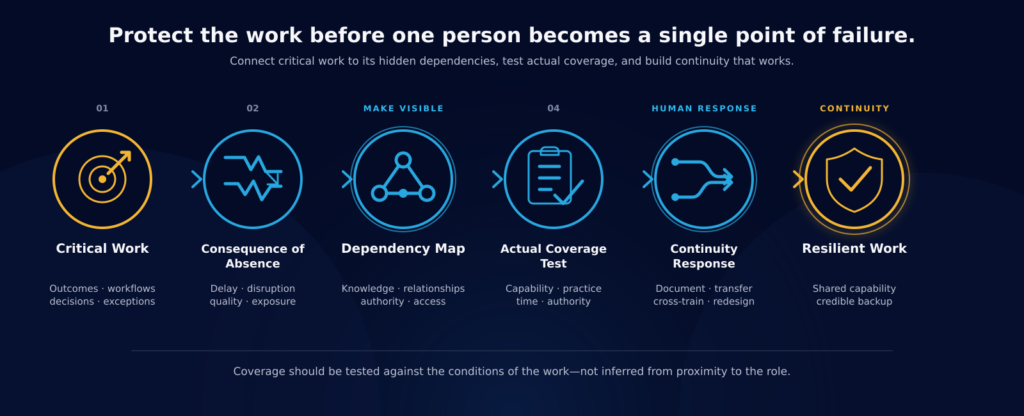
To understand actual coverage, the organization must connect the critical outcome, required work, knowledge, relationships, systems, permissions, authority, exceptions, current contributors, evidence, consequences, transfer time, and responsible owner.
Without those connections, the organization may believe it has coverage while the essential conditions remain concentrated in one person.
See the complete dependency—not just the person or position.
Critical Work
- Essential outcomes
- Customer commitments
- Core workflows
- High-consequence decisions
- Exceptions and recovery
Dependency Sources
- Specialized knowledge
- Relationships and trust
- Credentials and licenses
- Authority and access
- Judgment and workarounds
Current Coverage
- Primary contributor
- Named backup
- Actual capability
- Available time
- Access and experience
Consequences of Absence
- Delayed work
- Lost quality
- Customer disruption
- Compliance exposure
- Overloaded colleagues
Continuity Responses
- Stabilize
- Document
- Transfer
- Cross-train
- Redesign
- Add coverage
Key-person risk becomes decision-useful when the organization can connect critical work to its dependencies, actual coverage, consequences, and realistic continuity options.
How key-person dependency takes hold
STAGE 1
Expertise accumulates around one person
An employee becomes the reliable source for difficult decisions, exceptions, relationships, systems, or specialized work.
STAGE 2
The organization routes more work to the expert
Because the person can solve the problem quickly, colleagues continue escalating work rather than developing broader capability.
STAGE 3
Informal dependency substitutes for coverage
The person maintains private notes, personal relationships, undocumented workarounds, and context that others cannot readily access.
STAGE 4
An absence becomes an operational disruption
Departure, leave, reassignment, overload, or unexpected unavailability reveals that the work was never adequately distributed.
Why a named successor does not guarantee continuity
Succession planning can identify people who may eventually assume an important role. That does not establish whether the work is currently protected.
A succession chart identifies a possible person. A coverage review tests whether the work can actually continue.
Actual coverage must be tested against the conditions of the work—not inferred from proximity to the role.
Critical knowledge is only one part of the exposure.
Knowledge
Technical information, process understanding, organizational history, customer context, and lessons accumulated through experience.
Relationships
Trust and working connections with customers, vendors, regulators, partners, communities, and internal stakeholders.
Authority and access
Decision rights, approvals, security permissions, system access, credentials, licenses, and contractual authority.
Judgment
The ability to recognize patterns, interpret incomplete information, handle exceptions, and determine when escalation is necessary.
Workarounds
Informal practices used to compensate for system limitations, incomplete procedures, unusual cases, and recurring failures.
Available capacity
The time and attention required to respond, support colleagues, transfer knowledge, and perform critical work without chronic overload.
Named coverage
A simplified plan may show a successor, a second name on an escalation list, a documented process, shared credentials, someone with outdated experience, a manager assumed to be capable, or a team expected to absorb the work.
Actual coverage
A decision-useful review examines capability, current knowledge, access, authority, relationships, time, workload, exception handling, quality expectations, and evidence from simulations or real coverage.
A backup on paper is not necessarily a backup in practice.
Coverage should establish whether another person can perform the required work under real operating conditions.
Test the work, not the organizational chart
Credible coverage depends on knowledge, experience, access, availability, authority, and the consequences of absence.
Turn key-person dependency into a practical continuity plan.
Connect critical work to the knowledge, relationships, access, judgment, and capability behind it—then build coverage that can operate under real conditions.
THE MATCHING WORKSHOP MODULE
Module 4: Critical Knowledge & Role Coverage
This module helps participants identify critical work that depends on too few people and evaluate whether existing continuity arrangements are credible.
The workshop connects important outcomes to the knowledge, relationships, authority, access, judgment, capability, and operating conditions required to protect them. Participants distinguish named coverage from actual coverage and determine what additional evidence or action may be needed.
This module helps your team:
- Identify work with significant continuity consequences
- Reveal key-person and single-point-of-failure dependencies
- Map critical knowledge, relationships, authority, and access
- Examine exceptions and undocumented workarounds
- Test whether named backups provide actual coverage
- Identify overloaded experts and fragile escalation paths
- Estimate the time required to build credible coverage
- Prioritize documentation and knowledge transfer
- Compare continuity response options
- Identify questions requiring specialist review
What should happen next for each critical dependency?
The organization should consider the importance of the work, consequences of absence, current coverage, transfer difficulty, available time, employee circumstances, and evidence supporting the risk.
Stabilize
Protect immediate continuity
Document
Make essential information accessible
Transfer
Share relationships and responsibility
Cross-Train
Build credible backup capability
Redesign
Remove unnecessary dependency
Add Coverage
Increase available capability
Investigate
Resolve uncertainty first
These categories structure continuity planning. They do not automatically determine staffing, succession, employment actions, access changes, or judgments about an individual employee.
What should a critical knowledge and role coverage review examine?
The work
Which outcomes, activities, decisions, relationships, exceptions, and responsibilities must continue?
The dependency
What knowledge, capability, trust, access, authority, credentials, judgment, systems, or workarounds does the work require?
The concentration
How many people can contribute, where are they located, and how much of the requirement depends on each person?
The consequences
What happens to customers, employees, quality, revenue, compliance, operations, and commitments if the person is unavailable?
The coverage
Who can perform the work under real conditions, and what evidence demonstrates readiness, authority, access, and availability?
The response
What action can reduce the dependency within the available time, and who will own it?
Use TalentSync to connect critical work to the people and evidence behind it.
TalentSync can help organizations examine critical knowledge and role coverage across people, teams, roles, projects, workflows, and systems. The process begins with important work and its consequences—not with automatically labeling employees as key-person risks.
STEP 1
Identify critical work
Clarify the outcome, activity, decision, relationship, workflow, or responsibility that must continue.
STEP 2
Map the dependency
Connect the work to capability, knowledge, judgment, credentials, access, authority, relationships, systems, and workarounds.
STEP 3
Reveal current contributors
Identify the people, roles, teams, contractors, partners, and systems that currently support the work.
STEP 4
Test actual coverage
Examine who can contribute and whether the necessary evidence, experience, time, access, and authority are present.
STEP 5
Show concentration and gaps
Reveal where work depends on too few people, backups remain unprepared, or evidence is incomplete.
STEP 6
Support a continuity response
Organize evidence for stabilization, documentation, transfer, cross-training, redesign, added coverage, or investigation.
TalentSync can make relationships among work, people, capabilities, knowledge, and dependencies more visible. Leaders, managers, employees, and qualified specialists remain responsible for interpretation, communication, access decisions, and final action.
- Critical work
- Knowledge and judgment
- Relationships and trust
- Authority and access
- Current contributors
- Actual coverage
- Concentration and gaps
- Continuity options
THE ROLE OF TALENTPASS
A person’s relevant experience may extend beyond the organization’s records.
TalentPass is designed to help an individual develop a reusable view of their experience and talent evidence. With the individual’s participation, that profile may include employment history, activities performed, skills and their origins, credentials, accomplishment stories, prior experience, leadership, stewardship, interests, and potential development directions.
The individual controls their TalentPass information and chooses when it is shared. Appropriately shared information may reveal possible coverage, adjacent capability, or development pathways, but it does not establish readiness, interest, availability, authorization, or suitability for a responsibility.
PRODUCT AND DECISION BOUNDARIES
Coverage evidence supports continuity planning. It does not replace judgment.
TalentSync, TalentPass, Pythia, and workshop outputs should not be presented as automatically identifying indispensable employees, predicting departure, measuring productivity, selecting successors, transferring knowledge, establishing readiness, directing employment actions, determining security access, replacing employee and manager conversation, or guaranteeing uninterrupted operations.
The workflow helps people connect critical work, dependencies, contributors, evidence, consequences, and continuity options. Employment, labor, privacy, accessibility, cybersecurity, records, safety, licensing, compliance, and other questions may require review by qualified specialists. TalentPass is not designed for use by minors.
What to bring into the conversation
You do not need a complete knowledge-management system or a perfect succession plan.
We begin with the work, people, coverage arrangements, and evidence the organization already has.
Useful inputs may include:
- Strategic and operational priorities
- Critical workflows and services
- Customer or contractual commitments
- Roles considered essential
- Succession and continuity plans
- Organizational charts
- Process and procedure documentation
- Role descriptions and responsibility matrices
- System access and permission information
- Credential and license requirements
- Customer, vendor, and partner relationships
- Project and assignment information
- Vacancy, retirement, leave, or turnover concerns
- Workload and escalation patterns
- Business continuity plans
- Incident and recovery information
- Employee and manager observations
- Known knowledge-transfer concerns
- Relevant privacy, access, and retention practices
Workforce Direction establishes the organizational outcome, affected work, available evidence, and bounded workforce decision this module should support.
What this module can help clarify
Which work is vulnerable
Identify important outcomes, workflows, decisions, relationships, and responsibilities with fragile continuity.
What the work depends on
Reveal critical knowledge, judgment, trust, credentials, authority, access, systems, and informal practices.
Where coverage is insufficient
Distinguish actual backup capability from named successors, assumed team capacity, outdated experience, and incomplete evidence.
What should happen next
Organize options to stabilize, document, transfer, cross-train, redesign, add coverage, or investigate.
Final outputs depend on the modules selected and the workforce decision established through the required Workforce Direction foundation.
Where might the work lead next?
Critical knowledge and role coverage frequently reveals connected problems involving capability visibility, succession, development, role design, workload, and external talent.
Workforce Capability Visibility
Reveal active, latent, emerging, missing, concentrated, and insufficiently documented capability.
Workforce Growth & Reskilling
Develop the capabilities required to distribute important work and prepare credible coverage.
Internal Talent Sourcing & Mobility
Identify people whose experience and adjacent capabilities may support critical work.
Skills-Based Role Design
Clarify the outcomes, activities, capabilities, authority, and conditions attached to critical work.
Workload, Retention & Sustainable Scale
Address chronic overload affecting experts, backups, managers, and teams.
External Talent Pipeline Development
Prepare external relationships when important capability cannot be developed internally in time.
Frequently asked questions
Questions leaders ask before booking.
PROTECT THE WORK BEFORE COVERAGE BECOMES URGENT
Turn key-person dependency into a practical continuity plan.
Connect critical work to the knowledge, relationships, access, judgment, and capability behind it—then build coverage that can operate under real conditions.
This module is part of Gobekli’s configurable Workforce Scalability Workshop. Explore the complete 12-module structure and identify the right starting point for your organization.