
A PROGRAM RELEVANCE WORKSHOP MODULE
Learner Demand, Goals & Access:
Understand the People Behind Enrollment
Institutions often evaluate learner demand through applications, enrollment, search activity, inquiries, or survey responses.
Those signals matter—but they reveal only the people who found the institution, recognized the opportunity, navigated its requirements, and decided the program might fit their lives.
A program can address a meaningful need and still remain inaccessible. It can attract enrollment without producing the value learners expected. Declining enrollment can reflect weak demand, but it can also reflect price, scheduling, geography, awareness, trust, competition, or a poor connection between the program and the learner’s goal.
Program decisions require a clearer understanding of what people are trying to accomplish, what shapes their choices, and whether they can realistically enter, complete, and benefit.
Does this sound familiar?
Enrollment is treated as demand
Current enrollment is used as the primary measure of learner interest even though it reflects access, awareness, admissions, price, timing, and institutional capacity.
The program assumes one learner goal
Recruitment and curriculum are organized around a traditional career path while learners may be seeking advancement, career change, licensure, transfer, confidence, stability, or personal growth.
Interest disappears before enrollment
Prospective learners inquire, attend events, visit pages, or begin applications but do not enter—and the institution cannot explain where or why they leave.
Access is reduced to financial aid
Tuition matters, but learners may also face scheduling, transportation, childcare, technology, language, disability, documentation, advising, or eligibility barriers.
Programs recruit people they are not designed to serve
Marketing reaches new populations without changing the delivery, support, prerequisites, culture, or pathways that shape whether those learners can succeed.
Non-consumption remains invisible
The institution studies enrolled learners but knows much less about people who need the opportunity and never consider, find, trust, or reach the program.
What is learner demand?
Learner demand is the demonstrated or potential willingness of people to invest time, effort, money, and personal risk in an educational experience they believe may help them achieve a meaningful goal.
It can appear through applications, enrollment, inquiries, search behavior, events, advising conversations, waitlists, course-taking patterns, stop-out and reentry behavior, partner requests, interest in adjacent programs, competing choices, and unmet demand among people who never reach the institution.
Learner demand is shaped by more than interest in a subject.
People evaluate whether a program appears relevant to their goals, whether they qualify, whether they belong, whether they trust the provider, whether the schedule works, whether they can afford the complete cost, whether participation fits their responsibilities, and whether the likely value justifies the risk.
A useful learner demand assessment examines desire, goals, choices, access, persistence conditions, and expected benefit together.
The problem is not simply whether learners want the program. It is whether the opportunity fits their goals and lives.
A person may want a better job without wanting a two-year degree. An incumbent worker may need one capability rather than a complete program. A prospective learner may value a credential but be unable to attend during the hours it is offered. Another may enroll because the program is available without understanding where it leads.
Institutions need to connect the people a program may serve; their goals; available alternatives; prior education and experience; awareness; prerequisites; direct and indirect costs; time and pace; geography and technology; language, disability, and caregiving conditions; advising and support; expected outcomes; persistence; and evidence from people who did not enroll or continue.
Without those connections, low enrollment may be interpreted as weak demand when the real problem is access. Strong enrollment may be interpreted as proof of relevance even when learners leave, fail to reach their goals, or would have chosen differently with better information.
See the complete learner decision—not just the enrollment count.
Learners and Goals
- Career entry
- Advancement
- Career change
- Transfer
- Licensure
- Personal or civic goals
Awareness and Choice
- Program discovery
- Trusted information
- Available alternatives
- Perceived fit
- Reputation
- Decision support
Access Conditions
- Cost and financial risk
- Time and scheduling
- Transportation
- Technology
- Eligibility
- Care responsibilities
Participation and Support
- Advising
- Academic preparation
- Belonging
- Flexibility
- Student services
- Workplace support
Value and Evidence
- Completion
- Employment
- Advancement
- Transfer
- Capability growth
- Learner-defined value
Learner demand becomes decision-useful when institutions can connect people’s goals to how they discover, evaluate, access, experience, and benefit from the program.
How learner demand gets misread
STAGE 1
The institution observes an enrollment signal
Applications rise or fall, a program develops a waitlist, inquiries change, or a particular learner population appears underrepresented.
STAGE 2
The signal becomes a conclusion
Leaders interpret the pattern as evidence that learners want—or no longer want—the program.
STAGE 3
The institution changes the offering or recruitment strategy
Marketing, admissions targets, curriculum, schedules, modality, pricing, or program capacity changes around the initial interpretation.
STAGE 4
The underlying conditions remain unresolved
Learner goals, access barriers, competitive choices, support needs, expected value, or institutional trust continue to shape participation.
Why enrollment does not tell the whole story
Enrollment is a consequential measure. It demonstrates that people moved through enough of the decision and access process to begin the program.
But it cannot independently explain why they enrolled, who wanted the opportunity but could not enter, whether the program fits their goals, or whether they are likely to benefit.
A useful learner demand assessment asks several additional questions.
Which populations, life stages, employment situations, communities, educational histories, or circumstances are relevant to the decision?
Are people seeking employment, advancement, transfer, licensure, career change, stability, confidence, connection, or another outcome?
Could they choose another institution, a shorter credential, employer training, self-directed learning, immediate work, or no education at all?
Where do awareness, information, admissions, cost, scheduling, transportation, technology, eligibility, trust, or other barriers intervene?
Which academic, financial, social, workplace, family, advising, and institutional conditions affect persistence?
What outcome would make the time, effort, cost, and opportunity risk feel worthwhile—and is the program positioned to deliver it?
Interest is a signal. Participation is a consequential decision.
Specific
The person can connect the program or learning need to a meaningful goal.
Informed
The learner understands the format, expectations, cost, duration, prerequisites, and likely outcomes.
Feasible
The person can reasonably navigate the time, location, technology, financial, and participation requirements.
Sustained
Interest persists beyond a single survey, event, marketing campaign, funding incentive, or moment of urgency.
Actionable
The institution can identify a realistic program, pathway, access, support, or advising response.
Corroborated
Learner-reported interest is supported by behavior, community evidence, enrollment patterns, partner observations, or unmet participation.
Expressed demand
Institutions can often observe:
- Applications and enrollments
- Deposits or registrations
- Information requests
- Website visits
- Event attendance
- Waitlists
- Advising appointments
- Survey responses
- Program transfers
- Course registrations
These signals reflect people who already know enough about the institution or program to take a visible action.
Potential and unmet demand
Less visible demand may include people who:
- Do not know the program exists
- Do not recognize themselves in its messaging
- Assume they are ineligible
- Cannot attend at available times
- Cannot afford the complete cost
- Lack transportation, technology, or childcare
- Distrust the institution
- Need a shorter or stackable option
- Cannot see a credible path to the outcome
- Want the outcome but reject the format
The goal is to understand whom current institutional data can see—and who remains outside it.
The same program can mean something different to every learner.
A learner may be trying to enter a field, advance, change direction, transfer, meet a formal requirement, or build knowledge, confidence, relationships, civic capacity, or personal agency.
A relevant program makes its intended outcomes clear enough for learners to judge whether the opportunity fits their goals.
Access is not one doorway.
A program may appear open while remaining unreachable during discovery, understanding, eligibility, entry, participation, or the learner’s ability to use and benefit from what they learned.
Access should be examined across the entire learner path—not only at the moment of admission.
See the people
behind enrollment.
Connect learner goals to choices, access, participation, and value.
THE MATCHING WORKSHOP MODULE
Module 4: Learner Demand, Goals & Access
This module examines who may want or need a program, what those learners are trying to accomplish, what shapes their choices, and whether they can realistically enter, participate, complete, and benefit.
Participants compare enrollment and inquiry data with learner goals, access conditions, advising insights, community evidence, participation patterns, and the experiences of people who stopped, chose another option, or never reached the institution.
The purpose is not to assume that every learner preference should determine program design. It is to distinguish meaningful demand from general interest and identify where program structure, information, access, support, or value affects the decision.
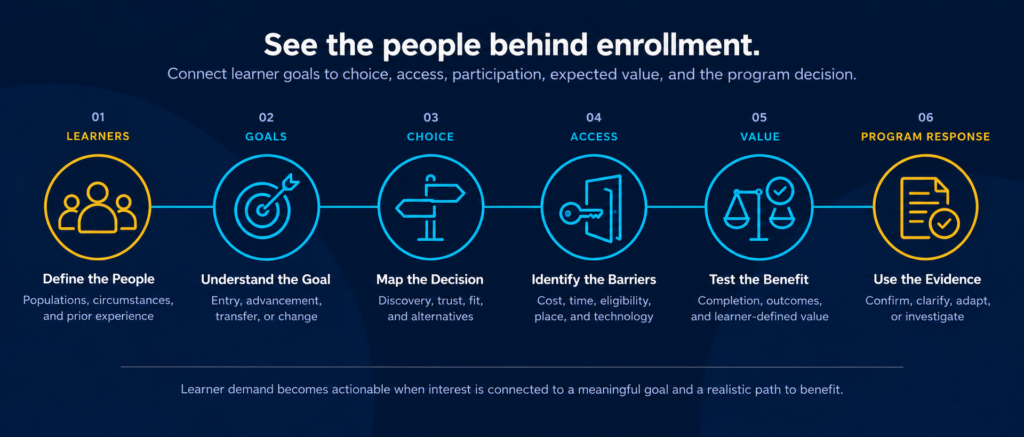
This module helps your team:
- Define the learners and populations relevant to the decision
- Identify the goals learners are trying to achieve
- Distinguish enrollment from broader learner demand
- Examine expressed, potential, and unmet demand
- Understand how learners discover and evaluate the program
- Identify barriers across discovery, eligibility, entry, participation, and benefit
- Examine the complete cost and risk learners experience
- Compare demand across learner populations and delivery options
- Understand why people do not enroll, continue, or return
- Clarify which learner signals are strong enough to influence the program
- Identify questions requiring additional evidence
- Develop an evidence-backed learner demand response
What should the learner evidence mean for the program?
Learner demand can support several different responses. The appropriate choice depends on learner goals, signal strength, access, expected value, institutional capacity, and the consequences of changing the program.
Confirm
Learner evidence supports the program’s current purpose, outcomes, structure, delivery approach, and intended population.
Clarify
Potential learners cannot clearly determine what the program offers, who it serves, what it requires, where it leads, or how it connects to their goals.
Adapt
The underlying learning need appears valid, but schedule, pace, modality, location, sequence, prerequisites, or program structure limits participation.
Support
Learners need more effective advising, financial support, academic preparation, technology, transportation, childcare, navigation, belonging, or workplace coordination.
Differentiate
The current program attempts to address several different goals that may require clearer pathways, specializations, credentials, entry points, or support models.
Investigate
The institution lacks enough evidence about learner goals, potential demand, barriers, alternatives, persistence, or expected value to act responsibly.
These categories organize the program inquiry. They do not determine whether a program should be launched, expanded, redesigned, combined, paused, or retired.
What should a learner demand assessment examine?
The learner
Who may want or need the opportunity, and whose experience is missing from existing institutional data?
The goal
What is the learner trying to accomplish, and how consequential is that outcome?
The choice
How do learners discover, compare, understand, trust, and select among available alternatives?
The access conditions
What affects eligibility, affordability, timing, location, technology, participation, and completion?
The expected value
What benefit does the learner expect, and what evidence supports or challenges that expectation?
The demand signal
Is the evidence specific, informed, feasible, sustained, actionable, and corroborated?
Trace the complete learner path
A learner demand assessment becomes useful when it creates a clear connection between people’s goals and the bounded program decision.
STEP 1
Define the learners
Identify the populations, circumstances, educational histories, employment situations, and communities relevant to the decision.
STEP 2
Understand the goals
Clarify what learners are trying to change, gain, protect, continue, or make possible through education.
STEP 3
Map the decision
Examine how learners discover the opportunity, interpret its value, compare alternatives, and decide whether to proceed.
STEP 4
Identify access conditions
Trace the financial, geographic, scheduling, technological, institutional, and personal conditions affecting participation.
STEP 5
Test the evidence
Compare stated interest with behavior, enrollment, persistence, partner observations, learner experiences, and contradictory findings.
STEP 6
Define the program response
Clarify whether the evidence supports confirmation, clearer information, adaptation, additional support, differentiation, or investigation.
The result is not a promise that every interested person will enroll. It is an evidence-backed account of who the program may serve, what learners need from it, and what affects their ability to benefit.
- Define the relevant learner populations
- Connect demand to learner goals
- Map discovery and decision points
- Trace access across the full journey
- Test interest against behavior and evidence
- Define the program’s responsible response
WHOSE VOICE IS MISSING?
Current students can explain the program. Nonparticipants can reveal its boundaries.
Enrolled learners can describe advising, instruction, support, belonging, scheduling, cost, and the experience of participating.
They cannot fully represent people who never heard about the program, considered it but did not apply, began an application but stopped, were denied admission, could not secure financial support, chose another option, enrolled and withdrew, or want the outcome but reject the current format.
A credible assessment deliberately seeks evidence from people at different points in the learner decision—not only those who completed it successfully.
Participation should be accessible, purposeful, and transparent. Learners should understand what decision is being considered, how their input may influence it, and where institutional authority remains.
LEARNER EVIDENCE AND DECISION BOUNDARIES
Learner-centered does not mean preference-driven.
Learner perspectives are essential to understanding goals, choices, barriers, experiences, and value. They are not the only evidence in a program decision.
This module should not be presented as:
- Allowing a survey to determine program strategy
- Treating general interest as enrollment commitment
- Guaranteeing enrollment, completion, employment, transfer, or earnings
- Assuming current students represent all potential learners
- Predicting an individual’s likelihood of success
- Defining learners only by demographic categories
- Using protected characteristics to make individual decisions
- Replacing accessibility review
- Replacing financial-aid, admissions, advising, or support functions
- Assuming every access barrier can be solved by the program
- Promising that a preferred format will produce equivalent outcomes
- Removing faculty, academic, regulatory, or governance judgment
A program must also consider community need, employer demand, future work, educational coherence, professional standards, regulatory requirements, resources, institutional mission, and the responsibilities associated with the credential.
Accessibility, civil rights, admissions, financial aid, privacy, consumer protection, licensure, accreditation, and other questions may require review by qualified specialists.
What to bring into the conversation
You do not need a complete market-research study or a perfect profile of every potential learner.
We begin with the learner signals, institutional records, community knowledge, and unresolved questions already available. The workshop then helps distinguish what is known from what has been assumed.
Useful inputs may include:
- The Program Relevance Decision Foundation
- Application and enrollment trends
- Inquiry and lead information
- Website and search behavior
- Event participation and waitlists
- Admissions and registration data
- Financial-aid information
- Student demographic and geographic patterns
- Course-taking and modality patterns
- Advising observations
- Learner surveys and interviews
- Focus-group findings
- Stop-out, withdrawal, and reentry information
- Completion and time-to-completion data
- Transfer evidence
- Employment and advancement outcomes
- Student-support usage
- Complaints and appeals
- Community and employer observations
- Competing programs and alternative pathways
- Known access barriers
- Evidence from people who did not enroll
- Evidence that challenges the current interpretation
The Decision Foundation establishes the outcome, program boundary, learner population, evidence scope, and decision this module should support.
What this module can help clarify
Who the program may need to serve
Define the learners, populations, circumstances, and goals relevant to the program decision.
What demand exists beyond enrollment
Identify expressed, potential, and unmet demand that current institutional measures may not capture.
Where access or value affects participation
Reveal how information, eligibility, cost, scheduling, location, support, trust, and expected benefit shape learner decisions.
What the program should do next
Organize the evidence into options to confirm, clarify, adapt, support, differentiate, or investigate.
Final outputs depend on the modules selected and the program decision established through the workshop’s required Decision Foundation.
Where might the work lead next?
Questions institutions ask about learner demand.
A learner demand assessment examines who may want or need an educational opportunity, what those people are trying to accomplish, how they evaluate available choices, and whether they can realistically enter, complete, and benefit. It combines visible signals with evidence about goals, access, alternatives, persistence, expected value, and people who never reach the institution.
No. Enrollment demonstrates that people navigated enough of the awareness, choice, eligibility, financial, and registration process to begin. Learner demand is broader and may include people who want or need the outcome but cannot find, access, afford, trust, schedule, or justify the current offering.
Employer demand examines what organizations need people to accomplish and how hiring and workplace systems respond. Learner demand examines what people are trying to accomplish through education, how they make choices, and whether they can access and benefit. The signals may reinforce one another, but they are not interchangeable.
Use several forms of evidence rather than one survey or projection. Relevant sources include community and employer need, search and inquiry behavior, related enrollment, competing programs, learner interviews, partner observations, demographic conditions, access constraints, labor-market evidence, and the strength of learners’ intended goals.
Survey responses provide evidence of stated interest. They do not independently demonstrate that people understand the program or are willing and able to enroll. Responses become more useful when participants receive realistic information about cost, duration, schedule, format, requirements, and likely outcomes.
Unmet learner demand exists when people want or need an educational outcome but available programs, formats, information, requirements, costs, locations, schedules, or support do not provide a realistic path. Not every unmet need should become a new program; scale, fit, value, feasibility, and institutional role still matter.
Examine the learner journey from discovery through registration. Useful evidence may come from incomplete applications, declined offers, advising notes, event follow-up, website behavior, financial-aid interactions, community partners, competing providers, and direct conversations with people who chose not to enroll.
Relevant barriers may include awareness, language, trust, admissions, prerequisites, documentation, tuition, materials, transportation, technology, childcare, work schedules, disability access, clinical requirements, unpaid learning experiences, advising, and academic support.
Online delivery may reduce travel and scheduling barriers, but it can introduce others. Learners may need reliable technology, broadband, quiet space, digital fluency, flexible support, accessible design, and opportunities for interaction or applied practice.
Examine scheduling, pace, recognition of prior learning, stackability, workplace relevance, support availability, complete cost, time to value, and opportunities to pause and return. Adult learners are not one uniform population, so their goals and circumstances should not be generalized.
Learner goals should help clarify outcomes, pathways, delivery, advising, evidence, and support. They should not override educational standards or lead the institution to promise outcomes it cannot support. Materially different goals may require clearer pathways or entry and exit points.
Learners evaluate direct and opportunity cost against expected benefit. Earnings may matter, but learners may also value stability, advancement, transfer, licensure, flexibility, meaningful work, civic contribution, or personal development. Institutions should communicate evidence without guaranteeing outcomes.
Yes. People who withdrew, stopped out, transferred, failed to complete requirements, or chose not to return can reveal barriers and program conditions that successful graduates may not experience.
The cycle depends on the program, population, market, and rate of change. Triggers may include application decline, changing demographics, new competitors, policy changes, delivery disruptions, declining persistence, shifts in employer demand, or new outcome evidence.
No. This module examines program-level demand, goals, access conditions, choices, and expected value. It does not evaluate, score, or predict an individual. Making individual learning and capability evidence visible belongs to Gobekli’s separate Learning Visibility work.
Program Relevance Direction first establishes the outcome, program boundary, affected learners and stakeholders, evidence foundation, and decision. Learner Demand, Goals & Access is selected when the institution needs to understand who may want or need the program, what they are trying to accomplish, and what affects their ability to participate and benefit.
SEE THE PEOPLE BEHIND THE ENROLLMENT
Turn learner interest into a clearer understanding of demand, access, and value.
Connect learners’ goals to their choices, circumstances, access conditions, participation, and expected outcomes—then decide what the program should do next.
Learner Demand, Goals & Access is part of Gobekli’s configurable Program Relevance Workshop.