
LEARNING ALIGNMENT WORKSHOP MODULE
Learning Activities & Assessment Alignment
Connect what learners do to what they can demonstrate. Review one activity and its assessment to identify gaps in practice, feedback, and evidence—and plan a focused improvement.
Does this sound familiar?
Learners complete the work, but capability remains unclear
Participation, submission, and completion are recorded, but the evidence does not clearly show what learners can explain, apply, create, or decide.
The assessment asks for something learners barely practiced
Learners encounter new levels of complexity, independence, or application for the first time in a consequential assessment.
The rubric rewards something different from the outcome
Marks emphasize formatting, speed, recall, or presentation while the intended capability depends on analysis, judgment, collaboration, or performance.
A strong group result hides individual learning
The final product looks convincing, but participants’ contributions, decisions, and capabilities are difficult to distinguish.
Feedback arrives after the opportunity to improve
Learners receive comments and scores without a meaningful chance to revise, practice again, or apply the feedback in later work.
Tools change what the finished work can tell you
AI, templates, collaborators, and other forms of assistance contribute to the output, but expectations and evidence of learner contribution remain unclear.
What is learning activity and assessment alignment?
Learning activity alignment examines whether the work learners perform gives them a meaningful opportunity to develop an intended outcome or capability.
Assessment alignment examines whether the task, criteria, conditions, and evidence allow an appropriate judgment about that outcome or capability.
The two must work together. Learners need opportunities to practice the relevant actions, receive useful feedback, and demonstrate learning under conditions that fit the claim being made.
An outcome such as “evaluate competing explanations” calls for opportunities to compare evidence, examine assumptions, and justify a conclusion. An assessment focused only on recalling definitions would reveal only part of that expectation.
Activities and assessments may include discussions, investigations, essays, demonstrations, projects, simulations, laboratories, studios, clinical encounters, portfolios, presentations, workplace tasks, and reflective work.
The appropriate combination depends on what learners are expected to develop and what the resulting evidence needs to support.
An outcome becomes meaningful through the work learners actually do.
Outcomes, activities, rubrics, and grades often live in separate documents and systems. Each may appear reasonable on its own while the connections among them remain weak.
A useful alignment review brings those connections into view:
- The intended outcome or capability
- The specific actions learners need to perform
- The context and expected level of performance
- The activity instructions and available resources
- The practice learners receive before assessment
- The feedback they can use to improve
- The assessment task and conditions
- The criteria used to judge the work
- The evidence produced by the activity
- The contribution attributable to each learner
- The tools, assistance, and collaboration involved
- The access conditions affecting participation
- The person responsible for reviewing the evidence
- The conclusion the evidence can reasonably support
Without these connections, an organization can collect substantial amounts of assessed work while remaining uncertain about what the work demonstrates.
Connect the outcome to the activity, assessment, and evidence.
Outcomes and Capabilities
Intended learning
Observable actions
Application context
Expected level
Purpose of the judgment
Activities and Practice
Tasks and instructions
Decisions and methods
Resources and tools
Guided practice
Independent application
Feedback and Improvement
Success criteria
Instructor guidance
Peer feedback
Revision opportunities
Application to later work
Assessment and Evidence
Assessment task
Rubric criteria
Learner work
Observed performance
Individual contribution
Review and Responsibility
Reviewer roles
Shared interpretation
Access conditions
Evidence limitations
Improvement ownership
The connection is strongest when your team can explain what learners do, how that work develops the intended capability, and what the resulting evidence allows someone to judge.
How activities and assessments drift apart
STAGE 1 — Outcomes describe the intention
A course or program establishes what learners should know, do, create, explain, or demonstrate.
STAGE 2 — Activities develop around practical needs
Instructors build assignments around teaching experience, available resources, delivery formats, time, and learner needs.
STAGE 3 — Assessment follows familiar routines
Existing tasks, rubrics, grade categories, and submission requirements are reused or adapted without fully revisiting the intended capability.
STAGE 4 — The result becomes difficult to interpret
Learners receive grades and complete requirements, but the organization cannot clearly explain whether the activity developed the outcome or whether the assessment captured it.
A completed assignment can answer fewer questions than you think.
An assignment record can establish that work was submitted and reviewed.
Understanding what it demonstrates requires a closer look at the task, the learner’s actions, the conditions, and the criteria used to judge it.
The review should clarify:
Identify the actions within the outcome: explain, compare, investigate, design, calculate, perform, collaborate, interpret, decide, or create. Then locate where the activity requires those actions. A topic match alone does not establish alignment.
Examine the instruction, examples, practice, support, and feedback available before the assessment. Identify whether learners practice the relevant action at a suitable level and under conditions that prepare them for the eventual task.
Review the actual prompt, performance, product, or encounter. Determine whether a learner could complete it successfully without demonstrating an essential part of the intended outcome.
Examine which qualities influence the judgment. Check whether the rubric makes the intended capability visible and whether unrelated requirements dominate the result.
Identify what can be attributed to the learner, including their decisions, explanations, contributions, performance, revisions, and use of assistance. Distinguish the quality of a shared product from evidence of individual capability.
State what the evidence shows, the conditions under which it was produced, and what remains uncertain. Keep the conclusion proportionate to the task and the evidence available.
Look beyond whether the assignment mentions the outcome.
Action
The activity requires learners to perform the action the outcome describes. Explaining, applying, evaluating, and creating involve different demands.
Level
The task reflects the expected complexity, independence, precision, responsibility, or depth of learning.
Context
The conditions fit the purpose of the learning. A classroom explanation, simulated encounter, and workplace performance may reveal different aspects of a capability.
Practice
Learners have opportunities to develop the relevant capability, encounter useful feedback, and improve before a consequential judgment.
Criteria
The assessment makes the important qualities of performance visible and gives them appropriate attention in the judgment.
Evidence
The work, observation, explanation, or performance supports the intended conclusion about the learner, with assistance and limitations understood.
Activities that develop the intended capability
A well-connected learning activity gives learners opportunities to:
- Perform the actions named in the outcome
- Work with relevant knowledge, tools, and methods
- Make decisions at an appropriate level
- Encounter examples of successful performance
- Practice difficult parts of the task
- Receive feedback tied to clear criteria
- Explain or reflect on their approach
- Revise or apply learning in subsequent work
The activity earns its place through what it helps learners develop.
Activities that leave the outcome uncertain
An activity deserves closer review when learners can:
- Complete the task without using the target capability
- Follow a template without understanding the method
- Produce a polished result without explaining key decisions
- Rely on one group member for the essential work
- Receive high marks for qualities peripheral to the outcome
- Encounter assessment demands they have not practiced
- Finish without using the feedback they receive
- Submit work whose connection to individual learning remains unclear
These signals identify questions to investigate. They do not automatically make the activity unsuitable.
“Evaluate evidence” should be visible in the learner’s decisions.
Consider a course outcome:
Evaluate conflicting evidence and justify a recommendation.
Learners attend a presentation about evidence quality and then complete a multiple-choice quiz on terminology.
The quiz may provide useful information about foundational knowledge. The team still needs evidence of how learners compare conflicting sources, handle uncertainty, and defend a recommendation.
An aligned sequence could include a guided comparison of two sources, feedback on the reasoning, and a later case requiring an independently justified recommendation.
Assessment criteria could examine source quality, treatment of conflicting information, reasoning, and acknowledgment of limitations.
This review may preserve the quiz while adding the practice and evidence needed for the broader outcome.
Clarify what the learner contributes when tools and collaborators are involved.
An activity may appropriately involve AI, calculators, specialist software, templates, reference materials, peers, or supervisors. Their role should reflect the intended outcome.
If the outcome concerns independent performance, the assessment needs conditions and evidence appropriate to that expectation.
If the outcome concerns effective tool use or collaboration, the assessment should examine how learners select resources, contribute to the work, check results, and exercise judgment.
Useful evidence may include explanations of decisions, observed performance, selected drafts, contribution records, critique of a generated output, or a follow-up application.
The workshop helps participants identify which evidence is necessary for the specific judgment. It should not create unnecessary monitoring or documentation around every learning activity.
Learners need a fair opportunity to practice and demonstrate what matters.
Instructions, language demands, time limits, technology, equipment, delivery format, and access to assistance can influence performance.
Review whether these conditions are part of the intended capability or introduce unrelated barriers. Where different demonstration formats are appropriate, connect them to shared expectations while preserving the essential demands of the outcome.
The aim is a clearer view of learning and a more deliberate design for participation.
THE MATCHING WORKSHOP MODULE
Module 4: Learning Activities & Assessment Alignment
This practical minicourse helps faculty, instructional designers, assessment teams, and learning leaders examine whether an activity develops the intended capability and whether its assessment produces useful evidence of learning.
Participants learn a repeatable review method, apply it to one selected activity and assessment, identify the most important mismatch, and outline an improvement they can test.
The exercise also identifies the outcomes, activities, criteria, evidence, reviewer roles, and learner connections that a subsequent Gobekli configuration would need to maintain.
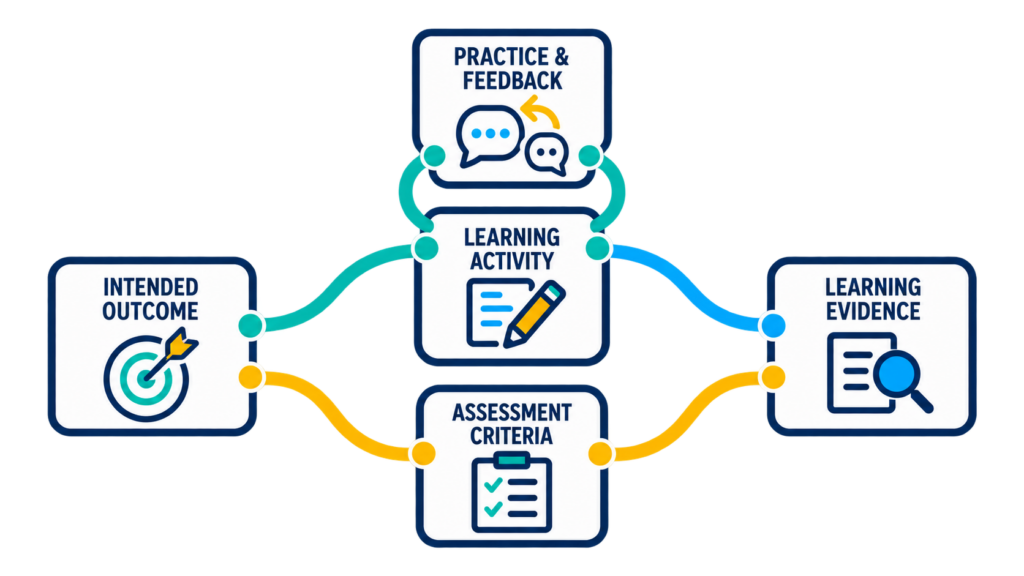
This module helps your team:
- Translate an outcome into observable learner actions
- Examine the fit between the activity and the intended capability
- Identify missing practice, feedback, or preparation
- Review the match between assessment demands and expected level
- Check whether rubric criteria reward the intended learning
- Distinguish task completion from evidence of capability
- Clarify individual contribution within shared or assisted work
- Examine access conditions and alternative demonstration formats
- Identify evidence that supports a proportionate judgment
- Select a practical improvement for a real learning activity
- Assign ownership for testing and reviewing the change
- Outline a connected activity and assessment configuration
What should change when an activity and its assessment do not line up?
Different mismatches require different responses. Participants learn to identify the specific connection that needs attention before redesigning the learning experience.
Confirm
Retain the activity where its purpose, practice, criteria, and evidence are sufficiently connected.
Strengthen Practice
Add or improve the preparation, feedback, and revision opportunities learners need.
Redesign the Task
Change what learners do so the activity develops or reveals the intended capability more directly.
Refine the Criteria
Make the important qualities of performance clearer and adjust their role in the judgment.
Improve the Evidence
Capture the explanation, performance, contribution, or artifact needed to support the intended conclusion.
Investigate
Gather additional examples or perspectives where the cause of the mismatch remains uncertain.
Several responses may apply to the same activity. Proposed changes should be reviewed by the people responsible for the learning experience and tested against their effect on learners and staff.
What should an activity and assessment alignment review examine?
The intended learning
What should the learner be able to explain, apply, perform, create, or decide? In what context and at what level?
The activity
What does the learner actually do? Which parts of the intended capability are required, optional, or absent?
The preparation
What teaching, practice, examples, feedback, and support prepare learners for the assessment?
The judgment
What criteria are used, who applies them, and which qualities determine the result?
The evidence and conditions
What work or performance supports the judgment? What assistance, collaboration, access conditions, and limitations affect its interpretation?
The improvement
Which connection needs attention, what change is feasible, and who will determine whether it helped?
Learn the method. Apply it to one real activity.
Bring one outcome, one learning activity, and its assessment. Participants work through the connections together and produce a focused improvement brief.
STEP 1
Define the capability
Translate the selected outcome into the actions, context, and level participants expect to see. Identify the judgment the evidence must support.
STEP 2
Walk through the learner’s task
Read the instructions from the learner’s perspective. Identify the actions, choices, tools, collaboration, and work products the task actually requires.
STEP 3
Check practice and feedback
Locate how learners prepare for the assessed demands. Identify where they can try, receive guidance, revise, or apply feedback.
STEP 4
Test the assessment connection
Compare the task and criteria with the intended capability. Ask whether successful completion could leave an essential part of the outcome unobserved.
STEP 5
Examine evidence and conditions
Review what can be concluded from the work, whose contribution is visible, and how tools, assistance, or access conditions affect interpretation.
STEP 6
Plan the improvement and configuration
Select a response, identify the owner and review point, and record the relationships that would need to remain connected in a future implementation.
Participants leave with a reviewed example, a proposed improvement, and a starting configuration brief. Where evidence is incomplete, the brief records the questions to resolve before implementation.
- Begin with a specific outcome and activity
- Make learner actions and assessment criteria visible
- Connect practice and feedback to the expected performance
- Keep evidence claims proportionate
- Choose a feasible change and assign responsibility
- Carry the reviewed relationships into an implementation brief
FUTURE PRODUCT CONNECTION
Turn the reviewed activity into a connected learning configuration.
The workshop identifies the relationships your organization needs to maintain as activities, expectations, and assessments change.
A potential TalentSync EDU configuration could organize those relationships around shared profiles for outcomes, capabilities, learning activities, and assessments. The reviewed workshop example would provide a concrete starting point for scoping that implementation.
The proposed configuration could connect:
- Outcome and capability profiles: what learners are expected to develop, including action, context, and level
- Learning activity profiles: what learners do, the resources involved, and the capabilities the activity is intended to develop
- Practice and feedback relationships: where preparation, guidance, revision, and subsequent application occur
- Assessment relationships: which task examines which outcome and under what conditions
- Criteria and evidence expectations: what reviewers need to observe and what information supports the judgment
- Reviewer and owner roles: who designs, reviews, approves, and maintains each connection
- Source records: where instructions, rubrics, artifacts, and other supporting information are maintained
- Improvement records: what needs to change, who owns the action, and when the result should be reviewed
- Learner connections: which experiences and reviewed evidence may appropriately contribute to a learner’s TalentPass
For example, the workshop might identify that a project is intended to develop evidence evaluation but that its current rubric primarily measures presentation quality. An implementation brief could specify the activity profile, associated capability, revised criteria, supporting evidence, reviewer role, and review date needed to maintain that connection.
With the learner’s participation, relevant experiences, activities, capabilities, artifacts, feedback, and stories could also connect to TalentPass. Learners would control what they choose to share through their TalentPass.
The next step is a scoped implementation conversation: select the initial activities, confirm available capabilities, identify any development or integration work, and agree on responsibilities and success criteria.
PRODUCT AND DECISION BOUNDARIES
Keep the learning judgment grounded in evidence and accountable review.
A connected configuration should help people understand and maintain the relationships among outcomes, activities, assessments, and evidence.
Its design should preserve the distinction between:
- An activity being associated with a capability and a learner demonstrating it
- A submitted artifact and evidence sufficient for a particular judgment
- The quality of a group result and an individual’s contribution
- Performance with assistance and performance under other conditions
- A course grade and the specific capabilities reflected within it
- A proposed assessment improvement and evidence that the change worked
- Information useful for institutional review and information a learner chooses to share
Faculty and other authorized reviewers remain responsible for interpreting evidence and making the judgments within their roles.
The product connection described here includes capabilities envisioned for TalentSync EDU and potential TalentPass connections. Availability, configuration needs, integrations, and any required development would be confirmed during scoping.
The workshop produces a useful review and improvement brief independently of product adoption.
What to bring into the conversation
Start with a manageable example: one important outcome, one activity, and the assessment used to judge it.
A useful starting question is: “What are we still unsure learners can do after completing this work?”
Useful inputs may include:
- The selected program or course outcome
- Existing capability definitions
- The activity or assignment instructions
- The assessment prompt
- Rubrics or scoring criteria
- Examples of expected performance
- Teaching materials supporting the activity
- Practice tasks completed beforehand
- Feedback provided during the activity
- Opportunities for revision or subsequent application
- Appropriately shared examples of learner work
- Assessment results relevant to the question
- Instructor and assessor observations
- Learner feedback about the task
- Group-work roles and contribution expectations
- Expectations for AI, tools, and other assistance
- Relevant delivery and access conditions
- Current activity and assessment ownership
- Locations of source documents and records
- Known concerns and decisions the review should support
The required Learning Alignment Direction module establishes the scope and decision this work should support. If outcome definitions remain unclear, Outcome & Capability Clarity can help establish the expectations used in this review.
The depth of the exercise depends on the available evidence and the time allocated within the selected workshop.
What this module can help your team produce
A reviewed alignment example
A documented connection among the intended capability, learner actions, practice, assessment criteria, and evidence for the selected activity.
A focused improvement brief
A prioritized mismatch, a proposed response, the person responsible, and the evidence needed to evaluate the change.
Clearer evidence expectations
A shared description of what reviewers need to observe, the conditions that matter, and the conclusions the evidence can support.
A starting configuration brief
An outline of the profiles, relationships, source records, reviewer roles, and learner connections a subsequent Gobekli implementation would need.
These outputs begin with the example reviewed during the module. Final scope depends on the modules selected, available inputs, and the alignment decision established through Learning Alignment Direction.
Where might the work lead next?
Reviewing an activity can reveal a need to clarify the outcome, strengthen the wider learning pathway, or revisit the decision guiding the work. Explore the connected modules below.
Learning Alignment Direction
Clarify the decision, scope, participants, and evidence boundary guiding your activity and assessment review.
Outcome & Capability Clarity
Define the actions, context, and level an activity should develop and its assessment should reveal.
Curriculum Coverage & Progression
Examine how the reviewed activity connects to preparation, reinforcement, and later demonstrations across the program.
Questions institutions ask before beginning.
It is the connection among what learners are expected to develop, what they actually do, how they practice and receive feedback, and how their learning is assessed. The review examines whether those elements support a coherent judgment about the intended outcome.
Constructive alignment connects intended learning outcomes with learning activities and assessment. This module applies that principle to a selected example and examines the practical details: learner actions, preparation, criteria, evidence, conditions, and responsibility.
Curriculum Coverage & Progression examines where learning occurs and how it develops across courses and experiences. This module looks inside a selected activity and assessment to examine whether the task, preparation, criteria, and evidence fit the intended learning.
A learning activity gives learners opportunities to develop or apply knowledge and capability. An assessment gathers information used to judge learning. One task can serve both purposes, particularly when learners receive feedback and can revise or apply it.
No. Activities can support exploration, practice, discussion, and feedback without producing a formal judgment. The review asks which evidence is necessary for the outcome and decision under consideration.
Their usefulness depends on the intended outcome and their design. They may reveal relevant knowledge, reasoning, or application. Other expectations may require additional evidence, such as a performance, explanation, project, or observation.
No. A meaningful task may reflect disciplinary inquiry, creative practice, civic participation, research, professional work, or another context relevant to the outcome. The task should fit the purpose of the learning.
Compare each important part of the outcome with the qualities the rubric examines. Check whether the descriptors make those qualities observable and whether the judgment gives appropriate attention to them. Review actual work to identify ambiguity or unintended emphasis.
Formative assessment should provide information learners and instructors can use while learning develops. Summative assessment supports a judgment at a defined point. This module examines whether practice and feedback prepare learners for the eventual demands and whether learners have an opportunity to use the feedback.
Identify which conclusions concern the group result and which concern each learner. Then select proportionate evidence of individual contribution, such as explanations, observed performance, defined responsibilities, or a related individual task.
AI changes the relationship between a finished output and the contribution required to produce it. The review clarifies permitted assistance, the capability being assessed, and the evidence needed to understand the learner’s own decisions, understanding, or performance.
Potentially. Different formats can be appropriate when they preserve the essential capability and provide evidence that can be judged against suitable shared expectations. The team should examine whether the format itself is part of the intended outcome.
The core exercise focuses on one selected outcome, activity, and assessment. Participants learn a method they can apply elsewhere. Broader redesign can be scoped after the initial review identifies the work required.
Include people who understand the intended outcome, design or deliver the activity, review learner work, and can authorize or support improvements. Depending on the example, this may include faculty, instructional designers, assessment leads, program leaders, placement supervisors, and learner-support colleagues.
The reviewed example identifies the outcomes, capabilities, activities, assessments, evidence expectations, source records, and responsible people that need to remain connected. Those requirements become the starting point for scoping a potential TalentSync EDU configuration and appropriate TalentPass connections.
No. The review method and improvement brief are useful independently. A subsequent implementation can be considered if your organization wants help maintaining the connections, extending the approach, or supporting appropriate learner records and sharing. Product availability and implementation requirements are confirmed during scoping.
MAKE THE CONNECTION BETWEEN ACTIVITY AND CAPABILITY
Give learners the right practice—and make their learning easier to see.
Examine what learners do, how they receive feedback, and what their assessments reveal. Leave with a focused improvement and a clear starting point for keeping those connections visible.
This module is part of Gobekli’s configurable Learning Alignment Workshop. Begin with Learning Alignment Direction, then select the modules that address your organization’s particular challenges.
