
MEMBER ENGAGEMENT WORKSHOP MODULE
Learning Program Participation & Follow-Through
Members may enroll with a clear intention and still struggle to begin or continue. Connect discovery, enrollment, participation, completion, and next steps to realistic expectations and useful support.
Does this sound familiar?
The right starting point is unclear
Members can browse courses but struggle to understand which opportunity fits their question, experience, or available time.
Enrollment does not become a start
A registration succeeds, but access, orientation, preparation, or the first activity leaves members unsure how to begin.
Commitments appear too late
Time, scheduling, prerequisites, assignments, or participation requirements become clear only after members have committed.
Participation stalls without explanation
Members stop progressing, while the organization has little context about whether they need help, more time, or a different route.
Support arrives as another reminder
Members receive prompts to continue without an answer to the question or practical difficulty preventing their next step.
Completion becomes a dead end
Members finish the program without a clear opportunity to apply, reflect on, extend, or appropriately conclude the experience.
What are learning program participation and follow-through?
Learning program participation is the route through which members discover an opportunity, decide whether it fits, enroll, begin, and take part in the learning experience.
Follow-through concerns what helps members carry out their intended participation and decide what should happen afterward.
The route may involve a short course, a cohort program, a self-paced sequence, a professional development pathway, or another structured learning offering.
Members need understandable expectations, practical access, and support appropriate to the commitments involved.
This module examines those conditions for one selected learning journey, including the choices to continue, pause, return, complete, or pursue another next step.
An intention to learn needs a workable route through the program.
A member may enroll because they want to address a current challenge, prepare for a responsibility, explore an interest, or meet a stated requirement.
That purpose can be clear while the participation route remains difficult.
Access may require an unfamiliar system. A live session may conflict with work. An assignment may take more time than expected. A member may need clarification before attempting the next activity.
A practical review follows those moments from the member’s perspective.
It connects the intended purpose to the information, choices, support, and responsibilities that make participation manageable.
See the complete learning participation journey.
Purpose and Discovery
Member questions and goals
Relevant learning opportunities
Starting knowledge and experience
Program expectations
Available time and circumstances
Enrollment and Start
Eligibility and prerequisites
Registration and payment
Access and account setup
Orientation and preparation
First meaningful activity
Participation and Support
Sessions and activities
Pace and commitments
Questions and feedback
Practical assistance
Pause and return options
Completion and Review
Stated completion requirements
Outstanding activities
Recorded participation status
Member reflection
Unresolved questions
Application and Next Steps
Opportunities to use learning
Further practice or support
Related learning choices
Appropriate recognition
Continuation or conclusion
The journey becomes easier to support when discovery, entry, participation, completion, and next steps remain connected to the member’s purpose and circumstances.
How learning participation loses continuity
STAGE 1 — A member finds a relevant opportunity
The program appears to address a question, goal, responsibility, or requirement that matters to the member.
STAGE 2 — Enrollment becomes the main handoff
The member registers and moves into a learning platform or program process, sometimes with limited preparation for what follows.
STAGE 3 — Participation depends on working around difficulties
Members manage access, time, unfamiliar expectations, and unanswered questions using whatever help they can find.
STAGE 4 — Progress records replace understanding
The organization sees activity or inactivity without enough context to know which support, adjustment, or next step would be appropriate.
A progress record can show where someone stopped without explaining why.
A learning report can answer an important question:
Who enrolled, started, completed activities, or met the program’s recorded completion requirements?
A participation review also examines whether members understood the commitment, could use the learning environment, received help, and had a workable route forward.
The review should clarify:
Identify the question, goal, responsibility, or requirement that brought the member to the opportunity. Distinguish expressed purpose from assumptions based on a course selection.
Review the description of preparation, time, format, activities, costs, prerequisites, and completion requirements.
Trace enrollment through access, orientation, and the first meaningful activity. Identify any handoff that leaves the member waiting or uncertain.
Examine the pace, commitments, questions, feedback, and practical circumstances relevant to the selected journey.
Identify how members ask for help, receive a response, clarify expectations, or explore a permitted pause, return, or alternative route.
Consider an appropriate opportunity to apply learning, seek further support, continue studying, receive established recognition, or conclude the experience.
A workable learning journey needs six forms of clarity.
Fit
Members can understand how the opportunity relates to their purpose and starting point.
Commitment
Time, preparation, activities, and completion expectations are visible before enrollment.
Start
Members can move from registration to access and a meaningful first activity.
Support
Questions and participation difficulties have an understandable route to help.
Progress
Members understand what remains, what choices are available, and how their recorded status is determined.
Next Step
The program helps members consider appropriate application, further learning, support, or conclusion.
Supported follow-through
A learning journey is easier to navigate when it provides:
- A clear connection to the member’s purpose.
- Understandable commitments before enrollment.
- A practical route into the first activity.
- Timely answers and appropriate feedback.
- Clear options when circumstances change.
- An appropriate next step after participation.
The support responds to what the member needs to do and what is making that difficult.
Progress without context
A learning journey can leave members unsupported when it relies on:
- Course titles to communicate fit.
- Registration confirmation as the entire orientation.
- Hidden preparation or time requirements.
- Activity records as the explanation for participation.
- Repeated reminders without a route to help.
- Completion messages that offer no useful continuation.
The review identifies where clearer expectations, access, support, or choices would make the route more workable.
A member can need help with the next activity rather than another reminder.
An association offers a short program for members taking on supervisory responsibilities.
A member enrolls to improve how they handle difficult conversations. They begin the opening material but stop before an activity asking them to prepare a workplace example.
The program sends reminders to finish.
The team selects this point in the journey for review.
Participants examine whether the activity explains what kind of example is appropriate, how much detail is needed, and where the member can ask a question.
They consider a short preparation guide, a fictional example where permitted, and a clear support contact.
They also clarify what happens if the member needs more time and what opportunity could help them use the learning afterward.
The result is a focused change to test at a specific participation difficulty, with an owner and a way to gather feedback.
A pause needs context before it becomes a problem to solve.
A member may pause because of workload, changing priorities, access difficulties, uncertainty, or a need for support.
They may also discover that the program does not fit their purpose or decide that they have received what they currently need.
Those situations call for different responses.
The review examines what the organization knows, what remains uncertain, and how a member can explain their circumstances without being required to disclose unnecessary personal information.
Where the program allows it, a clearer pause, return, or alternative route may be more useful than additional reminders.
Where participation requirements are fixed, members need an understandable explanation of those requirements and their available options.
Completion and application answer different questions.
Completion concerns whether the member has met the program’s stated completion requirements.
Application concerns what happens when the member tries to use relevant learning in a situation beyond the program.
A completion record may be useful without establishing that application has occurred or that a capability has been demonstrated.
The participation review can clarify what members are invited to do next, what support is available, and what they choose to share about their experience.
Detailed work on learning outcomes, assessment quality, or credential claims can extend through the relevant learning-focused workshops.
THE MATCHING WORKSHOP MODULE
Module 8: Learning Program Participation & Follow-Through
This practical minicourse helps membership organizations examine the route from discovering a learning opportunity to enrollment, participation, completion, and an appropriate next step.
Participants learn a repeatable review method, apply it to one selected learning journey, and identify whether the priority response concerns fit, expectations, entry, support, progress, or continuation.
The exercise also defines the member context, program relationships, participation stages, support responsibilities, and next-step opportunities that a subsequent Gobekli configuration would need to support.
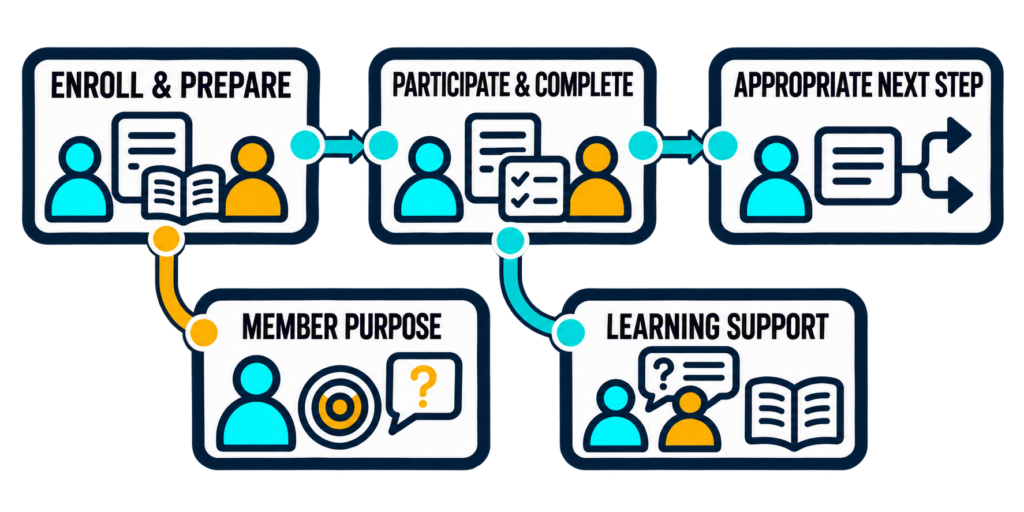
This module helps your team:
- Define the purpose of one learning journey.
- Connect the opportunity to member questions and goals.
- Examine readiness and participation expectations.
- Review enrollment, access, and orientation.
- Trace the first meaningful learning activity.
- Identify where continued participation becomes difficult.
- Clarify questions, feedback, and support routes.
- Examine permitted pause and return options.
- Explain progress and completion requirements.
- Connect appropriate application and next steps.
- Develop a focused participation improvement brief.
- Outline a connected learning configuration.
What should happen to each part of the learning journey?
The review leads to a deliberate response based on the member’s purpose, the program’s requirements, and the conditions affecting participation.
Confirm
Retain a route that fits the intended purpose and provides workable expectations and support.
Clarify
Explain program fit, commitments, activities, progress, or completion requirements.
Prepare
Provide the orientation or guidance needed to begin and approach the next activity.
Support
Resolve questions or connect members to appropriate help with participation difficulties.
Adjust
Revise the participation route or explain permitted changes in pace, timing, or format.
Connect
Link completion, a pause, or an unmet need to an appropriate next opportunity or conclusion.
These responses guide the participation experience. They do not waive program requirements or establish learning achievement from activity records alone.
What should a learning participation review examine?
The purpose
What question, goal, responsibility, or requirement brings the member to the learning opportunity?
The expectations
What preparation, time, activities, and completion requirements should the member understand before enrolling?
The entry
How does the member move through registration, access, orientation, and the first meaningful activity?
The support
Where can members receive answers, feedback, practical help, or clarification when participation becomes difficult?
The progression
How do members understand what remains and explore any permitted pause, return, or alternative route?
The next step
What application, further learning, recognition, support, or conclusion is appropriate after the selected experience?
Trace one learning journey from discovery to the next step.
Your team applies the method to one learning participation journey established through Member Engagement Direction.
STEP 1
Define the member purpose
Identify the population, question, goal, or requirement within scope.
STEP 2
Review fit and expectations
Examine how the opportunity explains its relevance, starting requirements, commitments, and completion conditions.
STEP 3
Follow enrollment into participation
Trace registration, access, orientation, the first activity, and the point where the selected difficulty occurs.
STEP 4
Examine support and choices
Review questions, feedback, assistance, progress information, and any permitted pause, return, or adjustment.
STEP 5
Choose a response
Confirm, clarify, prepare, support, adjust, or connect the parts of the journey that need attention.
STEP 6
Assign and test the change
Identify the owner, proposed improvement, member feedback needed, next-step responsibilities, and starting configuration requirements.
The result is a draft Learning Participation Journey Map connecting member purpose, enrollment, participation, support, completion, and an appropriate next step.
FUTURE PRODUCT CONNECTION
Keep learning opportunities connected to member purpose and practical support.
A subsequent Gobekli configuration could help the organization relate learning programs to member-selected goals, participation expectations, support routes, and next-step opportunities.
TalentSync could connect programs and activities to their purposes, starting requirements, responsible teams, participation stages, and available support.
TalentPass could help members express relevant goals, experience, participation preferences, and the progress or application they choose to share. Pythia could help clarify program fit, explain expectations, prepare questions, or explore an appropriate next step using the information and permissions in scope. Passport Pages could support agreed source and sharing connections.
A connected learning participation view could potentially show:
- What purpose brings a member to the opportunity.
- Which program could address that purpose.
- What starting requirements and commitments apply.
- How enrollment connects to access and orientation.
- Which participation stage is recorded and by which source.
- What questions or support requests the member has shared.
- Who is responsible for responding.
- Which permitted pause, return, or continuation options exist.
- What supports the recorded completion status.
- Which application or next-step opportunity the member chooses.
The workshop produces a starting configuration brief: member context, program profiles, enrollment and participation states, support roles, completion source responsibilities, sharing choices, and next-step relationships.
Specific learning-platform connections, progress imports, suggestions, messaging, reminders, and workflows would be confirmed during solution planning.
PRODUCT AND DECISION BOUNDARIES
Participation records need context before they become conclusions.
Enrollment can establish a decision to join without showing that the member has begun.
Activity records can show interactions with a learning environment without explaining understanding, effort, or the reasons for a pause.
A later configuration should distinguish registration, recorded participation, completion, assessment results, and member-reported application.
The workshop and product connection do not establish:
- Readiness based only on a member’s job title.
- Understanding based only on content views.
- Lack of motivation inferred from inactivity.
- Capability based only on course completion.
- Application inferred from a completion record.
- Permission to expose private learning reflections.
- Authority to change credential or program requirements.
Program owners remain responsible for requirements, assessment decisions, support arrangements, and the interpretation of their records.
The workshop can clarify the journey and its responsibilities independently of future product adoption.
What to bring into the conversation
You do not need a new learning platform or a complete program redesign.
Begin with one learning journey connected to the participation challenge established through Member Engagement Direction.
Useful inputs may include:
- The purpose of the selected learning opportunity.
- Program descriptions and entry requirements.
- Enrollment and access instructions.
- Orientation and preparation materials.
- Activity and completion expectations.
- Examples of member questions or difficulties.
- Support and feedback arrangements.
- Available participation and completion records.
- Permitted pause, return, or adjustment options.
- Application and next-step opportunities.
- A program lead and participant perspective.
- The owner of a proposed improvement.
The aim is to examine one journey in sufficient detail to make a practical change. The foundation module establishes the population, purpose, evidence, and boundaries for that work.
What this module can help clarify
Why members enroll
Connect the opportunity to member purpose, starting requirements, and realistic expectations.
How members begin and continue
Clarify access, orientation, activities, support, and the points where participation becomes difficult.
What completion leads to
Explain recorded completion and identify appropriate application, continuation, support, or conclusion.
What should change next
Develop an assigned improvement and test plan, supported by a starting configuration brief.
These outputs begin with the example reviewed during the module. Final scope depends on the modules selected, available inputs, and the participation challenge established through Member Engagement Direction.
Where might the work lead next?
Benefit & Opportunity Discovery
Clarify how members find and compare learning opportunities before deciding which route fits their needs.
Mentoring & Peer Support Participation
Develop an agreed support arrangement when members would benefit from continuing guidance or shared reflection alongside learning.
Participation Barriers & Inclusive Access
Examine broader access difficulties when time, cost, technology, format, or other participation conditions affect the learning journey.
Your team can combine this module with other parts of the Member Engagement Workshop according to the participation challenge established through Member Engagement Direction.
Frequently asked questions
Questions organizations ask before beginning.
It includes discovery, deciding whether the opportunity fits, enrollment, access, orientation, activities, support, completion, and an appropriate next step.
It concerns the conditions that help members carry out their intended participation and decide what happens afterward. That may involve continuing, completing, applying learning, seeking support, or making an informed change.
Self-paced courses, cohort programs, live learning sequences, professional development pathways, and other structured offerings. The exercise focuses on one manageable journey or a defined part of a larger program.
The module examines the member’s route through the learning experience. It can reveal unclear activities or expectations, while detailed work on outcomes, instructional design, and assessment belongs in the relevant learning-focused workshops.
No. The method can be applied to learning delivered through meetings, email, shared resources, partner platforms, or an existing LMS. System requirements follow from the participation route the team decides to support.
Yes. Trace a proposed member journey using the current description, enrollment process, activities, and support plan. The exercise can identify assumptions to test before a wider launch.
Begin with what the records actually show and what members choose to explain. Inactivity alone does not establish whether the issue concerns time, access, expectations, support, fit, or a changed priority.
A reminder may help someone act on an intention they still hold. First examine whether the member needs information, assistance, a permitted adjustment, or a different route. Repetition does not resolve every participation difficulty.
The program’s purpose, intended participants, starting requirements, format, time commitment, activities, costs, support, and completion conditions relevant to their decision.
Review the handoff from registration to access and orientation. Clarify what to do first, what preparation is needed, and whom to contact when access or instructions are unclear.
Yes. The review examines what options the program permits, how members understand them, and how they resume with appropriate context. It does not assume every program can offer the same flexibility.
Completion establishes that stated completion requirements have been met according to the responsible source. Whether it supports a capability claim depends on the learning and assessment involved, which may require a separate review.
Identify an appropriate opportunity to try, reflect on, or extend relevant learning. Clarify what help is available and what the member chooses to share. An invitation to apply learning does not establish that application has occurred.
The events module connects individual gatherings to preparation, participation, follow-up, and opportunities between events. This module follows a structured learning journey with program commitments, progress, support, completion, and next steps.
This module examines difficulties within one learning journey. The access module can extend the work when barriers across formats, systems, schedules, costs, or participation arrangements require broader attention.
The outputs can inform a configuration connecting member-selected goals, programs, participation stages, support requests, responsible sources, completion context, and next-step opportunities. Specific capabilities and implementation requirements would be confirmed during scoping.
Your team will review one bounded learning journey and develop a draft participation map, assigned improvement and test plan, and starting configuration brief. Wider rollout and ongoing operation are subsequent steps.
GIVE LEARNING INTENT A WORKABLE ROUTE FORWARD
Help members begin, stay supported, and choose what comes next.
Connect learning discovery, enrollment, participation, and completion to clear expectations, practical help, and an appropriate next step.
This module is part of Gobekli’s configurable Member Engagement Workshop.
