
MEMBERSHIP VALUE WORKSHOP MODULE
Membership Value Direction
“Improve membership value” can mean several different things. Define whose question matters, which decision needs support, and what membership should enable before choosing where to focus the work.
Does this sound familiar?
Everyone means something different by value
Leadership discusses renewal, program teams discuss participation, and members describe the practical help they need.
The question is too broad to act on
The team wants to demonstrate the value of membership without identifying a particular audience, offering, or decision.
The payer and participant need different answers
An employer funds membership while the individual using it has goals and experiences that do not fit the same value account.
The benefit list becomes the starting point
The conversation begins with what the organization offers before clarifying what those offerings should help someone accomplish.
Available measures shape the conclusion
Attendance, completion, satisfaction, or renewal records become substitutes for examining the benefit the team actually needs to understand.
The workshop has no clear decision owner
People can discuss improvements, but responsibility for choosing, implementing, and reviewing a response remains uncertain.
What is membership value direction?
Membership value direction is the shared definition of the question a value review needs to answer.
It identifies whose perspective matters, what membership is intended to enable, and which organizational decision the work should support.
It also establishes what evidence is available, which perspectives are missing, who holds relevant responsibilities, and what remains outside the engagement.
A question about a professional development program may require a different review from a question about organizational membership, benefit packaging, or collective representation.
This required foundation creates the brief that guides the selected Membership Value Workshop modules.
A useful value review begins with a decision someone needs to make.
An organization may want to “show more value” because renewal conversations have become difficult.
That concern can lead toward several different questions.
Does the offering fit the audience? Is its purpose clear? Has it helped members in ways the organization can substantiate? Does the person paying understand the benefit? Is the membership package difficult to evaluate?
Those questions are related, but they require different inputs and responses.
The foundation identifies the decision that needs support and the value question that will help the team make it.
That direction makes it possible to choose a manageable example, involve the appropriate people, and define what a useful workshop result would look like.
See the decisions that shape the value review.
Whose Perspective
Individual members
Paying organizations
People using the benefits
Relevant member differences
Perspectives requiring input
Decision and Scope
Decision to support
Offering or portfolio in scope
Alternatives being considered
Time horizon
Practical boundaries
Intended Benefit
Member purpose
Organizational purpose
What the offering should enable
Conditions that matter
Limits of the promise
Evidence and Questions
Available source records
Member accounts
Observed results
Interpretations and assumptions
Missing evidence
Responsibility and Follow-Through
Decision owner
Benefit owner
Relevant contributors
Validation responsibilities
Review and next steps
The foundation connects these elements into one working brief so later modules address the same question.
How a broad value concern becomes an unfocused project
STAGE 1 — A concern creates urgency
A difficult renewal conversation, changing member expectations, or pressure on a program prompts the organization to examine value.
STAGE 2 — Different interpretations accumulate
Teams bring concerns about communications, participation, benefits, pricing, and outcomes into the same discussion.
STAGE 3 — Familiar measures take over
The review follows the reports already available, even when they do not answer the decision at hand.
STAGE 4 — Recommendations lack a shared purpose
The team produces a wide set of ideas without agreement on whose needs they serve, what they should improve, or who can act.
A value question should identify what needs to become clearer.
An initial concern may sound like this:
How can we demonstrate more membership value?
A focused review also asks whose decision the explanation should support, which benefit matters, and what evidence would make the account useful.
The review should clarify:
Identify the member population, paying organization, participant, or other relevant perspective. Clarify where their needs differ.
Name the choice the organization needs to make, such as improving an offering, reviewing a package, clarifying recognition, or preparing a credible value account.
Describe the practical benefit or contribution being examined, including the conditions that affect whether it can occur.
Identify relevant records, member accounts, reviewed examples, and other sources. Distinguish evidence from interpretation.
Identify missing perspectives, uncertain assumptions, and questions the workshop cannot resolve from existing information.
Clarify decision rights, operating responsibilities, validation needs, and the person accountable for carrying the brief forward.
A useful direction needs six forms of clarity.
Audience
The team knows whose experience and decision the value question concerns.
Decision
The workshop supports an identifiable organizational choice.
Benefit
The team can explain what membership or the selected offering is intended to enable.
Evidence
Available information has a known source, scope, and relationship to the question.
Ownership
Relevant decision, delivery, and review responsibilities are assigned.
Boundary
The team understands what the engagement will examine and what requires subsequent work.
A focused value direction
A workable brief establishes:
- A defined audience or membership arrangement.
- A specific decision that needs support.
- An intended benefit worth examining.
- A manageable offering or example.
- Evidence and assumptions kept distinguishable.
- An owner and a clear next step.
The selected modules can then investigate different parts of the same question.
An open-ended value discussion
A review becomes difficult to complete when it relies on:
- “All members” as a single assumed audience.
- A general instruction to prove value.
- Every benefit being examined at once.
- Measures chosen because they are easy to retrieve.
- Unstated expectations about the final recommendation.
- No agreement on who can implement a response.
The foundation turns that broad concern into work the team can carry forward.
An employer-funded membership question can become a focused review.
A professional association hears that some employers are questioning whether to continue funding memberships for their staff.
Leadership initially asks the team to demonstrate the return on every member benefit.
The foundation narrows the starting point to one organizational membership arrangement and a defined group of staff using its professional development offerings.
Participants identify the decision: what should change in the benefit explanation and supporting evidence before the next employer value conversation?
They distinguish the employer’s interest in useful development from the individual member’s goals and sharing preferences.
The team reviews what it currently knows about access, completion, and reported application. It identifies where those records stop short of explaining the benefit.
A membership lead owns the value conversation. A program owner contributes the offering’s purpose and requirements. Employer and member perspectives are identified for validation.
The team selects Employer & Organizational Membership Value and Professional Learning & Development Value as the initial problem modules.
The result is a bounded review with a practical decision, relevant participants, and an explicit distinction between available evidence and conclusions still to be tested.
Different perspectives can belong in the same review without becoming one answer.
The member using an offering, the employer funding membership, and the organization providing it may each ask a different question.
An individual may value professional confidence or access to a community. An employer may want to understand development relevant to the person’s work. The association may need to decide whether to strengthen the program.
The foundation identifies those perspectives and establishes which decision leads the engagement.
It also clarifies what information each party needs and what can appropriately be shared.
A useful brief can connect the perspectives while preserving their differences.
It should not assume that one person’s participation record answers every stakeholder’s value question.
The direction should be specific enough to guide work and open enough to learn.
A workshop should not begin with a conclusion that the evidence is expected to confirm.
The team may believe a benefit needs better explanation and discover that the offering itself needs improvement.
It may expect to create a financial value statement and find that a more useful account concerns learning, access, recognition, or collective contribution.
The foundation records those initial interpretations as assumptions.
It establishes a process for revisiting the scope when the selected modules reveal something material.
Changes to the direction should remain explicit, with the decision owner understanding why the focus changed and what that means for the work.
THE MATCHING WORKSHOP MODULE
Module 1: Membership Value Direction
This required foundation helps membership organizations define whose value question matters, the organizational decision, intended benefit, available evidence, responsibilities, and boundaries the workshop should address.
Participants learn how to frame a useful value question, apply the method to their organization’s concern, and create the direction brief used by the selected problem modules.
The exercise also identifies the audience, offering, intended-benefit relationships, source context, responsible roles, and sharing boundaries that a subsequent Gobekli configuration would need to support.
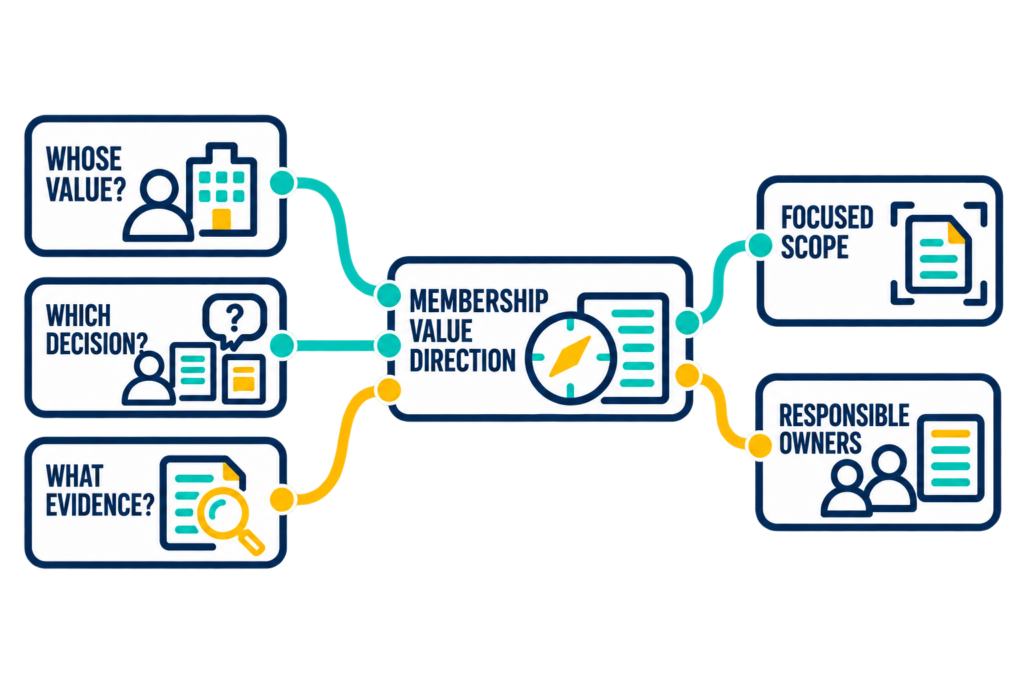
This module helps your team:
- Define the value concern prompting the workshop.
- Identify the audience and perspectives involved.
- Name the organizational decision to support.
- Clarify the intended benefit.
- Select a manageable offering or example.
- Establish an appropriate time horizon.
- Inventory relevant evidence and source limitations.
- Distinguish assumptions from supported findings.
- Identify missing perspectives and validation needs.
- Assign decision and operating responsibilities.
- Select the relevant problem modules.
- Create the starting direction and configuration brief.
What should happen to each part of the proposed scope?
The foundation leads to a deliberate response based on the decision, audience, available evidence, and practical capacity of the engagement.
Confirm
Retain a question or example that directly supports the agreed decision.
Clarify
Make an ambiguous audience, intended benefit, responsibility, or term understandable.
Narrow
Reduce the scope to an offering, population, or decision the workshop can examine meaningfully.
Separate
Distinguish questions that require different evidence, participants, or decisions.
Validate
Identify assumptions or missing perspectives that need additional input.
Defer
Record work that matters but belongs outside the current engagement.
These responses establish a useful starting scope. They do not predetermine what the selected modules will conclude.
What should a membership value direction review examine?
The initiating concern
What has prompted the organization to examine value, and what is currently difficult to understand or decide?
The relevant audience
Whose needs, experience, funding decision, or membership arrangement should the work consider?
The decision
What choice should become better informed through the workshop, and who has authority to make it?
The intended benefit
What should membership or the selected offering enable, and which conditions affect that benefit?
The evidence position
What information is available, what does it support, and which questions remain unresolved?
The operating scope
Which people, examples, modules, responsibilities, and boundaries will make the work manageable?
Turn one broad concern into a shared direction brief.
Your team applies the method to the membership value question that prompted the engagement.
STEP 1
State the concern
Describe what is difficult to explain, improve, or decide without assuming the cause.
STEP 2
Identify the perspectives
Define the audience, participant, payer, and other perspectives that materially affect the question.
STEP 3
Name the decision and benefit
Clarify the organizational choice and what the selected offering is intended to enable.
STEP 4
Review the evidence position
Identify available records, member accounts, assumptions, missing perspectives, and validation needs.
STEP 5
Set the boundaries and responsibilities
Choose the example, time horizon, decision owner, contributors, and work that remains outside scope.
STEP 6
Select the modules and next steps
Choose the problem modules, agree on useful outputs, and assign preparation and follow-through.
The result is a draft Membership Value Direction Brief connecting the audience, decision, intended benefit, evidence position, selected modules, responsibilities, and boundaries.
FUTURE PRODUCT CONNECTION
Give the future configuration a defined purpose.
A subsequent Gobekli configuration could help the organization maintain the relationships that matter to the agreed value question.
TalentSync could connect the selected benefits and intended outcomes to organizational audiences, responsible roles, source records, and review needs.
TalentPass could help members express relevant goals and organize experience or evidence they choose to share. Pythia could help clarify the question, surface missing context, or explain the available account within the information and permissions in scope. Passport Pages could support agreed source connections and sharing arrangements.
A connected value review could potentially show:
- Which audience and membership arrangement are in scope.
- What organizational decision the review supports.
- Which benefit or offering is being examined.
- What it is intended to enable.
- Which conditions affect that intended benefit.
- What evidence and member accounts are available.
- Which interpretations remain assumptions.
- Who owns the offering, decision, and review.
- Which information can be shared for which purpose.
- What needs validation or reconsideration as circumstances change.
The foundation produces a starting configuration brief: audience definitions, benefit and outcome relationships, relevant profiles, evidence sources, responsible roles, sharing boundaries, and review questions.
The selected modules develop that brief further. Specific interfaces, integrations, evidence workflows, and review processes would be confirmed during solution planning.
PRODUCT AND DECISION BOUNDARIES
A defined question does not establish its answer.
The foundation organizes the work needed to examine membership value.
It does not establish that a particular benefit is effective, that a package is appropriately priced, or that a value claim is supported.
A later configuration should distinguish the intended benefit, observed activity, member account, reviewed evidence, organizational interpretation, and decision.
The workshop and product connection do not establish:
- A shared definition of value across all members.
- An outcome based only on access or participation.
- A financial return without appropriate evidence.
- The organization’s sole responsibility for a wider outcome.
- Permission to share individual information with a paying organization.
- A predetermined recommendation about benefits, dues, or renewal.
- An organization-wide conclusion from one bounded example.
- Product capability or implementation scope beyond what has been confirmed.
The organization retains responsibility for its decisions, value statements, and commitments to members.
The direction brief remains useful independently of future product adoption.
What to bring into the conversation
You do not need a complete membership value assessment before beginning.
Start with the concern that prompted the workshop and the decision your organization needs help making.
Useful inputs may include:
- A short description of the value concern.
- The member population or membership arrangement involved.
- The decision and its responsible owner.
- Relevant benefit or program descriptions.
- The membership promise currently being communicated.
- Examples of questions from members or paying organizations.
- Available activity, feedback, or outcome records.
- Known limitations in those records.
- Current assumptions about what needs to change.
- Relevant deadlines and practical constraints.
- People who understand the offering and its delivery.
- Member or organizational perspectives requiring input.
The aim is to establish a shared direction, identify appropriate preparation, and select a manageable set of problem modules.
What this module can help clarify
Whose question leads the work
Define the audience and distinguish other perspectives that need to inform the review.
Which decision needs support
Connect the value concern to an organizational choice and an intended benefit.
What can be examined now
Identify a bounded example, available evidence, assumptions, and additional input needed.
How the workshop moves forward
Select the problem modules, assign responsibilities, and establish the starting direction and configuration brief.
These outputs establish the foundation for the selected modules. Final workshop scope depends on the agreed question, available information, participants, and practical boundaries.
Where might the work lead next?
Membership Value Proposition & Differentiation
Examine the membership promise when the core question concerns relevance, audience fit, or meaningful differences from alternatives.
Benefit Portfolio Relevance & Gaps
Review the offerings when the decision concerns duplication, outdated benefits, missing support, or investment priorities.
Member Value Evidence & Renewal Conversations
Develop a credible value account when the priority is helping members or paying organizations make an informed renewal decision.
Your team can combine this foundation with other parts of the Membership Value Workshop according to the value question and decision established here.
Frequently asked questions
Questions organizations ask before beginning.
The other modules need a shared audience, decision, intended benefit, and scope. This foundation establishes that direction so the selected exercises contribute to the same purpose.
That is enough to begin. The foundation helps clarify who is asking, what they need to understand, and which organizational decision should follow.
No. A particular benefit, audience, membership arrangement, or decision can provide a useful starting point. Wider conclusions require wider evidence and review.
Include someone who owns the decision, people who understand the relevant offering, and appropriate member or payer perspectives. The exact participants depend on the question.
Yes. The foundation distinguishes those perspectives and identifies which decision leads the engagement. It also clarifies what information can appropriately move between them.
Make the differences explicit. The exercise helps separate competing interpretations, identify a shared decision, and determine whether distinct questions require separate work.
It is what membership or the selected offering is meant to help someone accomplish or access. Examples include practical development, useful support, professional recognition, exchange, or collective representation.
No. The foundation identifies what information exists and where the gaps are. Missing evidence becomes part of the work to plan rather than a reason to invent a conclusion.
Yes, within their scope. They describe activity or membership decisions but may not explain the benefit received or the reason behind a decision.
Select the modules that investigate the most important parts of the agreed value question. A typical workshop combines this foundation with two or three problem modules.
Yes, when new information justifies it. The change should be explicit, with the decision owner understanding its effect on scope, outputs, and follow-through.
It can frame the questions and evidence those decisions require. It does not establish a price or organization-wide strategy from the foundation exercise alone.
Member Intelligence Direction defines a question about what the organization needs to understand about its members. Membership Value Direction defines a question about what membership enables and which decision that understanding should support.
Member Engagement Direction focuses on a participation experience. Membership Value Direction focuses on the intended benefit, its relevance, and the evidence needed to examine or explain it.
No. The direction brief guides the workshop and subsequent organizational action independently of software adoption.
The brief can inform a configuration connecting audiences, benefits, intended outcomes, evidence, responsible roles, and sharing boundaries. The selected modules and later scoping establish the relevant details.
Your team will develop a draft Membership Value Direction Brief, select the relevant problem modules, and assign preparation and follow-through. Broader assessment, validation, and implementation continue through the selected work.
START WITH THE VALUE QUESTION THAT MATTERS
Give the workshop a decision to support and a benefit to examine.
Align the audience, intended benefit, evidence, responsibilities, and boundaries before choosing the work that follows.
Membership Value Direction is the required foundation for Gobekli’s configurable Membership Value Workshop.
