
MEMBER INTELLIGENCE WORKSHOP MODULE
Participation & Contribution Visibility
You can see who attended. Can you see what members actually contributed?
Understand what members do across activities and programs by connecting attendance, responsibilities, contributions, and the context needed to interpret each.
Module 7 · Member Intelligence Workshop
Does this sound familiar?
Attendance becomes the whole story.
Registrations and check-ins are easy to count. Preparation, mentoring, problem-solving, and work between meetings may remain invisible.
A role does not show what happened.
Committee membership or a volunteer title may identify an assignment without showing the responsibilities undertaken or work completed.
Contributions stay inside individual programs.
A chapter, event team, or working group may know what a member contributed while the wider organization sees only disconnected records.
Staff memory fills the gaps.
Understanding who helped, how, and under what circumstances depends on the people who happened to witness it.
Different activities get treated as equivalent.
Attending a webinar, organizing an event, and developing a professional resource may all appear as another activity on a member record.
Missing records become judgments about people.
Members with little recorded activity may be contributing through channels the organization does not capture—or participating in ways its categories overlook.
What is participation and contribution visibility?
Participation and contribution visibility connects members to the activities they took part in, the responsibilities they held, the work they contributed, and the sources that help explain what happened.
It distinguishes several questions that are often combined:
- Was the member registered, present, or actively involved?
- What responsibility, if any, did the member accept?
- What did the member actually do or help produce?
- What information supports that account?
- What remains unknown?
The aim is to create an understandable account of involvement that supports a defined organizational decision and gives members appropriate ways to clarify their own contributions.
Activity records need context before they become useful intelligence.
An organization may have event registrations, learning records, committee rosters, volunteer assignments, discussion posts, and staff notes.
Each source describes a different part of participation. A registration records an intention. A check-in records presence under a particular process. A roster records an affiliation or assignment. A completed resource may show collaborative work without identifying each person’s contribution.
Combining these records becomes useful when the distinctions remain visible.
This module helps your team examine how a selected participation record was created, what it describes, and what additional context is needed before it informs recognition, program review, member conversations, or future opportunities.
Where member involvement takes place
Events & Convenings
Members attend, speak, facilitate, organize, introduce people, and help others participate. Registration and attendance records may capture only some of these activities.
Learning & Professional Development
Members participate as learners, instructors, reviewers, discussion contributors, and resource developers. Completion records and teaching contributions describe different forms of involvement.
Committees & Governance
Members hold appointments, prepare materials, review proposals, contribute expertise, and carry decisions into action. A committee roster alone cannot explain this work.
Service & Volunteer Programs
Members mentor, support peers, deliver services, coordinate volunteers, and contribute to community projects. Some contributions happen outside formal reporting channels.
Chapters, Networks & Shared Work
Members organize local activities, contribute to working groups, develop shared resources, and support partner initiatives. The relevant context may remain with a local leader or project team.
The workshop begins with the activities relevant to your decision. It does not require a complete inventory of everything every member does.
How contribution becomes difficult to see
1. An activity leaves a limited record.
A system captures a registration, assignment, attendance status, or completion. Other parts of the experience may never be recorded.
2. The record loses its context.
The member, activity, role, time period, and source become separated as information moves between programs or systems.
3. Interpretation fills the gaps.
Presence is treated as contribution, a title is treated as completed work, or a missing record is treated as lack of interest.
4. Decisions inherit those assumptions.
Recognition, invitations, program reviews, and member conversations rely on an incomplete account of what people actually did.
One member. Several records. An incomplete picture.
A member appears on a committee roster, attends two meetings, helps draft a resource between meetings, and supports a newer member privately.
The organization may record the appointment and meeting attendance while missing the drafting work. The private support may appropriately remain outside organizational reporting.
Understanding this member’s involvement requires examining both the available information and the limits of what should be collected.
Questions that change the interpretation:
It may establish presence at particular meetings. It does not necessarily show preparation, participation during the meeting, or work completed afterward.
It identifies a formal relationship or assigned role. The responsibilities actually undertaken may need separate clarification.
Draft histories, project records, coordinator notes, or a member’s own account may help describe it. Relevant sources should remain connected to the contribution they support.
The member, a coordinator, or a collaborator may provide useful context. Their accounts should identify what they know directly and what remains uncertain.
No. The purpose of the review determines what information is needed. Private mentoring or peer support should not automatically become organizational reporting.
It may support an accurate account of the work, an appropriate recognition decision, or a follow-up conversation. Broader claims about capability, commitment, or impact require further support.
Six dimensions of an understandable participation record
Member & Affiliation
Who participated, and in what relevant capacity? Distinguish the individual from a company membership, chapter affiliation, or representative role.
Activity & Purpose
What activity took place, and what was it intended to accomplish? Identify the program, project, event, or working group involved.
Participation & Responsibility
How was the member involved? Separate attendance, active participation, assigned responsibility, and responsibility actually undertaken.
Contribution & Output
What did the member do, support, review, create, or help deliver? Preserve the distinction between individual work and a shared result.
Source & Review Context
Where did the account come from, and what has been clarified or reviewed? Keep member statements, system records, and collaborator observations distinguishable.
Timing & Appropriate Use
When did the involvement occur, what period does it describe, and where may the information appropriately be used or shared?
From activity counts to understandable involvement
A limited activity view
- Number of registrations.
- Number of events attended.
- Committee membership status.
- Volunteer hours without activity context.
- Posts or interactions counted together.
- A combined engagement score.
- Little explanation of missing information.
This view can describe recorded activity, but it leaves important questions about responsibility and contribution unanswered.
A contextual participation view
- The activity and its purpose.
- The member’s relevant role.
- Attendance or participation status.
- Responsibilities undertaken.
- Contributions and associated outputs.
- Sources, review status, and limitations.
- Appropriate uses and unresolved questions.
This view helps people understand what a record supports before using it in a decision.
Worked example: making a working group’s contributions visible
A professional association wants to recognize the members who helped produce a new practice guide.
Its records include a working-group roster, meeting attendance, a shared document, and the project lead’s notes. Several members attended regularly. Others reviewed drafts or contributed specialist examples without joining every meeting.
During the module, the team examines one part of the guide and identifies:
- The work that needed to be done.
- The responsibilities assigned.
- The contributions described by members and the project lead.
- Relevant drafts, comments, and completed materials.
- Contributions that can be reasonably attributed.
- Shared work that should remain described collectively.
- Questions requiring clarification before recognition.
The result is a more accurate contribution account and a repeatable approach for documenting future working groups.
The exercise does not need to rank members or assign a numerical value to each contribution.
Visible participation does not establish every kind of value.
A high activity count does not, by itself, establish commitment, capability, influence, or impact.
Members participate under different circumstances. Available time, employer support, accessibility, geography, and the opportunities offered can affect what appears in organizational records.
Contribution also depends on context. A brief specialist review may be consequential, while many hours may reflect a demanding assignment, inefficient coordination, or incomplete recording.
The module helps your team state what the information supports and identify where further interpretation would be premature.
An incomplete record is a question to investigate.
Low recorded participation can have several explanations.
A member may participate through a chapter whose records are not connected. Their work may occur between formal activities. They may use resources independently, receive value through collective representation, or choose a quieter form of membership.
The organization may also lack the information needed to know.
A useful record can therefore include “not recorded,” “not yet clarified,” or “outside the scope of this review.” These distinctions prevent an information gap from becoming an unsupported judgment about a person.
THE MATCHING WORKSHOP MODULE
Participation & Contribution Visibility
This practical minicourse helps your team examine one real activity or program, distinguish the forms of involvement it contains, and create a clearer account of member participation and contribution.
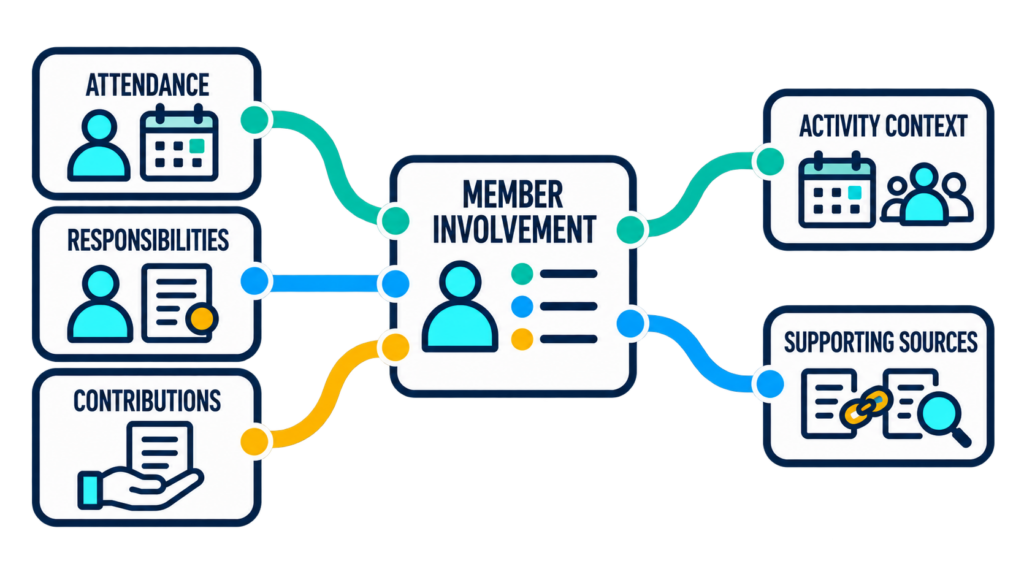
This module helps your team:
- The organizational decision the information should support.
- The member population and activity in scope.
- How attendance and participation are recorded.
- Formal roles and assigned responsibilities.
- Work completed within and between activities.
- Individual and shared contributions.
- Available sources and their limitations.
- Member clarification and review needs.
- Timing, duration, and current relevance.
- Missing or disconnected records.
- Appropriate access and sharing.
- Responsibilities for keeping the information useful.
What might an appropriate response involve?
The right response depends on why participation is difficult to understand.
Clarify the Meaning
Seek further explanation where a comment, request, or summary is ambiguous.
Preserve the Context
Keep the relevant question, source, experience, and timing attached to the input.
Examine the Pattern
Compare related feedback while retaining meaningful differences and contradictory accounts.
Seek Further Evidence
Identify which missing perspectives or unanswered questions could change the interpretation.
Assign the Response
Route individual issues and broader findings to the people responsible for reviewing and acting.
Communicate the Outcome
Explain what was heard, what happens next, and what remains under consideration.
A useful response may begin with clearer definitions or a better handover process. A later product configuration can support the agreed approach.
What we review together
Decision & Intended Use
What needs to be understood, who will use the information, and what action it could inform.
Activity & Program Structure
The events, projects, responsibilities, and outputs that provide context for participation.
Member Connections
How individuals are connected to activities, affiliations, assignments, and shared work.
Source Records
What registrations, rosters, project records, member accounts, and observations actually establish.
Interpretation & Gaps
Where records are incomplete, categories are ambiguous, or conclusions exceed the available information.
Ownership & Maintenance
Who clarifies records, reviews changes, manages access, and keeps the account current.
The minicourse: make one participation account understandable
Your team applies the concepts to a bounded example, such as a committee project, mentoring cohort, chapter event, or volunteer program.
STEP 1
Step 1 — Choose the decision and activity.
Select the question the organization needs to answer and the activity that provides a useful starting point.
STEP 2
Step 2 — Separate the forms of involvement.
Identify attendance, participation, assigned responsibility, work undertaken, and contribution. Agree which distinctions matter for this example.
STEP 3
Step 3 — Examine the available records.
Review a small set of relevant sources. Identify how each record was created, what it describes, and what it cannot establish.
STEP 4
Step 4 — Build a contextual contribution account.
Connect the member, activity, role, contribution, timing, and supporting sources. Preserve collective work and unresolved attribution where appropriate.
STEP 5
Step 5 — Review interpretation and access.
Identify what needs clarification, who can review it, and which information is appropriate for the intended audience.
STEP 6
Step 6 — Define the response and starting configuration.
Choose practical improvements and outline the records, relationships, views, and responsibilities a subsequent implementation would need.
Exercise output
A draft Participation & Contribution Map for the selected activity, with interpretation limits, clarification needs, and a practical next step.
- A defined decision and activity.
- Clear participation distinctions.
- Connected source context.
- A draft contribution account.
- Review and sharing boundaries.
- An assigned next step.
FUTURE PRODUCT CONNECTION
How this work can connect to Gobekli
The workshop establishes what a useful participation account needs to contain and how it should be interpreted. That work can inform a scoped Gobekli configuration.
A TalentSync configuration could connect organizational activities, member roles, contributions, outputs, and appropriate source context. TalentPass could support member-held accounts of experience and selective sharing. Pythia could guide clarification where suitable functionality is available and included in scope.
The configuration begins with the decisions and information needs established during the workshop.
Potential configuration mapping
- Participation records refer to different people or affiliations ambiguously. Connections among member identities, relevant affiliations, and activity records.
- Activity names provide little explanation. Program and activity records with purpose, dates, owners, and relevant relationships.
- Attendance and contribution are mixed together. Distinct participation categories with definitions appropriate to the activity.
- Formal titles obscure the work undertaken. Relationships connecting roles and assignments to described responsibilities.
- Contributions are difficult to explain. Contextual contribution records linked to activities and outputs.
- Supporting information becomes detached. Source references and review context associated with the relevant account.
- Members need to clarify their involvement. Member input and correction processes with defined review responsibilities.
- Different audiences need different information. Scoped views and access rules based on purpose and appropriate sharing.
- Members want to carry suitable experience forward. TalentPass sharing of relevant experience or recognition, subject to the agreed scope.
- Records lose relevance over time. Ownership, review dates, and maintenance processes for keeping accounts useful.
Specific capabilities, integrations, and implementation scope would be confirmed during solution planning.
PRODUCT AND DECISION BOUNDARIES
What this module does—and its boundaries
The module helps your team:
- Understand the distinctions within participation records.
- Examine one real activity or program.
- Connect involvement to relevant context.
- Identify unsupported interpretations and information gaps.
- Plan practical improvements.
- Prepare a starting configuration brief.
The module does not establish:
- A universal engagement or contribution score.
- A ranking of members by value.
- Proof of capability from attendance alone.
- An audited account of every contribution.
- An organization-wide data integration.
- Permission to expose private member interactions.
The exercise provides a practical starting point. Broader recognition policies, participation redesign, capability review, or system implementation may require additional work.
What to bring into the conversation
Begin with one question that member input could help answer, or one collection of feedback that has been difficult to turn into a clear next step.
A useful starting question is: “What are members telling us about this experience, what does that evidence support, and who should do what next?”
Useful inputs may include:
- A decision involving member participation or contribution.
- One activity, program, project, or committee to examine.
- A small sample of relevant participation records.
- Role descriptions or assignment information.
- Available outputs or supporting materials.
- Existing participation categories or reporting examples.
- The person responsible for the decision.
- A program, committee, chapter, or volunteer coordinator.
- Someone familiar with the source records.
- A member perspective where appropriate.
- Someone responsible for access or information practices.
- A person who could own the next step.
Bring what is available and appropriate to share. Anonymized or representative examples can support the exercise when identifiable records are unnecessary.
What this module can help your team produce
A Participation & Contribution Brief
A clear account of the decision, activity, participation distinctions, available sources, and limits of the review.
A Contextual Participation Map
A structured view connecting members, activities, roles, contributions, outputs, and relevant source information.
A Clarification & Improvement Plan
Assigned next steps for resolving ambiguity, improving contribution capture, and reviewing appropriate uses.
A Starting Configuration Brief
An outline of the records, relationships, member input, access boundaries, and maintenance responsibilities a subsequent Gobekli implementation would need.
These outputs begin with the example examined during the module. Final scope depends on available inputs, selected modules, and the decision established through Member Intelligence Direction.
Where might the work lead next?
A participation review may reveal contributions that need deeper explanation, relationships that remain difficult to see, or source records that cannot yet be connected.
Member Expertise & Hidden Capability
Examine the experience and capabilities behind a contribution before drawing conclusions about what a member could do in another context.
Member Relationships & Network Visibility
Understand the relationships surrounding shared activities, collaboration, mentoring, and other member connections.
Fragmented Member Data & System Connections
Examine how participation records are distributed across programs and systems, and what would be needed to connect them responsibly.
Findings may also inform the Member Engagement Workshop when the priority is improving participation opportunities, or the Membership Value Workshop when the question concerns what involvement enables for members.
Frequently asked questions
Questions membership organizations ask before beginning.
It connects member involvement to the activity, role, work, timing, and source context needed to understand it. The aim is to support a defined decision with a clearer account of what happened.
Attendance describes presence under a particular recording process. Contribution visibility also examines responsibilities, work undertaken, and relevant outputs, including work that happens outside scheduled activities.
This module focuses on understanding existing participation and contribution. Its findings can inform engagement work, but designing onboarding, outreach, or participation opportunities belongs in the relevant engagement modules.
No. The exercise preserves meaningful distinctions among forms of involvement. It does not require combining different activities into a score or ranking members.
Yes. Registrations, attendance records, committee rosters, project materials, and appropriate member accounts can provide a starting point. The module examines what those sources establish and where context is missing.
No. A small, relevant sample is enough to explore the problem. Missing information becomes part of the review and helps identify practical next steps.
A role describes a position or responsibility. A contribution describes work undertaken or support provided in a particular context. The module helps relate the two without assuming that an appointment proves completed work.
Yes. Member accounts can add important context. The source of the account should remain visible, and any review needed for its intended use should be defined.
Relevant information might include completed materials, project records, draft comments, coordinator observations, or collaborator accounts. Its usefulness depends on the claim being made and the decision it will support.
Preserve the collective result and describe individual roles where there is sufficient context. Avoid assigning sole credit or precise shares of contribution when the available information does not support them.
Begin by examining coverage and context. The member may participate through unconnected channels, contribute informally, or engage in ways that are not recorded. The available information may also be insufficient to explain the pattern.
Only to the extent appropriate for the purpose and the expectations of the people involved. Recording that a mentoring role occurred does not require capturing private conversations or personal details.
It may provide relevant experience to examine, but attendance or a role title alone does not establish expertise. The Member Expertise & Hidden Capability module explores how experience and capability can be understood more fully.
They can provide a clearer factual basis for consideration. Recognition still requires appropriate criteria, review, and organizational responsibility.
The workshop does not assume replacement. It identifies the information and relationships needed, then helps clarify what a later implementation would require from existing sources.
The outputs can inform a scoped configuration connecting activities, members, roles, contributions, and supporting context. Member clarification, selective sharing, and organizational views would be considered according to the agreed purpose and available capabilities.
Your team will examine one bounded example and create a draft brief, contextual participation map, improvement plan, and starting configuration brief. Wider rollout and implementation are subsequent steps.
Make member involvement easier to understand.
Start with one activity, connect the context behind its records, and give your team a clearer basis for understanding participation and contribution.
Choose Participation & Contribution Visibility as part of your Member Intelligence Workshop.