
MEMBER INTELLIGENCE WORKSHOP MODULE
Fragmented Member Data & System Connections
Your systems each hold part of the member story. Can those parts be connected?
Trace information across membership, events, learning, community, and other sources to clarify identity, source responsibilities, and useful connections.
Module 10 · Member Intelligence Workshop
Does this sound familiar?
One member appears as several different people.
Separate accounts, changed email addresses, and inconsistent identifiers make it difficult to determine which records belong together.
Reports require another spreadsheet exercise.
Staff repeatedly export, compare, and combine records to answer questions that cross programs or systems.
The same field means different things.
“Member,” “active,” “completed,” or “organization” carries different meanings across sources, creating misleading comparisons.
Conflicting records have no clear resolution path.
Teams disagree about which source should guide a particular use or who is responsible for reviewing and correcting the information.
Connections move data but lose its meaning.
Information arrives in another system without the activity context, dates, definitions, or source references needed to interpret it.
No one knows whether the combined view is current.
Updates, corrections, and failed transfers are difficult to trace, leaving staff uncertain about what the connected information actually reflects.
What is fragmented member data?
Member data becomes fragmented when information needed for a particular purpose is distributed across sources that cannot be interpreted together reliably.
Those sources may include membership systems, event platforms, learning systems, community spaces, chapter records, partner reports, spreadsheets, and information provided directly by members.
The problem can involve several different gaps:
- Records cannot be confidently connected to the same person.
- Individuals and organizations are confused.
- Field names hide different definitions.
- Relevant context remains in a separate source.
- Responsibility for an item of information is unclear.
- Updates and corrections do not reach the places that use them.
- The organization cannot explain how a combined view was produced.
A useful system connection addresses the information need while preserving the distinctions required to understand and maintain it.
Connecting systems begins with the question the information should answer.
An organization may want to understand participation across programs, identify members with relevant experience, or examine whether a particular group is receiving useful support.
Each question requires a different combination of information.
Connecting every available field can create more complexity without resolving the underlying uncertainty. A useful starting point is to identify the information needed, where it comes from, and how the relevant records relate.
This module helps your team trace one information need across its sources and define what a dependable connection would require.
The result is a practical basis for deciding what to clarify, correct, connect, or investigate further.
Where member information lives
Membership & Organization Records
Membership arrangements, contact details, company relationships, chapter affiliations, and administrative status provide part of the organizational context.
Events & Participation Systems
Registrations, attendance, speaker roles, volunteer assignments, and event feedback describe different aspects of participation.
Learning & Recognition Systems
Enrollments, course activity, completion records, assessments, and recognitions provide information about particular learning experiences.
Community & Collaboration Spaces
Group membership, discussions, shared projects, and collaborative work may add context that formal membership records do not contain.
Local, Partner & Member-Provided Sources
Chapter spreadsheets, partner reports, staff records, and information shared by members can fill important gaps while introducing different definitions and responsibilities.
The workshop examines the sources relevant to your selected question. It does not require a complete inventory of every system the organization uses.
How useful information becomes disconnected
1. A source records information for its own purpose.
A platform or team captures the details needed to administer a membership, event, course, group, or service.
2. Another activity creates another record.
The same person may appear under a different identifier, account, affiliation, or name.
3. Information is combined without enough clarification.
Exports or connections align fields while leaving uncertainty about identity, definitions, timing, and source responsibility.
4. The combined view inherits the gaps.
Reports and member conversations rely on duplicate, incomplete, conflicting, or outdated information that is difficult to explain or correct.
Three systems. Three accounts. Is this the same member?
A member uses a personal email address for membership, a work address for an event, and an older account for a learning program.
A spreadsheet combines the records by name. Another report combines them by email address.
The first approach may connect records belonging to different people. The second may leave one person’s records separated.
Resolving the question requires more than selecting a matching field. The team needs to understand the identifiers, relationships, source context, and review process involved.
Questions that change the interpretation:
Identify whether the record represents an individual, an organization, an account, a registration, or another entity. Similar-looking rows may describe different things.
Review membership numbers, source-specific account identifiers, email addresses, and other relevant information. Examine how each is created and whether it can change or be shared.
Identify the information that supports the proposed connection and what could contradict it. Ambiguous cases need a defined review route.
A person may have several roles, affiliations, accounts, or historical records that should remain distinguishable even after their connection is understood.
Responsibility may differ by item. One source may maintain membership status while another maintains attendance or course completion.
Clarify who can review the link, where the correction belongs, and how downstream views would be updated.
Six dimensions of a useful system connection
Purpose & Information Need
What question should the connection help answer, and which information is necessary for that use?
Identity & Relationships
Whom or what does each record describe, and how can the relevant people, organizations, accounts, and activities be connected?
Meaning & Definitions
What do the fields, statuses, categories, and dates mean in their original setting?
Source & Responsibility
Where did the information originate, who maintains it, and which source should guide a particular use?
Movement & Currency
How would information become available, how often would it change, and how would missing or failed updates be recognized?
Access & Correction
Who should see or change the information, and how would errors, disputes, or inappropriate connections be handled?
From combined records to understandable information
A limited integration view
- Fields matched because their names look similar.
- Email addresses treated as permanent identities.
- Individuals and company accounts combined.
- One source assumed to be authoritative for everything.
- Historical and current values mixed together.
- Successful transfer treated as proof of correctness.
- Corrections handled only in the final spreadsheet.
This view may move information while leaving its reliability difficult to assess.
A contextual connection view
- A defined question and necessary information.
- Clear distinctions among record types.
- Explicit identity relationships and review needs.
- Field meanings and source responsibilities documented.
- Dates and update expectations preserved.
- Connection failures and unresolved cases visible.
- A correction path back to the appropriate source.
This view gives the organization a clearer basis for using and maintaining connected information.
Worked example: understanding participation across events and learning
An association wants to understand which members participated in a particular professional development initiative.
Relevant information is spread across its membership system, event platform, and learning system.
The membership system identifies current membership arrangements. The event platform records registrations and check-ins. The learning system records enrollment and completion.
During the module, the team traces a small sample and examines:
- Whether each record describes a person or an account.
- How the same person is identified across sources.
- What registration, attendance, enrollment, and completion establish.
- Which time period the question concerns.
- Whether historical participation should be interpreted alongside current or historical membership status.
- Which source maintains each item of information.
- Where records cannot yet be connected confidently.
- How corrections would affect the combined view.
The output is a defined connection map and a list of issues to resolve before implementing the view.
The exercise preserves participation distinctions instead of treating every record as equivalent evidence of involvement.
One connected view can preserve several responsible sources.
A useful member view does not require one system to become the authority for every piece of information.
Different sources may maintain different facts.
The membership system may maintain a membership arrangement. An event owner may maintain an attendance record. A learning provider may maintain a completion record. A member may provide context about their current role or goals.
The workshop helps your team identify these responsibilities and define how the information should be brought together.
Where sources disagree, the response may involve clarification, a correction, or preserving different valid accounts of different periods or circumstances.
Missing information and conflicting information need different responses.
A blank field may mean that information was never collected, is unavailable in the selected export, is outside the source’s purpose, or has not yet been connected.
Conflicting values may reflect an error. They may also describe different dates, roles, definitions, or contexts.
Treating all of these situations as a generic data-quality problem can hide what needs to happen next.
The module helps distinguish:
- Information that was not collected.
- Information that exists but is not accessible for the selected use.
- Records awaiting identity clarification.
- Differences caused by field definitions.
- Values describing different time periods.
- Errors requiring source correction.
- Updates that have not reached a dependent view.
Each distinction supports a more specific response and a clearer assignment of responsibility.
THE MATCHING WORKSHOP MODULE
Fragmented Member Data & System Connections
This practical minicourse helps your team trace one information need across relevant sources, clarify the relationships and responsibilities involved, and define a useful starting connection.
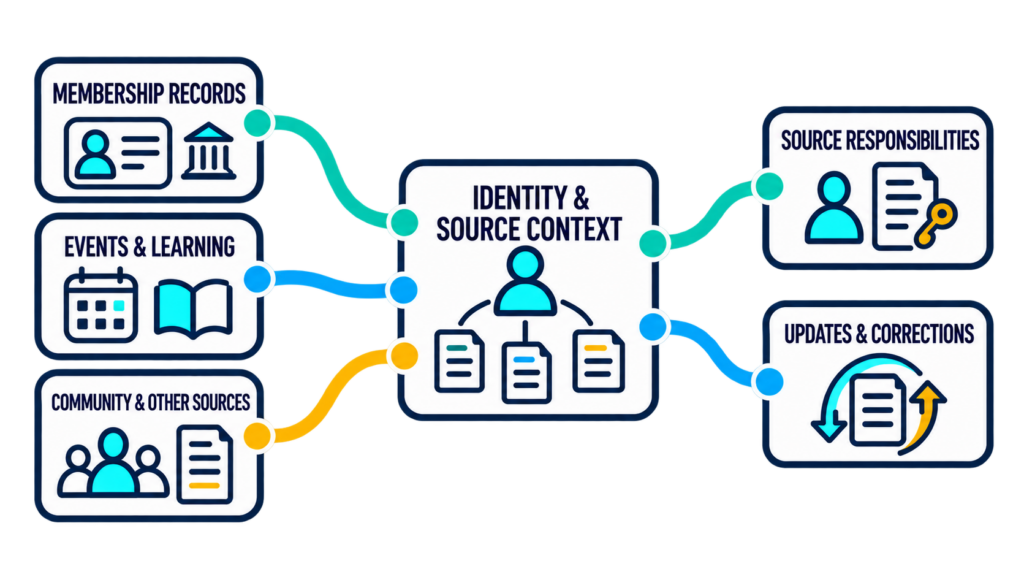
This module helps your team:
- The organizational question the information should support.
- The records and fields needed for that purpose.
- Relevant systems, files, and member-provided sources.
- Individuals, organizations, accounts, and activity records.
- Available identifiers and matching limitations.
- Field definitions and status meanings.
- Source responsibilities and points of disagreement.
- Historical context and update expectations.
- Missing information and unresolved records.
- Appropriate access and member sharing.
- Correction and exception processes.
- A bounded starting configuration.
What might an appropriate response involve?
The response depends on whether the difficulty concerns identity, meaning, source responsibility, information movement, or maintenance.
Clarify the Meaning
Seek further explanation where a comment, request, or summary is ambiguous.
Preserve the Context
Keep the relevant question, source, experience, and timing attached to the input.
Examine the Pattern
Compare related feedback while retaining meaningful differences and contradictory accounts.
Seek Further Evidence
Identify which missing perspectives or unanswered questions could change the interpretation.
Assign the Response
Route individual issues and broader findings to the people responsible for reviewing and acting.
Communicate the Outcome
Explain what was heard, what happens next, and what remains under consideration.
A useful response may begin with definitions, identifiers, or responsibilities. Technical integration follows the information requirements established through that work.
What we review together
Question & Scope
The decision being supported and the information needed to answer it.
Source Landscape
The relevant systems, files, teams, partners, and member-provided inputs.
Identity & Record Structure
What each record describes and how people, organizations, accounts, and activities relate.
Definitions & Responsibility
The meaning of important fields and the source or person responsible for maintaining them.
Updates & Exceptions
Timing, missing records, conflicting values, and the handling of unsuccessful connections.
Access & Maintenance
Who can use, review, correct, and maintain the connected information.
The minicourse: trace one information need across its sources
Your team applies the concepts to a bounded example, such as participation across programs, a member’s learning history, or the relationship between company membership and individual involvement.
STEP 1
Step 1 — Define the question and necessary information.
Choose the organizational use and identify the information required to support it.
STEP 2
Step 2 — Locate the relevant sources.
Identify where the records originate, why they are collected, and who is responsible for them.
STEP 3
Step 3 — Clarify identity and meaning.
Examine what each record describes, which identifiers are available, and how important fields should be interpreted.
STEP 4
Step 4 — Trace the useful connections.
Map how the selected records would relate, preserving source context, timing, and unresolved questions.
STEP 5
Step 5 — Review updates, access, and correction.
Identify who should see the information, how it would remain current, and how mistakes or unsuccessful connections would be handled.
STEP 6
Step 6 — Define the next step and starting configuration.
Choose a bounded connection to explore and assign the clarification, technical discovery, and review work needed to move forward.
Exercise output
A draft Member Information Connection Map, with source responsibilities, identity questions, field meanings, and an assigned next step.
- A defined question and information need.
- Identified sources and owners.
- Clear identity and field distinctions.
- A draft connection map.
- Update, access, and correction requirements.
- A bounded next step.
FUTURE PRODUCT CONNECTION
How this work can connect to Gobekli
The workshop establishes which information needs to connect, what it means, and how it should be maintained. That work can inform a scoped Gobekli configuration.
A TalentSync configuration could connect organizational information across relevant sources while preserving identity relationships, activity context, and source responsibility. TalentPass could support member-provided information and selective sharing where appropriate.
Passport Pages could provide the connection and sharing arrangements included in the agreed scope. Pythia could help people understand and clarify the resulting information within their permitted access.
The starting configuration should answer a specific organizational question and make its information understandable enough to review.
Potential configuration mapping
- One person appears under several accounts. Explicit connections among source records and the relevant member identity, with review for uncertain matches.
- Individuals and member companies are confused. Separate person and organization records linked through defined affiliations or roles.
- Identical field names hide different meanings. Field mappings that preserve source definitions and necessary distinctions.
- No source is responsible for a disputed value. Item-specific source responsibilities and a defined resolution process.
- Useful context remains in another system. Relationships connecting records to relevant activities, roles, dates, and sources.
- Information is available only through selected exports. A scoped import or connection approach based on confirmed source capabilities.
- Updates arrive at different times. Refresh expectations and visible information about source currency.
- Unresolved records disappear from reports. An exception process for missing, conflicting, or uncertain connections.
- Members need to clarify or share information. Appropriate member input, correction, and selective-sharing arrangements.
- Connected views become difficult to maintain. Assigned owners, review responsibilities, and checks for ongoing usefulness.
Specific connectors, source access, technical feasibility, and implementation scope would be confirmed during solution planning.
PRODUCT AND DECISION BOUNDARIES
What this module does—and its boundaries
The module helps your team:
- Trace one information need across relevant sources.
- Clarify record identity and field meaning.
- Identify source responsibilities.
- Define useful information relationships.
- Plan for updates, access, and correction.
- Prepare a starting configuration brief.
The module does not complete:
- An organization-wide system integration.
- A full data migration or cleanup.
- Automatic resolution of every duplicate record.
- A replacement decision for the entire technology stack.
- A security or compliance assessment.
- A guarantee that every platform offers the required access.
The exercise provides a practical starting point. Technical discovery, source remediation, integration development, and wider rollout may require additional work.
What to bring into the conversation
Begin with one question that member input could help answer, or one collection of feedback that has been difficult to turn into a clear next step.
A useful starting question is: “What are members telling us about this experience, what does that evidence support, and who should do what next?”
Useful inputs may include:
- A question that requires information from more than one source.
- A short list of the relevant systems or files.
- Sample records, exports, or field descriptions.
- Available identifiers and status definitions.
- Examples of duplicate, conflicting, or missing information.
- Existing information about source access and responsibilities.
- The person responsible for the decision.
- A membership or operations lead.
- Someone familiar with the relevant programs.
- A system administrator or integration contact.
- Someone responsible for information access or quality.
- A person who could own the next step.
Use anonymized samples or field descriptions where possible. The workshop does not require passwords, production credentials, or unrestricted access to member records.
What this module can help your team produce
A Member Data & Connection Brief
A clear account of the question, necessary information, relevant sources, and limits of the review.
A Member Information Connection Map
A structured view showing how selected records relate, including identity questions, field meanings, and source responsibilities.
A Clarification & Connection Plan
Assigned next steps for resolving ambiguity, confirming access, reviewing technical options, and defining update and correction processes.
A Starting Configuration Brief
An outline of the source connections, record relationships, access arrangements, and maintenance responsibilities a subsequent Gobekli implementation would need.
These outputs begin with the example examined during the module. Final scope depends on available inputs, selected modules, and the decision established through Member Intelligence Direction.
Where might the work lead next?
A source review may reveal ambiguous affiliations, questions about appropriate sharing, or responsibilities that need ongoing ownership.
Member Identity & Affiliation Clarity
Clarify the individuals, companies, employers, chapters, roles, and membership arrangements the source records describe.
Member Consent, Sharing & Trust
Define appropriate purposes, access, sharing expectations, and member choices for the information being connected.
Member Intelligence Governance & Currency
Establish ongoing ownership, review responsibilities, correction processes, and expectations for keeping information useful.
The resulting connections can also support other Member Intelligence modules when a specific question concerns participation, expertise, goals, feedback, or relationships.
Frequently asked questions
Questions membership organizations ask before beginning.
It is information distributed across sources that cannot be interpreted together reliably for a particular purpose. The difficulty may concern identity, definitions, context, access, updates, or responsibility.
It establishes the information requirements that a useful integration would need to satisfy. Technical constraints can be identified, but detailed development and implementation are subsequent work.
The workshop does not assume replacement. It begins with the question the organization needs to answer and examines what existing sources can contribute.
No. The exercise identifies a bounded set of sources and information relevant to the selected use. Additional connections can be considered when there is a defined need.
Yes. Samples can reveal important identity, meaning, and responsibility questions. The later connection approach depends on the source capabilities and agreed requirements.
Not always. Addresses can change, be shared, or differ by activity. The module examines available identifiers and defines how uncertain connections should be reviewed.
Distinguish the individual from the organization and describe the relevant relationship, such as employee, representative, or participant under a company membership.
Responsibility may differ by item of information. The workshop helps identify which source maintains a particular fact and how that information should be used elsewhere.
Examine whether they describe the same fact, definition, person, and time period. Some differences require correction; others are valid distinctions that should remain visible.
Some approaches can preserve source records while making selected information available elsewhere. The appropriate design depends on access, technical capabilities, timing, and the intended use.
The team can identify the constraint and consider suitable alternatives during technical discovery. The workshop does not assume that every source offers an API, export, or required permission.
Define update expectations, source responsibilities, and a way to identify missing or unsuccessful refreshes. Currency should be visible enough for users to interpret the information appropriately.
The correction process should identify where the change belongs, who reviews it, and which dependent views need updating. Editing a final report alone may leave the underlying issue unresolved.
It should not be assumed to. Appropriate access and use need to be defined for the connected view, including member-provided information and source-specific restrictions.
No. Anonymized samples, exports, field descriptions, and knowledgeable participants can support the exercise. Technical access can be addressed separately when needed.
The outputs can inform a scoped configuration connecting relevant sources, identities, activities, and context. Specific connectors, access, update processes, and member-sharing arrangements would be confirmed during solution planning.
Your team will examine one bounded example and create a draft brief, information connection map, clarification and connection plan, and starting configuration brief. Technical implementation and wider rollout are subsequent steps.
Connect the information your team needs to understand members.
Start with one organizational question, trace the relevant sources, and clarify the identities, meanings, and responsibilities needed for a useful connection.
Choose Fragmented Member Data & System Connections as part of your Member Intelligence Workshop.
