
MEMBER ENGAGEMENT WORKSHOP MODULE
Events & Year-Round Participation
An event can bring members together while leaving the next step unclear. Connect discovery, preparation, participation, and follow-up to useful opportunities before, between, and after individual events.
Does this sound familiar?
Every event starts over
Teams build a new promotion and registration cycle without connecting the experience to what members previously asked, explored, or began.
Members arrive unprepared
Participants know when and where to attend but have little guidance on what to bring, consider, or expect.
Attendance becomes the outcome
Reports count registrations and check-ins without clarifying what members wanted to accomplish or what the experience helped them do.
Follow-up stops at the recording
Members receive slides, a survey, or a replay without a clear connection to questions, actions, or opportunities arising from the event.
Momentum has nowhere to go
Members want to continue a conversation or explore a topic, but the route into another activity, resource, or group is unclear.
The calendar replaces the pathway
The organization offers many events, yet members must work out how they relate and which next experience would be useful.
What is events and year-round participation?
Events and year-round participation concerns how individual events connect to a member’s wider experience with the organization.
An event may help someone explore a question, meet peers, learn from experience, contribute an idea, or identify a next step.
The experience begins before attendance, when the member discovers the opportunity and decides whether it fits. It continues through preparation, participation, and any follow-up the member chooses.
Year-round participation provides useful routes between those moments. It can include resources, conversations, groups, learning, contribution opportunities, or another relevant event.
This module examines those connections for one selected event experience. It does not assume that members need a continuous schedule of activities.
An event needs a place in the member’s wider journey.
The organization may see an annual conference, monthly webinar, chapter meeting, or roundtable as an item in its calendar.
The member may see a chance to address something specific.
They might want to understand a change in their field, hear how others handle a challenge, ask a question, or find people with relevant experience.
That purpose can guide what happens before the event, how the member participates, and which next step would help afterward.
A practical review connects the event to that purpose while leaving room for the experience to stand on its own when no continuation is needed.
See the complete event participation journey.
Member Purpose
Questions and interests
Current challenges
Experience to exchange
Contributions to offer
Desired next steps
Discovery and Preparation
Event relevance
Participation requirements
Session or activity choices
Useful advance information
Questions or materials to bring
Event Participation
Sessions and activities
Discussion and interaction
Ways to ask or contribute
Host and facilitator support
Practical participation routes
Follow-Up and Handoffs
Unanswered questions
Requested resources
Agreed introductions
Actions members choose
Responsible next contacts
Between-Event Opportunities
Relevant resources
Peer or community interaction
Learning and application
Contribution opportunities
Return, pause, or conclusion
The experience becomes more connected when member purpose, preparation, participation, follow-up, and optional continuation can be understood together.
How events become isolated moments
STAGE 1 — The organization builds an event
Teams establish a topic, format, speakers, activities, and a date around an organizational or member need.
STAGE 2 — Work concentrates on attendance
Promotion, registration, scheduling, and delivery take priority as the event approaches.
STAGE 3 — Follow-up follows a standard routine
Attendees receive the same survey, resources, and announcements regardless of what they asked or chose during the experience.
STAGE 4 — The next event begins a new cycle
Useful questions, interests, and commitments lose their connection to the programs, people, or opportunities that could carry them forward.
A successful event report can leave the next step unresolved.
An event report can answer an important question:
How many members registered, attended, participated in sessions, or completed the survey?
A participation review also examines what members came to do, how the experience supported that purpose, and whether appropriate follow-up was available.
The review should clarify:
Identify the question, interest, challenge, or contribution that made the event relevant. Distinguish what the member expressed from what the organization assumed.
Review the information, choices, prompts, or materials available before attendance. Clarify which preparation is necessary and which is optional.
Examine the routes to listen, ask, discuss, contribute, connect, or request support within the event’s format.
Identify questions, requests, interests, or agreed actions that participants chose to raise or share.
Trace the handoff to a resource owner, program team, host, peer contact, or other responsible person.
Consider whether the member needs a resource, conversation, activity, future event, or an appropriate conclusion to the experience.
A connected event experience needs six forms of clarity.
Purpose
Members understand what the event could help them explore, accomplish, or contribute.
Preparation
Participants know what to expect and what would help them arrive ready.
Participation
The format provides understandable ways to take part and seek assistance.
Capture
Questions, requests, and agreed actions can be recorded appropriately without assuming permission to capture everything.
Handoff
Follow-up reaches a responsible person or a usable destination.
Continuation
Members can choose a relevant next opportunity, return later, or finish with what they came to receive.
Useful continuity
An event connects to the wider member experience when it provides:
- A clear relationship to a member question or purpose.
- Preparation proportionate to the experience.
- Understandable ways to participate.
- A route for questions and chosen next steps.
- Assigned responsibility for follow-up.
- Optional opportunities that build on what happened.
The connection helps members carry something useful forward without creating an obligation to stay continuously active.
An isolated event cycle
An event can remain disconnected when it leaves members with:
- A topic description without a clear reason to attend.
- Logistical information but little practical preparation.
- Few ways to contribute or request help.
- Questions and commitments with no follow-up owner.
- A generic resource email with no usable next step.
- Another invitation that ignores the previous experience.
The review identifies which connection would make the event more useful within the member’s wider participation.
A roundtable can open a useful route beyond the meeting.
An association runs a roundtable for members introducing new technology into their organizations.
Members attend with different questions. Some want to understand available approaches. Others want to compare implementation experiences or discuss a problem they have already encountered.
The team selects this event for review.
Before the roundtable, participants can submit a question and receive a short explanation of how the discussion will work.
During the session, the host helps members exchange relevant experience and identifies questions that need another source or conversation.
Afterward, members can choose a practical resource, a further peer discussion, or an introduction that both parties welcome.
The team assigns responsibility for those handoffs and tests whether members can use them.
The result is a more connected event experience, with a manageable route from the original question to an appropriate next step.
Year-round participation does not require year-round attendance.
Members may participate intensely for a short period, return around a particular question, or use resources between occasional events.
An annual gathering may be valuable on its own. A webinar may resolve the question someone brought. A discussion may lead to a longer relationship.
The review examines which kind of continuation fits the selected purpose.
It avoids filling the calendar simply to maintain activity or treating a quiet period as evidence that the event failed.
A useful year-round experience makes relevant opportunities available when members need them and explains how to return.
Follow-up needs someone to receive it.
An event may generate requests that belong with different teams.
A resource question may go to a program owner. A request to meet a peer may need an introduction. An interest in contributing may belong with a volunteer coordinator.
The member should not need to understand the organization’s internal structure to reach that next step.
The review follows each selected handoff, clarifies the information needed, and assigns responsibility for responding.
It also examines capacity. An event should not invite requests that nobody is prepared to handle.
THE MATCHING WORKSHOP MODULE
Module 7: Events & Year-Round Participation
This practical minicourse helps membership organizations connect event discovery, preparation, participation, and follow-up to useful opportunities before, between, and after individual events.
Participants learn a repeatable review method, apply it to one selected event journey, and identify whether the priority response concerns purpose, preparation, participation, handoffs, or continuation.
The exercise also defines the member context, event relationships, participation choices, follow-up responsibilities, and next-step opportunities that a subsequent Gobekli configuration would need to support.
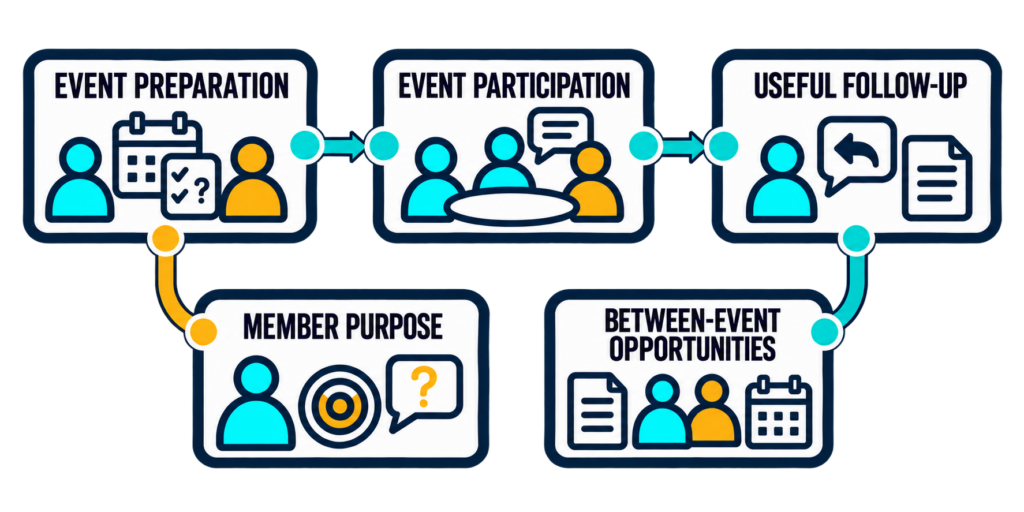
This module helps your team:
- Define the purpose of one event experience.
- Identify the members and questions it could serve.
- Examine discovery and participation information.
- Clarify useful preparation and choices.
- Review ways to ask, contribute, and receive support.
- Identify what participants choose to carry forward.
- Trace resources, requests, and follow-up handoffs.
- Assign responsibility for the next step.
- Connect relevant opportunities between events.
- Establish choices to continue, return, or conclude.
- Develop a focused event participation brief.
- Outline a connected event configuration.
What should happen to each part of the event journey?
The review leads to a deliberate response based on the member purpose, the event experience, and the conditions affecting useful continuation.
Confirm
Retain a connection that serves a clear purpose and has a workable route for participation.
Clarify
Explain event relevance, expectations, participation choices, or the next step.
Prepare
Provide the information or prompts that help members arrive ready to take part.
Connect
Link a question, request, or chosen action to a relevant resource, person, or opportunity.
Support
Assign help where participation or a follow-up handoff needs attention.
Conclude
Close requests and commitments appropriately when no further action is needed or wanted.
These responses guide the participation experience. They do not establish that every event needs an extended program or that every attendee wants ongoing contact.
What should an event participation review examine?
The purpose
What question, interest, exchange, or contribution makes the event useful to the selected members?
The preparation
What do participants need to understand, choose, or bring before the experience begins?
The participation
How can members engage with the content, people, and activities in ways appropriate to the format?
The follow-up
Which questions, requests, and agreed actions need a response, and what information is appropriate to carry forward?
The continuation
Which resources, conversations, programs, or future events could provide a relevant next step?
The ownership
Who coordinates the experience, handles handoffs, and checks that the selected routes work?
Trace one event from member purpose to a useful next step.
Your team applies the method to one event journey established through Member Engagement Direction.
STEP 1
Define the purpose
Identify the member population, question, interest, or contribution within scope.
STEP 2
Examine discovery and preparation
Review how members recognize the event’s relevance, decide to attend, and understand what would help them prepare.
STEP 3
Follow the participation experience
Trace the ways participants can listen, ask, contribute, interact, and receive support.
STEP 4
Trace follow-up and continuation
Examine how chosen questions and actions reach a responsible person or a usable next opportunity.
STEP 5
Choose a response
Confirm, clarify, prepare, connect, support, or conclude the parts of the journey that need attention.
STEP 6
Assign and test the change
Identify the owner, proposed improvement, member feedback needed, follow-up responsibilities, and starting configuration requirements.
The result is a draft Event Participation Journey Map connecting member purpose, preparation, participation, follow-up, and optional opportunities between events.
FUTURE PRODUCT CONNECTION
Keep event experiences connected to what members want to carry forward.
A subsequent Gobekli configuration could help the organization relate individual events to member-selected purposes, participation options, resources, and follow-up responsibilities.
TalentSync could connect events and sessions to their intended purposes, preparation, hosts, related opportunities, and responsible handoffs.
TalentPass could help members express relevant interests, questions, participation preferences, and the next steps they choose to share. Pythia could help clarify an event’s relevance, prepare questions, or explore an appropriate continuation using the information and permissions in scope. Passport Pages could support agreed source and sharing connections.
A connected event participation view could potentially show:
- What purpose brings a member to the experience.
- Which event or session could address that purpose.
- What participants need to know beforehand.
- Which choices and participation routes are available.
- What questions or requests a member chooses to share.
- Which resources or next actions relate to those requests.
- Who is responsible for each handoff.
- Which opportunities could extend the experience.
- Whether a chosen next step is pending, completed, or concluded.
- What feedback identifies a break in the journey.
The workshop produces a starting configuration brief: member context, event and session profiles, preparation fields, participation choices, resource relationships, follow-up states, and responsible roles.
Specific event-platform connections, registration data, suggestions, messaging, scheduling, reminders, and workflows would be confirmed during solution planning.
PRODUCT AND DECISION BOUNDARIES
A connected event journey preserves member choice and context.
Registration can establish an intention to attend without explaining what the member wants to accomplish.
Attendance can establish presence without demonstrating learning, useful relationships, or a desire for further contact.
A later configuration should distinguish expressed interests, registrations, participation records, member-reported usefulness, and next steps someone has actually chosen.
The workshop and product connection do not establish:
- Learning or capability based only on attendance.
- Satisfaction or belonging from registration records.
- Permission to record or analyze private conversations.
- Consent to an introduction based only on shared attendance.
- Interest in every related offering after one event.
- A requirement to participate continuously.
- A causal link between event attendance and membership renewal.
Event teams remain responsible for the information they collect, the expectations they set, and the follow-up they invite.
The workshop can clarify the journey and its responsibilities independently of future product adoption.
What to bring into the conversation
You do not need a new event platform or a complete annual calendar redesign.
Begin with one event experience connected to the participation challenge established through Member Engagement Direction.
Useful inputs may include:
- The purpose of the selected event.
- Event descriptions and registration information.
- Session or activity choices.
- Advance messages and preparation materials.
- Ways participants ask questions or contribute.
- Feedback about the event experience.
- Follow-up messages and shared resources.
- Examples of requests or agreed next steps.
- Related programs, groups, or future events.
- Responsibilities for handoffs and support.
- An event lead and participant perspective.
- The owner of a proposed improvement.
The aim is to examine one journey in sufficient detail to make a practical change. The foundation module establishes the population, purpose, evidence, and boundaries for that work.
What this module can help clarify
Why the event matters
Connect the selected event to member questions, interests, and intended contributions.
How members take part
Clarify discovery, preparation, participation choices, and support within the experience.
What carries forward
Identify useful resources, chosen next steps, responsible handoffs, and opportunities between events.
What should change next
Develop an assigned improvement and test plan, supported by a starting configuration brief.
These outputs begin with the example reviewed during the module. Final scope depends on the modules selected, available inputs, and the participation challenge established through Member Engagement Direction.
Where might the work lead next?
Peer Connections & Community Belonging
Create clearer routes for event introductions and conversations to become useful peer interaction or community participation.
Learning Program Participation & Follow-Through
Examine the learning journey when an event is part of a program that requires preparation, continued participation, or application afterward.
Chapter, Committee & Partner Participation
Clarify shared responsibilities when event experiences and follow-up span chapters, committees, program teams, or delivery partners.
Your team can combine this module with other parts of the Member Engagement Workshop according to the participation challenge established through Member Engagement Direction.
Frequently asked questions
Questions organizations ask before beginning.
It means members have understandable routes to useful opportunities between individual events. Those routes may involve resources, conversations, groups, learning, contribution, or a later event. It does not require continuous attendance.
Conferences, webinars, roundtables, chapter meetings, member forums, networking sessions, and other gatherings. The exercise focuses on one manageable event journey or a bounded part of a larger event.
The module examines the member’s participation journey. It can reveal changes needed in preparation or delivery, but it does not replace detailed work on venues, budgets, production, or event operations.
No. A single event can provide the example. The review examines whether preparation, participation, and any useful continuation are connected.
No. An event may meet the member’s purpose on its own. The review should make continuation available where useful and support a clear conclusion where it is not needed.
Enough to understand the purpose, format, participation choices, and any necessary preparation. Optional prompts or advance questions may help, but preparation should remain proportionate to the experience.
Begin with questions or interests members choose to express and feedback already available. Broad registration categories may provide context without explaining an individual’s purpose.
It should reflect what the event offered and what participants chose to carry forward. That may include a requested resource, an answer, an agreed introduction, an action, or a relevant opportunity.
They may be sufficient for some purposes. The review examines whether members can use them and whether other questions, requests, or commitments remain unresolved.
Yes. Select a bounded journey, such as one topic, participant group, or session pathway. Trace how preparation and subsequent opportunities connect to that experience before attempting to redesign the whole conference cycle.
Yes, where that fits the selected purpose. The review can examine alternative resources, asynchronous participation, or later opportunities. It should make clear what each route offers without assuming the experiences are equivalent.
Examine whether members understand the purpose, arrive appropriately prepared, can participate, and can use the next steps they choose. Member feedback and follow-up records can inform the review alongside attendance data.
Discovery examines how members locate, understand, and enter available options. This module follows a selected event further through preparation, participation, follow-up, and its relationship to opportunities between events.
Outreach examines invitations, timing, channels, and response handling. This module examines the wider event experience that those messages support, including participation and subsequent handoffs.
An event may serve discussion, connection, contribution, or learning. The learning module focuses on participation through a defined learning program and the follow-through needed to use what members learn.
The outputs can inform a configuration connecting member-selected purposes, events, preparation, participation choices, resources, follow-up responsibilities, and next-step opportunities. Specific capabilities and implementation requirements would be confirmed during scoping.
Your team will review one bounded event journey and develop a draft participation map, assigned improvement and test plan, and starting configuration brief. Wider rollout and ongoing operation are subsequent steps.
CONNECT EACH EVENT TO A USEFUL NEXT STEP
Help members carry the value of an event beyond the day.
Connect preparation, participation, and follow-up to opportunities members can use before, between, and after individual events.
This module is part of Gobekli’s configurable Member Engagement Workshop.
