
A PROGRAM RELEVANCE WORKSHOP MODULE
Program Relevance Direction:
Start With the Decision That Matters
Program reviews often begin with data collection, stakeholder meetings, curriculum comparisons, or broad questions about whether a program is still relevant.
But relevance can mean very different things to different people. One stakeholder may be thinking about enrollment. Another may be concerned about learner outcomes, employer demand, community need, curriculum currency, delivery capacity, financial sustainability, or institutional mission.
Program Relevance Direction establishes the consequential outcome, bounded program question, relevance criteria, stakeholders, and evidence needs that guide the rest of the review.
Does this sound familiar?
The review begins before the decision is clear
Teams start collecting enrollment, labor-market, curriculum, financial, or outcomes data without agreeing on what the institution must decide.
Relevance means something different to everyone
Academic leaders, faculty, learners, employers, community partners, and administrators evaluate the same program through different priorities.
The scope keeps expanding
A question about one program grows into a review of every course, credential, pathway, partnership, learner population, and regional workforce need.
Available data determines the conversation
The review concentrates on information that is easy to retrieve rather than evidence connected to the actual decision.
Stakeholders enter too late
People affected by the program are asked to react after the question, criteria, or proposed direction has already been established.
The review ends with findings but no direction
Participants produce observations, recommendations, or a long report without clarifying who must decide what happens next.
What is Program Relevance Direction?
Program Relevance Direction is the process of defining the decision a program review must support before the institution begins a deeper analysis of demand, work, capabilities, curriculum, outcomes, delivery, or portfolio options.
It establishes a common foundation for the rest of the Program Relevance Workshop.
That foundation identifies:
- The condition or event prompting the review
- The consequential outcome the institution is trying to protect or improve
- The program, credential, pathway, or learning experience being examined
- The learners, communities, employers, and institutional stakeholders affected
- The specific decision that must be supported
- The dimensions of relevance that matter to that decision
- The evidence already available
- The assumptions and evidence gaps that remain
- The constraints and decision rights that shape what is possible
- The additional workshop modules required for deeper investigation
The purpose is not to decide whether a program is relevant before the evidence has been examined. It is to make the review focused enough that the evidence can become useful.
The problem is not a lack of information. It is a lack of decision structure.
Institutions may already have extensive information about enrollment, curriculum, learner demographics, graduate outcomes, employer feedback, labor-market projections, community priorities, faculty observations, accreditation, costs, facilities, transfer, competitor offerings, learner satisfaction, and strategic commitments.
But more information does not automatically create a clearer decision. Different measures may point in different directions, describe different populations, cover different periods, or answer different questions.
A program may serve an important community need while producing weak short-term enrollment. Employer demand may be strong while the institution lacks the faculty, equipment, clinical sites, or work-based learning partners required to respond. Learners may value a program for transfer, advancement, or personal goals that are not visible in conventional placement data.
A strong direction connects a consequential outcome, a bounded program question, the people affected, the relevant evidence, the tradeoffs involved, and the person or group responsible for the decision.
See the complete decision—not just the program data.
The Trigger
- Changing enrollment
- New or declining demand
- Employer or community concern
- Curriculum change
- Resource pressure
- Scheduled program review
The Consequential Outcome
- Learner opportunity
- Community value
- Workforce preparation
- Institutional mission
- Program quality
- Sustainable delivery
The Program Boundary
- One program
- A credential or pathway
- A group of related programs
- A learner population
- A regional offering
- A defined decision horizon
The Relevance Questions
- Who needs the program?
- What should learners gain?
- How is work changing?
- Is the curriculum current?
- Can the institution deliver it?
- What evidence is missing?
The Decision Structure
- Responsible decision-makers
- Affected stakeholders
- Required evidence
- Known constraints
- Important tradeoffs
- Appropriate next step
Program relevance becomes decision-useful when the reason for the review, the outcome at stake, the program boundary, the questions being asked, and the responsibility for acting can be understood together.
How program reviews lose direction
STAGE 1
A signal creates concern
Enrollment changes, employer feedback, community demand, new technology, financial pressure, learner outcomes, or a scheduled review raises questions about a program.
STAGE 2
The institution begins gathering information
Teams request reports, compare curricula, survey stakeholders, examine labor-market data, and assemble existing documents.
STAGE 3
Different definitions of relevance emerge
Participants emphasize different outcomes, populations, time horizons, standards, constraints, and measures of value.
STAGE 4
The review becomes difficult to resolve
The institution has more information but lacks a shared question, an agreed boundary, or a clear path from evidence to decision.
What decision must the review actually support?
“Is this program relevant?” is too broad to guide a responsible review.
A useful review question identifies what may need to change, why the question matters, who will be affected, and what evidence decision-makers require.
The institution may need to determine:
What unmet learner, community, industry, or institutional need could the program address, and what conditions would make development responsible?
Which outcomes, capabilities, courses, experiences, partnerships, resources, or delivery conditions require improvement?
Have learner needs, community priorities, occupational conditions, transfer pathways, or institutional goals changed enough to require a new direction?
Do the program’s learning outcomes, activities, capabilities, assessments, and applied experiences remain connected to what learners will need next?
Are the required faculty, expertise, technology, facilities, partnerships, learner supports, time, and financial resources available?
Does the issue involve duplication, combination, sequencing, differentiation, investment, pause, or retirement across several programs rather than a change to one program?
What makes a program relevance question usable?
Consequential
The question is connected to an outcome that matters to learners, communities, partners, the institution, or the responsible delivery of education.
Bounded
The program, population, location, pathway, decision horizon, and part of the learning experience under review are clear enough to examine.
Evidence-seeking
The question distinguishes known facts from assumptions and identifies what additional evidence could materially affect the decision.
Actionable
The review has an identified decision-maker, a realistic set of possible responses, and a clear understanding of what happens after the evidence is considered.
Shared
Participants understand which relevance dimensions matter and where legitimate tensions or tradeoffs may remain.
Configurable
The question makes it possible to select only the deeper analyses the decision actually requires.
An unbounded review
An unbounded review may attempt to:
- Evaluate the entire program portfolio at once
- Serve several unrelated decisions
- Collect every available data source
- Treat every stakeholder question as equally central
- Compare programs with different purposes
- Use a single definition of relevance everywhere
- Resolve operational, academic, financial, and strategic questions simultaneously
The result may be thorough in appearance but difficult to interpret or act upon.
A decision-bounded review
A decision-bounded review clarifies:
- The outcome that makes the review necessary
- The program or program group being examined
- The learners and communities affected
- The decision horizon
- The relevance dimensions requiring attention
- The evidence that could change the decision
- The constraints that must be acknowledged
- The people responsible for interpretation and action
The boundary gives the institution a stable starting point from which connected issues can be investigated.
Relevant to whom—and for what purpose?
A program can appear relevant through one lens and uncertain through another. Depending on the decision, the review may examine learner relevance, community relevance, employer relevance, academic relevance, institutional relevance, and operational relevance.
These dimensions should not be collapsed into one score. Program Relevance Direction identifies which dimensions are material to the decision, where tensions may exist, and what evidence the institution needs to interpret them responsibly.
Bring the right perspectives into the question—not only the final reaction.
Relevant participants may include academic leaders, faculty, curriculum and assessment specialists, learners, alumni, employers, community organizations, workforce partners, advising, enrollment, institutional research, finance, operations, technology, work-based learning partners, accreditation specialists, transfer partners, and governing decision-makers.
Participation does not mean every stakeholder has the same role or authority. The foundation clarifies who holds knowledge, who is affected, who interprets evidence, who identifies constraints, and who decides.
Start with the decision
before the evidence begins to multiply.
Give every selected module one shared foundation.
THE REQUIRED STARTING MODULE
Module 1: Program Relevance Direction
Every Program Relevance Workshop begins with this module.
Participants translate a broad concern, scheduled review, strategic priority, or emerging opportunity into a bounded program decision that the remaining workshop must support.
The module does not perform every analysis or produce a premature recommendation. It establishes the common Decision Foundation used to select and configure the modules that follow.
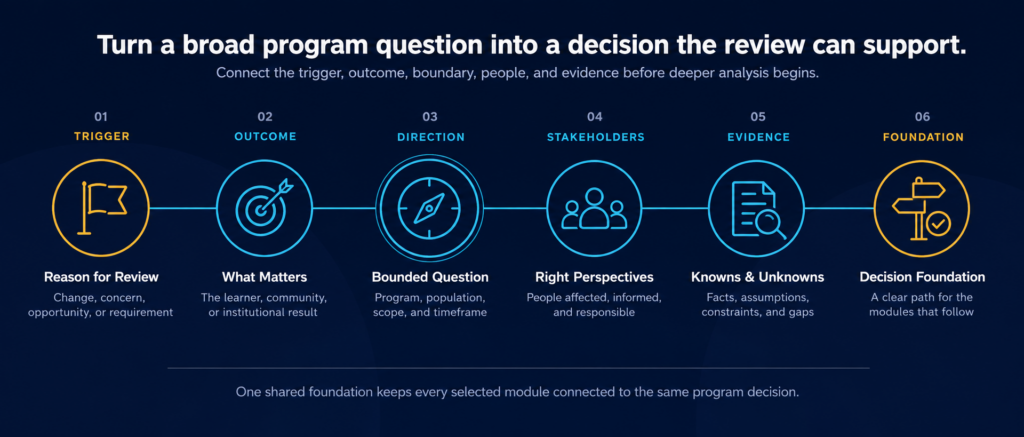
This module helps your team:
- Clarify why the program review is happening now
- Identify the consequential outcome at stake
- Define the program, learner population, location, and time horizon in scope
- Turn a broad concern into a usable decision question
- Identify the dimensions of relevance that matter
- Distinguish decision-makers, contributors, and affected stakeholders
- Inventory available evidence without allowing it to define the question
- Surface important assumptions, constraints, and evidence gaps
- Identify connected questions requiring specialist review
- Select the additional Program Relevance modules required
- Establish a shared direction for the rest of the workshop
- Define what a useful workshop outcome should make clearer
What must be established before the deeper review begins?
The Decision Foundation gives every later module a common point of reference. It does not decide whether the program is relevant; it structures the evidence and tradeoffs the institution must examine.
Trigger
Why is the question being raised now? Identify the event, condition, concern, opportunity, requirement, or strategic priority that prompted the review.
Outcome
What consequential result is at stake? Clarify what the institution is trying to protect, improve, create, understand, or avoid.
Boundary
What exactly is being examined? Define the program, credential, pathway, population, location, and decision horizon.
Decision
What must become clearer? State the specific choice, direction, investment, change, or uncertainty the review must address.
Stakeholders
Whose perspective and authority matter? Identify affected people, knowledge holders, implementation partners, and decision-makers.
Evidence & Path
What is known, assumed, constrained, and missing—and which additional modules or specialist reviews are required?
The Decision Foundation is not a final recommendation or a substitute for evidence. It establishes the structure through which evidence, constraints, and tradeoffs can be interpreted.
What should the foundation examine first?
The initiating signal
What changed, what was observed, who raised the concern, and how reliable or representative is the initial signal?
The outcome at stake
Which learner, community, workforce, academic, operational, financial, or institutional consequence makes the question important?
The current program position
What is already known about the program’s purpose, learners, curriculum, outcomes, partnerships, resources, and institutional role?
The affected people
Who experiences the program, relies on its outcomes, delivers it, supports it, partners with it, or holds authority over its future?
The available evidence
Which internal and external sources are current, credible, comparable, decision-relevant, and appropriately interpreted?
The unresolved questions
Which assumptions, contradictions, missing perspectives, constraints, or evidence gaps could materially change the direction?
From a broad concern to a bounded program decision
Program Relevance Direction creates a disciplined path from the first signal to a shared Decision Foundation.
The process keeps purpose, people, evidence, constraints, and decision ownership connected.
STEP 1
Clarify the trigger
State why the review is happening now and what signal, requirement, concern, or opportunity prompted it.
STEP 2
Define the outcome
Identify the consequential learner, community, academic, workforce, operational, or institutional result at stake.
STEP 3
Bound the program question
Specify the program, credential, population, location, experience, and decision horizon being examined.
STEP 4
Map stakeholders and relevance lenses
Identify who is affected, who holds knowledge or authority, and which definitions of relevance matter.
STEP 5
Test evidence and assumptions
Separate known facts from interpretation, assumption, unknowns, constraints, and specialist questions.
STEP 6
Configure the review
Name the bounded decision and select the additional modules capable of supporting it.
The result is not a predetermined program recommendation. It is a shared, evidence-seeking foundation for the analyses and institutional judgments that follow.
- Keep the consequential outcome visible
- Connect evidence to a bounded question
- Record competing definitions of relevance
- Make assumptions and constraints explicit
- Assign clear decision ownership
- Carry one foundation into every selected module
FROM DIRECTION TO CONFIGURATION
The decision determines which modules come next.
The complete Program Relevance Workshop includes 12 modules, but every review does not require every module at equal depth.
The required Program Relevance Direction module helps configure an appropriate path.
The foundation may lead into modules addressing:
- Community & Regional Need
- Employer Demand & Hiring Reality
- Learner Demand, Goals & Access
- Program Outcomes & Value
- Changing Work & Occupational Futures
- Work-to-Capability Translation
- Curriculum Currency & Coverage
- Program Delivery & Resource Feasibility
- Applied & Work-Based Learning Relevance
- Program Portfolio Decisions
- Continuous Relevance Governance
Module selection follows the decision. It should not become a checklist performed identically for every program.
SPECIALIST AND DECISION BOUNDARIES
A structured workshop supports institutional judgment. It does not replace it.
The Program Relevance Workshop should not be presented as:
- Automatically determining whether a program is relevant
- Producing a universal relevance score
- Recommending closure based on one metric
- Replacing faculty expertise or shared governance
- Making accreditation or licensing determinations
- Conducting a complete financial audit
- Guaranteeing enrollment, completion, placement, or employer demand
- Treating labor-market projections as certainty
- Speaking for stakeholders who were not included
- Making final decisions for institutional leaders or governing bodies
The workshop helps decision-makers understand what they know, what they need to investigate, whose perspective matters, and which tradeoffs require human judgment.
Questions involving accreditation, licensure, legal obligations, finance, accessibility, labor relations, privacy, procurement, facilities, technology, safety, or public policy may require review by qualified specialists.
What to bring into the conversation
You do not need a completed program review, a perfect data warehouse, or agreement about the program’s future.
We begin with the concern, opportunity, requirement, or decision the institution is already facing.
Useful inputs may include:
- The program’s stated purpose
- Existing program-review documents
- Strategic-plan priorities
- Program descriptions and learning outcomes
- Enrollment, persistence, completion, and demographic information
- Graduate or learner outcomes
- Learner and alumni feedback
- Employer or community feedback
- Advisory-board notes
- Labor-market or occupational information
- Curriculum maps
- Accreditation or licensing requirements
- Transfer and articulation agreements
- Faculty observations
- Resource and delivery concerns
- Partnership information
- Known technology or industry changes
- Previous recommendations
- The decision leadership expects to make
- Questions or disagreements the review needs to resolve
Incomplete or conflicting information is acceptable. The module is designed to distinguish evidence from assumption and determine what deeper investigation is necessary.
What this module can help clarify
Why the review matters now
Connect the initiating signal to a meaningful learner, community, academic, workforce, operational, or institutional outcome.
What is—and is not—in scope
Establish a workable boundary around the program, population, location, decision horizon, and questions being examined.
Whose perspectives are required
Identify decision-makers, affected stakeholders, evidence holders, delivery partners, and specialist contributors.
What the evidence must support
Define the decision question, relevance dimensions, available sources, important assumptions, and material evidence gaps.
The Direction module also clarifies which modules should follow and what a useful result should make possible. Final findings depend on the additional modules selected, the evidence available, stakeholder participation, and the institution’s formal decision process.
Where might the work lead next?
Questions institutions ask before beginning.
Program Relevance Direction is the required starting module of Gobekli’s Program Relevance Workshop. It turns a broad concern, opportunity, or scheduled review into a defined Decision Foundation: the outcome, boundary, stakeholders, decision question, relevance criteria, evidence, assumptions, constraints, and deeper analyses required.
Data becomes useful in relation to a question. Beginning with direction allows participants to identify the consequential outcome, define the scope, clarify whose perspectives matter, and determine which evidence could materially affect the decision.
No. It is a foundation for a focused program review. It can be used within a formal academic program review or when a consequential program question arises between scheduled reviews.
Yes. Every engagement begins with Program Relevance Direction because the remaining modules need a shared outcome, boundary, decision question, stakeholder map, and evidence foundation.
It can establish direction for a degree, certificate, credential, pathway, course sequence, continuing-education offering, apprenticeship-related program, workforce program, professional learning experience, community offering, or a defined group of related programs.
Program relevance is not reduced to a single definition. Depending on the decision, relevance may include learner goals, community need, employer demand, changing work, academic currency, outcomes, institutional mission, access, feasibility, or sustainable value.
Not necessarily. Enrollment is important evidence, but it does not explain the cause of low participation or the complete value of a program. The review must consider the decision context and other relevant evidence.
No. Labor-market information can indicate an opportunity, but the institution must still examine hiring reality, learner demand, curriculum implications, competition, partnerships, delivery capacity, cost, and opportunity quality.
Participation depends on the decision and may include academic leaders, faculty, program staff, learners, alumni, employers, community partners, institutional research, advising, enrollment, operations, finance, and executive decision-makers.
The boundary should be narrow enough to support a coherent decision but not so narrow that important dependencies disappear. It may specify a program, population, location, credential level, delivery model, pathway, or decision horizon.
The disagreement becomes part of the evidence and decision structure. The module identifies the purposes being proposed, the people affected, the evidence supporting them, and who has authority to resolve the direction.
The institution can still establish a direction. The module separates what is known, interpreted, assumed, unknown, and in need of specialist judgment, then identifies which missing evidence could materially affect the decision.
Program Relevance Direction defines the question and foundation. Program Portfolio Decisions is used later to compare evidence and organize responses such as launch, grow, redesign, differentiate, combine, pause, retire, or investigate.
No. The workshop can organize evidence, perspectives, dependencies, tradeoffs, uncertainties, and possible responses. Final decisions remain with the institution’s authorized bodies and applicable processes.
Yes. It can clarify the unmet need, intended learners, expected outcomes, institutional purpose, decision horizon, evidence requirements, stakeholders, and conditions that would make development responsible.
It is the required first module. It establishes the Decision Foundation and determines which of the remaining 11 modules are needed, keeping the workshop configurable while ensuring that every selected module serves the same bounded decision.
START WITH THE DECISION
Give every program review a clear direction before the evidence begins to multiply.
Define the outcome, boundary, stakeholders, relevance questions, evidence needs, and decision the institution must support.
Program Relevance Direction is the required starting module in Gobekli’s configurable Program Relevance Workshop.