
LER & TRUSTED WORKFORCE INFRASTRUCTURE WORKSHOP MODULE
Record Quality, Evidence & Provenance
Examine what selected records establish, what supports their claims, and how their history and limitations remain visible—so recipients have a clearer basis for interpretation.
Does this sound familiar?
Important context is missing
A record includes a title or result but leaves out the dates, conditions, criteria, or other information needed to understand it.
A claim has no clear supporting basis
Recipients can read what the record says but cannot determine whether it reflects an individual account, an observation, an assessment, or another source.
A summary says more than the evidence
An export, profile, or generated description turns limited participation or experience into a broader claim about capability or qualification.
The record’s history is difficult to follow
Information has been copied, combined, or transformed, but recipients cannot trace those changes back to the underlying records.
Conflicting versions circulate together
Different records describe the same event or result without a clear explanation of which has been corrected, superseded, or disputed.
People cannot get an error resolved
Someone identifies inaccurate or incomplete information but cannot find a responsible reviewer or understand what happens after a correction request.
What are record quality, evidence, and provenance?
Record quality concerns whether information is sufficiently complete, accurate, consistent, and current for its intended use.
Supporting evidence is the basis for a particular claim. It may include an observation, assessment result, source document, work example, or another account whose role and limitations need to be understood.
Provenance describes the record’s origin and relevant history, including how it was created, supplied, transformed, reviewed, or corrected.
These questions are connected but distinct. Knowing where a statement came from helps explain its history; it does not, by itself, establish that the statement is accurate or sufficient for every receiving decision.
This module examines the quality, support, history, and correction arrangements needed to interpret selected records within a defined exchange.
A record should make its basis as understandable as its claim.
A polished record can appear more conclusive than the information behind it.
A brief statement may omit the conditions under which an activity occurred or a result was established.
A combined profile may place an individual account beside an assessed outcome without making that difference clear.
Recipients need enough context to understand those distinctions.
The workshop examines the selected claim, its supporting basis, and the limits that should remain visible.
That gives partners a clearer starting point for improving records and deciding what requires additional confirmation.
Where record quality can become unclear
Completeness and relevance
Information the receiving use needs
Missing contextual fields
Relevant dates and conditions
Necessary supporting references
Unnecessary detail
Accuracy and consistency
Agreement with the underlying event
Conflicting values
Transcription or export errors
Unsupported assumptions
Review responsibility
Evidence and claims
The specific statement
Type of supporting evidence
Observation or assessment conditions
Scope of the support
Limits on interpretation
Origin and history
Originating source
Creation or collection process
Copies and transformations
Review or correction history
Version relationships
Resolution and maintenance
Issue reporting
Investigation responsibility
Disputed or unresolved information
Correction and follow-up
Review triggers
The review focuses on the records needed for the selected exchange. It does not require a complete cleanup of every participating organization’s data.
How this module helps
Examine the record’s fitness for use
Identify the information and context the receiving workflow needs, then review the gaps that affect interpretation.
Connect claims to their support
Distinguish what a record states from the evidence, observation, or account supporting that statement.
Trace relevant history
Identify where the information originated and how copies, transformations, or summaries have affected its representation.
Define correction and review routes
Clarify who investigates a concern, what can be corrected, and how the outcome should reach affected participants and partners.
The summary may be easier to read than the evidence is to understand.
A record may describe someone as having a capability.
The underlying material may show participation in a learning activity, a work example, or a reviewed demonstration under particular conditions.
The workshop examines whether the wording preserves what that material actually supports.
Example: “The profile says ‘demonstrated,’ but the source shows attendance.”
A provider exports a record showing that a participant attended a workshop.
A later summary describes the participant as having demonstrated the capability discussed during the session.
The source contains no assessment result supporting that stronger statement.
Partners identify where the wording changed, revise the proposed claim, and define what additional evidence would be needed if the receiving workflow requires a demonstrated outcome.
Questions to review together
What exactly does the record state, and what does the recipient need to understand?
Which details matter to that use, and where is information missing, inconsistent, or in need of confirmation?
What evidence, observation, assessment, or account supports the statement?
Where did the information originate, and what happened as it was copied, combined, or transformed?
What does the evidence leave unresolved, and how should those limits remain visible?
Who investigates a concern, what changes are appropriate, and how are affected records or recipients addressed?
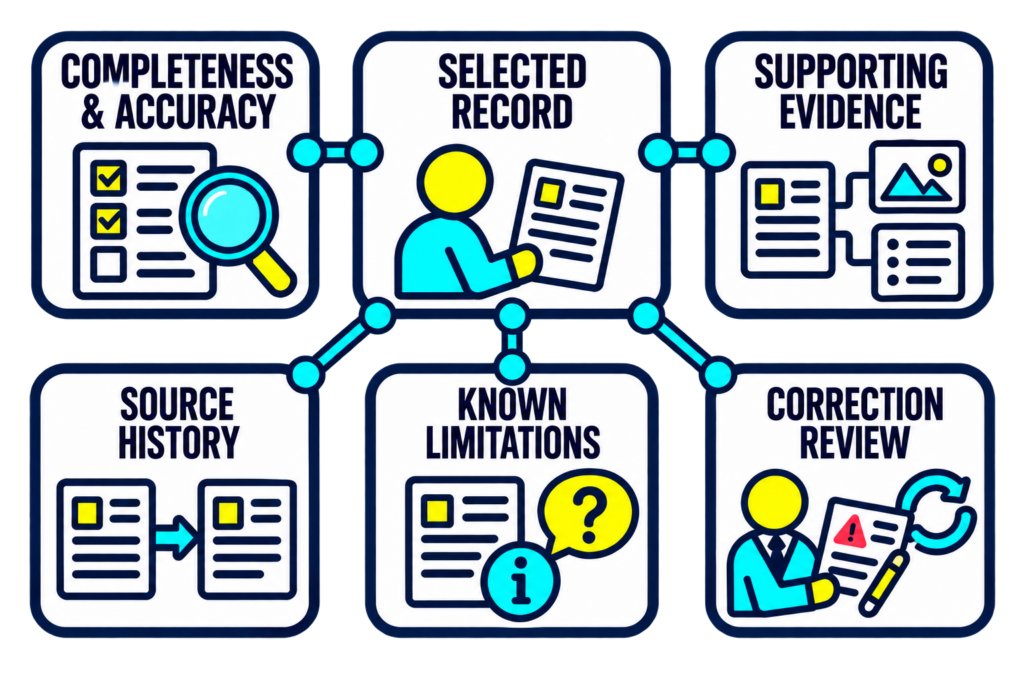
What needs to connect?
The selected claim
The particular statement the record makes about an activity, experience, result, or qualification.
The receiving use
The question the recipient needs to answer and the information relevant to that purpose.
The supporting evidence
The material or process that supports the claim, including the conditions under which it was produced.
The source history
The record’s origin, relevant transformations, reviews, and relationships to other versions.
The known limitations
Missing context, unresolved conflicts, scope restrictions, and conclusions the evidence does not establish.
The correction route
The people and processes responsible for investigating concerns and communicating appropriate changes.
When presentation outruns support
Recipients may encounter a clear-looking record with an unclear evidentiary basis.
- Important conditions are omitted.
- A source statement becomes a broader conclusion.
- Individual accounts and reviewed results appear indistinguishable.
- Transformations lose their connection to the original material.
- Conflicting versions remain unexplained.
- Correction requests have no accountable route.
The receiving workflow may rely on a claim whose support or limitations are difficult to assess.
When claims retain their supporting context
Partners can examine what the information establishes and what remains uncertain.
- Required context is identified for the receiving use.
- Claims remain proportionate to their support.
- Different evidence types remain distinguishable.
- Relevant origins and transformations are traceable.
- Conflicts and version relationships are visible.
- Corrections have responsible reviewers and follow-up.
Recipients have a clearer basis for interpretation, further questions, and appropriate review.
A practical example
A workforce partnership wants participants to present preparation records to employers.
One record states that a participant completed a project-based training program.
The source includes the completion date and a program description.
An accompanying summary states that the participant can independently perform several workplace activities.
The workshop separates the completion statement from the broader capability claims.
Partners examine whether the underlying material includes assessed work, what criteria were used, and which activities were actually reviewed.
They identify a missing explanation of the assessment conditions and a summary phrase that exceeds the available support.
The proposed response preserves the completion record, qualifies the summary, and assigns responsibility for confirming the additional evidence.
The group also defines how a participant or employer can raise a concern about the record and how a confirmed correction would be communicated.
The resulting brief links the selected claims to their evidence, history, limitations, and priority improvements without promising that every receiving organization will reach the same decision.
Quality depends on the use the record needs to support.
A record may be sufficient to document participation.
The same record may be insufficient to establish an assessed outcome or satisfy a recipient’s preparation requirement.
The workshop begins with the receiving question so the review has a practical basis.
It identifies which missing details affect that question and which additional information would not materially help.
Completeness therefore means having the relevant information needed for the selected purpose.
It does not mean collecting every available detail about a person or their experience.
A traceable history helps explain a record without settling every claim.
Knowing the originating source helps recipients understand where information came from.
Knowing that a summary was generated from several records helps explain how it was assembled.
Those details do not eliminate the need to examine the underlying support.
A source can make an error, a transformation can omit context, and a summary can introduce an unsupported conclusion.
The workshop distinguishes source history from the review of accuracy and evidence.
That keeps provenance useful while preserving appropriate questions about the claim itself.
WORKSHOP MODULE 5
Record Quality, Evidence & Provenance
This module is a focused minicourse and working session within the LER & Trusted Workforce Infrastructure Workshop.
Your team learns how to examine a record’s claims, supporting basis, and relevant history, then applies that method to a selected exchange.
The work produces a reviewed starting point for improving interpretation, assigning corrections, and defining a supporting product configuration.
What this module can address
The selected scope may include:
The workshop selects the issues that materially affect the defined exchange.
- Claims and contextual information needed for the receiving use.
- Missing, incomplete, or inconsistent record details.
- Accuracy questions requiring source confirmation.
- Individual accounts, observations, and assessed results.
- Evidence references and the conditions they describe.
- Wording that exceeds the available support.
- Source origin and relevant creation processes.
- Copies, transformations, combinations, and summaries.
- Record dates, versions, and correction history.
- Conflicting, disputed, or unresolved information.
- Investigation, correction, and communication responsibilities.
- Quality review priorities and configuration requirements.
What kinds of responses might emerge?
The response depends on the weaknesses uncovered in the selected example.
A clearer claim
Revise wording so the statement reflects what the source and evidence actually establish.
Additional relevant context
Identify missing conditions, criteria, dates, or references needed for the receiving interpretation.
A source confirmation task
Assign a specific accuracy or evidence question to the organization or person able to investigate it.
A more traceable record history
Preserve the relationship between originating information and later copies, transformations, or summaries.
An accountable correction route
Define how concerns are reported, reviewed, resolved, and communicated to those affected.
A focused configuration brief
Describe the evidence relationships, context, review states, and correction requirements a subsequent implementation would need.
Some responses may involve improving a description or adding a reference. Others may require source investigation, revised processes, or additional substantive review.
What we review together
The receiving requirement
What the recipient needs to understand and which details materially affect that use.
The record’s content
The selected claims, contextual fields, inconsistencies, and gaps.
The supporting material
The observations, assessments, documents, examples, or accounts behind the statements.
The relevant history
Origin, collection, transformation, review, and relationships among versions.
The interpretive limits
What the record supports, what remains uncertain, and which conclusions need additional evidence.
The resolution arrangements
Who investigates concerns, authorizes changes, maintains the record, and follows through with affected parties.
The working exercise
Review one record from claim to supporting basis.
Choose a representative record that needs to move between organizations and inform a defined receiving use.
STEP 1
State the receiving question
Identify what the recipient needs to understand and why the selected record is relevant.
STEP 2
Separate the claims
List the distinct statements the record makes rather than treating the whole document as one undifferentiated claim.
STEP 3
Examine support and context
Identify the evidence, conditions, dates, and references supporting each important statement.
STEP 4
Trace the relevant history
Follow the information from its origin through any copies, transformations, reviews, or summaries that affect interpretation.
STEP 5
Identify gaps and corrections
Record missing context, unsupported wording, conflicts, and questions requiring confirmation.
STEP 6
Assign the response
Define the improvement, responsible reviewer, follow-up route, and examples needed to check the revised record.
The exercise produces a reviewed record quality and evidence brief for the selected example.
CONNECTING THE WORKSHOP TO A POSSIBLE GOBEKLI SETUP
Keep claims connected to their evidence and history.
The workshop can help define how a subsequent Gobekli implementation would organize selected claims, supporting context, and review responsibilities across TalentPass, TalentSync, Passport Pages, and participating systems.
Depending on confirmed scope and product availability, the configuration brief may describe:
- Selected claims and their receiving uses.
- Relevant contextual fields.
- Distinctions among individual accounts, observations, and assessed results.
- Relationships between claims and supporting material.
- Source references and relevant record dates.
- Copies, transformations, and summary relationships.
- Known limitations and unresolved questions.
- Review responsibilities and confirmation tasks.
- Correction routes and version relationships.
- Examples for evaluating the resulting presentation.
The workshop clarifies the information and behavior required before implementation is proposed.
Specific evidence-management functions, source-history representations, review features, correction handling, and integrations must be confirmed separately against current product availability and partner requirements.
SCOPE AND BOUNDARIES
A focused review of selected records and their supporting basis.
The module begins with the exchange defined through Workforce Infrastructure Direction.
It examines the content, support, relevant history, and correction needs of representative records.
It does not automatically establish or deliver:
- Verification of every underlying claim.
- A complete audit of participating databases.
- Guaranteed accuracy or freedom from error.
- Equivalence between different evidence types.
- A new assessment of a person’s capability.
- Permission to disclose supporting material.
- A decision to accept a credential or qualification.
- Production cleanup, migration, or correction of every copy.
Appropriate source representatives or subject-matter reviewers may need to confirm the findings before changes are made.
Questions about identity, shared definitions, credential verification, permissions, and receiving acceptance connect to their respective modules when they affect the selected use case.
What should you bring?
A few representative records and their available supporting context are enough to begin.
Use fictionalized or appropriately redacted materials where practical.
Helpful starting materials
- A description of the selected exchange.
- The receiving question or intended use.
- Representative records or selected fields.
- Relevant source descriptions.
- Available evidence references.
- Assessment or observation criteria, where applicable.
- Examples of individual or organizational statements.
- Known transformations or generated summaries.
- Relevant dates and version information.
- Examples of missing or conflicting details.
- Current correction and review procedures.
- Responsible source and receiving contacts.
Evidence does not need to be copied into the workshop simply because it exists. A description or appropriately limited example may be sufficient to identify the review needed.
What can you leave with?
A record quality review
The completeness, accuracy, consistency, and context questions that affect the selected receiving use.
A claims and evidence map
The relationships between important statements, their supporting basis, and the limits of what they establish.
A provenance and correction outline
Relevant origins, transformations, versions, and responsibilities for investigating and communicating corrections.
An improvement and configuration brief
Priority changes, confirmation tasks, responsible owners, and requirements for a subsequent implementation.
These outputs begin with the example reviewed during the module. Final scope depends on the modules selected, available inputs, and the exchange established through Workforce Infrastructure Direction.
Where might the work lead next?
Credential Issuance, Verification & Status
Examine how issued credentials are checked and maintained, including what verification establishes and how corrections may affect credential status.
AI Context, Human Review & Decision Boundaries
Examine how AI-generated interpretations or summaries should preserve evidence, uncertainty, and accountable review.
Employer & Institutional Acceptance
Validate what receiving organizations need to interpret the reviewed records and use them appropriately within their workflows.
These modules extend different parts of the work. Selection depends on the problem and decision established through Workforce Infrastructure Direction.
Frequently asked questions
Questions organizations ask before beginning.
It addresses records that are incomplete, difficult to substantiate, unclear about their history, or difficult to correct. The focus is the information needed to interpret selected claims within a defined exchange.
The foundation establishes the exchange and receiving decision. That provides the basis for deciding which quality issues and evidence questions matter to the selected use.
It means the record’s origin and relevant history, including how information was created, supplied, transformed, reviewed, or corrected. The workshop examines the parts of that history that affect interpretation.
No. A traceable source and history help explain a statement, but the accuracy and sufficiency of its support remain separate questions.
That module identifies where information originates, who maintains it, and which connections the exchange needs. This module examines the content and evidentiary basis of selected records, including problems that require correction.
The definitions module clarifies what terms and relationships mean. This module examines whether the record is complete, accurate, supported, and appropriately represented once its meaning is understood.
No. Begin with representative examples that reveal important quality or evidence questions. A wider review or cleanup can be scoped separately if needed.
That depends on the claim. Relevant support may include an observation, assessment, source document, work example, or another account. The workshop examines what the material establishes and the conditions or limits that matter.
Yes. Its source and nature should remain understandable. An individual account can provide useful context without being represented as an independently assessed or organization-issued statement.
No. Missing support may mean the claim cannot yet be established for the selected purpose. The workshop distinguishes lack of evidence from evidence that a statement is inaccurate.
Identify the specific conflict, relevant dates, source processes, and available support. The module can assign an investigation and resolution route without assuming that the newest or most polished record is correct.
Yes. The review can examine whether a summary preserves the source claims and their limitations. AI Context, Human Review & Decision Boundaries provides deeper work on the use of AI and accountable interpretation.
No. It can identify where a claim needs additional assessment or confirmation, but conducting that substantive assessment is separate work.
The module identifies affected representations and the responsibilities for communicating a confirmed change. It does not assume that every downloaded, retained, or previously presented copy can be changed automatically.
No. The review distinguishes what supports a claim from what a recipient needs and is permitted to receive. Appropriate references, summaries, or confirmation arrangements may be considered within the selected exchange.
The outputs can inform requirements for evidence relationships, source context, review, limitations, and corrections in a subsequent Gobekli configuration. Specific capabilities and integrations must be confirmed separately.
Partners can confirm priority questions, improve selected records, test revised presentations, and scope the supporting implementation. Related modules can address credential status, AI interpretation, permissions, or receiving acceptance.
BUILD A MORE CREDIBLE WORKFORCE EXCHANGE
Make the support behind the record easier to understand.
Record Quality, Evidence & Provenance helps your team connect selected claims to their evidence, history, limitations, and correction responsibilities.
Begin with Workforce Infrastructure Direction, then combine the modules that address the questions your participating organizations need to resolve.