
A WORKFORCE SCALABILITY WORKSHOP MODULE
Skills-Based Role Design:
Stop Hiring for Yesterday’s Job
When work changes, organizations often begin recruiting with a job description inherited from the past.
The title may be familiar. The responsibilities may look reasonable. But the role may not reflect the outcome, capabilities, relationships, authority, or operating conditions the organization’s next stage requires.
Before asking who to hire, leaders need to clarify what the work needs from the role.
Does this sound familiar?
The job description was copied from an earlier role
The organization begins with language written for a different team, operating model, manager, or stage of growth.
Every stakeholder wants something different
Executives, managers, recruiters, and team members hold conflicting assumptions about what the person will actually do.
The requirements keep expanding
Preferred qualifications, responsibilities, credentials, and personality traits accumulate without a clear connection to the work.
The role combines several different jobs
One position is expected to provide strategy, execution, coordination, technical expertise, administration, and leadership.
“Culture fit” remains undefined
Hiring teams rely on intuition without explaining the operating conditions, values, behaviors, or team expectations candidates need to understand.
Candidates are difficult to compare
The organization receives résumés but has not defined what evidence would demonstrate readiness for the actual work.
What is work and role design?
Work and role design is the process of determining how a needed organizational outcome should translate into work, responsibilities, capabilities, relationships, authority, evidence, and operating conditions.
It begins before the job description.
Participants examine what must be accomplished, how the work fits into surrounding workflows, which capabilities are genuinely required, what can be developed, and how responsibilities should be distributed.
The results may be:
- A new role
- A redesigned existing role
- A temporary assignment
- A project team
- A contractor or specialist relationship
- A partnership
- A division of work across several roles
- A development opportunity for an existing employee
- A redesigned or automated workflow
- A decision to gather more evidence before acting
Role design does not presume that the answer is external hiring. It helps the organization understand what kind of contribution the work actually requires.
The problem is not the job-description wording. It is the missing work view.
A job description can communicate a role once the organization understands it. It cannot resolve conflicting assumptions about the work by itself.
To design a useful role, leaders need to connect:
- The organizational outcome
- The work required to produce it
- The responsibilities the role should own
- The decisions the role should make
- The people and systems it must coordinate with
- The capabilities required at entry
- The capabilities that can be developed
- The knowledge and credentials the work requires
- The conditions in which the person will operate
- The evidence candidates should be asked to provide
- The consequences for the surrounding team
- The alternatives to creating a conventional position
Without these relationships, a polished job description may still describe the wrong role.
Design the complete role
not just the requirements list.
Lorem ipsum dolor sit amet, consectetur adipiscing elit. Ut elit tellus, luctus nec ullamcorper mattis, pulvinar dapibus leo.
Outcomes
- Organizational objective
- Customer or stakeholder result
- Performance expectations
- Timeframe and priorities
- Consequences of success or failure
Work and Responsibilities
- Core activities
- Decisions and authority
- Workflow ownership
- Coordination and handoffs
- Recurring and emerging work
Capabilities
- Technical capabilities
- Human capabilities
- Domain knowledge
- Required credentials
- Developable capabilities
Team and Operating Context
- Manager and team relationships
- Pace and ambiguity
- Communication practices
- Systems and resources
- Values and behavioral expectations
Evidence and Decisions
- Prerequisite evidence
- Accomplishment stories
- Skills and credentials
- Follow-up questions
- Human review criteria
A role becomes meaningful when its requirements can be traced back to real work and its operating conditions can be explained to the people being asked to perform it.
How outdated roles reach the recruiting process
Work changes
Growth, technology, turnover, new customers, funding, contracts, acquisitions, or operating changes create a new organizational need.
An existing title becomes the starting point
Leaders search for the nearest familiar position or retrieve an older job description.
Stakeholders add requirements
Responsibilities, credentials, skills, preferences, and expectations accumulate without being reconciled against the work.
Recruiting inherits the ambiguity
Recruiters and candidates receive a description that appears complete but contains unresolved assumptions about contribution and success.
Why rewriting the job description is not enough
A job description is an important communication and employment artifact. It can explain the responsibilities, requirements, reporting relationship, and conditions associated with a position.
But it usually begins after several more consequential questions should have been answered.
What has changed, what must the organization deliver, and why is this role or assignment being considered now?
Which activities, decisions, relationships, handoffs, and responsibilities are necessary to produce the outcome?
Is the organization combining several distinct needs because one requisition appears easier than redesigning the surrounding system?
Which capabilities, credentials, experiences, or knowledge are true prerequisites—and which could be learned after entry?
What should a candidate be able to show, explain, verify, or discuss to help the hiring team understand their relevant experience?
What management, systems, authority, resources, relationships, expectations, and constraints will shape the person’s ability to contribute?
Will the new role remove work, create handoffs, require supervision, change decision rights, or increase the burden placed on experienced employees?
Without these answers, better wording may make an unresolved role sound more convincing without making it more coherent.
Clear role design should not freeze changing work.
A role needs enough clarity for people to understand its purpose, responsibilities, authority, relationships, and expectations.
But excessive rigidity can make a role obsolete as soon as the work changes.
Useful role clarity
A well-designed role can clarify:
- The outcome it exists to support
- Its most important responsibilities
- The decisions it owns
- Its relationship to other roles
- Genuine entry requirements
- What can be learned
- How contribution will be understood
- What support and resources are available
- How the role may evolve
Role rigidity
An overly fixed role may create:
- Long lists of disconnected duties
- Inflated credential requirements
- Narrow definitions of qualified talent
- Work trapped inside departmental boundaries
- Titles that conceal several different needs
- Inflexible career paths
- Responsibilities that no longer reflect reality
- Hiring criteria that age faster than the job description
The goal is not to eliminate roles. It is to connect each role clearly enough to the work that the organization can adapt it deliberately.
Replace undefined “culture fit” with visible operating context.
Culture affects how work happens, but it should not become an unexplained filter used to justify subjective hiring preferences.
The organization should identify the conditions candidates and employees genuinely need to understand.
Decision Environment
How are decisions made? What authority will the person have, and when must they coordinate or escalate?
Ways of Working
How do people communicate, collaborate, share knowledge, manage disagreement, and respond to changing priorities?
Leadership Conditions
What direction, feedback, coaching, resources, and management capacity will actually be available?
Values in Practice
Which values have visible consequences for how the work is performed, customers are treated, and tradeoffs are made?
Contribution to the Team
What capability, perspective, experience, working approach, or relationship is currently missing?
Organizational Responsibility
What conditions could prevent an otherwise capable person from succeeding?
The purpose is not to calculate a definitive cultural match. It is to make the environment more transparent so candidates, recruiters, managers, and team members can make better human-reviewed decisions.
What leaders need to see clearly
What the role exists to accomplish
Connect the role to a consequential organizational, customer, workforce, or operational outcome.
Which requirements are truly necessary
Separate prerequisites from preferences, inherited conventions, and capabilities that can be developed.
How the role affects the system around it
Reveal new handoffs, dependencies, management needs, workload changes, and role-boundary questions.
What evidence should guide hiring
Define relevant evidence before candidates enter the process rather than creating criteria after reviewing applications.
The goal is not to make the job description longer.
It is to make the work clear enough to support a responsible workforce decision.
THE MATCHING WORKSHOP MODULE
Module 5: Work & Role Design
This module translates a validated workforce need into clear work, responsibilities, capability requirements, relationships, evidence criteria, and operating context.
Participants examine whether the work should become a new role, an altered role, an internal assignment, a contractor engagement, a team responsibility, a partnership, or a redesigned workflow.
The purpose is not merely to produce a job description. It is to ensure that any role or opportunity presented to internal or external talent reflects what the organization genuinely needs.
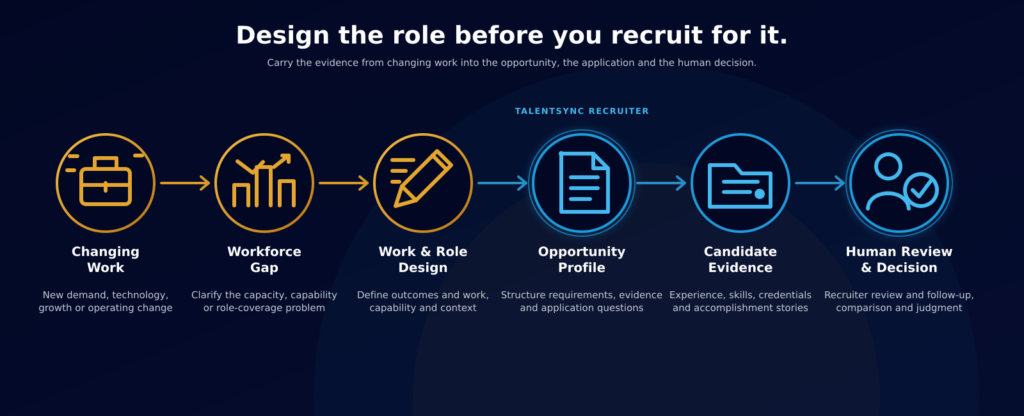
This module helps your team:
- Connect a proposed role to a defined organizational outcome
- Map the work, decisions, responsibilities, and handoffs involved
- Distinguish required capabilities from developable capabilities
- Identify necessary credentials and operating prerequisites
- Clarify team, leadership, and organizational context
- Examine the effect on surrounding roles and workloads
- Define evidence candidates may be asked to provide
- Compare employment, assignment, contracting, partnership, and redesign options
- Prepare findings for an Opportunity Profile or other role artifact
- Identify questions requiring HR, legal, compensation, classification, labor, or other specialist review
Keep
The existing role remains appropriate The current role accurately reflects the outcome, work, requirements, relationships, and conditions the organization needs.
Update
The role is sound but its definition is outdated Responsibilities, capability requirements, evidence, reporting relationships, or operating context need to be brought into alignment with current work.
Redesign
The work needs a different role structure Responsibilities, authority, boundaries, handoffs, or capability requirements should be reconfigured before recruiting or reassignment begins.
Redistribute
The work should not belong to one role Responsibilities may be divided across existing employees, teams, contractors, partners, systems, or several new roles.
Investigate
The organization lacks sufficient evidence Additional workflow analysis, stakeholder input, market information, technical review, or qualified specialist judgment is required.
These categories organize the available evidence and design questions. They are not automatic employment, classification, compensation, hiring, or organizational recommendations.
What should role design examine?
The Outcome
What must the organization accomplish, and why is the role or assignment being considered now?
The Work
What activities, decisions, relationships, responsibilities, and handoffs are required?
The Capability
What must someone know or be able to do? What is required at entry, and what can be developed?
The Context
What team, leadership, systems, resources, authority, values, and constraints will surround the person?
The Evidence
What could someone show, explain, verify, or discuss to demonstrate relevant capability or experience?
The Consequences
What changes for the surrounding workforce if this role is created, altered, left unfilled, or distributed differently?
What to bring into the conversation
You do not need a completed job analysis, competency model, or final job description.
We begin with the information and observations your organization already has. The workshop distinguishes known facts from stakeholder assumptions, unresolved requirements, and questions needing specialist review.
Useful inputs may include:
- The growth event, contract, initiative, customer need, or workforce gap
- Existing job descriptions or requisitions
- Organization and team charts
- Workflow, process, or responsibility documentation
- Relevant performance goals or customer commitments
- Known capability or knowledge gaps
- Credential, licensing, location, schedule, or travel requirements
- Manager and team observations
- Recruiting feedback from similar roles
- Candidate questions or sources of confusion
- Onboarding and development information
- Workload, capacity, or role-coverage concerns
- Available compensation or job-architecture information
- Legal, labor, contractual, or regulatory constraints already known to the organization
The Workforce Direction foundation establishes the outcome, timeframe, affected work, and bounded decision this module should examine.
What this module can help clarify
The purpose of the role
Define why the contribution is needed and the organizational outcome it should support.
The work and responsibilities
Clarify the activities, decisions, relationships, handoffs, and boundaries involved.
The capability requirements
Separate genuine prerequisites from preferences and identify what could be learned or developed.
The team and operating context
Explain the leadership, collaboration, systems, values, constraints, and conditions surrounding the work.
The candidate evidence
Identify the experiences, skills, credentials, accomplishment stories, or follow-up questions relevant to human review.
The appropriate workforce response
Determine whether the organization should keep, update, redesign, redistribute, or investigate the proposed role.
Final outputs depend on the modules selected and the decision established through the workshop’s required Workforce Direction foundation.
Where might the work lead next?
Role-design problems frequently overlap with unclear workforce demand, hidden internal capability, weak talent pipelines, and inconsistent candidate evidence.
Workforce Demand & Capacity Planning
Determine how much capacity is needed, for what work, in which locations, and by when.
Internal Talent Sourcing & Mobility
Find relevant capability inside the organization and determine what would be required for people to reach the work.
Hiring Readiness & Candidate Evidence
Clarify application requirements, evidence criteria, recruiter workflows, and the conditions needed to turn potential candidates into informed hiring decisions.
Questions leaders ask before booking.
Role design is the process of defining how an organizational need should translate into work, responsibilities, decisions, relationships, capabilities, evidence requirements, and operating conditions.
It helps the organization determine what contribution is needed and whether that contribution should become a job, assignment, contractor relationship, team responsibility, partnership, redesigned workflow, or another workforce response.
A job description communicates the tasks, duties, responsibilities, requirements, and conditions associated with a position.
Role design happens earlier. It examines why the role is needed, what work should belong to it, what outcomes it must support, what authority it requires, how it interacts with the surrounding system, and what capabilities and evidence matter.
The findings of role design may then be used to create or update a job description.
Skills-based role design connects capability requirements to the work rather than relying primarily on titles, degrees, tenure, or inherited qualification lists.
It does not mean eliminating every credential or experience requirement. Some work requires specific licenses, education, certifications, clearances, or prior experience.
The purpose is to determine which requirements are genuinely connected to the work and which capabilities may have been developed through different forms of employment, education, service, projects, volunteering, or lived experience.
Role design may be useful when:
- Work has changed substantially
- A new position is being created
- A role has remained vacant
- Qualified candidates are difficult to identify
- Responsibilities have accumulated without clear ownership
- Several employees are covering parts of the same gap
- Technology has changed the workflow
- A new contract, product, location, acquisition, or funding event changes demand
- Internal mobility or development is being considered
- Recruiters and hiring managers disagree about requirements
- A job description no longer reflects what employees actually do
No. The module helps participants examine the work and organize the available evidence.
The appropriate response may be to hire, redeploy, develop, contract, partner, redistribute responsibilities, redesign the workflow, automate appropriate work, or investigate further.
Organizational leaders retain responsibility for the decision.
The organization should explain relevant operating conditions rather than relying on an undefined idea of “culture fit.”
Useful context may include decision practices, expected autonomy, communication, collaboration, customer expectations, pace, ambiguity, feedback, leadership support, organizational values, and conditions that could affect someone’s ability to contribute.
This context should help candidates and organizations understand one another. It should not be treated as a definitive measurement of personal compatibility.
AI can help organize information, identify contradictions, suggest questions, structure requirements, and draft artifacts.
It cannot independently determine what the organization needs, resolve stakeholder disagreements, verify every assumption, make legal or classification decisions, or take responsibility for the consequences of the role.
The workshop uses facilitated dialogue and available evidence to establish the role before optional AI-supported configuration.
TalentSync Recruiter can help organize recruiter-defined requirements and present standardized candidate evidence for review, comparison, and follow-up.
It should not be represented as making a sole-basis automated employment decision, identifying an objectively best candidate, or predicting success. Recruiters, hiring managers, and organizational leaders remain responsible for decisions and appropriate specialist review.
No. The module examines organizational work, capabilities, evidence, relationships, and operating context.
It does not determine employee or contractor classification, establish exempt status, conduct compensation benchmarking, perform a regulated psychological assessment, approve employment criteria, or determine labor, union, licensing, immigration, accessibility, or other legal compliance.
Questions requiring professional judgment should be referred to qualified HR, legal, compensation, labor, compliance, occupational, or other appropriate specialists.
Every engagement begins with Set the Workforce Direction, which establishes the outcome, changing demand, affected work, timeframe, available evidence, and bounded workforce decision.
Work & Role Design can then be selected when the organization needs to translate that decision into responsibilities, capabilities, team context, evidence requirements, and an appropriate workforce structure.
It may be combined with modules addressing demand and capacity, capability visibility, critical role coverage, internal sourcing, workforce development, external talent pipelines, hiring readiness, contingent workforce strategy, mobilization, or sustainable scale.
Clarify what the organization needs before asking who to hire.
Connect the outcome, work, capabilities, responsibilities, team context, and candidate evidence—then decide whether to keep, update, redesign, redistribute, or recruit for the role.
This module is part of Gobekli’s configurable Workforce Scalability Workshop. Explore the complete 12-module structure and learn how we identify the right starting point for your organization.
