

The Future of the Chief People Officer: From Function Leader to System Gardener
Chief People Officers are being asked to connect people strategy with business performance—but the deeper challenge is understanding how the organization creates value as a living system. This article explores the CPO’s evolution from functional leader to steward of organizational intelligence.

Why Skills-Based Hiring Is Really Competency-Based Hiring
Employers may list skills in job descriptions, but they make decisions based on something more complex: competency. This article explores how applied capability emerges across skills, experience, behavior, and context—and why organizations need better ways to observe its development.
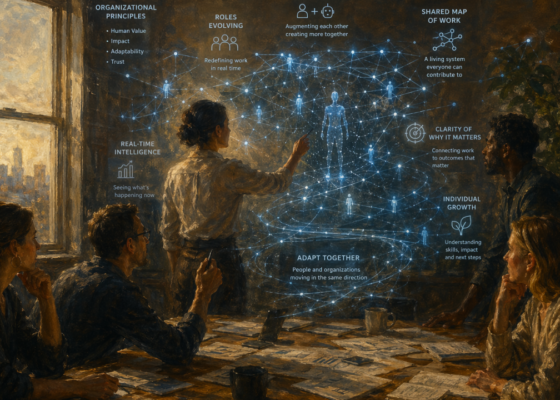
We’re Asking People to Reinvent Their Roles Without Acknowledging What That Requires
Organizations are asking employees to reinvent their roles around AI while the future of work remains unclear. This article explains why AI adoption is not simply a tooling or training challenge—it is a human alignment and organizational-design problem.

Becoming the Source of Truth
As AI makes polished resumes, pitches, and online identities abundant, traditional signals of trust are losing meaning. This article explores how people can become the source of truth about their own experience—and how self-understanding and evidence can restore agency and opportunity.

We’re Scaling Artificial Intelligence Faster Than We’re Scaling Human Agency. That’s the Risk.
AI capabilities and the energy systems supporting them are scaling at unprecedented speed, while people remain represented by static resumes, job titles, and outdated credentials. This article explains why human agency must become scalable infrastructure—and why leaders must invest in people and AI with equal seriousness.

Early Career Pathways With TalentPass: A Friendship Story of Growth, Creativity, and Opportunity
A fictional early-career story showing how TalentPass could help friends document growth, share feedback, build portfolios, and pursue different pathways through school, trade training, marketing, retail, and entrepreneurship.

Navigating Workplace Change With TalentPass: A Team Story of Rediscovery and Growth
When an organization changes, employees need more than uncertainty and job titles. This fictional team story shows how TalentPass could help people document strengths, explore new paths, and adapt with greater clarity.

A School Year with TalentPass – Empowering the Johnson Family
A fictional school-year story showing how TalentPass could help students and families document learning, set goals, reflect on experiences, and build richer learner profiles across school, home, travel, projects, and community life.

A Practical 3-5 Year LER Roadmap for Community Colleges
Community colleges do not need to implement LERs all at once. This roadmap shows how institutions can start with strategy and pilots, then expand toward trusted learner records, career pathways, advising, and workforce partnerships.

Learning and Employment Records as Infrastructure for a More Equitable Talent System
Systemic challenges in education and workforce systems cannot be solved with disconnected records. LERs, Verifiable Credentials, TalentPass, and TalentSync point toward a more portable, trusted, and human-centered talent infrastructure.