We’re Asking People to Reinvent Their Roles Without Acknowledging What That Requires
Organizations keep talking about adopting AI as though it were primarily a technology decision. But inside the workplace, something much more consequential is happening.
People are being asked to redefine their roles in real time while the systems, expectations, and technologies around them continue to change.
In this new article, Gobekli founder Danny Done explores why AI adoption is fundamentally a human alignment and organizational-design challenge—not simply a tooling or training problem.
“Use AI” is not enough direction
Historically, determining what a job should accomplish, how it creates value, and how it should evolve was specialized work performed by leaders, organizational designers, and experienced operators.
Now that responsibility is being distributed across the workforce. Employees are effectively being told: “Here is AI. Figure out what your job becomes.”
They are doing so while watching layoffs associated—accurately or not—with AI, experiencing declining trust between people and institutions, and facing a future that is clearly changing but poorly defined.
The question many people are asking is not simply, “How do I use AI?”
It is: “How do I use AI to become more valuable without making myself replaceable?”
That tension matters.
AI adoption contains a conflict of interest
Organizations are trying to improve speed, efficiency, and performance. Individuals are trying to preserve and increase their own value.
Those goals can and should align. But when the future state of work is unclear, they can begin to diverge.
People experiment with AI, learn new tools, and improve parts of their workflows. At the same time, they hedge against uncertainty and make choices that feel personally safe.
This is where AI adoption can quietly break down—not because the technology does not work, but because people and organizations are optimizing toward different, poorly defined outcomes.
Without a shared picture of what roles are becoming, people continue working and adapting, but their efforts scatter. They improve what they can see rather than what matters most. Roles drift instead of evolving intentionally.
Over time, that drift becomes erosion.
This is a design problem
The default organizational response has been to offer more tools, more training, and more pressure to move faster. But training someone to operate an AI system does not tell them how their role should change or where their distinctly human value is moving.
If organizations expect people to reinvent their work, they must meet them halfway by providing enough clarity to orient that reinvention:
- What matters now?
- Where is human value moving?
- What does good performance look like in the emerging system?
- How can individual growth align with organizational needs?
No organization can provide a perfect blueprint for a future that is still developing. But people need something concrete enough to move toward rather than being left to react independently.
Even with that direction, redesigning a role to benefit both the individual and the organization is a substantial cognitive and creative challenge. We have not built many systems that help people do this well.
As a result, some people accelerate, some get stuck, and most operate somewhere in between—all working with partial visibility.
The relationship between people and organizations is changing
For much of the modern economy, organizations defined roles and people filled them. AI is disrupting that boundary.
People now have more agency in shaping how they work, but they also carry more responsibility for determining what their work should become. Organizations, in turn, need to understand talent as something dynamic and evolving—not merely a collection of resumes, job descriptions, and past performance reviews.
Neither side currently has a complete map.
People often cannot clearly see what they are doing, why it matters, or how their contribution is changing. Organizations lack a real-time understanding of the capabilities they already possess, how those capabilities are being applied, and how they are developing.
That incomplete information produces drift instead of direction.
The missing layer is shared clarity
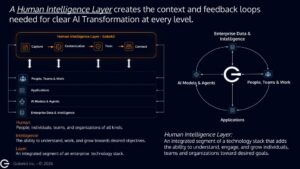
Successful AI transformation requires more than productivity tools and operational data. It requires infrastructure for aligned role development, useful talent intelligence, evolving profiles of what good performance looks like, and visible relationships between people, work, and organizational goals.
Providing that shared clarity can do more than improve technology adoption. It can rebuild trust, align personal growth with organizational needs, and make AI something people can advance with rather than defend themselves against.
Organizations are not struggling with AI adoption simply because employees do not understand the technology. They are struggling because the human side of the future remains insufficiently defined.
The real question is not, “How do we get people to adopt AI?”
It is: How do we make the future of work clear enough that people and organizations can step into it together?