We’re Scaling Artificial Intelligence Faster Than We’re Scaling Human Agency. That’s the Risk.
Artificial intelligence is advancing from experimental technology to operational infrastructure. At the same time, the energy systems required to support its growth are becoming a strategic priority, driving unprecedented investment in data centers, power generation, advanced nuclear fission, and fusion.
These are more than ordinary market trends. They are phase shifts that change the assumptions under which organizations and economies operate.
In this new article, Gobekli founder Danny Done argues that a dangerous imbalance is emerging: we are scaling intelligence, automation, and energy without making an equivalent investment in the human agency required to absorb and direct them.
Capability is scaling at unprecedented speed
The AI singularity does not need to involve sentience or science fiction. It can be understood more practically as a sudden expansion of capability.
Organizations can now deploy systems that generate knowledge, synthesize expertise, automate complex reasoning, and reshape workflows across nearly every sector. These capabilities are already operational, and they continue to improve at extraordinary speed.
This growth is also creating enormous demand for energy. The race to build data centers, secure power, and stabilize supply chains reflects a simple reality: digital intelligence depends upon physical infrastructure.
AI and energy are therefore scaling together. Leaders recognize both as strategic priorities and are investing accordingly.
Humans remain the static variable
The greater risk is not simply that AI will replace jobs. It is that AI is unbundling work into tasks faster than organizations and public institutions can reorganize around it.
Roles are fragmenting. Traditional credentials lag behind reality. Resumes and job titles provide increasingly weak signals. Career mobility becomes harder when neither individuals nor organizations can clearly understand how experience transfers into new contexts.
Meanwhile, machines benefit from sophisticated feedback infrastructure: continuous learning, telemetry, versioning, measurement, and performance optimization.
Humans are still represented through job titles, static resumes, degrees earned years earlier, and opaque performance reviews. People may be connected to more systems than ever, but they are not necessarily more empowered or better understood.
This is not an individual failure. It is an infrastructure failure.
Human agency must become scalable
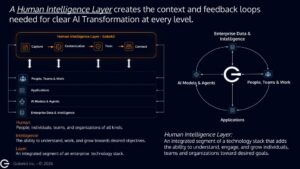
A third transformation is therefore needed: the scaling of human agency.
This does not mean a vague philosophical awakening. It means building practical systems through which self-understanding becomes structured, experience becomes legible, learning becomes cumulative, personal narratives become transferable, and agency becomes infrastructure.
Humans understand their lives through stories, while organizations make decisions using structured signals. We now have the technical capacity to bridge these two worlds—to translate lived experience into trustworthy, portable records that remain owned and controlled by the individual.
This work is already underway. Governments, standards organizations, educational institutions, workforce agencies, and philanthropies are investing in digital credentials, badges, and Learning and Employment Records because traditional labor-market signals no longer provide enough clarity or trust.
The question is no longer whether new human infrastructure is possible. It is whether we will build and adopt it quickly enough.
Imbalance creates the failure mode
Few leaders intentionally seek a future in which people are monitored but powerless, optimized without dignity, or treated solely as inputs into increasingly efficient systems.
But harmful systems do not always emerge from malicious intent. They can develop when efficiency consistently advances faster than agency.
Without better human infrastructure, automation can amplify inequality, concentrate value, and reduce mobility. People become easier for systems to observe but harder for organizations to understand. Institutions optimize around individuals without giving those individuals greater capacity to navigate change themselves.
The risk is not technology alone. It is imbalance.
Leadership requires investment in both sides
The responsibility of today’s leaders is not simply to scale intelligence, automation, and optimization. It is to keep the broader system in balance.
Until recently, organizations lacked practical ways to invest in human agency with the same rigor, portability, and compounding value they bring to technology. That is changing.
Leaders can now invest in agency rather than compliance, mobility rather than retention alone, narrative clarity rather than isolated skills lists, and people who can adapt alongside the systems transforming their work.
The AI and energy transitions are already in motion. We cannot opt out of them. What remains a choice is whether we build the human infrastructure necessary to complete and stabilize the system.
At Gobekli, this is the work we have committed to: helping people understand themselves, carry their experience forward, and participate meaningfully in shaping how intelligence is used.
Leadership in this era is not about choosing between technology and humanity. It is about investing in both with equal seriousness.