
A WORKFORCE SCALABILITY WORKSHOP MODULE
Talent Pipeline Development:
Stop Starting Every Search From Zero
Many organizations begin looking for talent only after a vacancy becomes urgent, a contract is awarded, a growth target changes, or a critical capability is already missing.
By then, the organization is competing under pressure—with an incomplete role definition, a shallow candidate pool, and little credible evidence about who may be ready.
External talent pipeline development helps organizations build relevant relationships before every hiring need becomes an emergency.
Does this sound familiar?
Every search starts from zero
Recruiters rebuild similar candidate pools each time a role opens because previous relationships and evidence are difficult to reuse.
Hiring begins after the need becomes urgent
Teams wait until capacity has already broken down before identifying potential candidates, partners, or talent sources.
Pipelines are organized around job titles
Candidate lists reflect familiar titles rather than the capabilities, activities, and operating context the future work actually requires.
Promising people disappear between openings
Former applicants, referrals, contractors, students, alumni, and industry contacts are not connected to future opportunities.
Pipeline size substitutes for pipeline quality
Leaders can see how many people are in a database but not whether the pipeline contains the capabilities the organization may need.
Candidates repeatedly rebuild their story
People submit similar résumés and applications without developing a reusable, evidence-rich view of their experience and capabilities.
What is external talent pipeline development?
External talent pipeline development is the deliberate process of identifying, engaging, understanding, and maintaining relationships with people and talent sources that may help meet future workforce needs.
A useful pipeline can include:
- Previous applicants
- Employee and community referrals
- Independent professionals and contractors
- Apprentices and students
- Industry and professional association members
- Alumni and former employees
- Credential holders
- Partner organizations
- People developing adjacent capabilities
- Prospects identified through targeted sourcing
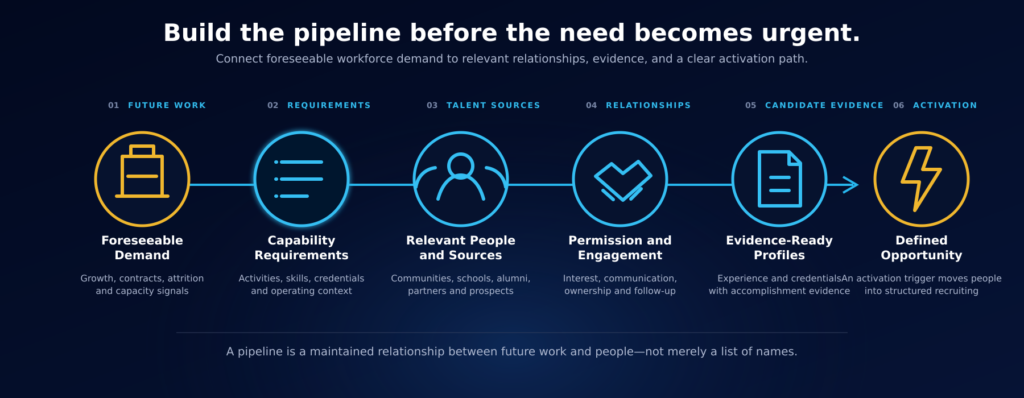
The goal is not to create the largest possible candidate database. It is to build relevant, permission-based relationships around work and capabilities the organization can reasonably anticipate.
A pipeline becomes valuable when the organization can explain what future need it supports, why the people in it may be relevant, what evidence is available, and what should happen next.
The problem is not a shortage of names. It is a shortage of relevant, maintained relationships.
A conventional sourcing list may contain hundreds or thousands of profiles. That does not mean the organization has a usable talent pipeline.
To support workforce scalability, leaders need to connect external talent relationships to:
- Expected workforce demand
- Critical activities and outcomes
- Capabilities that may be needed
- Role designs or opportunity profiles
- Geographic, scheduling, licensing, or other prerequisites
- Potential talent sources and communities
- Candidate interest and permission
- Available evidence
- Relationship status
- A responsible owner
- A clear activation condition
Without these connections, a talent database can become another static inventory.
The organization may have many contacts but still be unable to find qualified, interested, and available people when the work changes.
See the complete talent pipeline
not just the candidate list.
Future Work
- Expected demand
- Critical workflows
- Growth commitments
- Emerging capability needs
- Potential capacity risks
Capability Requirements
- Work activities
- Technical capabilities
- Human capabilities
- Required credentials
- Operating context
Talent Sources
- Previous applicants
- Referrals and alumni
- Schools and apprenticeships
- Associations and communities
- Contractors and partners
Candidate Evidence
- Relevant experience
- Demonstrated activities
- Skills and their origins
- Credentials and licenses
- Accomplishment stories
Relationships and Decisions
- Interest and permission
- Engagement status
- Pipeline ownership
- Activation triggers
- Appropriate next step
A pipeline becomes decision-useful when workforce demand, role requirements, talent sources, candidate evidence, and human relationships can be viewed together.
How reactive recruiting takes hold
STAGE 1
Workforce needs remain vague
Leaders know the organization may grow or change but do not translate that expectation into specific work and capability needs.
STAGE 2
The organization waits for an opening
Pipeline development is postponed until a role is approved or capacity has already become constrained.
STAGE 3
Recruiters search under pressure
Teams rely on broad job titles, familiar channels, résumé keywords, and whoever happens to be available.
STAGE 4
Candidate relationships reset
People who are not selected disappear from view, and valuable evidence must be gathered again during the next search.
Build talent relationships before every need becomes a requisition.
The purpose of pipeline development is not to preselect people for jobs that do not yet exist. It is to reduce the distance between a foreseeable workforce need and an informed recruiting response.
A useful pipeline can help the organization understand:
Identify capabilities connected to growth, contracts, succession risk, emerging technology, seasonal demand, or difficult-to-fill work.
Examine professional communities, education providers, apprenticeships, credential programs, former workers, contractors, associations, and adjacent occupations.
Define evidence related to the actual work rather than relying exclusively on titles, degrees, keywords, or years of experience.
With appropriate permission, capture interests, qualifications, availability conditions, capability evidence, and the kinds of opportunities a person may want to consider.
Establish clear triggers such as funding, contract awards, attrition, workload thresholds, geographic expansion, or role approval.
Assign responsibility for communication, consent, information quality, follow-up, and the eventual transition into a formal hiring process.
A large pipeline is not necessarily a healthy pipeline.
Relevant
The people and sources connect to foreseeable work, capabilities, prerequisites, and operating conditions.
Evidence-ready
The organization knows what information would help evaluate relevance if an opportunity becomes real.
Engaged
Communication is appropriate, useful, permission-based, and respectful of each person’s circumstances.
Current
Important information, interest, availability, and relationship status can be revisited rather than silently assumed.
Diverse in source and perspective
The organization is not repeatedly drawing from the same limited networks, institutions, titles, or backgrounds.
Actionable
There is an owner, an activation condition, and a clear next step when workforce demand changes.
Pipeline volume
A volume-centered approach may emphasize:
- Number of profiles collected
- Size of a talent database
- Number of messages sent
- Application totals
- Broad résumé or keyword matches
- Passive contacts with no recent engagement
- People attached to outdated job titles
- Repeated collection of the same information
These measures can describe recruiting activity without showing whether the organization is better prepared to meet future workforce demand.
Pipeline value
A value-centered approach examines:
- Connection to foreseeable work
- Evidence of relevant capability
- Candidate interest and permission
- Important prerequisites
- Readiness for deeper conversation
- Strength of talent-source relationships
- Missing capabilities or perspectives
- Time required to activate the pipeline
- Evidence gaps requiring follow-up
A better pipeline begins with a better definition of the work.
Pipeline development should not begin with a generic persona or a copy of the last job description.
The Work & Role Design module helps the organization clarify:
- The outcomes the role must support
- The activities involved
- The capabilities required
- The responsibilities that should remain human
- The tools or systems involved
- The team and operating context
- The prerequisites that are genuinely necessary
- The capabilities that can be developed after entry
- The perspectives or experiences the team may be missing
This creates a more useful foundation for sourcing.
Rather than searching for people who resemble the previous role holder, recruiters can look for evidence connected to the work ahead.
Describe the environment without reducing people to “culture fit.”
Candidates need enough context to understand where and how the work happens. Recruiters also need a responsible way to discuss conditions that may support or constrain success.
Relevant operating context may include:
- How decisions are made
- Expected autonomy and escalation
- Communication and collaboration practices
- Pace and level of ambiguity
- Learning and feedback expectations
- Leadership and resource support
- Values demonstrated through real practices
- Customer, community, or stakeholder context
- Organizational conditions that could make the role difficult
- Perspectives or capabilities the team needs to add
This information should support a transparent conversation.
It should not be converted into a definitive cultural match, personality judgment, or automated prediction of who will succeed.
The goal is to change when
the evidence warrants it
—and preserve continuity when it does not.
WORKSHOP MODULE DETAILS
External Talent Pipeline Development
This module helps participants translate foreseeable workforce demand into targeted external talent relationships and sourcing strategies.
The workshop identifies where external talent may be needed, what capabilities matter, which communities or partners could provide access, what evidence would be useful, and how relationships should be maintained before a formal hiring decision.
This module helps your team:
- Connect external sourcing to workforce demand
- Prioritize roles and capabilities requiring advance pipeline development
- Define candidate relevance around activities and evidence
- Identify promising talent sources and partner channels
- Examine where current pipelines are shallow or repetitive
- Clarify interest, permission, ownership, and follow-up
- Establish pipeline activation conditions
- Connect pipeline prospects to structured opportunities
- Prepare for evidence-based hiring when a need becomes real
What should happen next for each talent need?
Not every anticipated workforce need requires an active candidate pipeline. The organization should choose a response based on urgency, capability scarcity, development time, evidence, and the consequences of being unprepared.
Build
Create a new external pipeline The organization expects to need a capability but lacks sufficient relationships with potentially relevant people or talent sources.
Strengthen
Improve an existing pipeline A pipeline exists but lacks relevance, evidence, engagement, diversity of sources, ownership, or sufficient depth.
Nurture
Maintain promising relationships The future need is credible but not yet ready for formal recruitment. Appropriate communication and permission should be maintained.
Activate
Move into a defined opportunity The workforce need is now sufficiently clear and authorized to begin structured recruiting and candidate evaluation.
Partner
Develop a shared talent source A school, apprenticeship program, association, workforce organization, staffing partner, or other institution may help build sustainable access to relevant talent.
Investigate
Resolve uncertainty first The organization lacks enough evidence about future demand, role design, availability, prerequisites, or sourcing conditions to invest responsibly.
These categories structure planning and human decision-making. They do not automatically determine whether a person should be contacted, advanced, selected, or hired.
What should a talent pipeline review examine?
The demand
What work is expected to change? When might capacity or capability be needed, and how consequential would a delay become?
The capability
Which activities, skills, knowledge, credentials, relationships, or experiences may be difficult to develop or acquire quickly?
The talent sources
Where might relevant people be found? Which communities, institutions, programs, partners, or adjacent occupations are currently overlooked?
The relationship
Has the person expressed interest or permission? Is communication current, appropriate, and useful?
The evidence
What demonstrates potential relevance? What remains unknown, outdated, self-reported, or in need of deeper review?
The activation path
Who owns the relationship, what event triggers action, and how will the prospect enter a fair and structured hiring process?
Use TalentSync Recruiter when the hiring need becomes real.
TalentSync Recruiter can help carry the work established through workforce planning and role design into a structured recruiting workflow.
The process begins with the client or hiring team’s need—not with a candidate score or an automated recommendation.
STEP 1
Clarify the opportunity
The recruiter uses a short Pythia conversation to turn the role description and hiring-team context into a structured Opportunity Profile.
STEP 2
Structure the requirements
The Opportunity Profile can organize requirement summaries, competency expressions, prerequisites, Talent Attributes, ARC Requests, skills, credentials, and additional questions.
STEP 3
Invite relevant prospects
The opportunity can be shared with appropriate pipeline prospects through a public application link or the recruiter’s established outreach process.
STEP 4
Check prerequisites early
Candidates complete a brief prerequisite conversation before being asked to invest in a deeper application profile.
STEP 5
Develop reusable evidence
Qualified candidates can use TalentPass to confirm their background and provide experience, skills, credentials, and accomplishment evidence.
STEP 6
Support human review
The recruiter reviews standardized profiles, identifies missing information, asks follow-up questions, compares relevant evidence, and shares appropriate information with the client or hiring team.
TalentSync Recruiter helps structure the transition from talent relationship to candidate evidence. The recruiter and hiring team remain responsible for interpretation, judgment, communication, and the final decision.
- Start with clearer client requirements: Translate client conversations and existing job descriptions into a structured Opportunity Profile.
- Use a staged application process: Check prerequisites before asking qualified candidates to invest in deeper evidence development.
- See evidence in a consistent structure: Compare candidate-provided information without requiring everyone to tell their story in exactly the same words.
- Ask more focused questions: Identify what remains unclear and direct recruiter attention toward the evidence requiring human inquiry.
- Build a reusable talent network: Retain relationships with interviewed or promising candidates for future opportunities, subject to appropriate consent and organizational practices.
- Share clearer profiles with clients: Present the candidate’s relevant evidence and context rather than forwarding only a résumé or unexplained ranking.
WHY TALENTPASS MATTERS TO THE PIPELINE
Let candidate evidence grow instead of resetting with every application.
Traditional recruiting processes repeatedly ask people to compress their experience into a résumé and rebuild similar application information for every opportunity.
TalentPass is designed to help an individual develop a reusable view of their experience and talent evidence.
With the individual’s participation, that profile may include:
- Confirmed employment and role history
- Activities performed
- The origins and use of relevant skills
- Licenses, certifications, and other credentials
- Accomplishment, Responsibility, and Challenge stories
- Additional information requested for a specific opportunity
The individual controls their TalentPass information and chooses when it is shared.
A reusable profile can reduce unnecessary repetition while allowing opportunity-specific questions and evidence to be added when relevant.
PRODUCT AND DECISION BOUNDARIES
Structured evidence supports recruiting judgment. It does not replace it.
TalentSync Recruiter and TalentPass should not be presented as:
- Determining the “best” candidate
- Predicting who will succeed
- Producing a definitive culture match
- Eliminating bias
- Making legal or compliance determinations
- Replacing recruiter or hiring-team judgment
- Providing the sole basis for an employment decision
- Guaranteeing that a pipeline will meet future demand
The workflow helps people structure requirements, collect relevant information, identify evidence gaps, and support a more transparent human review.
Employment, privacy, accessibility, cybersecurity, procurement, labor, and other questions may require review by qualified specialists.
TalentPass is not designed for use by minors.
What to bring into the conversation
You do not need a complete candidate database or a precise forecast of every future role.
We begin with the workforce signals, recruiting information, and external relationships the organization already has.
Useful inputs may include:
- Workforce demand projections
- Growth, funding, contract, or expansion plans
- Roles that are consistently difficult to fill
- Work and role definitions
- Critical capability or succession concerns
- Existing candidate and prospect lists
- Previous applicants
- Referral programs
- Talent community or alumni information
- School, apprenticeship, association, and workforce partnerships
- Staffing, contractor, and recruiting relationships
- Pipeline activity and conversion information
- Candidate feedback
- Known geographic, credential, scheduling, or availability constraints
- Consent, communication, and retention practices
The Decision Foundation establishes the workforce outcome and pipeline boundary the module should examine.
What this module can help clarify
Which needs require a pipeline
Identify the roles, activities, capabilities, locations, or operating conditions that justify advance preparation.
Where relevant talent may come from
Reveal external communities, institutions, programs, partners, and adjacent talent sources.
What evidence should be developed
Clarify what recruiters and hiring teams need to understand beyond a résumé or job title.
How relationships should be maintained
Establish ownership, permission, engagement practices, activation conditions, and appropriate next steps.
Final outputs depend on the modules selected and the workforce decision established through the workshop’s required Decision Foundation.
Where might the work lead next?
Questions leaders ask before booking.
A talent pipeline is a maintained group of relationships with people or talent sources that may be relevant to foreseeable workforce needs.
A pipeline may include previous applicants, referrals, independent professionals, students, apprentices, alumni, former employees, association members, credential holders, or prospects identified through sourcing.
A list of names is not automatically a pipeline. A useful pipeline connects people and sources to anticipated work, capability requirements, available evidence, relationship status, ownership, and an appropriate next step.
Recruiting typically responds to a defined and authorized hiring need. Talent pipeline development begins earlier.
It helps an organization identify future talent needs, build external relationships, understand potential sources, and determine what evidence may become useful before every role becomes urgent.
When a real opportunity is ready, relevant pipeline prospects can enter the organization’s formal recruiting and hiring process.
No. Pipeline development requires time, communication, ownership, and continued attention.
It is most useful for needs that are consequential, foreseeable, difficult to fill, highly variable, slow to develop, connected to growth commitments, or vulnerable to key-person dependency.
Other roles may be addressed effectively when a specific need arises.
That depends on the predictability of demand, scarcity of capability, recruiting cycle, development time, candidate availability, and consequences of delay.
A specialized capability requiring credentials or long relationship development may justify much earlier preparation than a widely available capability that can be sourced quickly.
The appropriate horizon should follow the workforce decision rather than a universal timeline.
Assign an owner, establish appropriate communication practices, record interest and permission, identify what information may become outdated, and define when relationships should be revisited.
The organization should not silently assume that a person remains interested, available, qualified, or appropriate for a future opportunity.
TalentSync Recruiter supports structured opportunities, candidate evidence, recruiter review, comparison, collaboration, and appropriate sharing or handoff.
It should be positioned around the recruiting and evidence workflow currently available—not as a claim that every conventional candidate-relationship-management feature is already supported.
Pipeline strategy may still involve existing ATS, CRM, sourcing, communication, or partner systems.
TalentSync can help organize requirements and candidate evidence so recruiters and hiring teams can understand potential relevance more clearly.
It should not be described as automatically selecting the best candidate, predicting success, or replacing human judgment.
Recruiters and hiring teams remain responsible for deciding whom to contact, advance, interview, recommend, or hire.
Describe the actual operating environment: decision practices, autonomy, communication, pace, ambiguity, learning expectations, leadership support, values in practice, and conditions affecting the work.
This helps people understand an opportunity and allows recruiters to have a more transparent conversation.
It should not become an opaque culture-fit score or a definitive judgment about whether someone belongs.
Often, yes.
The organization should examine whether relevant capability already exists internally, can be developed, or can be redeployed before assuming external hiring is the only response.
External pipeline development and internal mobility can operate together. They provide different sources of workforce capacity and evidence.
Every engagement begins with the required Workforce Direction module, which establishes the consequential outcome, affected work, demand conditions, evidence, and bounded workforce decision.
External Talent Pipeline Development can then be selected when the organization needs to prepare external talent relationships around foreseeable capacity or capability needs.
It may be combined with Work & Role Design, Internal Talent Sourcing & Mobility, Hiring Readiness & Candidate Evidence, Workforce Demand & Capacity Planning, or another connected module.
BUILD BEFORE THE NEED BECOMES URGENT
Turn future workforce demand into a talent pipeline you can actually activate.
Connect anticipated work to capabilities, talent sources, candidate relationships, and credible evidence—then move into structured hiring when the need becomes real.
This module is part of Gobekli’s configurable Workforce Scalability Workshop. Explore the complete 12-module structure and identify the right starting point for your organization.
